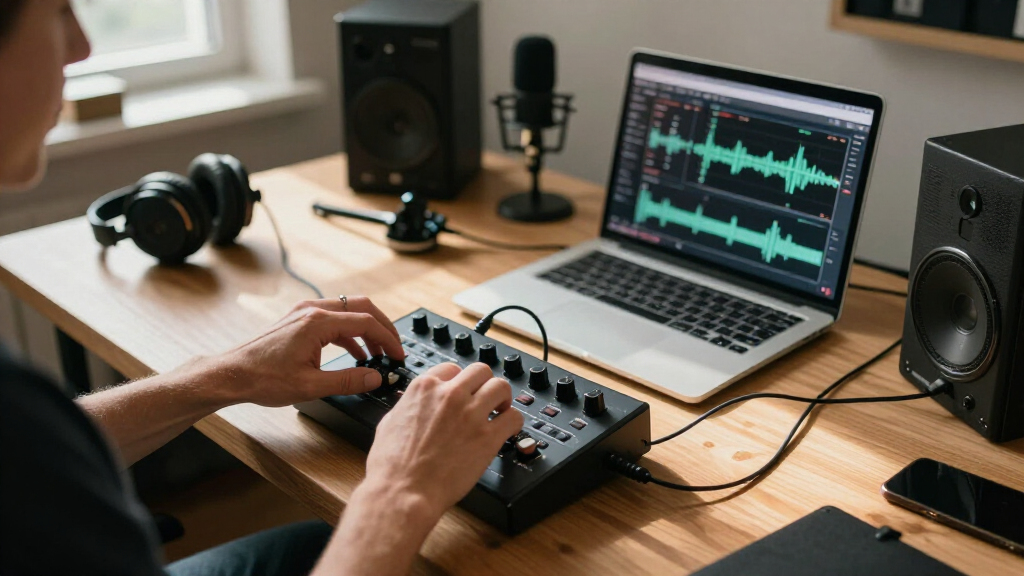

Choosing the right audio interface is essential for creators aiming for high-quality sound in recordings, streaming, or podcasting. The best options balance performance, ease of use, and value, with standout picks like the Focusrite Scarlett Solo 3rd Gen for its reliable performance and user-friendly design. For those seeking premium sound, the Apogee Symphony Desktop Elite offers studio-grade quality, while the MAONO P2 provides versatility at a budget. All creators face tradeoffs between sound quality, connectivity, and cost — continue reading to find the perfect fit for your setup and needs.

Get audio and creator gear delivered free — and shop member deals
- Fast, free delivery on millions of items
- Access to Prime Big Deal Days deals on October 6–7
- Prime Video, Amazon Music and more included
Complete the kit


Key Takeaways
- The top picks excel in balancing sound quality and ease of use for different creator needs.
- Connectivity options, like dual inputs or hybrid XLR/USB ports, significantly influence versatility.
- Higher-priced interfaces generally deliver better preamps and build quality, but affordable options can suffice for beginners.
- Portability and compact design matter for creators on the go, but may limit expansion options.
- Compatibility with various devices and software is crucial to prevent setup headaches and ensure smooth workflows.
| Focusrite Scarlett Solo 3rd Gen USB-C Audio Interface |  | Best Overall for Solo Creators | Connectivity: USB-C | Bit Depth: 24-bit | Maximum Sample Rate: 192kHz | VIEW LATEST PRICE | See Our Full Breakdown |
| MAONO PS22 Lite USB Audio Interface |  | Best for Solo Streaming | Bit Depth: 24-bit | Maximum Sample Rate: 192kHz | Number of Channels: 2 | VIEW LATEST PRICE | See Our Full Breakdown |
| MAONO P2 Hybrid USB Audio Interface |  | Best for Multi-Device Production | Bit Depth: 24-bit | Maximum Sample Rate: 192kHz | Number of Channels: 2 | VIEW LATEST PRICE | See Our Full Breakdown |
| 2×2 24-bit/192kHz USB-C Recording Interface |  | Best Plug-and-Play Dual-Input Pick | Bit Depth: 24-bit | Maximum Sample Rate: 192kHz | Analog Inputs: 2 XLR/TRS combo jacks | VIEW LATEST PRICE | See Our Full Breakdown |
| ESI Neva Duo USB Audio Interface |  | Best for Two-Mic Desktop Recording | Bit Depth: 24-bit | Maximum Sample Rate: 192kHz | Microphone Inputs: Dual XLR | VIEW LATEST PRICE | See Our Full Breakdown |
| Shure MVX2U Gen 2 XLR-to-USB-C Audio Interface |  | Best for Solo Podcasters | Microphone connection: XLR | Computer connection: USB-C | Maximum gain: +60 dB | VIEW LATEST PRICE | See Our Full Breakdown |
| M-Audio M-Track Duo USB Audio Interface |  | Best Value for Music Creators | Maximum sample rate: 48kHz | Input count: 2 | Input format: Combo XLR, line, and instrument | VIEW LATEST PRICE | See Our Full Breakdown |
| Apogee Symphony Desktop Elite USB-C Audio Interface |  | Best Premium Studio Interface | Channel count: 10 | Maximum sample rate: 192kHz | Connectivity: USB-C | VIEW LATEST PRICE | See Our Full Breakdown |
| Universal Audio Volt 2 USB Audio Interface |  | Best for Vintage Vocal Tone | Bit depth: 24-bit | Maximum sample rate: 192kHz | Preamp character: Classic UA 610 | VIEW LATEST PRICE | See Our Full Breakdown |
| Synido 2×2 USB-C Audio Interface |  | Best Compact Pick | Bit depth: 24-bit | Maximum sample rate: 48kHz | Inputs: XLR, 6.35mm, and line | VIEW LATEST PRICE | See Our Full Breakdown |
| audio interface for creator | Maximum Sample Rate | Connectivity | Bit Depth | Phantom Power |
|---|---|---|---|---|
| Focusrite Scarlett Solo 3rd Ge | 192kHz | USB-C | 24-bit | — |
| MAONO PS22 Lite USB Audio Inte | 192kHz | USB | 24-bit | — |
| MAONO P2 Hybrid USB Audio Inte | 192kHz | USB-C hybrid connectivity | 24-bit | — |
| 2×2 24-bit/192kHz USB-C Record | 192kHz | USB-C | 24-bit | 48V |
| ESI Neva Duo USB Audio Interfa | 192kHz | USB | 24-bit | 48V |
| Shure MVX2U Gen 2 XLR-to-USB-C | — | — | — | 48V |
| M-Audio M-Track Duo USB Audio | 48kHz | — | — | Supported |
| Apogee Symphony Desktop Elite | 192kHz | USB-C | — | — |
| Universal Audio Volt 2 USB Aud | 192kHz | — | 24-bit | — |
| Synido 2×2 USB-C Audio Interfa | 48kHz | USB-C to USB-A | 24-bit | 48V |
More Details on Our Top Picks
Focusrite Scarlett Solo 3rd Gen USB-C Audio Interface
I place Focusrite Scarlett Solo 3rd Gen at the front for solo creators because its appeal is not the headline 24-bit/192kHz figure alone; the simple gain Halo and Air mode make everyday vocal and guitar capture easier to manage. Compared with the MAONO P2, it offers fewer inputs and no multi-device workflow, but its named software bundle and three-year warranty make it the more reassuring first studio purchase. The separate microphone and high-impedance instrument inputs suit a singer-songwriter recording one voice and one guitar, while balanced outputs support proper monitors. The tradeoff is limited growth: there is only one microphone input, bus power ties the unit to its USB host, and advanced podcast or band setups will outgrow it quickly. I rank it highest for focused recording with low setup friction, not for routing-heavy live production.
Pros:- Gain Halo metering makes input levels easy to read
- Air mode can add presence to vocals and acoustic instruments
- Extensive starter software bundle covers recording and mixing
- Three-year warranty adds confidence for a first-time buyer
Cons:- Single microphone input cannot handle a two-person interview
- USB bus power provides little flexibility away from a host device
- Basic routing is less suited to complex livestream production
Best for: Solo singers, guitarists, voice-over artists, and video creators who want an approachable first desktop recording setup
Not ideal for: Podcast teams, bands, or creators who need two microphone inputs, onboard effects, or elaborate livestream routing
- Connectivity:USB-C
- Bit Depth:24-bit
- Maximum Sample Rate:192kHz
- Microphone Inputs:1
- Instrument Inputs:1 high-impedance input
- Analog Outputs:2 balanced outputs
- Recording Mode:Switchable Air mode
- Included Software:Pro Tools Intro+, Ableton Live Lite, Cubase LE, and Hitmaker Expansion
- Warranty:3 years
Our verdict“This is my leading pick for solo creators who value easy recording, dependable support, and a useful software package over expansion.”
MAONO PS22 Lite USB Audio Interface
I give MAONO PS22 Lite the streaming-focused slot because its routing software and broad device support address a creator problem the Scarlett Solo does not: moving microphone, instrument, computer, and phone audio through live apps such as OBS, Twitch, and Discord. Its 24-bit/192kHz ceiling matches the higher-resolution options here, and the 0.43 kg body is practical for a desk that doubles as a mobile setup. Compared with the MAONO P2, the PS22 Lite is the leaner choice, but it lacks the P2’s dual-XLR emphasis and simultaneous multi-device flexibility. I would choose it for a solo streamer who needs flexible signal routing more than studio expansion. Its two-channel limit rules out panel podcasts, while the software that creates its advantage may also add an initial learning curve. The compact, creator-oriented design is its main reason for making this list.
Pros:- Creator-focused routing software supports common streaming workflows
- Works across computers, smartphones, and several operating systems
- 24-bit/192kHz recording matches more studio-oriented models
- Compact 0.43 kg construction suits portable creator setups
Cons:- Two-channel design cannot accommodate larger recording sessions
- Routing software may take time for beginners to configure
- Less capable than the MAONO P2 for dual-microphone and multi-device production
Best for: Solo Twitch, YouTube, or TikTok creators who mix microphone, instrument, computer, and smartphone audio
Not ideal for: Multi-guest podcasters or musicians who need several microphones and a fast hardware-only workflow
- Bit Depth:24-bit
- Maximum Sample Rate:192kHz
- Number of Channels:2
- Connectivity:USB
- Audio Sources:Microphone, guitar, bass, computer, and smartphone
- Operating Systems:Android, ChromeOS, Windows, iOS, and macOS
- Supported Software:Ableton Live, Studio One, Logic Pro, Cubase, GarageBand, FL Studio, OBS, Twitch, Discord, YouTube, and TikTok
- Dimensions:6.29 x 5.19 x 2 inches
- Weight:0.43 kg
Our verdict“I recommend the PS22 Lite to solo streamers who prioritize flexible software routing and device support over extra microphone capacity.”
MAONO P2 Hybrid USB Audio Interface
MAONO P2 earns my multi-device role because it can connect with a computer, phone, and iPad in the same creator workflow, while dual XLR inputs accommodate two microphones for interviews or co-hosted shows. That makes it more capable than the Scarlett Solo for two-person recording and more flexible than the PS22 Lite when several devices need to stay connected. Real-time effects and noise reduction can speed up live production, and 24-bit/192kHz capture leaves enough resolution for later editing. Those gains come with more setup: software routing across several platforms takes time to configure, and two channels still cannot cover a larger roundtable or multi-instrument session. At 8.27 inches wide and 0.5 kg, it also occupies more desk and travel space than the PS22 Lite. I favor it for hybrid streaming and recording, provided the buyer will use the added routing power.
Pros:- Dual XLR inputs support two-person creator formats
- Hybrid connectivity links computers, phones, and iPads
- Real-time effects and noise reduction aid live production
- Cross-platform support fits mixed-device workspaces
Cons:- Software and device routing require more setup than the Scarlett Solo
- Two channels remain restrictive for group productions
- Larger and heavier than the PS22 Lite
Best for: Co-hosts, interviewers, and livestream producers who need two XLR microphones plus simultaneous computer and mobile-device connections
Not ideal for: Creators seeking the smallest travel interface or enough inputs for roundtables, ensembles, and full-band sessions
- Bit Depth:24-bit
- Maximum Sample Rate:192kHz
- Number of Channels:2
- Microphone Inputs:Dual XLR
- Connectivity:USB-C hybrid connectivity
- Supported Devices:Computer, smartphone, iPad, microphone, guitar, and headphones
- Operating Systems:Android, ChromeOS, Windows, iOS, and macOS
- Dimensions:6.42 x 8.27 x 3.23 inches
- Weight:0.5 kg
Our verdict“The MAONO P2 is my choice for two-person productions that rely on computers and mobile devices working together.”
2×2 24-bit/192kHz USB-C Recording Interface
I assign the 2×2 USB-C Recording Interface the plug-and-play role because its two XLR/TRS combo inputs with 48V phantom power cover microphones and instruments without a driver-heavy setup. Compared with the Scarlett Solo, it can accept two mic-level sources, making it better suited to a two-person podcast or stereo capture. Zero-latency direct monitoring also lets performers hear the input without the distracting delay that can come from software monitoring. The case for it weakens beyond those basics. Unlike the Scarlett, the supplied data names no software bundle or multi-year warranty, and compared with the MAONO P2, it offers no described routing tools, effects, or multi-device workflow. Bus power and its USB-C focus may also limit connection choices on older computers. I see this as the straightforward dual-input choice for buyers who already own recording software and value simple hardware over an ecosystem.
Pros:- Two combo inputs accept microphones and instruments
- 48V phantom power supports compatible condenser microphones
- Direct monitoring avoids software-monitoring delay
- Driver-free operation simplifies compatible setups
Cons:- No software bundle or warranty period is stated
- Bus-powered USB-C design may require adapters with older computers
- No described effects or creator-focused routing software
Best for: Two-person podcasters and home musicians who already own recording software and want uncomplicated dual-input USB-C hardware
Not ideal for: Buyers who want bundled production software, established support details, mobile routing tools, or connectivity for older USB computers
- Bit Depth:24-bit
- Maximum Sample Rate:192kHz
- Analog Inputs:2 XLR/TRS combo jacks
- Phantom Power:48V
- Connectivity:USB-C
- Compatible Platforms:PC, Mac, and iOS
- Monitoring:Zero-latency direct monitoring
- Headphone Output:3.5mm
- Power:USB bus powered
Our verdict“I would choose this model for a basic two-source studio where direct monitoring and quick setup matter more than bundled extras.”
ESI Neva Duo USB Audio Interface
I choose ESI Neva Duo for two-mic desktop work because its dual XLR inputs, 48V phantom power, and real-time monitoring form a clean foundation for a co-hosted podcast, interview, or paired vocal session. It gives creators more microphone capacity than the Scarlett Solo, while PC and Mac plug-and-play support keeps the hardware setup brief. Compared with the MAONO P2, though, the Neva Duo is less oriented toward live-production tricks: the supplied feature set lists no onboard effects or noise reduction, so advanced processing depends on external software. Its two-channel ceiling also blocks larger panels or full-band tracking, and no phone or iPad compatibility is stated. The included music-production software adds starter value, but the P2 is the stronger fit when cross-device routing matters. I would pick the Neva Duo for conventional computer-based recording where two powered microphones matter more than streaming automation.
Pros:- Dual XLR inputs suit co-hosted and interview formats
- 48V phantom power supports compatible condenser microphones
- Real-time monitoring helps performers record without distracting delay
- Included production software provides a starting toolkit
Cons:- Two input channels cannot handle larger panels or bands
- Advanced effects and processing depend on external software
- Phone and iPad compatibility is not stated
Best for: PC and Mac users recording two-person podcasts, interviews, paired vocals, or other dual-microphone sessions
Not ideal for: Mobile-first streamers, large podcast panels, and creators who want onboard effects or computer-and-phone routing
- Bit Depth:24-bit
- Maximum Sample Rate:192kHz
- Microphone Inputs:Dual XLR
- Phantom Power:48V
- Connectivity:USB
- Computer Compatibility:PC and Mac
- Monitoring:Real-time monitoring
- Included Software:Music-production software
Our verdict“The Neva Duo makes the most sense for computer-based creators who need two powered microphone inputs without the MAONO P2’s added routing complexity.”
Shure MVX2U Gen 2 XLR-to-USB-C Audio Interface
I rank the Shure MVX2U Gen 2 as the strongest speech-first pick because it turns a single XLR microphone into a compact recording chain. Unlike the M-Audio M-Track Duo, it provides automatic gain and onboard voice processing instead of leaving every adjustment to recording software. The +60 dB gain supports demanding microphones, while the denoiser and Digital Popper Stopper can produce cleaner podcast or livestream audio with less editing. Its 48V phantom power also accommodates condenser microphones. The tradeoff is a narrow role: it cannot record a microphone and instrument together, and non-XLR sources are excluded. USB-C works across current computers and mobile devices, but older hardware may require an adapter. I favor it for one-person spoken content, while musicians receive far more flexibility from the M-Track Duo.
Pros:- Auto Level Mode keeps spoken output more consistent
- Onboard denoiser and Digital Popper Stopper reduce editing work
- +60 dB gain supports a broad range of XLR microphones
- 48V phantom power accommodates condenser microphones
Cons:- Single-purpose XLR connection cannot handle instrument or line sources
- USB-C-only connection may require adapters with older devices
- One-microphone format cannot support an in-person co-host
Best for: Solo podcasters, streamers, and mobile interviewers using one XLR microphone who want automatic level control and voice cleanup
Not ideal for: Musicians, co-hosted podcasts, and creators who need simultaneous microphone, line, or instrument inputs
- Microphone connection:XLR
- Computer connection:USB-C
- Maximum gain:+60 dB
- Phantom power:48V
- Level processing:Auto Level Mode
- Noise processing:Real-Time Denoiser and Digital Popper Stopper
- Supported apps:MOTIV Mix, MOTIV Audio, and MOTIV Video
- Device support:Desktop, tablet, and smartphone
Our verdict“Choose this for a streamlined single-microphone podcast or streaming setup, but skip it if multichannel recording is part of the plan.”
M-Audio M-Track Duo USB Audio Interface
I give the M-Audio M-Track Duo the value role because its two combo inputs support microphones, instruments, and line-level gear without pushing creators into a higher price class. Compared with the Shure MVX2U Gen 2, it can record two sources at once, making vocal-and-guitar sessions or two-person conversations practical. The USB/Direct monitoring switch lets performers hear themselves without distracting computer delay, and 48V phantom power supports condenser microphones. Its 48kHz ceiling is modest beside the Universal Audio Volt 2’s 192kHz capability, though it remains suitable for podcasts, streams, and published music. MPC Beats adds a useful starting point for production. I would skip it for expanding ensembles: two inputs become restrictive, and there is no onboard automatic voice cleanup comparable with Shure’s processing.
Pros:- Two combo inputs accept microphones, instruments, and line-level sources
- USB/Direct switch provides zero-latency monitoring
- 48V phantom power supports condenser microphones
- MPC Beats software provides an entry point for music production
Cons:- 48kHz maximum sample rate trails higher-resolution alternatives
- Two-input ceiling limits ensemble and multi-microphone sessions
- No onboard denoising, auto-gain, or vocal processing
Best for: Budget-conscious singers, instrumentalists, and podcast pairs who need two flexible inputs and direct monitoring
Not ideal for: Bands, drum recording setups, and creators seeking 192kHz capture or automatic speech processing
- Maximum sample rate:48kHz
- Input count:2
- Input format:Combo XLR, line, and instrument
- Phantom power:Supported
- Monitoring:USB/Direct switch
- Headphone output:1/4-inch
- Main outputs:Stereo 1/4-inch
- Included software:MPC Beats
Our verdict“This is the practical budget choice for recording two flexible sources, provided larger sessions and 192kHz capture are unnecessary.”
Apogee Symphony Desktop Elite USB-C Audio Interface
At the high end, I place the Apogee Symphony Desktop Elite first for creators whose recordings and mixes justify studio-grade conversion, expanded channels, and a fast touchscreen workflow. Its 10-channel architecture offers far more routing scope than the Universal Audio Volt 2, while 192kHz recording and ultra-low distortion target detailed production rather than basic streaming. Vintage preamp emulations and included DSP and native plugins also let musicians shape tone without assembling a separate plugin collection. That capability carries a steep cost. Simple podcast hosts will pay for routing and processing they may never use, and full operation depends more heavily on Apogee’s software environment than the M-Track Duo’s basic controls. USB-C connectivity also narrows compatibility with older systems. I recommend it for serious recording and mixing rooms, not casual creator desks.
Pros:- Ultra-low-distortion conversion supports detailed recording and mixing
- 10-channel architecture offers broader routing than entry-level interfaces
- Touchscreen provides direct access to core controls
- Vintage preamp emulations and DSP plugins expand tonal options
Cons:- Premium price is difficult to justify for simple podcasts or streams
- Full functionality depends on compatible Apogee software
- USB-C workflow may require adapters or hardware changes on older systems
Best for: Professional musicians, producers, and studio-based creators who need premium conversion, flexible routing, and integrated tone shaping
Not ideal for: Casual podcasters and budget creators who only need one or two straightforward inputs
- Channel count:10
- Maximum sample rate:192kHz
- Connectivity:USB-C
- Control software:Apogee Control 2
- Operating systems:Mac and Windows
- Tablet support:iPad Pro
- Control surface:Touchscreen
- Included processing:DSP and native plugins with vintage mic preamp emulations
- Weight:1.9 pounds
Our verdict“Buy the Symphony Desktop Elite when sound quality, routing, and integrated processing matter more than price or simplicity.”
Universal Audio Volt 2 USB Audio Interface
I assign the Universal Audio Volt 2 its role for creators who want polished high-resolution capture with the character associated with UA’s classic 610 preamps. Compared with the M-Audio M-Track Duo, its 24-bit/192kHz resolution provides more recording headroom and detail for music production, while Mac, Windows, iPad, and iPhone support suits creators working across several devices. Access to UAD plugins and tutorials strengthens its appeal for users building production skills. It remains much less elaborate than the Apogee Symphony Desktop Elite, making it easier to justify for a personal studio. Mobility has limits, however: the interface requires an external Volt power supply and has no internal battery. Lightning-equipped Apple devices also need a separate camera adapter. I see it as a tone-focused desktop interface, not a cable-light field recorder.
Pros:- 24-bit/192kHz recording supports detailed production work
- Classic UA 610 preamp sound adds a distinct tonal option
- Works with Mac, Windows, iPad, and iPhone
- UAD plugins and tutorials add production value
Cons:- External power supply reduces portability
- No built-in battery for field recording
- Lightning-equipped Apple devices require a separate camera adapter
Best for: Singer-songwriters, vocal producers, and home-studio creators who want 610-style preamp character and 192kHz recording
Not ideal for: Travel creators who need battery operation or a minimal iPhone and iPad cable setup
- Bit depth:24-bit
- Maximum sample rate:192kHz
- Preamp character:Classic UA 610
- Desktop compatibility:macOS and Windows
- Tablet compatibility:iPad
- Phone compatibility:iPhone
- Power requirement:External Volt power supply
- Apple accessory requirement:Lightning to USB Camera Adapter for Lightning devices
- Included resources:UAD plugin access and tutorials
Our verdict“The Volt 2 fits creators who value high-resolution recording and vintage preamp color more than battery-powered mobility.”
Synido 2×2 USB-C Audio Interface
I choose the Synido 2×2 USB-C Audio Interface for creators who need a small recording box that can move between a desk, travel bag, and temporary streaming setup. At 300g, it combines XLR, 6.35mm, and line inputs with three monitoring modes, giving podcasters and musicians more source flexibility than the XLR-only Shure MVX2U Gen 2. Its listed 24-bit/48kHz format matches everyday publishing needs, but the Universal Audio Volt 2 offers a much higher 192kHz ceiling for demanding music work. Windows DAW users may also face setup friction because a third-party ASIO driver is needed for the best compatibility. The two-input, two-output layout cannot grow with a larger production. I rank it as the portable general-purpose choice, though the M-Track Duo has a more recognizable bundled music-software path.
Pros:- 300g chassis is easy to carry between recording locations
- XLR, 6.35mm, and line inputs support varied creator gear
- Three monitoring modes adapt to recording and streaming workflows
- 48V phantom power supports condenser microphones
Cons:- Third-party ASIO driver is required for the best DAW compatibility
- Two-input and two-output ceiling limits production growth
- 48kHz maximum sample rate trails 192kHz studio alternatives
Best for: Traveling podcasters, solo musicians, and streamers who want a lightweight interface with several input types and flexible monitoring
Not ideal for: Windows creators seeking plug-and-play ASIO support or recording groups that need more than two inputs
- Bit depth:24-bit
- Maximum sample rate:48kHz
- Inputs:XLR, 6.35mm, and line
- Outputs:Headphone and line
- I/O format:2 inputs and 2 outputs
- Monitoring modes:3
- Phantom power:48V
- Connectivity:USB-C to USB-A
- Size and weight:14 x 11.5 x 4.5 cm; 300g
Our verdict“Pick the Synido for portable two-source recording, but choose another interface if driver simplicity or future expansion matters more.”
How We Picked
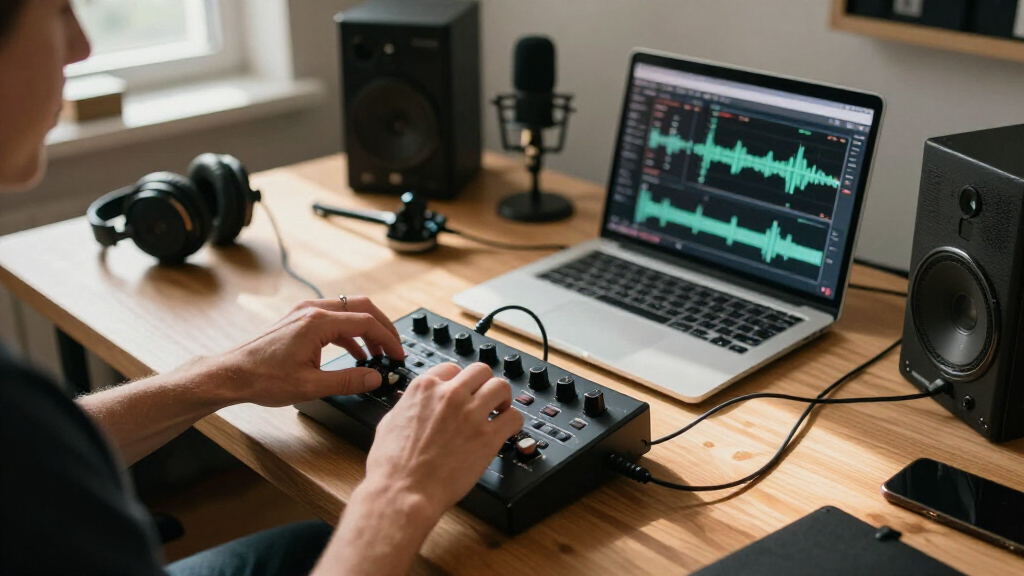
This roundup evaluates audio interfaces based on performance, build quality, usability, and value. We prioritized interfaces that deliver clear, professional sound with reliable connectivity and minimal latency. Ease of setup and compatibility with common creator tools like streaming platforms and recording software also played a key role. Devices were ranked considering whether they serve beginners, hobbyists, or professional creators, with a focus on balancing features against price. The goal was to highlight options that offer the best bang for the buck while meeting a range of creator needs.| audio interface for creator | Connectivity |
|---|---|
| Focusrite Scarlett Solo 3rd Ge | USB-C |
| MAONO PS22 Lite USB Audio Inte | USB |
| MAONO P2 Hybrid USB Audio Inte | USB-C hybrid connectivity |
| 2×2 24-bit/192kHz USB-C Record | USB-C |
| ESI Neva Duo USB Audio Interfa | USB |
| Shure MVX2U Gen 2 XLR-to-USB-C | — |
| M-Audio M-Track Duo USB Audio | — |
| Apogee Symphony Desktop Elite | USB-C |
| Universal Audio Volt 2 USB Aud | — |
| Synido 2×2 USB-C Audio Interfa | USB-C to USB-A |
Factors to Consider When Choosing Audio Interface For Creators
When selecting an audio interface for your creative work, it’s important to consider several key factors that influence both your current setup and future growth. Understanding these considerations helps avoid common pitfalls like overpaying for features you won’t use or buying models incompatible with your devices.Number and Type of Inputs
Assess how many microphones, instruments, or line-level sources you’ll connect. Interfaces with dual XLR or combo inputs offer versatility for recording multiple sources simultaneously. However, more inputs usually mean a higher price and larger size, so choose based on your current needs and potential expansion. If you’re just starting out, a simple 1-2 input model may suffice, while more advanced creators might need four or more inputs for complex setups.
Connectivity Options
Check whether the interface connects via USB-C, USB-A, Thunderbolt, or other ports, and ensure compatibility with your computer or device. USB-C interfaces often offer better speed and future-proofing, but may require adapters for older hardware. Hybrid ports, like XLR/USB combos, provide flexibility for different sources. Also, consider if the interface supports direct monitoring to avoid latency during recordings, especially important for live performances or streaming.
Sound Quality and Preamps
The quality of preamps and converters directly impacts your audio clarity and overall production. Higher-end models with 24-bit/192kHz recording and better preamps produce cleaner, more professional sound, but tend to be pricier. For casual creators or beginners, mid-range interfaces with decent preamps often suffice, while professionals should prioritize models with studio-grade components to capture every nuance.
Build and Portability
Consider whether you need a rugged, portable device for mobile recording or a more stationary setup. Compact interfaces are easier to carry but might lack expandability or advanced features. Conversely, larger models often offer additional inputs, outputs, and hardware controls, ideal for a fixed studio environment. Think about your workflow and environment to choose a device that balances durability with convenience.
Software Compatibility and Included Features
Verify that the interface works seamlessly with your preferred DAW and streaming platforms. Some models come bundled with recording or editing software, which can add value. Compatibility with iOS devices or smartphones might also matter if you record on the go. Avoid interfaces that require complex driver setups or have limited support, as these can hinder your creative flow.
Frequently Asked Questions
Will a more expensive audio interface automatically improve my sound quality?
Not necessarily. While higher-priced interfaces often feature better preamps and converters, the difference may be subtle for casual or beginner creators. If your current gear and environment are already of decent quality, investing in a more expensive model might yield diminishing returns. Focus on matching the interface’s capabilities to your actual needs—upgrading only when your workflow or professional requirements demand it.
Can I use a single audio interface for both streaming and recording?
Absolutely. Many interfaces are versatile enough to handle both streaming and recording tasks thanks to features like direct monitoring and multiple outputs. Look for models with low latency and simple connectivity. If you rely heavily on streaming, consider an interface with a built-in headphone output and easy-to-use controls that simplify live adjustments without disrupting your stream.
Is it better to buy an interface with multiple inputs or stick to a simple two-channel model?
The choice depends on your workflow. A two-channel interface is often sufficient for solo creators, such as podcasters or singer-songwriters. However, if you plan to record multiple sources simultaneously, or expand your setup later, investing in an interface with more inputs makes sense. Be mindful that additional inputs increase cost and complexity, so choose what aligns with your current and future recording goals.
Do I need an audio interface if I already have a USB microphone?
While a USB microphone connects directly to your computer, an audio interface can significantly improve sound quality and expand your options. Many interfaces include high-quality preamps and allow multiple inputs, enabling you to connect professional microphones, instruments, or headphones. If you want cleaner recordings or plan to upgrade your gear, adding an interface is a smart move that enhances your overall setup.
What should I consider if I want to record on the go?
Portability is key for mobile recording. Look for compact, bus-powered interfaces that don’t require external power supplies. Compatibility with smartphones or tablets is also important; some interfaces support iOS or Android. Ensure the device is durable enough to withstand transport and has simple setup procedures. This way, you can create high-quality recordings wherever inspiration strikes.
Conclusion
For creators seeking a reliable, all-around performer, the Focusrite Scarlett Solo 3rd Gen stands out as the best overall choice due to its balance of quality and affordability. Beginners or those on a tight budget will find the M-AUDIO M-Track Duo a solid entry point, while professionals who need studio-grade sound should consider the Apogee Symphony Desktop Elite. Streamers and mobile creators benefit from compact, portable options like the Shure MVX2U. Ultimately, your pick should align with your current setup, growth plans, and creative priorities—this guide helps clarify those decisions.
As an affiliate, we earn on qualifying purchases.Fall Picks
fall essentials