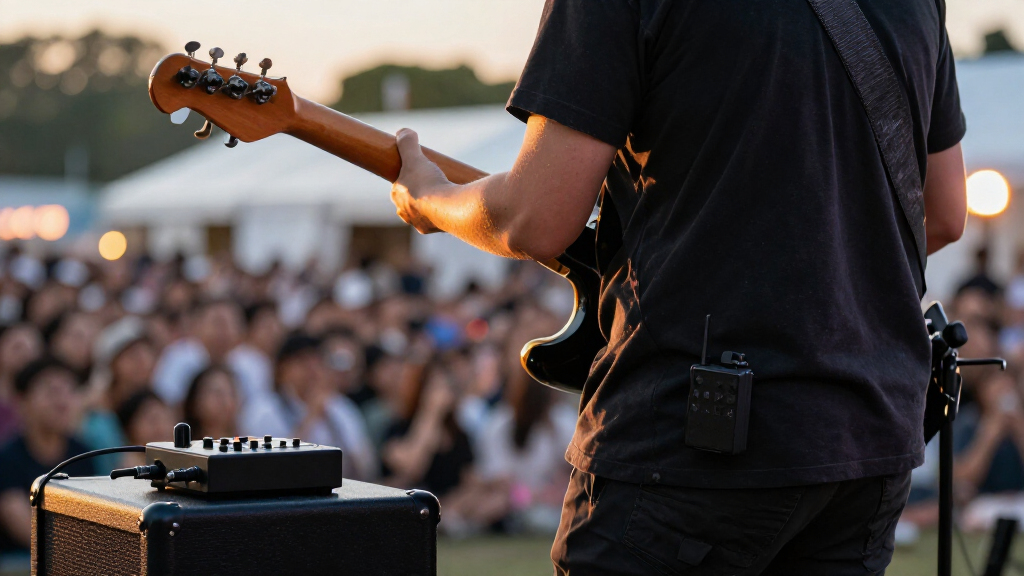
For most gigging players, I’d start with the Shure GLXD16+ Dual-Band Digital Wireless Guitar Pedal System: its pedalboard-style receiver and dual-band operation suit a working stage rig. The Line 6 Relay G10SII is a simpler alternative for players who want a tidy receiver setup, while the BOSS WL-60 puts more emphasis on checking signal conditions and managing a wearable transmitter. The main tradeoff is between stage-ready control and flexibility on one side, and compact size, simpler setup, or lower system complexity on the other. Frequency band, receiver format, battery routine, and how crowded your venue’s wireless environment gets can all change which system makes sense. Read on for how I rank all 15 options and what to weigh before choosing.

Get audio and creator gear delivered free with Prime
- Fast, free delivery on millions of items
- Prime Video, Amazon Music and more included
- Member-only deals all year
Complete the kit


Key Takeaways
- The Shure GLXD16+ leads for pedalboard use: its dual-band system and pedal-format receiver make it the clearest all-around fit for players who want wireless control alongside their effects.
- Shure’s GLXD14+ and SLXD14+ serve different rig priorities: the GLXD14+ is a more self-contained guitar-and-bass option, while the SLXD14+ is the more stage-focused choice for players who need a dedicated receiver-and-bodypack setup.
- Small plug-in systems trade stage controls for simplicity: options such as the Xvive U2, Fender Telepath, and LEKATO models reduce setup fuss, but they do not replace a receiver with more hands-on monitoring and control.
- Charging cases are useful when routine matters: the JOYO JW-06 and Xvive AC58 bundle storage and charging, while a case cannot compensate for poor frequency planning or a mismatched instrument jack.
- Band choice is a venue decision, not just a spec-sheet contest: the 2.4GHz and 5.8GHz plug-in options differ in where they operate, so players should check local wireless congestion and test their full stage setup before relying on one live.
| Shure GLXD16+ Dual-Band Digital Wireless Guitar Pedal System, Z3 Band |  | Best Overall for Pedalboard Setups | Wireless bands: 2.4 GHz and 5.8 GHz | Battery life: Up to 12 hours | Quick charge: 15 minutes provides up to 1.5 hours of use | VIEW LATEST PRICE | See Our Full Breakdown |
| Shure GLXD14+ Dual Band Pro Digital Wireless System for Guitar and Bass (GLXD14+-Z3) |  | Best for Straightforward Shure Bodypack Setup | Wireless bands: 2.4 GHz and 5.8 GHz | Battery life: Up to 12 hours | Quick charge: 15 minutes provides up to 1.5 hours of use | VIEW LATEST PRICE | See Our Full Breakdown |
| NUX B-8 Wireless System for Guitar, Bass, and Other Instruments |  | Best for Adjustable Stage Control | Wireless frequency: 2.4 GHz | Audio quality: 24-bit/48 kHz | Operating range: Up to 165 ft (50 m) | VIEW LATEST PRICE | See Our Full Breakdown |
| JOYO JW-06 5.8GHz Wireless Guitar System with Charging Case |  | Best for Extended Sets Without a Pedalboard Receiver | Wireless frequency: 5.8 GHz | Audio resolution: 48 kHz/24-bit | Latency: Under 6 ms | VIEW LATEST PRICE | See Our Full Breakdown |
| Xvive U2 Guitar Wireless System, 2.4 GHz, Black |  | Best for Simple Plug-and-Play Gigs | Wireless frequency: 2.4 GHz | Range: Up to 70 ft | Latency: Less than 5 ms | VIEW LATEST PRICE | See Our Full Breakdown |
| AKG Pro Audio WMS40 MINI Wireless Microphone System – Instrumental Set (US25D) with SR40 Receiver & PT40 Mini Pocket Transmitter |  | Best for Simple, Long-Runtime Setups | Receiver: SR40 | Transmitter: PT40 Mini pocket transmitter | Transmitter connector: 3-pin mini XLR | VIEW LATEST PRICE | See Our Full Breakdown |
| Flatsons TR-U2 5.8GHz Wireless Guitar System |  | Best Compact Rechargeable Pick | Wireless frequency: 5.725–5.850 GHz | Audio resolution: 44.1 kHz / 24-bit | Latency: 5.58 ms | VIEW LATEST PRICE | See Our Full Breakdown |
| Shure SLXD14+ Digital Wireless Guitar/Bass System – G57 Band |  | Best for Coordinated Multi-System Stages | System: SLXD4+ single-channel receiver and SLXD1+ bodypack transmitter | Audio: 24-bit digital | Dynamic range: Exceeds 118 dB | VIEW LATEST PRICE | See Our Full Breakdown |
| Line 6 Relay G10SII Guitar Wireless System |  | Best Pedalboard Receiver | Audio signal format: Digital | Wireless range: Up to 130 ft line of sight | Playing time: About 7 hours | VIEW LATEST PRICE | See Our Full Breakdown |
| Xvive AC58 Wireless Guitar System with Charging Case 5.8 GHz |  | Best for Recharge-and-Go 5.8 GHz Use | Wireless frequency: 5.8 GHz | Audio resolution: 24-bit / 48 kHz | Frequency range: 20 Hz–20 kHz | VIEW LATEST PRICE | See Our Full Breakdown |
| BOSS WL-60 Wireless Guitar System, Black |  | Best for Pedalboard-Based Live Rigs | Signal format: Digital | Channel scanning: Automatic scan across 14 channels | Transmitter style: Bodypack | VIEW LATEST PRICE | See Our Full Breakdown |
| LEKATO 2.4GHz Wireless Guitar System with Magnetic Charging Case |  | Best for Multi-Instrument Players on a Charging Routine | Wireless frequency: 2.4 GHz | Audio resolution: 24-bit/48 kHz | Latency: Under 9 ms | VIEW LATEST PRICE | See Our Full Breakdown |
| Xvive A58 5.8GHz Wireless Guitar System |  | Best for Low-Latency Stage Movement | Frequency: 5.8 GHz | Range: Over 100 feet | Latency: Less than 5 ms | VIEW LATEST PRICE | See Our Full Breakdown |
| Fender Telepath 5.8GHz Wireless System for Instruments, Mystic Ice Blue |  | Best for Longer Gigs and Instrument Switching | Frequency band: 5.8 GHz | Wireless range: Up to 70 feet | Latency: 4 ms | VIEW LATEST PRICE | See Our Full Breakdown |
| LEKATO 5.8GHz Wireless Guitar System, 24-Bit Audio Transmitter and Receiver for Live Stage and Studio Practice, 220° Rotatable Plug Fits Electric Bass, Black |  | Best Compact Pick for Shorter Sets | Frequency band: 5.8 GHz | Audio resolution: 24-bit/48 kHz | Latency: Less than 6 ms | VIEW LATEST PRICE | See Our Full Breakdown |
| wireless guitar systems for live performance | Battery life |
|---|---|
| Shure GLXD16+ Dual-Band Digita | Up to 12 hours |
| Shure GLXD14+ Dual Band Pro Di | Up to 12 hours |
| NUX B-8 Wireless System for Gu | — |
| JOYO JW-06 5.8GHz Wireless Gui | Up to 6 hours per charge; up to 18 hours with case recharges |
| Xvive U2 Guitar Wireless Syste | Up to 5 hours |
| AKG Pro Audio WMS40 MINI Wirel | Up to 30 hours |
| Flatsons TR-U2 5.8GHz Wireless | Over 6 hours |
| Shure SLXD14+ Digital Wireless | Up to 8 hours on 2 AA batteries |
| Line 6 Relay G10SII Guitar Wir | — |
| Xvive AC58 Wireless Guitar Sys | — |
| BOSS WL-60 Wireless Guitar Sys | Up to 25 hours on two AA batteries |
| LEKATO 2.4GHz Wireless Guitar | — |
| Xvive A58 5.8GHz Wireless Guit | Up to 5 hours |
| Fender Telepath 5.8GHz Wireles | Up to 8 hours |
| LEKATO 5.8GHz Wireless Guitar | Up to 5 hours |
More Details on Our Top Picks
Shure GLXD16+ Dual-Band Digital Wireless Guitar Pedal System, Z3 Band
Pedalboard integration is the GLXD16+’s clearest advantage: its receiver is designed to sit with a guitarist’s other pedals, while automatic pairing keeps setup simple at a gig. Unlike the Shure GLXD14+, which uses a separate tabletop receiver and bodypack, this version suits players who want the wireless unit within reach on the board. Its 2.4 and 5.8 GHz operation scans for interference, and the rechargeable battery runs up to 12 hours, with a short charge useful when a set is approaching. The tradeoff is system compatibility: it will not pair with earlier GLX-D generations. Players coordinating several systems also need the separately sold Frequency Manager. Compared with the compact JOYO JW-06, this is the more integrated pedalboard choice, but it relies on a receiver rather than a charging-case format.
Pros:- Dual-band operation monitors for interference and can move to a cleaner channel.
- Pedal-style receiver fits a board-based live setup.
- Up to 12 hours of battery life, with a 15-minute charge providing up to 1.5 hours of use.
- Supports up to 16 half-rack systems when paired with the separately sold GLX+ Frequency Manager.
Cons:- Not compatible with previous GLX-D or GLX-D Advanced systems.
- Frequency Manager is an additional requirement for coordinated multi-system setups.
Best for: Guitarists and bassists who want a dual-band wireless receiver mounted with their pedalboard and need long rechargeable runtime.
Not ideal for: Players who need compatibility with older GLX-D gear or want multi-system coordination without buying a separate Frequency Manager.
- Wireless bands:2.4 GHz and 5.8 GHz
- Battery life:Up to 12 hours
- Quick charge:15 minutes provides up to 1.5 hours of use
- Charging:Receiver or USB-C
- Compatible instruments:Guitar and bass
- Multi-system capacity:Up to 16 half-rack systems with optional GLX+ Frequency Manager
- Signal-to-noise ratio:103 dB
- Enclosure and weight:Metal; 16 oz
Our verdict“Choose the GLXD16+ if you want Shure’s dual-band wireless management in a pedalboard-oriented format and can work within its newer system generation.”
Shure GLXD14+ Dual Band Pro Digital Wireless System for Guitar and Bass (GLXD14+-Z3)
The GLXD14+ makes the most sense for performers who want Shure’s automatic frequency management without putting the receiver on a pedalboard. Its included GLXD4+ receiver and bodypack provide a familiar stage layout, and the package includes the instrument cable, rechargeable battery, power supply, and carrying case. Dual-band scanning across 2.4 and 5.8 GHz helps it find a cleaner channel, while the battery offers up to 12 hours of operation and quick charging. Compared with the GLXD16+, this is the better fit for a separate receiver position, not a board-integrated footprint. The tradeoffs are its single-channel configuration and lack of backward compatibility with older GLX-D systems. Coordinating a larger Shure wireless setup also calls for a separately sold Frequency Manager.
Pros:- Dual-band scanning and automatic frequency management simplify channel selection during live use.
- Includes the bodypack, instrument cable, receiver, rechargeable battery, power supply, and carrying case.
- Up to 12 hours of battery life with a quick-charge option.
- License-free frequency operation avoids the need for a frequency license.
Cons:- Not compatible with previous GLX-D or GLX-D Advanced systems.
- Frequency Manager is sold separately for coordinated multi-system installations.
- The separate receiver is less suited to players seeking a pedalboard-integrated setup.
Best for: Guitarists and bassists who want a complete Shure bodypack-and-receiver kit for gigs, rehearsals, or a fixed stage setup.
Not ideal for: Players who want a pedalboard receiver, need multiple channels from one unit, or rely on older GLX-D transmitters and receivers.
- Wireless bands:2.4 GHz and 5.8 GHz
- Battery life:Up to 12 hours
- Quick charge:15 minutes provides up to 1.5 hours of use
- Range:Up to 100 ft
- Included transmitter:GLXD1+ bodypack
- Included instrument cable:WA302, TA4F to 1/4-inch
- Receiver:GLXD4+ single-channel receiver
- Charging:SB904 rechargeable battery; receiver or USB-C charging
Our verdict“Pick the GLXD14+ for a ready-to-play Shure bodypack system with a separate receiver, rather than the GLXD16+’s pedalboard format.”
NUX B-8 Wireless System for Guitar, Bass, and Other Instruments
The NUX B-8 is aimed at players who want more control over how a wireless system behaves, rather than the simplest plug-and-play routine. Its color display and six stability settings provide options for adapting transmission behavior to a venue, and true-diversity dual antennas are designed to reduce dead spots. The 24-bit/48 kHz audio format, optional cable-tone simulation, and up to 12 dB of boost give it more shaping flexibility than the basic Xvive U2. Its stated range reaches 165 feet, though actual coverage can change with the room and obstructions. There is a latency tradeoff: the higher stability settings can raise delay to 8.7 ms. That makes the B-8 a more configurable pick than the JOYO JW-06, but a less appealing one for players who want minimal setup decisions.
Pros:- True-diversity dual antennas are designed to reduce dropouts and dead spots.
- Six stability settings let players adjust the system to their environment.
- Cable-tone simulation and up to 12 dB of boost add useful live-signal options.
- Magnetic charging port makes it easy to dock the transmitter on the receiver.
Cons:- Higher stability settings can increase latency to as much as 8.7 ms.
- The 2.4 GHz system may face congestion in busy wireless environments.
- Its feature and setting range may be unnecessary for players seeking a basic plug-and-play rig.
Best for: Gigging guitarists, bassists, and pickup-equipped instrumentalists who want display-based controls, adjustable stability, and onboard boost.
Not ideal for: Players who prioritize the lowest stated latency or want a simple transmitter-and-receiver pair with few settings to manage.
- Wireless frequency:2.4 GHz
- Audio quality:24-bit/48 kHz
- Operating range:Up to 165 ft (50 m)
- Stability settings:6 levels; 2.5–8.7 ms
- Maximum simultaneous units:Up to 10 B-8 systems
- Boost:0 to +12 dB
- Compatible instruments:Guitar, bass, and other instruments with pickups
- Display and enclosure:2.4-inch color display; metal enclosure
Our verdict“Choose the NUX B-8 if you value adjustable wireless behavior and signal tools more than the simplest setup or lowest possible latency.”
JOYO JW-06 5.8GHz Wireless Guitar System with Charging Case
The JW-06 stands out for performers who want a compact wireless pair and a charging case to stretch time between power sources. The transmitter and receiver run for up to six hours per charge, while the case provides two additional recharges—up to 18 hours in total. Its 5.8 GHz connection, 48 kHz/24-bit audio, and latency under 6 ms suit live instrument use, and four channels can help when several compatible units are part of a set. Compared with the Xvive U2, the JOYO offers more total runtime through its case, while the Xvive has a lower stated latency. Range is more limited once walls or other obstacles enter the path, and the JW-06 excludes 18V active pickups and extremely high-output systems. Its ABS construction is also less robust than the metal-cased NUX B-8.
Pros:- Charging case extends total stated playtime to as much as 18 hours.
- Under-6-ms latency and 48 kHz/24-bit audio suit live performance.
- Four channels support use alongside compatible wireless units.
- Works with most electric guitars, basses, and acoustic-electric instruments.
Cons:- Range can fall to approximately 30–50 ft around obstructions.
- Not compatible with 18V active pickups or extremely high-output systems.
- ABS plastic enclosure is less substantial than the metal enclosure on the NUX B-8.
Best for: Gigging guitarists who want a portable 5.8 GHz system with a charging case for longer sessions away from convenient power.
Not ideal for: Players using 18V active pickups, very high-output systems, or venues where the receiver and transmitter will be separated by walls or obstacles.
- Wireless frequency:5.8 GHz
- Audio resolution:48 kHz/24-bit
- Latency:Under 6 ms
- Wireless range:65–100 ft in open areas; approximately 30–50 ft with obstructions
- Battery life:Up to 6 hours per charge; up to 18 hours with case recharges
- Channels:4
- Connector:1/4-inch (6.35 mm) mono plug
- Pickup compatibility:Most active or passive pickups; excludes 18V active and extremely high-output systems
Our verdict“Choose the JW-06 if a rechargeable case and long combined runtime matter more than maximum obstructed-range coverage or broad pickup compatibility.”
Xvive U2 Guitar Wireless System, 2.4 GHz, Black
The Xvive U2 is the straightforward option in this group: its transmitter and receiver plug into 1/4-inch connections, making setup simpler than managing the Shure GLXD14+ receiver and bodypack or configuring the NUX B-8’s stability settings. Latency under 5 ms is a useful fit for players who want a responsive feel onstage, and its rechargeable battery is rated for up to five hours. The system can support up to four pairs at once, giving small groups some room to add compatible units. The tradeoff is limited reach: its stated range is up to 70 feet, below the NUX B-8’s 165-foot claim. It is also designed for guitar use, so players seeking wider instrument compatibility or longer all-day operation should look at the JOYO JW-06 or a Shure system instead.
Pros:- Plug-and-play transmitter and receiver simplify setup.
- Latency is specified at less than 5 ms.
- Rechargeable battery provides up to five hours of use.
- Supports up to four system pairs at the same time.
Cons:- Stated range is limited to up to 70 feet.
- Up to five hours of battery life may not suit long sessions without a recharge.
- Designed for guitar with 1/4-inch connections rather than broader instrument use.
Best for: Guitarists who want a compact, easy-to-connect wireless system for rehearsals and live sets within its stated range.
Not ideal for: Players who need coverage beyond 70 feet, extended runtime without recharging, or stated compatibility with a broader range of instruments.
- Wireless frequency:2.4 GHz
- Range:Up to 70 ft
- Latency:Less than 5 ms
- Battery life:Up to 5 hours
- Battery type:Rechargeable lithium polymer
- Connector:1/4-inch (6.35 mm)
- Compatibility:Guitar
- Included:Transmitter, receiver, and USB cable
Our verdict“Pick the Xvive U2 for uncomplicated guitar wireless with low stated latency, but choose the JOYO JW-06 or NUX B-8 if you need more range or broader instrument options.”
AKG Pro Audio WMS40 MINI Wireless Microphone System – Instrumental Set (US25D) with SR40 Receiver & PT40 Mini Pocket Transmitter
The AKG WMS40 MINI suits players who value a straightforward instrument link over compact plug-in convenience. Its PT40 pocket transmitter connects through a mini XLR cable, while the receiver’s standard 1/4-inch output feeds an amp or mixer. That bodypack arrangement can work better than rotating plug units when an instrument jack is awkwardly placed, but it adds a cable and a transmitter to secure onstage. The headline advantage is up to 30 hours from one AA battery, far longer than the Flatsons TR-U2’s stated six-plus hours between charges. The tradeoff is a single channel and a more basic feature set: unlike the Shure SLXD14+, it offers no listed remote RF management or multi-system coordination. I’d choose it for a simple, long-running setup, not a busy stage with several wireless channels.
Pros:- Up to 30 hours of operation from one AA battery
- Standard 1/4-inch receiver output connects readily to amps and mixers
- Pocket transmitter accepts a professional 3-pin mini XLR instrument connection
- Plug-and-play operation avoids complex setup
Cons:- Single-channel design does not suit dual-instrument or multi-mic wireless setups
- Bodypack and connecting cable add gear to secure and manage onstage
- AA battery operation requires replacement or recharging
Best for: Guitarists, bassists, or instrumental-mic players who want a bodypack system with long AA runtime and a simple receiver-to-amp connection.
Not ideal for: Players who need multiple simultaneous channels, advanced frequency coordination, or a cable-free plug-in transmitter.
- Receiver:SR40
- Transmitter:PT40 Mini pocket transmitter
- Transmitter connector:3-pin mini XLR
- Receiver output:1/4-inch
- Battery:1 AA battery
- Battery life:Up to 30 hours
- Frequency response:20 Hz–20 kHz
- Signal-to-noise ratio:76 dB
Our verdict“Choose the AKG if long runtime and a simple bodypack connection matter more than multiple channels or advanced wireless management.”
Flatsons TR-U2 5.8GHz Wireless Guitar System
The Flatsons TR-U2 is aimed at players who want a small, cable-free rig without moving up to a receiver-and-bodypack system like the AKG WMS40 MINI. Its rotatable 1/4-inch plugs help the transmitter and receiver fit instruments with recessed or inconveniently angled jacks, and automatic pairing keeps setup brief. The specified 5.8 GHz link, 24-bit audio, and 5.58 ms latency make it a practical option for rehearsal and live sets where quick movement matters. Its stated line-of-sight range exceeds 100 feet, but that figure does not promise the same reach through people or obstructions. More important for a long show, runtime is just over six hours, and an auto-sleep feature shuts both units off after ten minutes of inactivity. I’d favor it over the AKG for a lighter, cable-free setup, but not for a full-day gig without charging access.
Pros:- Compact transmitter and receiver use rotatable 1/4-inch plugs
- Automatic pairing with seven selectable channels
- 24-bit audio and stated latency of 5.58 ms
- USB-C rechargeable battery provides over six hours of use
Cons:- Specified range is line-of-sight and may not reflect obstructed stage conditions
- Auto-sleep turns both units off after ten minutes of inactivity
- Runtime is shorter than the AKG WMS40 MINI’s stated AA battery life
Best for: Gigging guitarists and multi-instrument players who want a compact rechargeable link, automatic pairing, and a rotatable plug for tight instrument jacks.
Not ideal for: Musicians playing long sets without charging breaks or stages where the transmitter-to-receiver path is frequently obstructed.
- Wireless frequency:5.725–5.850 GHz
- Audio resolution:44.1 kHz / 24-bit
- Latency:5.58 ms
- Wireless range:Over 100 ft (30 m), line of sight
- Battery life:Over 6 hours
- Charging:USB-C rechargeable lithium battery
- Channel selection:7 channels with automatic pairing
- Simultaneous sets:Up to 6
Our verdict“Pick the TR-U2 for a compact, rechargeable setup and quick stage movement, provided its limited runtime fits your set schedule.”
Shure SLXD14+ Digital Wireless Guitar/Bass System – G57 Band
The Shure SLXD14+ is the most management-focused choice in this group. Its 138 MHz tuning range, automatic linking, and support for up to 14 simultaneous systems make it a better fit for venues coordinating several wireless performers than the single-channel AKG WMS40 MINI. The 24-bit digital audio and stated dynamic range above 118 dB also put it in a different class from the simpler plug-in systems, while ShowLink and Wireless Workbench tools let an engineer monitor or adjust settings remotely. AES-256 encryption adds protection for the wireless connection. Those capabilities have a tradeoff: this is a receiver-and-bodypack system with more setup and gear to manage than the Flatsons TR-U2. Battery life is up to eight hours on two AA cells, so I’d plan power for extended shows rather than assume it will outlast the AKG.
Pros:- Supports up to 14 simultaneous systems
- 138 MHz tuning range and automatic linking support coordinated RF setup
- 24-bit digital audio with dynamic range exceeding 118 dB
- ShowLink and Wireless Workbench tools enable remote monitoring and configuration
Cons:- Receiver and bodypack require more setup and stage gear than compact plug-in systems
- Up to eight hours on two AA batteries may require a power plan for longer performances
- Advanced coordination features may be unnecessary for a simple one-instrument rig
Best for: Touring guitarists, bassists, and venue engineers coordinating several wireless systems who want remote oversight and a wide tuning range.
Not ideal for: Players seeking a minimal plug-in setup, or those who prioritize very long battery life and uncomplicated single-unit operation.
- System:SLXD4+ single-channel receiver and SLXD1+ bodypack transmitter
- Audio:24-bit digital
- Dynamic range:Exceeds 118 dB
- Tuning range:138 MHz
- Simultaneous systems:Up to 14
- Encryption:AES-256
- Battery life:Up to 8 hours on 2 AA batteries
- Included instrument cable:WA305 premium instrument cable
Our verdict“Choose the SLXD14+ when a multi-system stage needs remote RF oversight and broad tuning flexibility, rather than a minimal wireless rig.”
Line 6 Relay G10SII Guitar Wireless System
The Line 6 Relay G10SII is the natural choice for a guitarist who wants wireless to behave like another pedalboard connection. Its stompbox-style receiver can sit among existing effects or operate as a standalone unit, and the plug-and-play design avoids the bodypack and instrument cable used by the AKG WMS40 MINI. The stated 130-foot line-of-sight range gives players room to move across a stage, though that distance is not a guarantee in obstructed venues. Compatibility with active and passive pickups also makes it less fussy when switching guitars than a system that requires a narrower instrument match. Its battery life is about seven hours, which trails the AKG’s stated 30 hours, and the listed output choices are limited to 1/4-inch and XLR. I’d favor it for pedalboard integration, not extensive output routing.
Pros:- Compact stompbox-style receiver fits into a pedalboard setup
- Plug-and-play operation keeps setup simple
- Stated range reaches up to 130 feet line of sight
- Works with active and passive pickup systems
Cons:- About seven hours of playtime is much shorter than the AKG WMS40 MINI’s stated runtime
- Connectivity is limited to 1/4-inch and XLR outputs
- Line-of-sight range may be reduced by stage obstructions
Best for: Guitarists who want a plug-and-play wireless receiver on a pedalboard and need compatibility with both active- and passive-pickup instruments.
Not ideal for: Players who need extended battery runtime, several output options, or a receiver designed for detailed RF coordination.
- Audio signal format:Digital
- Wireless range:Up to 130 ft line of sight
- Playing time:About 7 hours
- Power:9 volts, 0.3 A
- Hardware interface:1/4-inch
- Outputs:1/4-inch and XLR
- Pickup compatibility:Active and passive
- Warranty:1-year manufacturer warranty
Our verdict“Pick the Relay G10SII if pedalboard integration and broad pickup compatibility matter more than long runtime or expanded connectivity.”
Xvive AC58 Wireless Guitar System with Charging Case 5.8 GHz
The Xvive AC58 makes the most sense for players who want a plug-in wireless pair and a charging case to extend use between power outlets. Its 5.8 GHz true-diversity link and 24-bit/48 kHz audio give it a more specified audio and transmission package than the Flatsons TR-U2, while support for both active and passive pickups suits players who swap instruments. The case can provide up to two full recharges, a useful buffer for rehearsals or a run of performances; it does not remove the need to keep the system charged. Compared with the Line 6 Relay G10SII, the Xvive emphasizes portable charging rather than pedalboard-style receiver integration. Channel selection relies on LED indicators instead of a dedicated display, so checking or changing channels is less direct. I’d choose it for mobile players who value the case, not for those who need detailed on-unit feedback.
Pros:- 5.8 GHz true-diversity transmission
- 24-bit/48 kHz audio across a stated 20 Hz–20 kHz frequency range
- Compatible with both active and passive pickups
- Charging case provides up to two full recharges
Cons:- Channel selection uses LED indicators rather than a dedicated display
- Charging case adds another item to keep charged and carry
- Product data does not specify operating range or runtime
Best for: Guitarists and bassists who move between rehearsals and gigs, use active or passive pickups, and want a case that can recharge the wireless units away from a power outlet.
Not ideal for: Players who want a dedicated pedalboard receiver, a clear channel display, or published details on operating range and battery runtime.
- Wireless frequency:5.8 GHz
- Audio resolution:24-bit / 48 kHz
- Frequency range:20 Hz–20 kHz
- Transmission:True diversity
- Pickup compatibility:Active and passive
- Charging case:Up to 2 full recharges
- Connector:USB-C
- Weight:3.2 oz
Our verdict“Choose the AC58 if a portable charging case and active/passive pickup compatibility outweigh the need for a channel display or pedalboard receiver.”
BOSS WL-60 Wireless Guitar System, Black
The BOSS WL-60 is the most stage-control-oriented choice here: its stompbox-size receiver sits on a pedalboard, while the LCD shows channel, signal strength, and battery life where a player can check them between songs. Automatic scanning across 14 channels gives it a more deliberate setup workflow than the plug-in LEKATO systems, and its bodypack transmitter keeps the instrument connection out of the way. The stated ultra-low latency suits tight live playing, while up to 25 hours on two AA batteries means fewer charging breaks than the five-hour Xvive A58 or LEKATO 5.8GHz options. The tradeoff is a more involved bodypack-and-receiver setup, plus a limited 14-channel selection and ongoing AA replacement. I’d choose it for a pedalboard built around visible controls, not for a minimal rig that prizes pocketable simplicity.
Pros:- Pedalboard-friendly receiver provides a dedicated, visible control point.
- LCD displays channel status, signal strength, and battery life.
- Automatic scanning across 14 channels simplifies finding a usable channel.
- Up to 25 hours of operation on two AA batteries reduces charging interruptions.
Cons:- Two AA alkaline batteries need replacement after about 25 hours of use.
- Fourteen selectable channels offer less channel choice than a crowded-stage user may want.
- Bodypack and separate receiver add more setup than compact plug-in systems.
Best for: Guitarists with pedalboards who want a receiver display, channel scanning, and long battery life for rehearsals and gigs.
Not ideal for: Players seeking a small plug-in transmitter-and-receiver pair with rechargeable batteries and minimal setup.
- Signal format:Digital
- Channel scanning:Automatic scan across 14 channels
- Transmitter style:Bodypack
- Battery life:Up to 25 hours on two AA batteries
- Receiver style:Stompbox-size receiver
- Connector:6.35 mm jack
- Dimensions:5 x 3 x 3 inches
- Weight:16 ounces
Our verdict“Choose the WL-60 if a pedalboard receiver and clear onstage status matter more to you than a minimal plug-in setup.”
LEKATO 2.4GHz Wireless Guitar System with Magnetic Charging Case
The LEKATO WS-300-CHUS is a practical pick for players who want to move between compatible instruments without carrying a bodypack. Its magnetic charging case raises total stated playtime to 18 hours, giving it a more convenient recharge plan than the five-hour Xvive A58 and LEKATO 5.8GHz systems. Automatic pairing keeps setup simple, and support for up to four simultaneous systems can help a band equip several players. The 220-degree rotating plug also gives it a better chance of fitting awkwardly positioned jacks than a fixed-angle design. Its range claim—over 20 meters—applies to open areas, though, and the 2.4GHz band may be less appealing where that spectrum is crowded than the 5.8GHz Fender Telepath. I’d favor this for routine gigs and short-to-medium stage movement, not for players who need a pedalboard receiver or extensive range details.
Pros:- Charging case raises total stated playtime to up to 18 hours.
- Automatic pairing cuts down on setup steps.
- Supports up to four systems operating simultaneously.
- 220-degree rotating plug accommodates varied instrument jack positions.
Cons:- The stated range of over 20 meters applies to open areas.
- Requires 6.35 mm (1/4-inch) jacks on instruments and connected audio equipment.
- Uses 2.4GHz, unlike the 5.8GHz Fender Telepath and other options aimed at avoiding that band.
Best for: Guitarists, bassists, or keyboard players with 1/4-inch outputs who want automatic pairing and a case that extends time between charging stops.
Not ideal for: Players on stages where 2.4GHz congestion is a concern, or performers who need a documented long-range setup beyond open-area use.
- Wireless frequency:2.4 GHz
- Audio resolution:24-bit/48 kHz
- Latency:Under 9 ms
- Transmission range:Over 20 m (65 ft) in open areas
- Playtime:Up to 6 hours per charge; up to 18 hours with charging case
- Simultaneous systems:Up to 4
- Compatible instruments:Electric guitar, bass guitar, and electronic keyboard with 6.35 mm output
- Plug rotation:220 degrees
- Weight:300 g
Our verdict“Pick the LEKATO WS-300-CHUS if you want simple pairing and a charging case for compatible instruments rather than a pedalboard receiver or a 5.8GHz system.”
Xvive A58 5.8GHz Wireless Guitar System
With latency under 5 ms and a stated range over 100 feet, the Xvive A58 is aimed at guitarists who want to move freely without accepting a noticeable delay. Its 5.8GHz band separates it from the 2.4GHz LEKATO WS-300-CHUS, which may suit stages where the lower band is busy. Up to four pairs can operate at once, giving it a useful role in multi-player setups. The main compromise is endurance: the rechargeable transmitter and receiver run for up to five hours, shorter than the Fender Telepath’s stated eight hours and far below the BOSS WL-60’s AA-powered runtime. That puts a charging plan or a shorter set at the center of the buying decision. I’d pick the A58 for responsive movement, but skip it if a full evening’s playing on one charge is a priority.
Pros:- Latency under 5 ms supports responsive live playing.
- Stated range exceeds 100 feet.
- 5.8GHz operation distinguishes it from the 2.4GHz LEKATO WS-300-CHUS.
- Up to four system pairs can be used at once.
Cons:- Up to five hours of battery life may not cover long gigs without recharging.
- The supplied product data does not specify an audio-resolution figure.
- Its stated range and short battery life make it a less balanced choice for long sets than the Fender Telepath.
Best for: Performers who move around the stage, value very low latency, and can recharge between sets or gigs.
Not ideal for: Players who need a single charge to cover long performances or who want a receiver designed to sit visibly on a pedalboard.
- Frequency:5.8 GHz
- Range:Over 100 feet
- Latency:Less than 5 ms
- Battery life:Up to 5 hours
- Simultaneous systems:Up to 4 pairs
- Connector types:USB, XLR
- Weight:0.27 kg
- Included components:Transmitter, receiver, USB cable, and case
Our verdict“Choose the Xvive A58 for low-latency movement and 5.8GHz operation if its five-hour battery limit fits your performance schedule.”
Fender Telepath 5.8GHz Wireless System for Instruments, Mystic Ice Blue
The Fender Telepath makes the clearest case for players who want a rechargeable plug-in system that can last through more of the show: its up to eight hours of battery life exceeds the five-hour Xvive A58 and LEKATO 5.8GHz models. The 5.8GHz connection, 4 ms latency, and auto-pairing suit quick starts, while multi-unit pairing helps when a set involves instrument changes. Its rotating input plug is useful across guitars, basses, acoustic-electrics, and keyboards with 1/4-inch outputs. The tradeoff is range: up to 70 feet is shorter than the A58’s stated range over 100 feet and the LEKATO 5.8GHz system’s approximate 100 feet. A two-hour recharge also calls for planning between uses. I’d put this ahead of the shorter-runtime options for longer gigs, but not for players who need the most room to roam.
Pros:- Up to eight hours of battery life outlasts the five-hour Xvive A58 and LEKATO 5.8GHz systems.
- 4 ms latency and auto-pairing support responsive, straightforward setup.
- Works with guitars, basses, acoustic-electric instruments, keyboards, and other 1/4-inch-output instruments.
- Multi-unit pairing supports instrument switching.
Cons:- Up to 70 feet of range is shorter than the stated range of the Xvive A58 and LEKATO 5.8GHz system.
- A full recharge takes about two hours.
- Requires a 1/4-inch (6.35 mm) TRS instrument connection.
Best for: Gigging musicians who want a rechargeable 5.8GHz system for several compatible instruments and value longer runtime over maximum range.
Not ideal for: Performers who roam beyond 70 feet or need the longer stated range of the Xvive A58 or LEKATO 5.8GHz system.
- Frequency band:5.8 GHz
- Wireless range:Up to 70 feet
- Latency:4 ms
- Battery life:Up to 8 hours
- Recharge time:2 hours
- Compatible instruments:Guitar, bass, acoustic-electric, keyboard, and other instruments with 1/4-inch output
- Connector:1/4-inch (6.35 mm) TRS
- Output channels:2
- Weight:8 ounces
Our verdict“Choose the Telepath if you want a 5.8GHz plug-in system with longer battery life for multi-instrument gigs and can work within its 70-foot range.”
LEKATO 5.8GHz Wireless Guitar System, 24-Bit Audio Transmitter and Receiver for Live Stage and Studio Practice, 220° Rotatable Plug Fits Electric Bass, Black
The LEKATO 5.8GHz system offers a compact, plug-in route to wireless playing, with 24-bit/48 kHz audio, latency under 6 ms, and a stated range of about 100 feet. Its 220-degree rotating plug helps it sit more naturally in different guitar and bass jack positions than a fixed plug, while four selectable channels give players some choice when a channel is busy. Compared with the Fender Telepath, it trades three hours of stated battery life and a longer recharge planning window for a compact system with a similar long-range claim; compared with the Xvive A58, its supplied data gives a specific audio-resolution figure and selectable channels. The key limit is still runtime: up to five hours may not cover a long gig. I’d choose it for rehearsals or shorter sets, not as my first pick for a full night without charging access.
Pros:- 24-bit/48 kHz audio and latency under 6 ms are specified for the system.
- 5.8GHz band separates it from the 2.4GHz LEKATO WS-300-CHUS.
- 220-degree rotatable plug fits a range of guitar and bass jack positions.
- Four selectable channels provide channel options for live use.
Cons:- Up to five hours of battery life may fall short for long gigs.
- The approximate 100-foot range may not cover larger venues.
- Dual Micro USB charging requires a charging plan between performances.
Best for: Guitarists and bassists seeking a compact 5.8GHz plug-in system for rehearsals, practice, or shorter live sets.
Not ideal for: Musicians playing long sets without charging access, or those who need range beyond the stated approximate 100 feet.
- Frequency band:5.8 GHz
- Audio resolution:24-bit/48 kHz
- Latency:Less than 6 ms
- Effective range:Approximately 100 feet
- Battery life:Up to 5 hours
- Charging method:Dual USB (Micro USB) cable
- Channels:4 selectable
- Plug design:220-degree rotatable plug
- Weight:42 g
Our verdict“Pick this LEKATO for a compact, low-latency 5.8GHz setup for shorter sets, but choose the Fender Telepath if you need more battery life.”
How We Picked
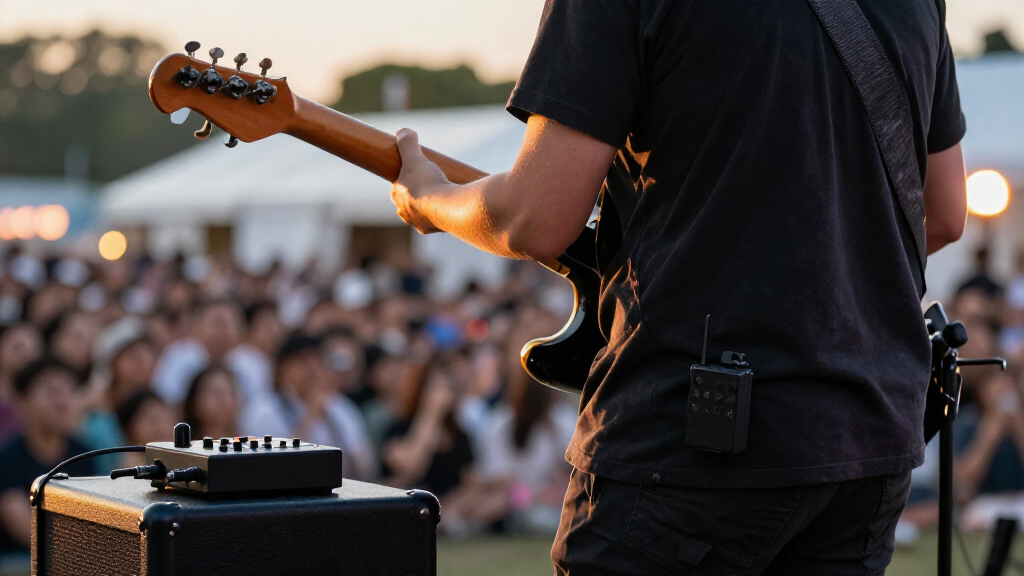
I ranked these wireless guitar systems for live performance by how well their complete setups fit a gig: dependable signal behavior, practical range for a stage, useful receiver controls, instrument compatibility, and a battery routine a player can manage between sets. I also weighed whether each design suits a pedalboard, a rack or amp-side receiver, or a compact direct-to-instrument setup. A feature only mattered when it answered a real stage need; a charging case, for example, helps with storage and power habits, but it does not make a system more suitable for a crowded venue by itself.
The order favors options with a stronger balance of live-stage control, flexibility, and credible system design, then separates out simpler, more specialized, or less documented choices. The Shure GLXD16+ ranks first for its stage-friendly pedal format and dual-band approach, while dedicated bodypack systems such as the Shure SLXD14+ appeal to players with different rig and monitoring needs. Compact plug-in models rank lower for players who need receiver controls or wearable transmitters, though they can be a better match for quick setups and lighter rigs. I treat product claims as features to compare, not guarantees of performance in every venue; local RF conditions, setup, and instrument fit still matter.
Factors to Consider When Choosing Wireless Guitar Systems For Live Performance
Before choosing a model, I’d match the system to the way you actually move and manage gear on stage. The right decision depends less on headline range claims than on receiver placement, venue conditions, battery habits, and how much control you want at your feet or on your belt.
Choose a receiver format that fits your stage routine
A pedal receiver makes sense when you want wireless status and control beside your tuner and effects, but it takes up board space and needs a reliable power plan. A separate receiver can be easier to place near an amp or rack, especially when the transmitter is a bodypack rather than a plug-in unit. Compact plug-in pairs cut down on cables and setup steps, though you may have fewer at-a-glance controls during a set. Think about where the receiver can sit with a clear path to your instrument, not only where it looks neat in a gear photo. A receiver hidden behind a metal rack or amp stack may perform differently from one placed in open view. I’d sketch the signal path and power connections before buying so the wireless unit doesn’t force a pedalboard redesign.
Match the frequency band to the places you play
Wireless systems in this roundup use different bands, including 2.4GHz and 5.8GHz, and neither is a universal answer for every room. Venue Wi-Fi, other wireless equipment, audience devices, and local regulations can affect how well a system operates. Ask venues or sound engineers about wireless coordination when playing on shared bills, festivals, or stages with several transmitters. A band that works smoothly in a rehearsal room may face more competition at a busy club. Avoid treating advertised range as a promise: walls, people, antenna placement, and interference can reduce usable coverage. If you play varied venues, favor a system and workflow that let you check signal conditions and test your position before the set.
Plan battery use around sets, not product claims
Battery life figures are useful only when they fit your full schedule: soundcheck, multiple sets, and time between shows. Work out whether the transmitter uses a rechargeable battery, replaceable cells, or a charging case, then decide what backup you’ll carry. A case can make charging and storage more orderly, but it still needs to be charged and brought along. For a long event, a transmitter that is easy to swap or recharge between sets may matter more than a smaller receiver. Build a habit of charging after every gig rather than waiting for a low-battery warning at the venue. I’d also check whether the receiver gives a clear battery indication, since an unexpected power loss is harder to manage mid-song.
Check the instrument connection and physical fit
Plug-in transmitters are convenient, but their shape and weight can matter on instruments with recessed jacks, crowded controls, or awkward strap clearance. A rotating connector can help with some guitar and bass layouts, but it does not guarantee a secure fit on every instrument. Bodypack systems avoid a transmitter hanging directly from the jack, at the cost of a cable, a belt clip, and another item to manage. Confirm whether the system suits active and passive pickups and whether its output level works with your instrument and amp chain. If you switch between guitar, bass, or other instruments, check connector needs before assuming one transmitter will cover them all. When possible, test the physical fit with your strap and cable-free playing posture.
Decide how much live control you need
A simple plug-in system can be a good match when you want to remove a cable and keep your setup quick. A receiver with visible status information or more hands-on controls is more useful when you need to monitor the link while moving around or coordinate equipment with a stage crew. More controls can also mean more setup decisions, so they are most valuable when you will actually use them. Players who share a rig or change instruments during a set should think about pairing, channel selection, and how quickly they can recover from a connection issue. Don’t pay attention to features only because they sound advanced; ask what you would do with them during soundcheck. A setup that is easy to understand under pressure can be a better live choice than a feature-heavy system you rarely adjust.
Budget for the whole wireless setup
The receiver and transmitter are only part of the cost in time and gear: power supplies, spare charging options, instrument cables, mounting space, and backup plans all affect gig readiness. A lower-complexity system may be a sensible value if it fits a stable, small-stage routine, while a more elaborate receiver can earn its place for frequent performers who need additional control. Avoid choosing solely by a claimed maximum range or a long feature list; neither tells you how the system behaves in your venue. Consider how many instruments you need to support and whether you need one link at a time or a broader professional setup. If wireless failure would disrupt a paid performance, keep a cable available as a fallback. The best value is the system that fits your workflow without adding unused complexity or recurring hassles.
Frequently Asked Questions
Is a 2.4GHz or 5.8GHz guitar system better for a busy venue?
Neither band wins in every venue, since local Wi-Fi and other wireless devices can affect conditions differently from room to room. A busy club may behave differently from a festival stage with coordinated RF equipment. Check what other systems are operating, then test your chosen unit from the positions you’ll use on stage. If you play many venues, prioritize a system whose setup lets you check the link and make a practical channel or placement decision. Keep a cable nearby for a set where interference cannot be resolved quickly.
Should I choose a plug-in transmitter or a bodypack system?
A plug-in transmitter is appealing when you want a minimal setup and your instrument jack can support its shape and weight without getting in the way. A bodypack keeps hardware off the guitar jack and can suit players who move vigorously, but it adds a cable, clip, and battery item to manage. Consider how many instruments you use, how their output jacks are positioned, and whether you need receiver controls during a set. If you switch instruments often, check how quickly the system can be moved or paired. The easiest system to live with is the one that fits your instrument and stage routine, not simply the smallest one.
Do I need a pedalboard receiver for live guitar?
No; a pedalboard receiver is useful when you want wireless operation integrated into a board and easy to check near your feet. Players with a compact rig or a separate amp-side receiver may prefer a smaller setup that takes less board space. A pedal format can simplify access to controls, but it also needs power and a place in the signal chain. Before choosing, account for your board’s available space, power supply capacity, and cable routing. If you rarely need to adjust or monitor the receiver during a set, a simpler receiver may be enough.
Can one wireless system work for both guitar and bass?
Many systems are marketed for both guitar and bass, but compatibility should not be assumed from the product category alone. Check the transmitter connection, instrument input handling, and any maker guidance for active pickups or unusually high output signals. Also consider physical jack fit, since basses and guitars can have different layouts. If you use multiple instruments in one performance, confirm how pairing and transmitter changes work before the gig. A system that supports both in its specifications still needs to fit your instruments and switching routine.
What should I do if the wireless signal drops during a performance?
Plan for a drop before it happens: keep a cable within reach and know how to reconnect or change the system’s settings without interrupting the whole set. At soundcheck, test from the farthest point you expect to play and with the receiver in its actual stage position. If the link falters, first move away from obvious obstacles or crowded equipment and check the receiver’s status indicators. Avoid making unfamiliar menu changes in the middle of a song. For festivals or multi-band bills, coordinate wireless use with the sound team and verify the setup again after stage changes.
Conclusion
For the broadest mix of live-stage practicality and receiver control, I’d choose the Shure GLXD16+ as my best overall pick. Players seeking a strong alternative with a more conventional dedicated receiver setup should compare the Shure GLXD14+, while the Shure SLXD14+ is the premium-style fit for performers who want a professional bodypack-and-receiver arrangement. For value and straightforward use, I’d look first at compact options such as the Xvive U2 or Fender Telepath, provided their form factor and band suit the venue. Beginners who want minimal setup can start with a simple plug-in pair; players who need a charging case can compare the JOYO JW-06 and Xvive AC58. If your needs center on a wearable transmitter, pedalboard integration, or busy-stage control, choose by that specific requirement rather than by compactness alone—and keep a cable as your live backup.
Black Friday Picks

Bose QuietComfort Headphones (2nd Gen), Wireless Over-Ear Noise-Cancelling Headphones, Black
As an affiliate, we earn on qualifying purchases.