
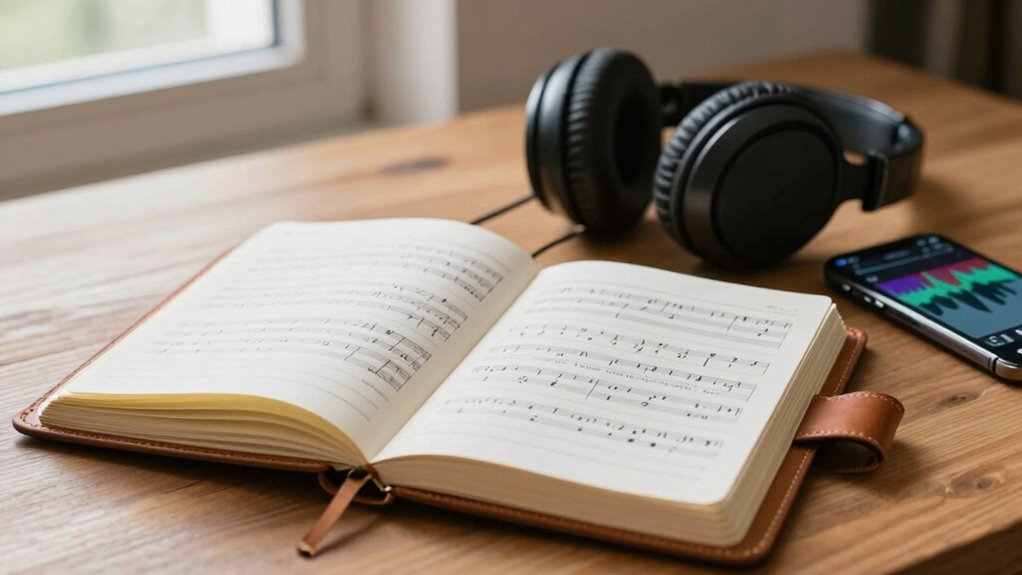

To build a listening journal that sharpens your ear, start by choosing a piece of music and actively listening, noting initial impressions and questions. Organize your entries with sections for genres, techniques, or emotions, and regularly review past notes to recognize patterns and progress. Focus on breaking down musical components like melody, harmony, and rhythm, and reflect on how they make you feel. Keep a consistent schedule; the more you engage, the more your listening skills will grow. Keep going, and you’ll find new depth in your musical understanding.

Get audio and creator gear delivered free with Prime
- Fast, free delivery on millions of items
- Prime Video, Amazon Music and more included
- Member-only deals all year
Key Takeaways
- Regularly document detailed observations and emotional responses to deepen musical understanding.
- Organize entries by genres, techniques, or artists to identify patterns and track progress over time.
- Analyze musical components (melody, harmony, rhythm) to sharpen your listening and analytical skills.
- Review past journal entries periodically to notice subtle improvements and evolving musical perception.
- Maintain consistent listening and journaling habits to reinforce learning and gradually enhance your ear.
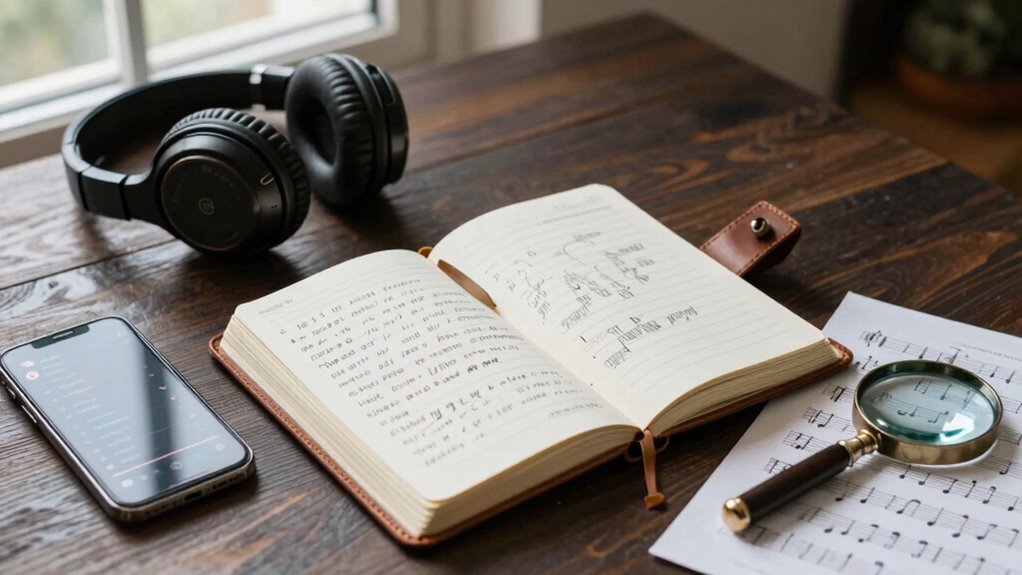
Creating a listening journal is a simple but powerful way to deepen your appreciation for music and improve your listening skills. When you start documenting your musical experiences, you engage in music analysis, which helps you develop a more nuanced understanding of different genres, techniques, and emotional expressions. To make the most of your journal, focus on journal organization. Structuring your entries logically allows you to track your growth and notice patterns over time.
Begin each session by choosing a piece of music and actively listening. As you listen, jot down initial impressions—what stands out, how it makes you feel, or any questions that arise. After the track ends, take time to analyze it more thoroughly. Break down elements like melody, harmony, rhythm, instrumentation, and lyrics if applicable. This kind of music analysis sharpens your ear and encourages you to think critically about what you’re hearing. Over time, you’ll start recognizing these components more instinctively, which is the goal of your listening practice. Incorporating free floating techniques can help you approach each listening session with an open mind and enhance your auditory sensitivity.
Start each listening session by actively engaging with the music and jotting down your immediate impressions.
To keep your journal organized, consider using sections or categories for different aspects of your listening. For example, dedicate pages to genres, artists, or specific techniques like syncopation or counterpoint. This organization makes it easier to revisit past entries and observe your evolving understanding. You might also include a section for personal reflections—how a song relates to your life, your emotional response, or any insights gained from analyzing its structure. These reflections deepen your engagement and make your journal a richer resource.
Consistency is key. Set aside regular times to listen and record, whether daily or weekly. As your collection grows, take time to review previous entries. This review process reinforces your music analysis skills, highlights your progress, and reveals areas where you’d like to improve. Over time, you’ll notice your ability to discern subtle differences in music quality and style, which indicates your ear is sharpening.
music journal notebook for musicians
As an affiliate, we earn on qualifying purchases.
As an affiliate, we earn on qualifying purchases.
Frequently Asked Questions
How Often Should I Update My Listening Journal?
You should update your listening journal after each session, ideally weekly, to track your evolving preferences across different music genres. Use varied journal formats like handwritten notes, digital logs, or audio recordings to keep it engaging. Regular updates help you notice patterns, refine your ear, and deepen your understanding of music. Consistency is key—make it a habit, and you’ll see your listening skills improve over time.
What Types of Music Should I Include?
Think of your listening journal as a garden; diversity helps it flourish. You should include a variety of genres—classical, jazz, indie, and world music—to expand your ear. Try mood tracking with each piece, like planting different seeds for your musical growth. I once explored unfamiliar genres, and it opened my ears to new nuances. This variety enhances your skills and keeps your listening experience fresh and engaging.
How Do I Track Subtle Sound Differences?
To track subtle sound differences, focus on sound detail during your listening sessions. Use your journal to note specific aspects like tone, pitch, and dynamics. Practice ear training exercises that challenge you to identify small variations, then record your observations consistently. Over time, this active tracking sharpens your ear, making it easier to notice nuances and improve your overall listening skills with each journal entry.
Can a Listening Journal Help With Musical Skills?
A listening journal can definitely boost your musical skills. Many assume it’s just about note-taking, but it enhances your music analysis and sound memory too. By consistently recording your observations, you train your ear to catch subtle differences and develop a deeper understanding of music. Over time, this practice sharpens your listening skills, helping you identify nuances in compositions and improvise more confidently. It’s a powerful tool for growth.
What Tools or Apps Are Best for Journaling?
You can use apps like Notion or Evernote for journaling, which let you include music notation and mood tracking easily. These tools help you organize your listening notes, add sketches, and record your emotional responses to music. For a more specialized approach, try music-specific apps like MuseScore for notation or Moodboard for mood tracking. They make it simple to reflect on your listening and improve your musical ear over time.
ear training and listening practice tools
As an affiliate, we earn on qualifying purchases.
As an affiliate, we earn on qualifying purchases.
Conclusion
By keeping a listening journal, you’re fundamentally training your ear like a muscle, sharpening your awareness with each entry. Think of it as tuning a musical instrument; the more you practice, the clearer and richer your perception becomes. Over time, you’ll notice subtle details in sounds you once overlooked. Just as a seasoned musician hears the faintest notes, your dedicated journaling transforms your listening into a finely tuned, instinctive skill—turning ordinary sounds into extraordinary experiences.
As an affiliate, we earn on qualifying purchases.
As an affiliate, we earn on qualifying purchases.
Halloween Picks
halloween
As an affiliate, we earn on qualifying purchases.




![Iron Maiden Legend Nicko McBrain Turned Down Trump Golf Invite: “[He] Should Be Put In Jail”](https://deadsetlive.com/wp-content/uploads/2026/10/iron-maiden-legend-nicko-mcbrain-turned-down-trump-golf-invite-he-should-be-put-featured-260x140.jpg)