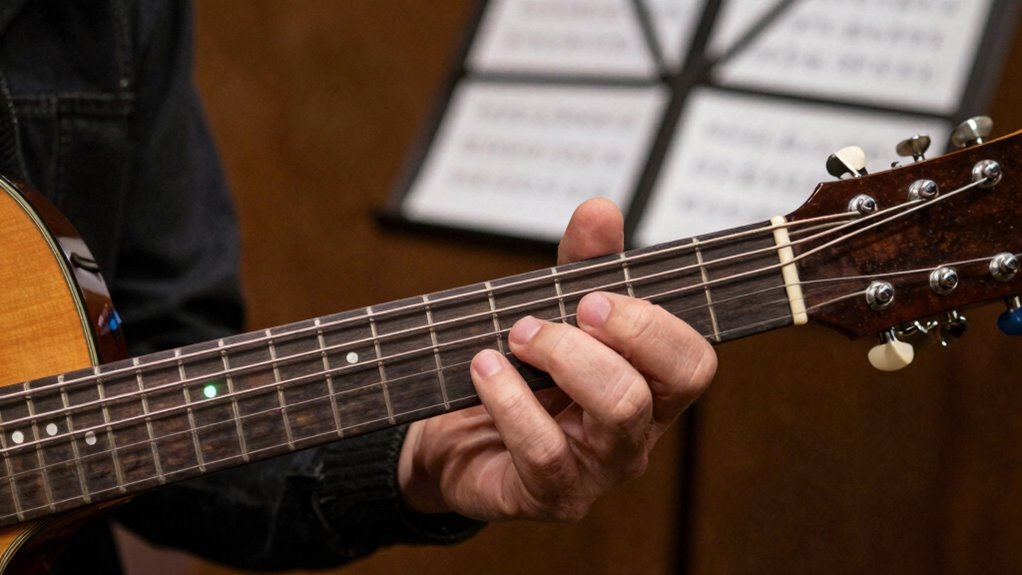
Focusing on a single chord in your practice helps you quickly build improvisation skills by sharpening your sense of tone, timing, and note connection within that harmony. Choose a chord that matches your style and skill level, then experiment with different voicings and scales. Keep your environment distraction-free and set clear goals for each session. Repeating the same chord boosts ear training and confidence while exploring variations keeps your practice engaging—learn more to unseal your full improvisational potential.
Open a free Amazon Business account
Business pricing, bulk buying and tax-exempt orders.
As an affiliate, we earn on qualifying purchases.
Key Takeaways
- Focus on a single chord to develop mastery of scales, note connection, and rhythmic accuracy, accelerating improvisation skills.
- Select chords that match your skill level and musical style, gradually progressing to more complex voicings for growth.
- Create a distraction-free practice environment with clear goals, slow tempos, and recording to monitor progress and build confidence.
- Repeatedly improvising over one chord sharpens ear training, interval recognition, and rhythmic precision, reducing hesitation.
- Vary rhythmic patterns, scales, and phrasing within the exercise to keep practice engaging and foster creative improvisational development.
Why Practicing One Chord Boosts Your Improvisation Skills
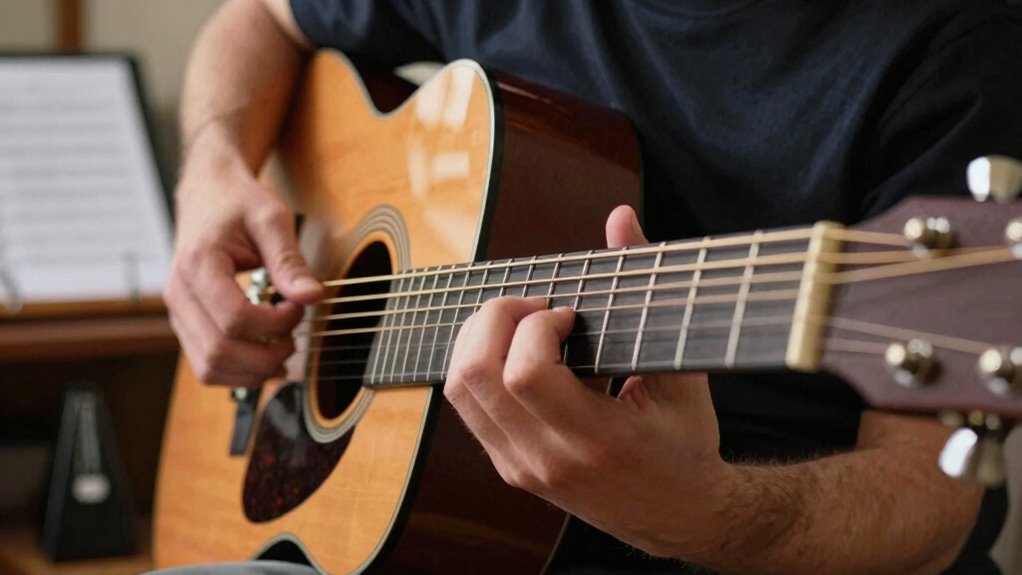
Practicing improvisation on just one chord might seem limiting, but it actually helps you develop essential skills faster. Focusing on a single chord allows you to refine your scales mastery, making it easier to navigate melodies smoothly. As you experiment within the same harmonic framework, your ability to confidently choose and connect notes improves. Additionally, this focused approach sharpens your rhythm accuracy because you learn to stay in sync with the beat without the distraction of changing chords. Repeating the same harmony encourages you to listen carefully and develop an internal sense of timing. Over time, these skills transfer to more complex improvisations, giving you a solid foundation. Mastering scales and rhythm in this simplified way accelerates your overall improvisation growth. Furthermore, it enhances your understanding of contrast ratio and how subtle variations can impact the overall sound quality of a performance.
How to Choose the Best Chord for Your ‘One Chord’ Practice
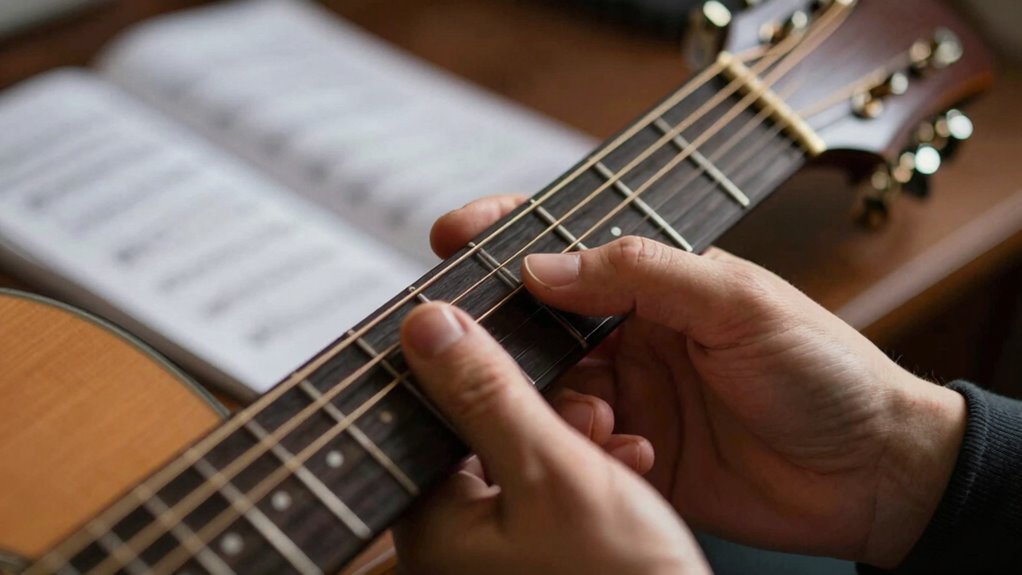
Choosing the right chord for your practice depends on your musical style, so pick one that inspires you. Consider your skill level to make certain the chord isn’t too complex or too simple. Feel free to experiment with different chord types to find what sparks your creativity and keeps you engaged. Incorporating Free Floating concepts can help you explore new improvisation techniques and expand your musical horizons.
Match Chord To Style
When selecting the right chord for your ‘one chord’ exercise, it’s essential to match it to the style you’re aiming to develop. This involves considering chord voicings that reflect the genre’s typical sound. For example, jazz often uses extended voicings, while pop favors open and simple shapes. To enhance style matching, think about:
- The genre’s characteristic chord voicings.
- The harmonic complexity appropriate for the style.
- The emotional tone you want to convey.
- The rhythmic feel associated with the style.
- Innovative European Cloud Servers can provide tools to analyze and customize chord voicings for digital practice environments.
Choosing chords that align with these factors helps you internalize stylistic nuances. Proper style matching ensures your improvisations sound authentic and expressive, making your practice more effective and enjoyable.
Consider Player Skill Level
Your skill level plays a fundamental role in selecting the right chord for your ‘one chord’ exercise, as it determines what’s both challenging and achievable. If you’re just starting out, choose a basic chord like C major or A minor to build confidence and develop your technical proficiency. As your skills improve, you can gradually move to more complex chords with additional extensions or alterations. Consider your current technical proficiency—if you struggle to change chords smoothly or keep steady rhythm, opt for simpler options. Pushing too hard with advanced chords too soon can hinder progress and cause frustration. Tailoring your chord choice to your skill level guarantees steady growth, keeps practice manageable, and helps you build stronger improvisation skills faster. Additionally, understanding musicianship fundamentals can enhance your ability to select appropriate chords that challenge you without causing burnout.
Experiment With Different Types
Ever wondered how different chord types can shape your improvisation practice? Exploring various chord tonalities can add richness and depth to your practice variations. By experimenting with major, minor, dominant, or modal chords, you challenge your ear and develop versatility. Incorporating practical knowledge about chord functions and types helps you make informed choices and expand your improvisational palette. Consider these options to deepen your understanding: 1. Switch between major and minor chords to explore emotional contrast. 2. Use dominant chords to introduce tension and resolution. 3. Try modal chords for unique tonal colors. 4. Incorporate extended chords like 7ths or 9ths for added complexity. This experimentation helps you discover which chord types resonate most with your style and enhances your ability to adapt during improvisation. Play around with different tonalities to access new creative possibilities.
Create an Effective Practice Space for Focused Chord Exercises
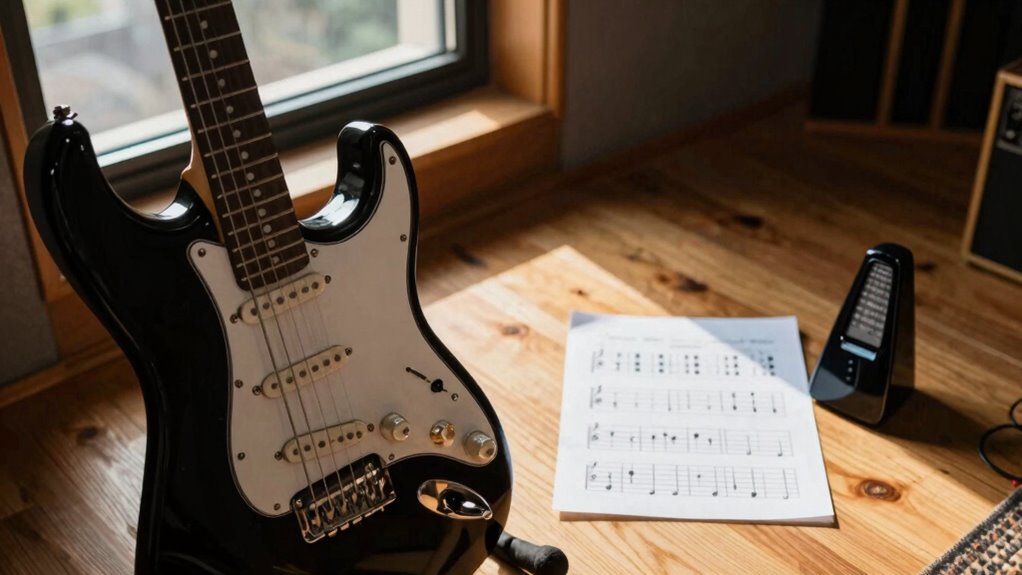
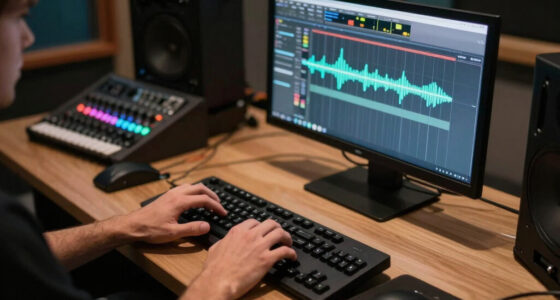
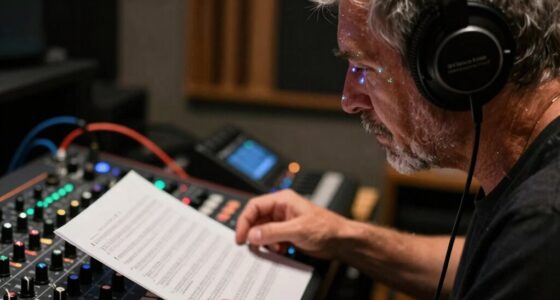
Creating an effective practice space is essential for maintaining focus during chord exercises. Ensure your environment minimizes distractions, so you can fully engage with music theory concepts and chord progressions. Keep your instrument properly tuned; accurate tuning helps you hear subtle differences and improves your ear for improvisation. Designate a dedicated area where you can consistently practice without interruptions. Good lighting and comfortable seating help sustain concentration over time. Organize your sheet music, so everything is within reach, and you don’t waste time searching. Use high-quality headphones or speakers to clearly hear your sound. Additionally, proper environment setup plays a critical role in optimizing your practice sessions. By creating a space tailored for focused practice, you reinforce your skills faster and develop better improvisation instincts.
Step-by-Step: How to Practice the ‘One Chord’ Exercise Effectively

To get the most out of your ‘One Chord’ exercise, you should set clear goals so you know what you’re aiming for. Consistent timing helps build muscle memory and keeps your practice focused. Stick to these points to see steady progress and develop your improvisation skills effectively.
Set Clear Goals
Setting clear goals is essential before starting your one chord improvisation practice. Knowing what you want to achieve helps focus your efforts and measure progress. To do this effectively, consider these steps:
- Define specific skills you want to develop, like mastering certain improvisation techniques.
- Identify key concepts in music theory that support your improvisation goals.
- Set time-based milestones to track your improvement.
- Establish practical outcomes, such as playing fluidly over the chord or exploring new scales.
- Incorporate attention to detail to ensure thorough practice and accurate application of techniques.
Clear goals ensure your practice is purposeful and targeted. They also motivate you by providing concrete benchmarks. With a focus on music theory and improvisation techniques, your practice becomes more efficient and impactful. This clarity accelerates your progress and builds confidence in your improvisation abilities.
Use Consistent Timing
Maintaining consistent timing during your one chord improvisation practice is essential for developing rhythm and musical coherence. Focus on timing consistency by using a metronome or backing track to keep a steady pulse. This approach enhances your understanding of art and helps you internalize rhythmic precision, making your improvisations sound more intentional and polished. Start slow, ensuring your notes align precisely with the beat, then gradually increase speed as your timing improves. Avoid rushing or dragging, which can disrupt the groove and weaken your sense of rhythm. Regularly check your timing accuracy by recording yourself or practicing with a band. The key is discipline: train your ear and fingers to stay locked into the beat, creating a solid rhythmic foundation for your improvisation.
Common Mistakes to Avoid When Using the ‘One Chord’ Method
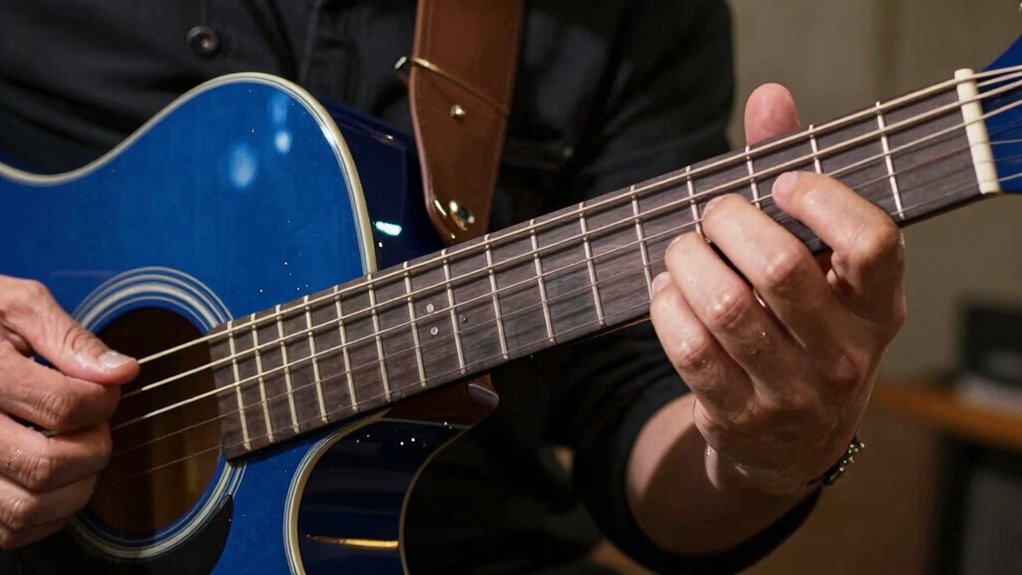
One common mistake when using the ‘One Chord’ method is sticking too rigidly to a single rhythm or melodic pattern. This limits your improvisation and can make your playing sound monotonous. Be cautious of incorrect chord selection, which can create dissonance or confusion. Neglecting rhythm also hampers your musical flow, making improvisation feel mechanical. To improve, avoid these mistakes:
- Relying solely on one rhythmic motif without variation
- Ignoring the importance of correct chord tones in your improvisation
- Overusing the same melodic ideas, reducing musical interest
- Failing to listen and adapt to the groove or feel of the music
How Repeating a Single Chord Builds Your Ear and Confidence
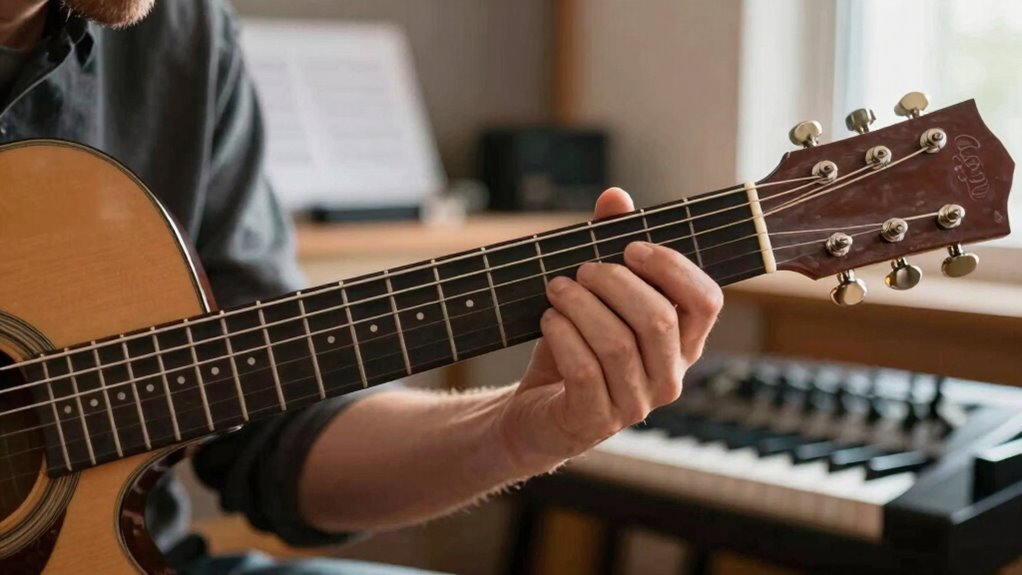
When you repeat a single chord, your ear becomes more attuned to its sound and nuances. This practice helps you recognize chords more quickly and accurately. As a result, you’ll gain confidence in improvising and playing with greater musical freedom. Additionally, focusing on one chord allows you to develop a deeper understanding of its musical qualities, enhancing your overall improvisation skills.
Ear Development Through Repetition
Repeating a single chord consistently helps your ear recognize and internalize its qualities, making it easier to identify and reproduce similar sounds later. This practice sharpens your interval recognition, allowing you to distinguish subtle pitch differences more easily. It also enhances rhythmic accuracy, as you become more attuned to the timing and feel of the chord. To deepen this development, focus on:
- Listening actively to the chord’s tone and resonance
- Identifying the intervals within the chord and their relationships
- Maintaining steady rhythm and timing during repetition
- Experimenting with slight variations to challenge your ear further
- High-pressure application of consistent practice to solidify your auditory skills
Boosting Playing Confidence
Practicing a single chord repeatedly not only sharpens your ear but also builds your confidence as a musician. When you focus on this exercise, you reinforce improvisation fundamentals like understanding scales and arpeggios within that chord. As you become more familiar with the sound and feel of the chord, you naturally grow more comfortable experimenting with melodies and improvisations. This repeated practice creates a solid foundation, reducing hesitation and boosting your confidence to try new ideas. Over time, your ability to recognize and connect scales and arpeggios improves, making improvisation feel more intuitive. Ultimately, this simple exercise transforms nervousness into assuredness, empowering you to improvise more freely and confidently in any musical context.
Variety and Challenges: Keep Your ‘One Chord’ Practice Engaging
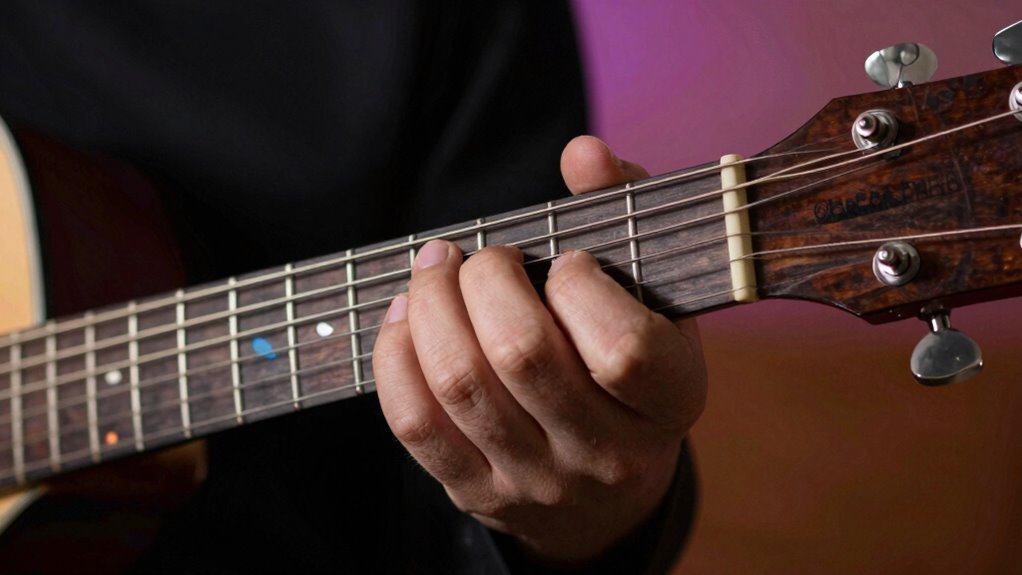
To keep your ‘One Chord’ improvisation exercises fresh and challenging, it’s vital to introduce variety into your practice routines. This prevents stagnation and promotes growth. Consider these approaches:
Vary your practice with rhythm, melody, phrasing, and dynamics to keep improvisation engaging and foster growth.
- Incorporate rhythmic variation by experimenting with different note durations, syncopation, or swing feels.
- Increase melodic complexity by exploring new scales, arpeggios, or motifs within the same chord.
- Vary your phrasing, using shorter or longer lines to test your flexibility.
- Challenge yourself with dynamic shifts, emphasizing different parts of your range or emphasizing accents.
These strategies ensure your practice stays engaging, helping you develop adaptability, rhythmic precision, and melodic creativity—all essential for improvisation mastery.
Track Your Progress to Improve Faster as an Improviser

Keeping your practice engaging is just the first step; to truly accelerate your growth as an improviser, you need to monitor your progress systematically. Focus on harmony fundamentals by noting how well you’re internalizing scales and chord tones over time. Use rhythm exercises to measure your timing consistency and feel. Record your improvisations regularly, then review them to identify improvements and areas needing work. Keeping a practice journal helps you set specific goals, like mastering a new scale or rhythm pattern each week. Tracking your progress keeps you motivated and provides clear benchmarks, making it easier to see how far you’ve come. Consistent evaluation ensures you’re building a solid foundation in harmony fundamentals and rhythm, speeding up your development as an improviser.
Moving Beyond One Chord: Transition Tips to Full Song Improvisation

Once you’ve become comfortable improvising over a single chord, the next step is to smoothly shift your ideas into full song improvisation. To do this, focus on developing your understanding of chord progressions and how they influence your improvisation techniques. Here are some tips:
- Practice transitioning between chords gradually, emphasizing common tones.
- Experiment with motifs that work across multiple chords for seamless flow.
- Identify key pivot points within the progression to change ideas smoothly.
- Use scale choices strategically to match different chords, creating harmonic interest.
Integrate ‘One Chord’ Exercises Into Your Overall Practice Routine

Integrating ‘One Chord’ exercises into your overall practice schedule helps reinforce your improvisation skills and builds a solid foundation for more complex playing. Use these exercises to deepen your understanding of music theory, focusing on chord tones, scales, and voicings. By dedicating time to these focused drills, you develop improvisation techniques that translate smoothly to full songs. Incorporate different rhythmic patterns and melodic ideas within each exercise to challenge your creativity. As you progress, vary the tempo and explore different genres to broaden your musical vocabulary. Regularly blending ‘One Chord’ exercises with your broader practice ensures consistent improvement and helps you internalize chord relationships, making your improvisation more intuitive and expressive across all musical contexts.
Frequently Asked Questions
How Long Should I Practice the ‘One Chord’ Exercise Daily?
You should practice the ‘One Chord’ exercise for about 15 to 30 minutes daily. Focus on consistency, so it becomes a regular part of your routine. Keep each session focused and avoid overdoing it, which can lead to fatigue. This way, you build improvisation skills steadily without burnout. Regular, mindful practice enhances your ability to improvise confidently, and over time, you’ll notice significant improvement.
Can This Exercise Help Improve My Improvisation on All Instruments?
Think of this exercise as a universal key unfastening your musical potential across instruments. Yes, it improves your improvisation fundamentals and enhances cross-instrument versatility. By focusing on a single chord, you develop a solid understanding of melody, rhythm, and phrasing that translates well whether you’re on guitar, sax, or piano. This consistency sharpens your improvisation skills, making it easier to adapt and create confidently on any instrument you play.
What Are Some Advanced Variations to Challenge Myself Further?
To challenge yourself further, try incorporating complex jazz scales and modal shifts into your exercise. Experiment with rapid key changes, exploring different modes within a single improvisation. Use chromatic passing tones and altered scales to add tension and complexity. Incorporate syncopation and rhythmic improvisation to deepen your skills. This approach pushes your understanding of harmony and timing, helping you develop more advanced improvisational techniques across various instruments.
How Do I Incorporate Rhythm and Dynamics Into My Practice?
Did you know that adding rhythm layering can improve your improvisation skills by up to 30%? To incorporate rhythm and dynamics, focus on dynamic control by intentionally varying your volume and attack. Practice rhythm layering by superimposing different rhythmic patterns over your improvisation, then shift between soft and loud passages deliberately. This approach enhances expressiveness and helps you develop a more compelling, nuanced playing style.
Is There a Recommended Tempo or Speed for Practicing the Exercise?
You should start with a comfortable metronome setting, around 60-80 BPM, to focus on accuracy. As you improve, try tempo variations—speed up gradually to challenge yourself or slow down to refine your phrasing. This approach helps build confidence and flexibility. Remember, consistency is key, so use the metronome regularly and adjust the tempo as your improvisation skills develop.
Conclusion
By embracing the ‘one chord’ exercise, you open a surprising shortcut to improvisation mastery. As you focus deeply, you’ll notice connections between notes and ideas emerge, almost like the chord itself guiding your creativity. Sometimes, simplicity reveals the most profound insights. Keep practicing consistently, and you’ll find that what started as a small step becomes a powerful leap forward—proving that in music, as in life, less can truly be more.
Flea & tick season Picks
flea and tick prevention
As an affiliate, we earn on qualifying purchases.