

To stay calm in a dense crowd, focus on controlling your breathing by taking deep, steady breaths and anchor your attention on a fixed point or familiar face around you. Maintain your personal space by visualizing an invisible bubble and adjusting your position if needed. Recognize crowd patterns and collective movements to anticipate shifts and avoid panic. Trust in your ability to adapt and stay grounded—continuing ahead will reveal even more strategies to keep you safe and composed.

Get audio and creator gear delivered free with Prime
- Fast, free delivery on millions of items
- Prime Video, Amazon Music and more included
- Member-only deals all year
Key Takeaways
- Practice deep, steady breathing to maintain calm and counteract anxiety.
- Focus on a fixed point or familiar face to stay grounded and reduce overwhelm.
- Maintain a mental boundary around yourself to preserve personal space and control feelings of claustrophobia.
- Observe crowd behavior patterns to anticipate movements and reduce surprise-induced panic.
- Use visualization techniques, like imagining an invisible bubble, to create a sense of safety and autonomy.
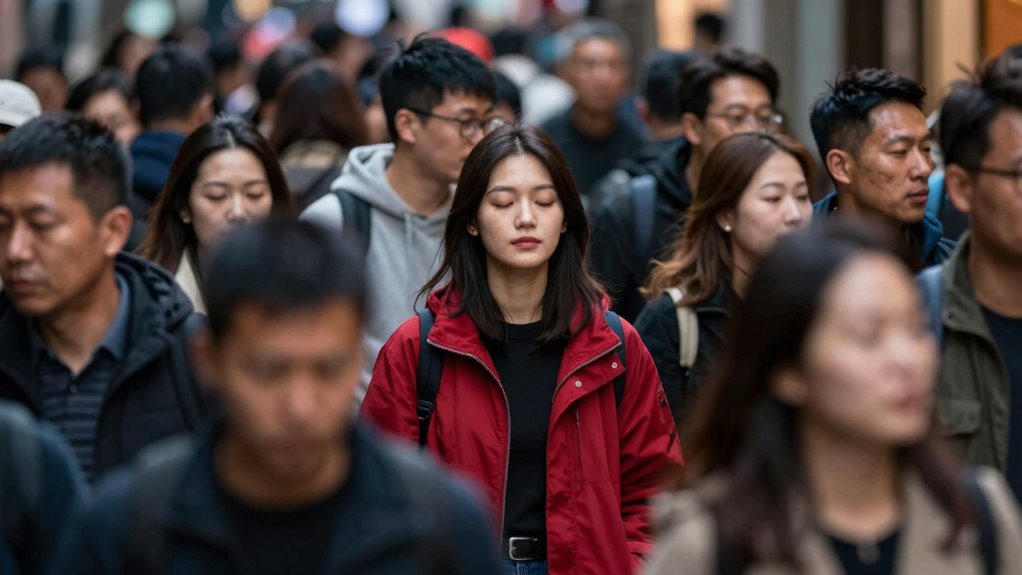
Ever found yourself overwhelmed by a dense crowd and wondered how to stay calm? It’s a common feeling, and understanding how crowd psychology works can help you manage your reactions. When you’re in a packed environment, your mind might instinctively perceive the situation as threatening, triggering anxiety or panic. Recognizing that crowd behavior follows certain patterns can ground you and reduce your fear. People tend to follow social cues and collective movements, which can be predictable once you observe the flow. Knowing this allows you to feel more in control, rather than overwhelmed.
Understanding crowd patterns helps you stay calm and regain control in dense environments.
One effective way to maintain your composure is through personal space management. Even in a crowded setting, you can create a mental boundary around yourself. Focus on maintaining a comfortable distance from others, which helps reduce feelings of claustrophobia and prevents you from feeling trapped. If you find yourself getting too close to others, subtly adjusting your position or stepping back can help regain a sense of autonomy. Visualize an invisible bubble around you—this mental image can serve as a reminder to preserve your personal space and avoid unnecessary contact or discomfort. This simple technique offers a quick way to feel more grounded and less overwhelmed by the surrounding chaos. Additionally, understanding crowd psychology can help you anticipate and adapt to collective movements more effectively. Recognizing the typical collective behavior in crowds can empower you to stay calm and respond appropriately. Being aware of group dynamics can further enhance your ability to predict and navigate crowd patterns smoothly. Developing this awareness can also improve your confidence in handling crowded situations, making you less likely to feel anxious. Moreover, cultivating awareness of behavioral cues within the crowd can help you identify signs of agitation or distress early, allowing you to adjust your actions accordingly.
In addition, controlling your breathing plays a pivotal role in staying calm. Deep, steady breaths can counteract the hyperventilation that sometimes accompanies panic. When you notice your heart racing or your thoughts spiraling, pause and take slow breaths—in through your nose for a count of four, then out through your mouth for a count of four. This not only calms your nervous system but also helps you stay focused and alert rather than succumbing to fear. Combining this with your awareness of crowd psychology and personal space management gives you a toolkit to navigate dense crowds more confidently.
Lastly, keep your attention on your immediate surroundings rather than the entire crowd. By focusing on a specific, stable point—like a fixed object or a familiar face—you anchor yourself and reduce feelings of being overwhelmed. Staying present helps prevent your mind from spiraling into worst-case scenarios. Remember, most crowds are temporary and follow predictable patterns. Trust in your ability to adapt, and use your knowledge of crowd psychology and personal space management to stay calm. With practice, you’ll find it easier to move through dense crowds without panicking, maintaining your composure and safety at all times.
As an affiliate, we earn on qualifying purchases.
Frequently Asked Questions
How Can I Identify Safe Exit Points Quickly?
To identify safe exit points quickly, stay alert to emergency signals like alarms or announcements. Keep your personal space awareness sharp; notice clear pathways and less crowded areas. Scan the perimeter and avoid bottlenecks or blocked exits. Trust your instincts—if a route looks less congested, move toward it calmly. Being aware of emergency signals and paying attention to your surroundings helps you find safe exits efficiently and stay calm during the chaos.
What Should I Do if Someone Nearby Is Panicking?
Imagine a ripple spreading outward in a pond—you see someone nearby panic, and it’s natural to feel overwhelmed. Use panic management by softly speaking to them, offering reassurance, and maintaining steady eye contact. Apply calming strategies like deep breathing and gentle gestures to help them regain control. Your calm presence can stabilize the situation, guiding both of you toward safety and easing their distress amid the crowd.
Are There Specific Breathing Techniques for Crowd Anxiety?
Yes, there are specific breathing techniques for crowd anxiety. Try deep breathing exercises like inhaling slowly through your nose for four seconds, holding for four seconds, then exhaling through your mouth for four seconds. Combine this with mindfulness techniques—focusing on your breath or surroundings—to anchor yourself. These methods help reduce panic, promote calmness, and keep you centered even in a dense crowd.
How Can I Communicate Effectively in a Noisy Crowd?
You can communicate effectively in a noisy crowd by using clear hand signals and simple verbal cues. Coincidentally, these methods draw attention without shouting, helping you stay calm. Keep your gestures deliberate and consistent, and use easy-to-understand words when speaking. By combining visual cues with brief verbal prompts, you can guarantee your message gets across even amid the chaos, making interactions smoother and reducing stress.
What Are Signs of Crowd Crush Danger I Should Watch For?
Watch for signs like people visibly struggling to breathe, sudden shifts in crowd movement, or individuals appearing disoriented—these are cues from crowd psychology indicating danger. Stay alert to your personal space awareness; if you feel squeezed or trapped, move slowly and calmly to less crowded areas. Recognizing these signs early helps you avoid crowd crush situations, ensuring your safety and that of others around you.
As an affiliate, we earn on qualifying purchases.
Conclusion
Imagine you’re caught in a bustling festival, the crowd pressing in like waves of a stormy sea. Remember, just like a seasoned sailor stays steady amidst turbulent waters, you can stay calm by focusing on your breath and grounding yourself. Studies show that controlled breathing reduces anxiety. So, next time you’re in a dense crowd, breathe deeply and stay anchored—because even in chaos, your calm can be your strongest anchor.
As an affiliate, we earn on qualifying purchases.
As an affiliate, we earn on qualifying purchases.
Halloween Picks
halloween
As an affiliate, we earn on qualifying purchases.