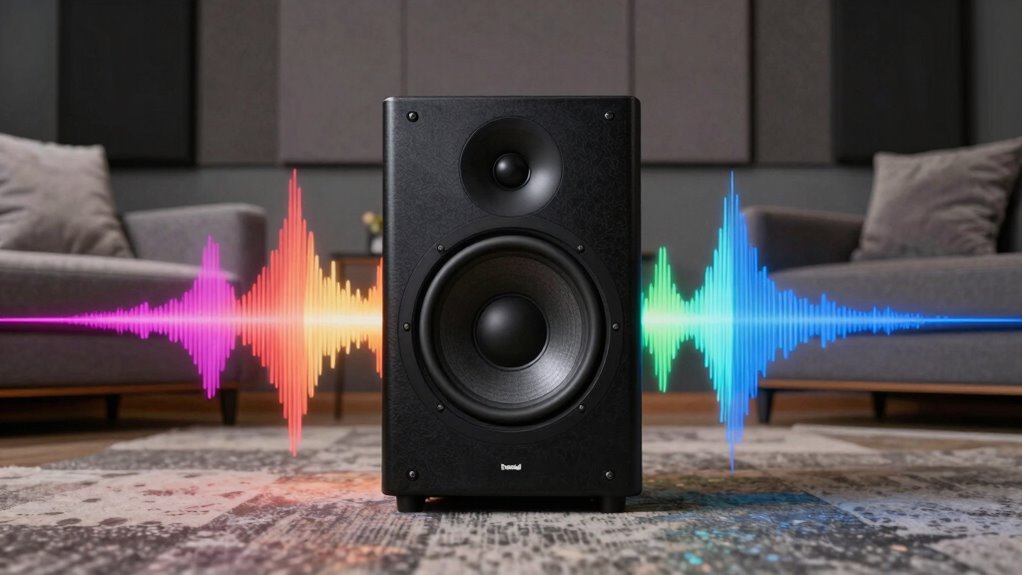
A studio subwoofer can enhance your sound by delivering deep, powerful bass that fills small or well-treated rooms, adding clarity and depth. However, if you place it poorly or your room is large or irregular, it can cause boomy sounds, resonances, or uneven bass, hurting your overall sound quality. Proper placement, room acoustics, and calibration are key to making it work effectively. Stick with us to learn how to optimize your setup and avoid common issues.
Key Takeaways
- Proper placement enhances bass response in small/medium rooms, but incorrect positioning can cause resonances or uneven sound.
- Room size and acoustics determine if a subwoofer will improve clarity or create muddiness.
- Multiple subwoofers may be needed in large or irregular rooms to achieve balanced bass.
- Overly powerful subwoofers in small spaces can overwhelm and distort sound quality.
- Understanding room acoustics helps optimize subwoofer use, preventing negative effects like dead spots or boomy bass.
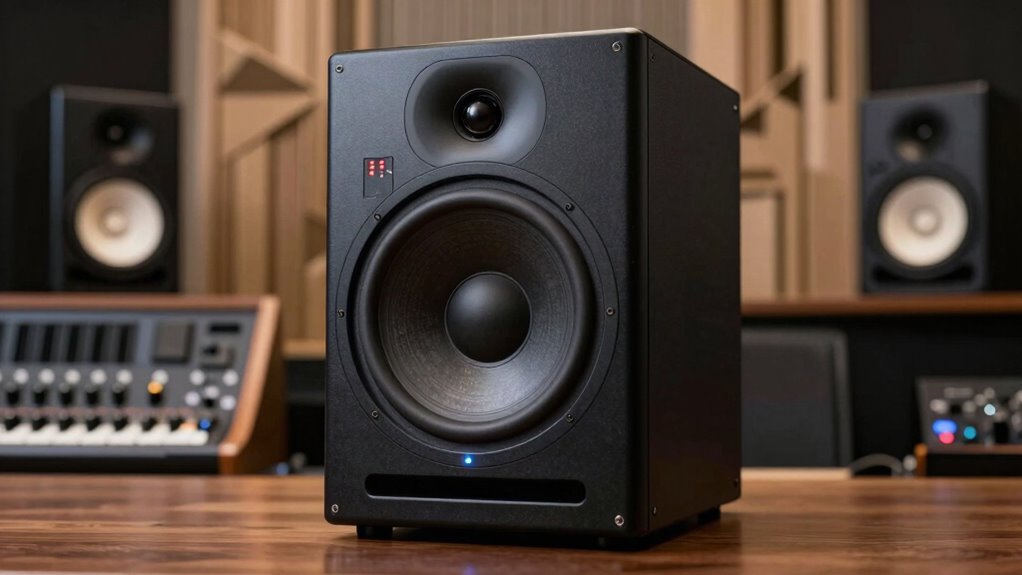
Studio subwoofers can substantially enhance your audio setup by delivering deep, powerful bass that brings your sound to life. However, whether they improve your listening experience depends heavily on your room size and how you position the subwoofer. If your room is small or medium-sized, a subwoofer can fill the space with rich bass, making your music or mixes sound more balanced and immersive. In these spaces, the subwoofer’s low-frequency response can add clarity and depth that might be missing from smaller speakers alone. Proper subwoofer placement is vital here; placing it near walls or corners can amplify bass response, helping it fill the room evenly and avoiding dead spots. Experimenting with placement might take some effort, but it guarantees you get the best possible sound, preventing issues like boomy or uneven bass. Additionally, understanding room acoustics**** can help you optimize your setup for the best sound quality. Recognizing how room size influences sound can guide your choices in subwoofer specifications and placement.
Furthermore, the frequency response of your subwoofer should match your room’s acoustics to avoid overpowering or underwhelming bass, which is especially important in spaces with challenging shapes or materials. Conversely, if your room is very large or has an irregular shape, a single subwoofer might not work as well. In larger spaces, bass waves can become uneven, resulting in some areas feeling overly boomy while others lack bass altogether. This is where a studio subwoofer can either help or hinder your setup. If you position the sub correctly—ideally along a wall or in a corner—you can boost the low-end response. But if you place it poorly, such as in the middle of a large room, it could create unwanted resonances or dead spots, making your audio less accurate. Additionally, in very large rooms, a single subwoofer might struggle to produce enough bass, requiring multiple units or more advanced calibration to achieve a smooth, balanced sound.
Your room’s size influences not just how much bass you get but also how easily the subwoofer interacts with your space. Smaller rooms tend to amplify bass naturally, so a powerful subwoofer can sometimes be too much, leading to muddiness. Larger rooms need more careful placement and possibly multiple subwoofers to evenly distribute low frequencies. The key is understanding your room’s acoustics and experimenting with placement to find the sweet spot. When done right, a studio subwoofer can provide a deep, controlled bass that enhances your sound without overwhelming it. But if you ignore these factors, you risk creating a chaotic sound environment that diminishes the clarity and precision you’re aiming for.
studio subwoofer for small room
As an affiliate, we earn on qualifying purchases.
As an affiliate, we earn on qualifying purchases.
Frequently Asked Questions
How Do I Determine if My Room Needs a Subwoofer?
You can determine if your room needs a subwoofer by evaluating its sound balance. If your speakers lack deep bass or sound muddy, a subwoofer might help. Use room dampening techniques to reduce unwanted reflections, then calibrate your speakers properly. If you still notice a bass deficit, adding a subwoofer will enhance low-end clarity. Proper calibration ensures the sub integrates smoothly, providing richer, more accurate sound.
Can a Subwoofer Improve Overall Room Acoustics?
A subwoofer can improve your overall room acoustics if you calibrate it properly and add acoustic treatment. Proper subwoofer calibration guarantees balanced bass response, avoiding muddiness or boomy sounds. Acoustic treatment helps manage reflections and dampen standing waves, creating a clearer sound environment. When combined, these steps optimize your room’s acoustics, making your listening experience more accurate and enjoyable, regardless of your space’s size or shape.
What Are the Signs That a Subwoofer Is Hurting My Sound?
You’ll notice your sound suffers if your subwoofer’s placement causes boomy or muddy bass, or if it creates uneven frequency response. Poor placement can lead to standing waves, hurting clarity. Acoustic treatment helps tame these issues, but if you see inconsistent bass levels or feel overwhelmed by low frequencies, your subwoofer might be doing more harm than good. Adjust its position and add treatments to improve your overall sound.
How Does Room Size Affect Subwoofer Performance?
Room size considerably impacts your subwoofer’s performance. In small rooms, room resonance can cause exaggerated bass, making calibration tricky. Larger rooms may absorb low frequencies, requiring more powerful subwoofers or strategic placement. Proper speaker calibration helps balance sound, but if your room is too reflective or resonant, the subwoofer’s output can become muddy or uneven. Adjusting placement and using acoustic treatments can improve performance regardless of room size.
Are There Best Practices for Placing a Studio Subwoofer?
You might think placement doesn’t matter, but it does. Start by experimenting with subwoofer calibration—move it around the room, listening for smooth, even bass. Place it near walls or corners to enhance low frequencies, but avoid placing it directly against walls to prevent boomy sound. Incorporate acoustic treatment to minimize reflections, and regularly check your positioning to optimize performance and achieve a balanced, accurate sound.
best subwoofer placement for home studio
As an affiliate, we earn on qualifying purchases.
As an affiliate, we earn on qualifying purchases.
Conclusion
A studio subwoofer can transform your listening experience—if your room’s setup supports it. It adds depth and clarity, making your mixes more accurate. But if your space isn’t ideal, it might cause more harm than good by muddling your sound. Are you ready to explore whether a subwoofer will truly elevate your studio? Remember, understanding your room’s acoustics is key to making the most of this powerful addition.
multiple subwoofers for large room
As an affiliate, we earn on qualifying purchases.
As an affiliate, we earn on qualifying purchases.
room acoustics treatment for subwoofer
As an affiliate, we earn on qualifying purchases.
As an affiliate, we earn on qualifying purchases.