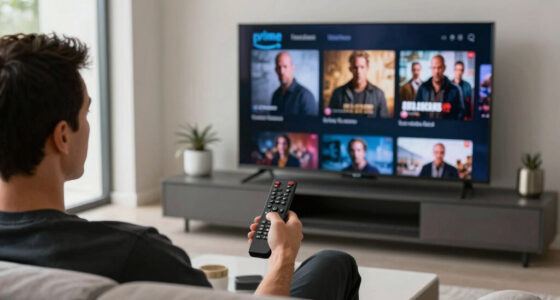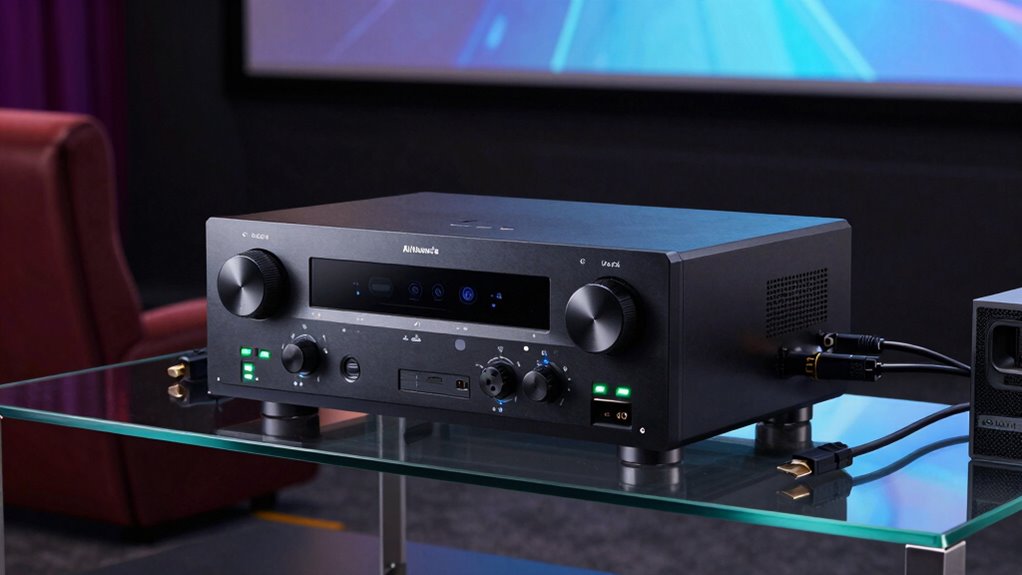

An AV receiver is the heart of your home theater, connecting your speakers and managing audio and video signals for a seamless experience. As a music fan, you’ll want one with HDMI 2.1 support for 4K, 8K, and immersive formats like Dolby Atmos. It also personalizes sound with calibration features to suit your room. Keep exploring, and you’ll discover how to choose the right model to elevate your audio and visual enjoyment.

Get audio and creator gear delivered free with Prime
- Fast, free delivery on millions of items
- Prime Video, Amazon Music and more included
- Member-only deals all year
Key Takeaways
- Choose an AV receiver with high-quality audio processing and support for music formats like Dolby Atmos and DTS:X.
- Ensure the receiver has ample HDMI inputs for connecting multiple sources and supports HDMI 2.1 for future compatibility.
- Use the built-in speaker calibration feature to optimize sound for your room acoustics and speaker placement.
- Opt for a receiver with Wi-Fi and Bluetooth for seamless streaming of your favorite music services and devices.
- Prioritize user-friendly setup and calibration options to quickly create an immersive, balanced audio environment.

Are you ready to elevate your home theater experience? When you’re building a setup that’s perfect for music lovers, understanding the basics of an AV receiver becomes vital. This device acts as the heart of your system, connecting and powering your speakers while managing audio and video signals. To get the most out of your setup, focus on features like speaker calibration and HDMI compatibility. Speaker calibration ensures your sound is balanced and tailored to your room, providing clear, immersive audio no matter where you’re seated. Most AV receivers come with automatic calibration tools—simply run the calibration process, and the receiver will analyze speaker levels, distances, and room acoustics. This step makes a noticeable difference in sound quality, especially if you’re mixing and matching different speakers or trying to optimize for a challenging space. Additionally, ensuring your AV receiver supports latest HDMI standards is crucial for future-proofing your setup, especially as video and audio technology continue to evolve.
Speaker calibration personalizes sound for your room, ensuring clear, immersive audio from every seat.
HDMI compatibility is equally vital, especially for a modern home theater. Your AV receiver should support the latest HDMI standards, like HDMI 2.1, to handle high-resolution video and high-bandwidth audio formats. This compatibility guarantees seamless transmission of 4K or even 8K content, along with features like HDR and Dolby Vision, which greatly enhance your viewing experience. Plus, HDMI ports with ARC (Audio Return Channel) or eARC (Enhanced Audio Return Channel) simplify connectivity by allowing audio to travel back from your TV to the receiver. This setup reduces clutter and makes controlling your system more straightforward, especially when you’re switching between streaming devices, gaming consoles, or Blu-ray players. A robust connection setup can also improve overall system stability and ease of use.
When choosing an AV receiver, check that it supports the number and types of connections you need. For music fans, it’s often beneficial to have multiple HDMI inputs and outputs, along with dedicated audio outputs for your hi-fi equipment. A receiver with built-in Wi-Fi and Bluetooth also allows easy streaming from your favorite apps and devices, giving you flexibility and convenience. Keep in mind that the receiver’s user interface and setup process matter, too—look for models that offer straightforward calibration and configuration options.
Ultimately, your goal is to create a balanced, immersive environment where music sounds rich and vibrant, and video quality is crisp and vibrant. By prioritizing speaker calibration and guaranteeing your AV receiver offers HDMI compatibility with the latest standards, you’re setting yourself up for a seamless, high-performance home theater that will delight your ears and eyes alike.
AV receiver with HDMI 2.1 support
As an affiliate, we earn on qualifying purchases.
As an affiliate, we earn on qualifying purchases.
Frequently Asked Questions
Can I Use a Home Theater AV Receiver for Stereo Music Only?
Yes, you can use a home theater AV receiver for stereo music only. It handles speaker placement well and adapts to room acoustics, providing excellent sound quality. Just make certain you configure the settings for stereo mode, optimize speaker placement, and adjust room acoustics to enhance your listening experience. This way, you get high-quality audio without the need for a dedicated stereo receiver, making your setup versatile and efficient.
How Many Speakers Can a Typical AV Receiver Support?
Think of your AV receiver as a conductor of an orchestra, effortlessly managing multiple players. Most typical receivers support 5.1 or 7.1 speaker configurations, but some can handle up to 11.2 channels. To make this work harmoniously, you’ll want to use speaker calibration and consider room acoustics. Proper calibration ensures balanced sound, while understanding room acoustics helps you position speakers for best audio performance.
What Is the Difference Between 4K and 8K AV Receivers?
A 4K AV receiver supports video resolution up to 4,000 pixels, while an 8K receiver handles up to 8,000 pixels, offering sharper images. The key difference lies in video scaling and HDMI standards; 8K receivers typically support the latest HDMI standards like HDMI 2.1, enabling higher bandwidth for better video quality and features. If you’re upgrading, an 8K receiver future-proofs your setup for upcoming content.
Do AV Receivers Require Special Wiring for Music Setup?
No, AV receivers don’t require special wiring for a music setup, but using high-quality speaker cables can improve sound. Make sure your wiring supports your receiver’s power output and allows proper speaker calibration. Proper wiring helps optimize speaker performance, especially for balanced audio and clarity. Focus on matching cable gauge to your system’s power needs, and run clear, secure connections to maximize sound quality without needing unique wiring configurations.
Can I Upgrade My AV Receiver Later Without Replacing All Components?
Yes, you can upgrade your AV receiver later without replacing all components. Modern receivers support advanced features like receiver calibration and enhanced audio decoding, making upgrades smoother. When upgrading, guarantee your new receiver is compatible with existing speakers and components. This way, you can enjoy improved sound quality and features without the hassle of changing your entire setup, and you’ll benefit from better calibration and decoding capabilities for a richer listening experience.
home theater AV receiver with Dolby Atmos
As an affiliate, we earn on qualifying purchases.
As an affiliate, we earn on qualifying purchases.
Conclusion
Think of your AV receiver as the captain of your home theater ship, steering your audio and video through a vast sea of entertainment. With the right receiver guiding your voyage, every song feels like a lively port, and every movie is an epic adventure. When you choose wisely, you’re not just building a system—you’re setting sail on a journey where music and films become your trusted crew, ready to bring your entertainment to life.
AV receiver with speaker calibration
As an affiliate, we earn on qualifying purchases.
As an affiliate, we earn on qualifying purchases.
wireless streaming AV receiver Bluetooth Wi-Fi
As an affiliate, we earn on qualifying purchases.
As an affiliate, we earn on qualifying purchases.
Halloween Picks
halloween
As an affiliate, we earn on qualifying purchases.