
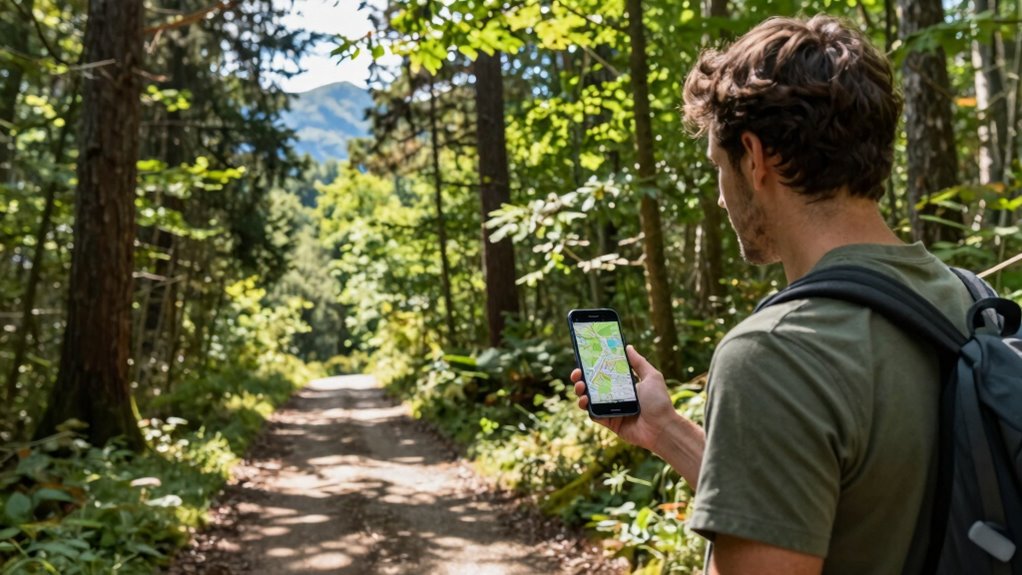

To use offline maps when you lose signal on your way to a show, make certain you downloaded the correct area beforehand and have enough storage. Open your offline map app and check if the map is accessible. Use visual cues like landmarks, street signs, and compass directions to confirm your location. If GPS acts up, move to open areas and restart your device. Stay aware of your surroundings—these tips will help you navigate confidently even if your signal drops.

Get audio and creator gear delivered free with Prime
- Fast, free delivery on millions of items
- Prime Video, Amazon Music and more included
- Member-only deals all year
Key Takeaways
- Ensure offline maps are downloaded and accessible before your trip to avoid signal dependency.
- Use visual landmarks and street signs on your offline map to verify your location.
- Move to open areas to improve GPS signal and enhance location accuracy.
- Restart your device or toggle location services if GPS accuracy worsens.
- Switch to alternative offline map apps if your current app experiences issues.

When your phone loses signal, exploring unfamiliar areas can become challenging. Without a reliable connection, relying solely on real-time GPS can leave you feeling stranded or lost. That’s why it’s essential to prepare in advance by understanding how to use offline maps effectively. Before heading out, verify your device has downloaded the necessary maps for the area you’re visiting. Many map apps, like Google Maps and Apple Maps, allow you to save offline regions, so you can access them without an internet connection. This way, even if your signal drops, you’ll still have a detailed map at your fingertips, guiding you to your destination.
Download offline maps before your trip to stay oriented without signal.
If you encounter GPS troubleshooting issues—like incorrect positioning or lag—you should first check your device’s settings. Sometimes, toggling location services off and on again can resolve minor glitches. Also, confirm your device has enough storage space for offline maps, and keep your app updated to the latest version. If one map app isn’t working properly, consider map app alternatives. Apps like HERE WeGo, Maps.me, or OsmAnd are excellent options, offering extensive offline capabilities and detailed maps. Download these apps and the relevant maps before your trip, so you’re not caught off guard when the signal drops.
When orienting with offline maps, pay attention to visual cues like street names, landmarks, and compass directions. These details can help you verify your position, especially if GPS accuracy seems off. Remember that GPS troubleshooting can sometimes involve recalibrating your device’s location sensor—moving in open areas, away from tall buildings or dense trees, can improve signal reception. If your device’s GPS continues acting up, restarting it or resetting network settings may help restore proper functionality. Additionally, understanding how Fact-checking & media literacy can assist you in verifying map data ensures you’re relying on accurate information while navigating offline. Keep in mind that offline maps aren’t perfect—they may not have real-time traffic data or updated information, but they’ll get you through the basics. Familiarize yourself with the map’s layout, and keep a sense of your surroundings by noting landmarks or street signs to stay oriented.
Frequently Asked Questions
Can I Update Offline Maps Without an Internet Connection?
You can’t update offline maps without an internet connection because map data sources need online access for updates. To keep your maps current, check update intervals before heading out, and download the latest versions when you have Wi-Fi. Once updated, your offline maps stay accurate, helping you navigate even if you lose signal. Always verify you’re using the latest data before your trip for the best experience.
How Much Storage Space Do Offline Maps Typically Require?
Offline map sizes vary depending on the area you download, but typically, map storage requirements range from a few megabytes for small regions to hundreds of megabytes or even gigabytes for larger areas. You should check your device’s available storage before downloading offline maps, as larger offline map sizes can quickly fill up your space. To avoid issues, plan your downloads based on your trip’s scope and your device’s storage capacity.
Are Offline Maps Available for All Countries and Regions?
Offline maps are available for most countries and regions, but map download options can vary depending on the app. You’ll want to verify if your chosen map app covers your destination before you travel. Keep in mind, map accuracy might differ in remote areas or less mapped regions. To guarantee smooth navigation, download the maps you need in advance, so you have reliable info even without a signal.
How Do Offline Maps Handle Real-Time Traffic Updates?
Think of offline maps like a compass in a dense forest—they guide you but don’t show real-time traffic changes. When you lose signal, offline maps rely on pre-downloaded map updates, so they don’t provide real-time traffic info. To stay current, you’ll need an internet connection for live map updates, but once offline, you follow the saved routes without real-time traffic data. It’s like steering with a fixed map instead of a live GPS.
Can I Switch Between Multiple Offline Maps Easily?
Yes, you can switch between multiple offline maps easily. During the map download process, you select and save different areas for offline use, which simplifies offline map management. To switch, open your navigation app, go to the offline maps section, and select the map you need. This allows seamless navigation without signal, ensuring you stay on track even if you change routes or locations unexpectedly.
Conclusion
Now that you know how to access offline maps, you’re like a navigator with a secret weapon—ready to conquer any lost signal. Remember, these maps are your compass in the wilderness of connectivity issues, guiding you safely to your destination. Keep them updated and stored on your device, so you’re never left stranded. With offline maps in your pocket, you hold the power to turn a potential detour into a smooth journey—your adventure, uninterrupted.
Halloween Picks
halloween
As an affiliate, we earn on qualifying purchases.







![Iron Maiden Legend Nicko McBrain Turned Down Trump Golf Invite: “[He] Should Be Put In Jail”](https://deadsetlive.com/wp-content/uploads/2026/10/iron-maiden-legend-nicko-mcbrain-turned-down-trump-golf-invite-he-should-be-put-featured-260x140.jpg)