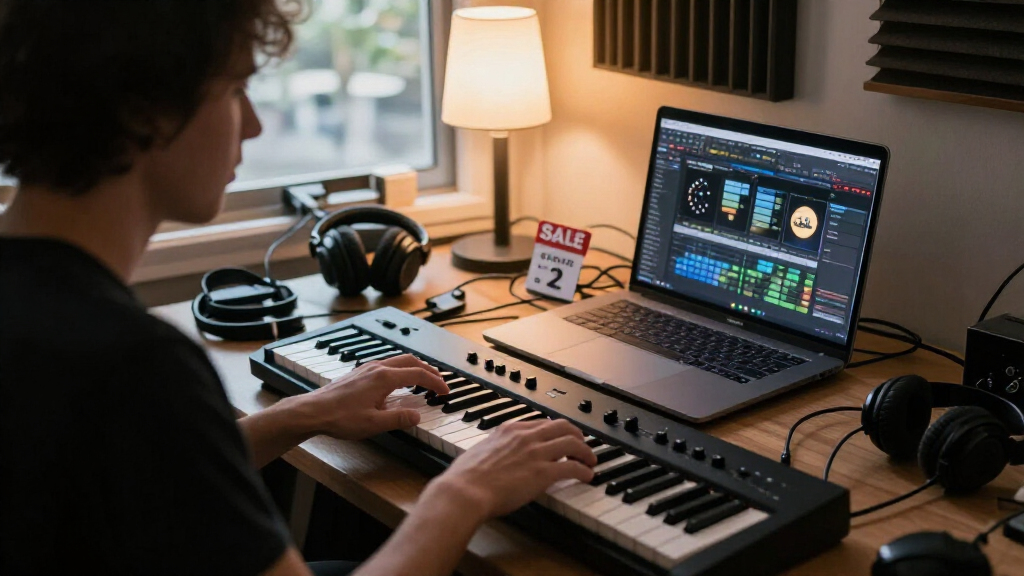
Black Friday MIDI keyboard controllers span compact travel boards, versatile 37-key options, and full-size controllers for studio work. My best overall pick is the Novation Launchkey 61 MK4, which balances a generous key range with hands-on control for production. For compact setups, the Arturia MiniLab 3 offers useful controls in a small footprint, while the Arturia KeyLab Mk3 61 is the premium choice for players who want a more advanced instrument interface. The main tradeoff is between portability and playing range, with software integration and standalone features also shaping the decision. Read on for the full comparison and recommendations by buyer type.

Get audio and creator gear delivered free with Prime
- Fast, free delivery on millions of items
- Prime Video, Amazon Music and more included
- Member-only deals all year
Complete the kit


Key Takeaways
- The Launchkey 61 MK4 is the strongest all-rounder here for buyers who want a full-size key range alongside production controls, while the Nektar SE61 and M-Audio Keystation 49 MK3 favor simpler keyboard-first setups.
- Compact does not always mean basic: the MiniLab 3 and MPK Mini models add hands-on controls to 25-key layouts, but their shorter ranges suit riffs and parts more than two-handed playing.
- The 37-key models occupy a useful middle ground. Donner STARRYKEY-37 PLAY and Akai MPK Mini Plus give more room than 25-key controllers without taking up as much space as 49- or 61-key boards.
- Standalone sound changes where you can work. The Akai MPK Mini Play MK3 is the standout for playing without a computer, while most other options rely on a connected setup.
- Wireless and compact features come with tradeoffs. Bluetooth, USB-C, pads, screens, and chord tools can suit specific workflows, but buyers should match those extras to their software, playing style, and connection needs.
| 25-Key Wireless USB MIDI Keyboard Controller with Smart Chord and Scale |  | Best for Wireless Performance Controls | Keys: 25 velocity-sensitive mini keys | Pads: 8 RGB velocity- and pressure-sensitive pads with aftertouch and dual banks | Controls: OLED display, push encoder, 9 assignable endless knobs with dual banks, pitch/modulation wheels, transport buttons | VIEW LATEST PRICE | See Our Full Breakdown |
| M-VAVE K5 25-Key Bluetooth MIDI Keyboard Controller with 8 Drum Pads |  | Best Value for Long Wireless Sessions | Keys: 25 velocity-sensitive mini keys | Drum pads: 8 RGB backlit velocity-sensitive pads | Rotary encoders: 8 assignable | VIEW LATEST PRICE | See Our Full Breakdown |
| Donner STARRYKEY-37 PLAY 37-Key MIDI Keyboard Controller |  | Best for Standalone Sound and Creative Practice | Keys: 37 spring-loaded mini keys | Built-in voices: 128 | Pads: 16 RGB pads | VIEW LATEST PRICE | See Our Full Breakdown |
| Novation FLkey 2 49 USB MIDI Controller Keyboard |  | Best for FL Studio Producers | Keys: 49 full-size, semi-weighted keys | Pads: 16 velocity-sensitive pads | Controls: 8 knobs and 9 faders | VIEW LATEST PRICE | See Our Full Breakdown |
| Arturia KeyLab Mk3 61-Key USB MIDI Keyboard Controller – Black |  | Best Premium Pick for a Wider Playing Range | Key count: 61 | Keyboard type: MIDI controller | Aftertouch: Yes | VIEW LATEST PRICE | See Our Full Breakdown |
| Akai Professional MPK Mini Play MK3 25-Key USB MIDI Keyboard Controller |  | Best for Standalone Practice | Keys: 25 Gen 2 dynamic mini keys | Drum pads: 8 velocity-sensitive, backlit MPC pads | Knobs: 4 assignable rotary encoder knobs | VIEW LATEST PRICE | See Our Full Breakdown |
| Novation Launchkey 61 MK4 USB MIDI Keyboard Controller |  | Best for Expressive DAW Performance | Keys: 61 semi-weighted keys | Pads: 16 FSR pads with polyphonic aftertouch | Controls: 9 faders, pitch and modulation wheels | VIEW LATEST PRICE | See Our Full Breakdown |
| Nektar SE61 61-Key USB MIDI Controller Keyboard |  | Best Value for a Full-Size Key Range | Keys: 61 full-size, velocity-sensitive keys | Connectivity: USB | Compatible platforms: Mac, iOS, Windows PC, and Linux | VIEW LATEST PRICE | See Our Full Breakdown |
| Arturia MiniLab 3 Mint Green 25-Key USB MIDI Keyboard Controller |  | Best Compact Control Surface | Keys: 25 velocity-sensitive slim keys | Pads: 16 RGB-backlit pads in 2 banks of 8 | Controls: 8 rotary encoders, 4 sliders, pitch and modulation touch sensors | VIEW LATEST PRICE | See Our Full Breakdown |
| Akai Professional MPK Mini Plus 37-Key USB MIDI Keyboard Controller |  | Best for Standalone Sequencing and Hardware Rigs | Keys: 37 Gen 2 dynamic, velocity-sensitive mini keys | Drum pads: 8 backlit RGB MPC pads | Knobs: 8 assignable endless rotary knobs | VIEW LATEST PRICE | See Our Full Breakdown |
| M-Audio Keystation 49 MK3 USB MIDI Controller |  | Best Value for Full-Size Keys | Keys: 49 full-size velocity-sensitive keys | Connection: USB-MIDI | Power: USB-powered | VIEW LATEST PRICE | See Our Full Breakdown |
| Donner DMK25 Pro 25-Key USB-C MIDI Keyboard Controller with 8 Drum Pads and OLED Display |  | Best Compact Controller for Learning | Keys: 25 | Key type: Mini keys | Drum pads: 8 velocity-sensitive pads | VIEW LATEST PRICE | See Our Full Breakdown |
| Nektar SE49 49-Key USB MIDI Controller Keyboard |  | Best for a Simple DAW Starter Setup | Keys: 49 full-size velocity-sensitive keys | Connectivity: USB | Compatible platforms: Mac, PC, iOS | VIEW LATEST PRICE | See Our Full Breakdown |
| Roland A-49-BK 49-Key MIDI Keyboard Controller, Black |  | Best for Expressive Keyboard Playing | Keys: 49 full-size velocity-sensitive keys | Key action: Premium keyboard action | Connectivity: USB | VIEW LATEST PRICE | See Our Full Breakdown |
| Akai Professional MPK Mini IV 25-Key USB-C MIDI Keyboard Controller, Black |  | Best Compact Controller for Hardware and Software | Keys: 25 velocity-sensitive mini keys | MIDI pads: 8 velocity- and pressure-sensitive RGB MPC pads | Knobs: 8 assignable 360-degree encoders | VIEW LATEST PRICE | See Our Full Breakdown |
| Black Friday MIDI keyboard controller | Keys | Connectivity | Controls |
|---|---|---|---|
| 25-Key Wireless USB MIDI Keybo | 25 velocity-sensitive mini keys | Bluetooth MIDI, USB-C, 1/8-inch MIDI In/Out/Thru, 1/4-inch sustain input | OLED display, push encoder, 9 assignable endless knobs with dual banks, pitch/modulation wheels, transport buttons |
| M-VAVE K5 25-Key Bluetooth MID | 25 velocity-sensitive mini keys | Bluetooth and USB | — |
| Donner STARRYKEY-37 PLAY 37-Ke | 37 spring-loaded mini keys | USB, MIDI, wireless | 8 rotary encoders and 4 faders |
| Novation FLkey 2 49 USB MIDI C | 49 full-size, semi-weighted keys | USB and 5-pin MIDI output | 8 knobs and 9 faders |
| Arturia KeyLab Mk3 61-Key USB | — | — | — |
| Akai Professional MPK Mini Pla | 25 Gen 2 dynamic mini keys | USB; 1/8-inch headphone output | — |
| Novation Launchkey 61 MK4 USB | 61 semi-weighted keys | USB-C and MIDI | 9 faders, pitch and modulation wheels |
| Nektar SE61 61-Key USB MIDI Co | 61 full-size, velocity-sensitive keys | USB | — |
| Arturia MiniLab 3 Mint Green 2 | 25 velocity-sensitive slim keys | — | 8 rotary encoders, 4 sliders, pitch and modulation touch sensors |
| Akai Professional MPK Mini Plu | 37 Gen 2 dynamic, velocity-sensitive mini keys | USB, MIDI I/O, and CV/Gate | — |
| M-Audio Keystation 49 MK3 USB | 49 full-size velocity-sensitive keys | — | Volume fader, transport and directional buttons, pitch and modulation wheels, octave buttons |
| Donner DMK25 Pro 25-Key USB-C | 25 | USB Type-C | Touch bar, 4 control wheels, 6 transport controllers |
| Nektar SE49 49-Key USB MIDI Co | 49 full-size velocity-sensitive keys | USB | — |
| Roland A-49-BK 49-Key MIDI Key | 49 full-size velocity-sensitive keys | USB | Two knobs, two switches, D-BEAM controller |
| Akai Professional MPK Mini IV | 25 velocity-sensitive mini keys | USB-C | — |
More Details on Our Top Picks
25-Key Wireless USB MIDI Keyboard Controller with Smart Chord and Scale
This controller is the most performance-focused of the two 25-key wireless options here. Its pressure-sensitive pads with aftertouch, nine assignable knobs, pitch and modulation wheels, and OLED display offer more hands-on control than the M-VAVE K5’s eight encoders and velocity-sensitive pads. Smart Scale and Smart Chord can also help players shape parts without relying on keyboard fluency alone. The tradeoff is battery life: up to five hours is notably shorter than the K5’s stated 16 hours, so it suits shorter sessions better than all-day untethered work. It also has mini keys and cannot make sound on its own; a DAW or virtual instrument is required. Choose it for flexible, portable control, not for standalone playing.
Pros:- Bluetooth MIDI and a rechargeable battery support portable, cable-light setups.
- Eight pressure-sensitive RGB pads provide aftertouch and dual banks.
- Nine assignable knobs, pitch and modulation wheels, and an OLED display offer hands-on control.
- Smart Scale, Smart Chord, and an arpeggiator support idea generation and performance.
Cons:- The stated battery life of up to five hours is shorter than the M-VAVE K5’s approximately 16 hours.
- Mini keys may feel cramped to players accustomed to full-size keyboards.
- It has no built-in sound generation or speakers, so it needs a sound source.
Best for: Mobile producers who want wireless MIDI, aftertouch pads, and extensive assignable controls for short sessions with a phone, tablet, or laptop.
Not ideal for: Players who need full-size keys, long battery life away from power, or an instrument that produces sound without a DAW or virtual instrument.
- Keys:25 velocity-sensitive mini keys
- Pads:8 RGB velocity- and pressure-sensitive pads with aftertouch and dual banks
- Controls:OLED display, push encoder, 9 assignable endless knobs with dual banks, pitch/modulation wheels, transport buttons
- Connectivity:Bluetooth MIDI, USB-C, 1/8-inch MIDI In/Out/Thru, 1/4-inch sustain input
- Battery:3000 mAh rechargeable; up to 5 hours
- Weight and thickness:2.75 lbs; 1.98 inches
- Performance features:Smart Scale, Smart Chord, arpeggiator, octave/semitone transpose, MIDI Clock Sync, adjustable gate length
- Sound:No built-in sound generation or speakers; requires a DAW or virtual instruments
Our verdict“Choose this for compact wireless performance control and pressure-sensitive pads, but pick the M-VAVE K5 if longer battery life matters more.”
M-VAVE K5 25-Key Bluetooth MIDI Keyboard Controller with 8 Drum Pads
The K5’s strongest case is straightforward: wireless portability with a stated battery life of about 16 hours. That gives it a more convincing role for extended sessions away from a desk than the other 25-key wireless controller here, whose battery is rated for up to five hours. Eight RGB pads and eight assignable encoders cover familiar beat-making and parameter-control tasks, while smart chord and smart sound functions can help newer players get ideas moving. Its control set is simpler than the first controller’s, which adds an OLED display, aftertouch pads, and more knobs. That makes the K5 the less elaborate option, not the more expressive one. It still uses mini keys and depends on external software or instruments for sound, so its appeal is portability and a practical core layout rather than standalone play.
Pros:- Bluetooth and USB connectivity support wireless and wired setups.
- The stated battery life of about 16 hours outlasts the five-hour rating of the other 25-key wireless controller.
- Eight velocity-sensitive RGB pads and eight assignable encoders cover core beat-making and control tasks.
- Compatibility includes Windows, Mac OS, Android, and iOS.
Cons:- Its 25 mini keys offer less playing room than the Donner STARRYKEY-37 PLAY’s 37-key layout.
- The pads are described as velocity-sensitive, without the aftertouch specified for the other wireless 25-key option.
- It relies on connected software or instruments for sound.
Best for: Producers who want a compact Bluetooth controller for longer mobile sessions across a computer, tablet, or phone.
Not ideal for: Players seeking pressure-sensitive pads with aftertouch, a display, extensive performance controls, or full-size keys.
- Keys:25 velocity-sensitive mini keys
- Drum pads:8 RGB backlit velocity-sensitive pads
- Rotary encoders:8 assignable
- Connectivity:Bluetooth and USB
- Battery:2000 mAh; about 16 hours of stated use
- Compatible platforms:Windows, Mac OS, Android, iOS
- Supported software:Ableton Live, FL Studio, Cubase, Logic Pro X, Bitwig, Reason, Studio One, GarageBand for iOS
- Included components:Software suite, USB cable, user manual
Our verdict“Pick the K5 if wireless runtime and broad device compatibility matter more than extra performance controls or a larger key range.”
Donner STARRYKEY-37 PLAY 37-Key MIDI Keyboard Controller
The STARRYKEY-37 PLAY is the most self-contained creative option in this group: its 128 built-in voices let you play without first opening a DAW or loading a virtual instrument. That separates it from both 25-key wireless controllers, which require an external sound source. Its 37 mini keys also give melodies and chord shapes more room than those smaller models, while 16 pads, eight encoders, four faders, and a 64-step sequencer invite broader experimentation. The compromise is that the built-in voices do not make its mini keys full-size, and the listed wireless connection lacks detail. Compared with the FLkey 2 49, it is less suited to full-size keyboard playing or a tightly integrated FL Studio workflow; its advantage is a wider set of creative tools in a compact format.
Pros:- 128 built-in voices allow sound-making without an external virtual instrument.
- A 37-key range provides more room than the 25-key wireless controllers.
- Sixteen RGB pads, eight encoders, and four faders support varied performance and editing tasks.
- Includes a 64-step sequencer, four DAW software options, and access to 40 keyboard-learning courses.
Cons:- Spring-loaded mini keys are not a substitute for a full-size keyboard.
- Wireless connection details are not specified.
- Its larger feature set may be more than needed for buyers seeking a simple controller.
Best for: Beginners and mobile creators who want built-in voices, learning content, and sequencing tools without depending on a DAW for every practice session.
Not ideal for: Players who need full-size keys, clearly specified wireless behavior, or dedicated hands-on FL Studio integration.
- Keys:37 spring-loaded mini keys
- Built-in voices:128
- Pads:16 RGB pads
- Controls:8 rotary encoders and 4 faders
- Performance features:7-mode arpeggiator, note repeat, 64-step sequencer, chord functions
- Connectivity:USB, MIDI, wireless
- Compatible platforms:Windows, macOS, iOS, iPadOS, Android
- Included learning and software:Access to 40 keyboard courses and 4 DAW software options
Our verdict“Choose the STARRYKEY-37 PLAY if built-in voices and learning tools matter more than full-size keys or tightly specified wireless use.”
Novation FLkey 2 49 USB MIDI Controller Keyboard
For buyers committed to FL Studio, this is the most workflow-specific pick in the lineup. Dedicated sequencing, mixing, and plugin controls make it easier to work from the keyboard rather than repeatedly reaching for a mouse. Its 49 full-size semi-weighted keys also give it a more substantial playing range than the STARRYKEY-37 PLAY, though that Donner model counters with built-in voices and broader creative tools. Sixteen velocity-sensitive pads and nine faders add practical control for beat creation and mix adjustments. The tradeoff is focus: the product is designed around FL Studio, and its stated USB and HUI support may be less compelling for someone who wants a general-purpose controller across multiple DAWs. The listed dimensions are unusually stated for a 49-key keyboard, so I would verify them before planning a close-fitting setup.
Pros:- Designed for hands-on FL Studio sequencing, mixing, and plugin control.
- 49 full-size semi-weighted keys provide more playing room than the mini-key Donner STARRYKEY-37 PLAY.
- Sixteen velocity-sensitive pads support beat creation and performance.
- Nine faders and eight knobs provide dedicated physical controls, with a 5-pin MIDI output also included.
Cons:- Its software-focused controls are primarily tailored to FL Studio.
- USB connectivity makes it a less suitable choice for buyers seeking a wireless controller.
- The listed dimensions are unusual for a 49-key keyboard and may need verification.
Best for: FL Studio producers who want full-size keys, pad-based beat input, and direct control over sequencing, mixing, and plugins.
Not ideal for: Buyers who need wireless operation, built-in sounds, a compact controller, or equally focused control across a range of DAWs.
- Keys:49 full-size, semi-weighted keys
- Pads:16 velocity-sensitive pads
- Controls:8 knobs and 9 faders
- Connectivity:USB and 5-pin MIDI output
- Supported software:FL Studio and HUI
- Compatible devices:PC, synthesizer, groovebox
- Weight:4.12 kg
- Included components:FLkey 2 49, USB cable, safety information sheet
Our verdict“Choose the FLkey 2 49 for a full-size, hands-on FL Studio setup, but favor a more general controller if your workflow spans DAWs.”
Arturia KeyLab Mk3 61-Key USB MIDI Keyboard Controller – Black
The KeyLab Mk3 takes the widest-keyboard role in this batch, pairing 61 keys with aftertouch for players who need more room for two-handed parts and expressive playing. Its 12 pressure-sensitive pads, nine encoders, and sustain and auxiliary pedal inputs also make it better suited to a developed studio setup than either compact wireless 25-key controller. Compared with the FLkey 2 49, it offers a broader key range and pressure-sensitive pads, while the Novation provides a clearly described FL Studio-focused control layout with nine faders. The available details for the KeyLab are sparse: there is no listed wireless connection, software bundle, or expanded control layout beyond the encoders and pads. I’d favor it for keyboard range and expressive input, not for buyers who need a clearly specified, DAW-specific workflow.
Pros:- A 61-key layout provides more playing range than the FLkey 2 49 and the compact controllers.
- Aftertouch adds expressive control beyond basic key velocity.
- Twelve pressure-sensitive performance pads provide a larger pad bank than the FLkey 2 49.
- Sustain and auxiliary pedal inputs support a more involved playing setup.
Cons:- Wireless connectivity is not listed, so it is not the clear choice for cable-free mobile setups.
- The supplied product details do not specify DAW integration or included software.
- Its 61-key size is less suited to buyers prioritizing compact portability.
Best for: Keyboardists building a studio controller setup who want 61 keys, aftertouch, pressure-sensitive pads, and two pedal inputs.
Not ideal for: Mobile producers seeking Bluetooth operation, buyers who need a compact keyboard, or shoppers who require detailed DAW integration and included software information.
- Key count:61
- Keyboard type:MIDI controller
- Aftertouch:Yes
- Performance pads:12 pressure-sensitive pads
- Encoders:9
- Pedal inputs:Sustain and auxiliary
- Power:USB-C
- Color:Black
Our verdict“Choose the KeyLab Mk3 if you want a broad 61-key range with aftertouch and pedal support, and skip it if compact wireless use is your priority.”
Akai Professional MPK Mini Play MK3 25-Key USB MIDI Keyboard Controller
The MPK Mini Play MK3 is the clearest pick here for making music away from a computer: its built-in sounds and speaker let me play or practice on its own, while USB adds DAW control when I return to a desk. That sets it apart from the Arturia MiniLab 3, which offers more pads and hands-on controls but depends on connected software or gear for sound. The Akai’s velocity-sensitive mini keys and eight pads give a compact setup room for expressive parts and beats, and the OLED helps with onboard navigation. The tradeoff is limited playing range: its 25 mini keys feel less comfortable for extended two-handed parts than the 37-key MPK Mini Plus or a full-size 61-key controller. Batteries are also sold separately, so standalone portability takes a little planning.
Pros:- Built-in sounds and speaker allow standalone playing without a computer.
- Velocity-sensitive keys and pads support more expressive input than fixed-response controls.
- USB connection and assignable knobs provide DAW control when connected.
- Includes production software and Melodics lessons for starting or building skills.
Cons:- The 25-key mini layout limits range and may feel cramped for players used to full-size keys.
- Batteries are not included, adding a separate requirement for portable standalone use.
Best for: Players who want a compact keyboard for casual practice, idea sketching, or playing built-in sounds without a computer.
Not ideal for: Pianists who prefer full-size keys or need a broad playing range for two-handed parts; batteries are not included for untethered use.
- Keys:25 Gen 2 dynamic mini keys
- Drum pads:8 velocity-sensitive, backlit MPC pads
- Knobs:4 assignable rotary encoder knobs
- Built-in sounds:Over 100 internal drum and instrument sounds
- Display:OLED
- Connectivity:USB; 1/8-inch headphone output
- Power:USB or batteries (not included); stated battery life of 14+ hours
- Included software:MPC Beats, AIR Music Tech instruments, Melodics lessons, and curated Komplete 15 Select bundle
Our verdict“Choose the MPK Mini Play MK3 if playing built-in sounds without a computer matters more than full-size keys or a larger playing range.”
Novation Launchkey 61 MK4 USB MIDI Keyboard Controller
The Launchkey 61 MK4 earns its place for players who want a broad key range plus controls that can shape a performance without constant mouse work. Its 61 semi-weighted keys give more room for parts than the compact MPK Mini Plus, while 16 pads with polyphonic aftertouch add expressive control for drum parts, clips, and chords. Scale and chord modes, an editable arpeggiator, and an OLED display make those controls useful for both composing and performing. The nine faders also give it a different role from the simpler Nektar SE61, which prioritizes full-size keys and straightforward USB operation over a dense performance surface. That breadth comes with a footprint and a dependency: this controller needs a compatible computer or MIDI instrument, and its 61-key size takes more desk space than either 25-key option.
Pros:- 61 semi-weighted keys provide a wider playing range than the compact controllers in this group.
- Sixteen pads with polyphonic aftertouch support expressive drumming and performance control.
- Scale and chord modes plus an editable arpeggiator support idea generation from the keyboard.
- Nine faders and broad DAW compatibility offer hands-on control across varied software setups.
Cons:- The 61-key chassis requires more desk space than 25- or 37-key alternatives.
- It needs a compatible computer or MIDI instrument and has no standalone sound engine.
Best for: DAW-based performers and producers who want a 61-key range, expressive pads, and hands-on clip, chord, and mixing controls.
Not ideal for: Travel-focused musicians or people with limited desk space; also skip it if you need a keyboard that makes sound without a computer or external MIDI instrument.
- Keys:61 semi-weighted keys
- Pads:16 FSR pads with polyphonic aftertouch
- Controls:9 faders, pitch and modulation wheels
- Display:OLED
- Connectivity:USB-C and MIDI
- Creative features:Scale Mode, three Chord Modes, editable arpeggiator, and Chord Detector
- Supported software:Ableton Live, Logic Pro, Cubase, Reason, Reaper, FL Studio, and Ardour
- Included software:Ableton Live Lite, Cubase LE, and Novation Play
Our verdict“Pick the Launchkey 61 MK4 for an expressive, control-rich DAW setup if you have room for a full-size controller.”
Nektar SE61 61-Key USB MIDI Controller Keyboard
The Nektar SE61 is the straightforward choice for buyers whose priority is 61 full-size, velocity-sensitive keys rather than an array of performance controls. That makes it a practical alternative to the more feature-dense Launchkey 61 MK4: the Novation adds pads, faders, creative modes, and an OLED, while the Nektar keeps the setup focused on playing notes into music software. Its stated support spans Mac, Windows, iOS, and Linux, giving it flexibility across computer and mobile workflows, and the included Bitwig Studio 8-Track license offers a starting point for a new software setup. The tradeoff is that the supplied details list no pads, display, or standalone sound source. At 61 keys it also occupies considerably more desk width than the MPK Mini Plus, so this is a better fit for a fixed workspace than a grab-and-go setup.
Pros:- Full-size, velocity-sensitive 61-key layout suits broader parts and familiar playing technique.
- Works with Mac, Windows, iOS, and Linux according to the supplied compatibility information.
- Nektar DAW integration supports a range of music software.
- Includes a Bitwig Studio 8-Track license and sound content.
Cons:- The listed feature set is less performance-focused than the Launchkey 61 MK4, with no pads or faders specified.
- USB-only connectivity and no onboard sounds mean it depends on a computer or compatible device and software.
- Its nearly 39-inch width makes it a poor match for cramped desks or frequent travel.
Best for: New or budget-conscious producers who want full-size keys for software instruments and prefer a simple controller over extra performance features.
Not ideal for: Players who need pads, faders, onboard sounds, or a compact travel keyboard; it requires music software or a compatible device to make sound.
- Keys:61 full-size, velocity-sensitive keys
- Connectivity:USB
- Compatible platforms:Mac, iOS, Windows PC, and Linux
- Supported software:Bitwig, Cubase, GarageBand, Logic, Nuendo, Digital Performer, Mixcraft, Reason, Reaper, Sonar, and Studio One
- Dimensions:7.75 × 38.77 × 2.75 in (D × W × H)
- Weight:3 kg
- Included components:Keyboard, USB cable, user manual, and Bitwig Studio 8-Track license card
- Warranty:2-year manufacturer warranty
Our verdict“Choose the SE61 if full-size keys and broad platform compatibility matter more than pads, faders, and standalone play.”
Arturia MiniLab 3 Mint Green 25-Key USB MIDI Keyboard Controller
The MiniLab 3 makes the most sense when a small keyboard needs to do more than trigger notes. Compared with the Akai MPK Mini Play MK3, it trades standalone sounds and a speaker for a wider control surface: 16 RGB pads, eight encoders, four sliders, a display, and touch controls give me more ways to shape a software session from a compact desk. Its USB-C and MIDI Out also make it more adaptable than a USB-only mini controller when connecting to external MIDI gear. Chord and hold modes and an arpeggiator help turn the 25-key range into a useful sketching tool, but they do not replace more keys for broad parts. It is USB-powered and aimed at computer-based production, so it suits a small studio better than computer-free practice; players seeking extra range should compare it with the 37-key MPK Mini Plus.
Pros:- A compact layout combines 16 pads, eight encoders, four sliders, and touch controls.
- USB-C and MIDI Out provide options for computer-based and external MIDI setups.
- Arpeggiator, chord and hold modes help generate parts despite the limited key range.
- Includes production software and has a stated five-year warranty.
Cons:- The 25 slim keys limit playing range compared with the MPK Mini Plus and 61-key controllers.
- It has no listed built-in sound engine or speaker and depends on connected software or MIDI gear.
- The dense control set may be unnecessary for buyers who mainly need a basic keyboard.
Best for: Laptop producers and home-studio musicians who want many hands-on controls in a small footprint and primarily work with software instruments.
Not ideal for: Players who need standalone sounds, a full-size keybed, or more than 25 keys for two-handed parts.
- Keys:25 velocity-sensitive slim keys
- Pads:16 RGB-backlit pads in 2 banks of 8
- Controls:8 rotary encoders, 4 sliders, pitch and modulation touch sensors
- Display:Mini display with clickable browsing knob
- Connectivity and power:USB-C, MIDI Out; USB-powered
- Creative features:Arpeggiator, hold mode, and chord mode
- Included software:Ableton Live Lite, UVI Model D, NI The Gentleman, and Analog Lab V
- Other details:Mint Green; at least 50% recycled material; 5-year warranty
Our verdict“Choose the MiniLab 3 if compact size and hands-on software control matter more than standalone sounds or a wider key range.”
Akai Professional MPK Mini Plus 37-Key USB MIDI Keyboard Controller
The MPK Mini Plus is the most flexible middle ground in this group for producers who want more than a 25-key sketch keyboard but do not have room for a 61-key controller. Its 37 velocity-sensitive mini keys give me three octaves for broader melodic and chord parts than the MPK Mini Play MK3, while the Mini Play remains the better match for computer-free practice because it has built-in sounds and a speaker. The Mini Plus instead distinguishes itself with MIDI I/O and CV/Gate for external synthesizers and modular gear, plus a 64-step sequencer for building patterns without a computer. Eight pads, assignable knobs, an arpeggiator, and chord and scale modes round out its performance tools. The main compromise is the mini-key feel, which may not suit players used to full-size keys; its single USB port also leaves fewer connection options than a larger studio controller might.
Pros:- Three octaves offer more playing range than the 25-key Akai MPK Mini Play MK3.
- MIDI I/O and CV/Gate support connections to synthesizers, sound modules, and modular gear.
- The 64-step sequencer can create patterns without relying on a computer.
- Eight RGB pads, eight assignable knobs, and chord and scale modes support hands-on production.
Cons:- Mini keys may feel cramped for players accustomed to full-size keyboards.
- It has no listed standalone sound engine or speaker, unlike the MPK Mini Play MK3.
- The single USB port limits USB connection flexibility.
Best for: Hardware-synth and modular users who want a compact controller with a built-in sequencer, MIDI connections, and CV/Gate.
Not ideal for: Players who require full-size keys, standalone onboard sounds, or a wide keyboard range for piano-style playing.
- Keys:37 Gen 2 dynamic, velocity-sensitive mini keys
- Drum pads:8 backlit RGB MPC pads
- Knobs:8 assignable endless rotary knobs
- Sequencer:64-step sequencer with one drum track and one melodic or chord track; up to 8 notes
- Connectivity:USB, MIDI I/O, and CV/Gate
- Creative features:Arpeggiator, Chords and Scales modes, and DAW transport controls
- Compatibility:Mac and Windows; NKS preset support
- Included software:MPC Beats
Our verdict“Pick the MPK Mini Plus if you want compact sequencing and hardware connectivity, and can work comfortably with mini keys.”
M-Audio Keystation 49 MK3 USB MIDI Controller
I’d put the Keystation 49 MK3 near the top for players who want full-size keys and straightforward setup without a crowded control surface. Its 49 velocity-sensitive keys offer more room for two-handed parts than the 25-key Donner DMK25 Pro or Akai MPK Mini IV, while the transport buttons, pitch and modulation wheels, and octave controls keep common tasks within reach. USB power and plug-and-play Mac and PC support suit a simple laptop-based Black Friday setup. The tradeoff is a deliberately basic playing surface: it has no drum pads or display, unlike the Donner and Akai mini controllers. A sustain pedal is also sold separately, and iOS connection needs a separate adapter. I’d choose it for playing virtual instruments, not for pad-led beat production.
Pros:- 49 full-size velocity-sensitive keys provide more playing room than the Donner DMK25 Pro and Akai MPK Mini IV.
- Pitch and modulation wheels support expressive instrument control.
- Dedicated transport, directional, and octave buttons reduce reliance on mouse clicks.
- USB-powered plug-and-play setup on Mac and PC needs no separate power supply.
Cons:- No drum pads or screen for pad-based production and visual feedback.
- Sustain pedal is sold separately.
- iOS connection requires a separately sold Apple USB Camera Adapter.
Best for: Players who want an affordable-feeling, compact 49-key controller for virtual instruments and DAW transport control on Mac or PC.
Not ideal for: Beatmakers who need built-in drum pads or a display, and iOS users who want a setup without a separately sold adapter.
- Keys:49 full-size velocity-sensitive keys
- Connection:USB-MIDI
- Power:USB-powered
- Compatibility:Mac and PC; iOS with a separately sold Apple USB Camera Adapter
- Controls:Volume fader, transport and directional buttons, pitch and modulation wheels, octave buttons
- Sustain input:1/4-inch (6.3 mm)
- Included software:MPC Beats, Ableton Live Lite, Velvet, Xpand2, Mini Grand, Touch Loops
- Learning content:Skoove online lessons and over 60 app-based Melodics lessons
Our verdict“Choose the Keystation 49 MK3 if full-size keys and simple computer setup matter more than pads, a display, or standalone features.”
Donner DMK25 Pro 25-Key USB-C MIDI Keyboard Controller with 8 Drum Pads and OLED Display
The DMK25 Pro packs more guidance and performance options into a small footprint than the full-size M-Audio Keystation 49 MK3. Its eight velocity-sensitive pads, OLED display, touch bar, and four control wheels suit a portable setup where quick access to beats and software controls matters more than a wide keyboard. Scale, chord, arpeggio, and note-repeat functions can help new players experiment without needing every part to come from keyboard technique, and the listed 40 courses add a learning path. But this is not a self-contained instrument: it needs a phone or computer running DAW software to make sound. Its 25 mini keys are also a tighter playing surface than the M-Audio or Roland A-49-BK. I’d favor it over those 49-key models for compact beat-making, but not for sustained two-handed playing.
Pros:- Eight velocity-sensitive drum pads add hands-on beat input.
- OLED display provides real-time performance information.
- Scale, arpeggio, note-repeat, and chord functions support varied playing approaches.
- USB-C connection and compact design suit portable production setups.
Cons:- Requires a connected phone or computer running DAW software to produce sound.
- 25 mini keys offer less range and playing space than 49-key options such as the M-Audio Keystation 49 MK3.
- The compact layout may feel cramped for two-handed parts.
Best for: New producers and mobile-minded beatmakers who want mini keys, pads, guided performance modes, and lessons in a compact controller.
Not ideal for: Pianists who need full-size keys or buyers seeking a keyboard that makes sound without a connected DAW device.
- Keys:25
- Key type:Mini keys
- Drum pads:8 velocity-sensitive pads
- Connectivity:USB Type-C
- Display:OLED
- Controls:Touch bar, 4 control wheels, 6 transport controllers
- Performance features:Dynamic scale mode, arpeggio, note repeat, chord functions
- Supported platforms:Android, Mac, Windows, iOS
- Learning content:40 keyboard teaching courses
Our verdict“Pick the DMK25 Pro for a portable, lesson-friendly beat-making setup, but choose a 49-key model if key size and range come first.”
Nektar SE49 49-Key USB MIDI Controller Keyboard
The SE49 is a sensible pick for someone building a first computer-based music setup and wanting full-size keys without a complicated control layout. Its 49 velocity-sensitive keys give it a similar playing range to the M-Audio Keystation 49 MK3, and the listed DAW integration and Bitwig Studio 8-Track license make it a useful starting point for software production. The Nektar also lists broad software compatibility, including Logic, GarageBand, Reaper, and Studio One. Compared with the Keystation, though, the supplied details don’t list dedicated pitch and modulation wheels or transport controls, so it may offer less immediate hands-on control. Its plastic construction keeps the design light, but won’t suit buyers seeking a more substantial-feeling controller such as the Roland A-49-BK. I’d choose it for a basic DAW desk, not a control-heavy performance rig.
Pros:- 49 full-size velocity-sensitive keys suit parts that feel cramped on mini-key controllers.
- Listed compatibility spans many popular Mac and PC music applications.
- Includes DAW integration and a Bitwig Studio 8-Track license with sound content.
- Four-pound weight makes it relatively easy to move between setups.
Cons:- Plastic construction may feel less substantial than the Roland A-49-BK.
- The supplied product details do not list dedicated pitch and modulation wheels or transport buttons.
- USB connectivity means it needs a connected host for MIDI use.
Best for: Beginning producers who want full-size keys, broad DAW compatibility, and an included Bitwig Studio 8-Track license.
Not ideal for: Performers who want a clearly specified set of hands-on wheels and transport controls, or buyers prioritizing a more substantial build.
- Keys:49 full-size velocity-sensitive keys
- Connectivity:USB
- Compatible platforms:Mac, PC, iOS
- Supported software:Bitwig, Cubase, GarageBand, Logic, Nuendo, Digital Performer, Mixcraft, Reason, Reaper, Sonar, FL Studio, Studio One
- Included software:Bitwig Studio 8-Track license with sound content
- Dimensions:7.75 × 31.7 × 2.75 inches (D × W × H)
- Weight:4 pounds
- Material:Plastic
- Warranty:2-year manufacturer warranty
Our verdict“Choose the SE49 for a straightforward full-size keyboard and included DAW starting point, rather than a controller with extensive performance controls.”
Roland A-49-BK 49-Key MIDI Keyboard Controller, Black
The A-49-BK earns its place for players who put keyboard feel ahead of extra buttons and bundled lessons. It has 49 full-size velocity-sensitive keys described as having premium keyboard action, making it a more playing-focused alternative to the Nektar SE49 and M-Audio Keystation 49 MK3. Its slim, six-pound design remains practical for a desk or transport, while USB bus power avoids another power adapter. For hands-on control, the A-49 offers two knobs, two switches, and Roland’s D-BEAM controller rather than the M-Audio’s pitch and modulation wheels and transport buttons. That difference matters: the Roland’s listed controls favor expressive gestures, while the M-Audio looks better suited to routine DAW navigation. The A-49 still has only 49 keys and needs a USB host or power source, so it is not a standalone keyboard.
Pros:- Full-size velocity-sensitive keys with premium keyboard action prioritize expressive playing.
- Slim, six-pound design is practical for a desk or transport.
- USB bus power removes the need for a separate AC adapter.
- Two knobs, two switches, and D-BEAM add hands-on control.
Cons:- The 49-key range is more limited than larger controllers such as 61-key models in the roundup.
- Its listed controls are less focused on DAW transport than the M-Audio Keystation 49 MK3.
- Requires a connected USB host or power source.
Best for: Keyboard players who want a portable 49-key controller with premium-action keys and expressive hands-on controls for computer-based music.
Not ideal for: Producers who need many transport controls, drum pads, a larger key range, or a self-contained instrument.
- Keys:49 full-size velocity-sensitive keys
- Key action:Premium keyboard action
- Connectivity:USB
- Power:USB bus power
- Controls:Two knobs, two switches, D-BEAM controller
- Connectors:USB Type B, MIDI OUT, 1/4-inch phone type
- Dimensions:34.9 × 9.3 × 5.4 inches
- Weight:6 pounds
Our verdict“Choose the Roland A-49-BK if expressive key action and portable 49-key playing matter more than pads or extensive DAW controls.”
Akai Professional MPK Mini IV 25-Key USB-C MIDI Keyboard Controller, Black
The MPK Mini IV is the most control-rich compact option in this group, pairing eight RGB MPC pads, eight assignable encoders, and a full-color display with 25 velocity-sensitive mini keys. Compared with the Donner DMK25 Pro, it adds pressure-sensitive pads, full-size MIDI Out, and a listed collection of software instruments and DAW tools; the Donner instead emphasizes its 40 keyboard lessons and OLED display. The Akai’s arpeggiator, chord and scale modes, plus Pattern, Freeze, and Mutate functions, give producers plenty to shape ideas without expanding the keyboard footprint. The tradeoff is the same tight key range found on other 25-key controllers, so the M-Audio Keystation 49 MK3 or Roland A-49-BK is a better fit for extended keyboard parts. It also needs a compatible device and music software to produce.
Pros:- Eight velocity- and pressure-sensitive RGB MPC pads support expressive beat input.
- Eight assignable 360-degree encoders and a full-color display provide hands-on control and feedback.
- Full-size MIDI Out supports connections to external MIDI hardware.
- Arpeggiator, Chord, and Scale modes support idea generation and performance.
Cons:- 25 mini keys provide less playing range and space than the M-Audio Keystation 49 MK3 or Roland A-49-BK.
- Requires a compatible computer or mobile setup and music software for production.
- Its compact keyboard layout may not suit extended two-handed playing.
Best for: Portable beatmakers who want expressive pads, assignable controls, software instruments, and MIDI Out for connecting hardware.
Not ideal for: Pianists who need full-size keys or buyers looking for a standalone keyboard that generates sound without a connected device.
- Keys:25 velocity-sensitive mini keys
- MIDI pads:8 velocity- and pressure-sensitive RGB MPC pads
- Knobs:8 assignable 360-degree encoders
- Display:Full-color screen
- Connectivity:USB-C
- MIDI output:Full-size MIDI Out
- Compatible platforms:Mac, Windows, and mobile setups
- Included software:Studio Instrument Collection with 1,000+ sounds; Ableton Live Lite 12; 30-day Melodics trial; 2 months of Splice
Our verdict“Pick the MPK Mini IV for a compact production hub with pads, encoders, software, and hardware MIDI Out; choose a 49-key controller for more room to play.”
How We Picked
I ranked these controllers around the decisions that affect day-to-day use: key range and playability, useful hands-on controls, connection options, software workflow, and how well each design suits its intended setup. I gave more weight to a balanced feature set than to a long spec list. A compact board can rank well for a small desk or mobile setup, but it is not treated as a substitute for a 49- or 61-key controller when two-handed playing matters.
The order reflects versatility across buyer types, not a claim that one format suits everyone. The Launchkey 61 MK4 leads as a capable full-size production controller; the Arturia KeyLab Mk3 61 takes the premium role, while simpler Nektar and M-Audio models make sense for buyers who want keys without as many controls. Compact picks rank by how effectively they use limited space, and niche features such as wireless operation or built-in sounds matter most when they solve a real setup need.
Factors to Consider When Choosing Black Friday MIDI Keyboard Controllers
Black Friday can make it tempting to choose by feature count alone. I would start with the way you play and connect, then decide which extras will genuinely change your workflow.
Choose a key range for the music you play
A 25-key controller is easy to fit on a crowded desk, but it usually means changing octaves to cover a wider part. That works well for bass lines, short melodies, drum programming, and mobile production. If you regularly play chords with both hands, a 49-key model is a more comfortable starting point; 61 keys offer additional range for parts that move across the keyboard. Do not choose a longer keyboard just because it appears more capable if you lack the space to keep it set up. Think about the parts you record most often, not the rare song that might use the full range.
Separate playing controls from production controls
Keys are only one way to control music software. Pads, knobs, transport buttons, and screens can speed up beat-making and mixing, but they also add complexity and take up space. A keyboard-first controller can be the better fit if you mainly play notes into a DAW and prefer to use a mouse for editing. Before choosing a feature-heavy model, check whether its controls support the software you use and whether you will reach for them often. Extra controls that sit unused do not make a setup more efficient.
Check the connection against your real setup
USB is the straightforward choice for many computer-based studios, while USB-C can suit newer devices and reduce adapter clutter when the rest of your setup supports it. Bluetooth can make a compact controller easier to place, but wireless compatibility and latency depend on the connected device and software. If you plan to use a tablet or phone, verify the connection requirements before buying, including power needs and any adapters. A wireless label does not guarantee a completely cable-free setup. For a fixed desk, a reliable wired connection may be the simpler option.
Decide whether you need sound without a computer
Most MIDI controllers send performance data and rely on a connected computer, tablet, or sound module to produce audio. A model with built-in sounds can support practice or quick ideas when opening a DAW is inconvenient. That feature matters most to players who want to make sound away from a full studio setup. If your keyboard will stay connected to a computer, standalone sounds may add little to your daily workflow. Confirm what sounds and outputs are available rather than assuming every controller can operate as a self-contained keyboard.
Check software fit before prioritizing bundled features
Integration can save setup time, but the value depends on your DAW, operating system, and preferred workflow. A controller designed around one software environment may offer a smoother experience there than a more general board, while still requiring configuration in other programs. Look for current compatibility details and setup instructions before treating bundled software or mapped controls as a deciding factor. Also check whether the package includes software you will actually use. A simpler controller can be the better long-term fit if it works reliably with the tools you already know.
Use the Black Friday window to compare fit, not just features
Seasonal promotions can make a more elaborate controller seem like an easy step up, but a larger feature set is useful only when it matches your needs. Compare models by the essentials you will use: key count, desk footprint, connection type, controls, and whether standalone operation matters. Check the exact model and generation, since similar names can refer to different layouts or feature sets. Before buying, confirm that the keyboard fits your available space and that your devices support its connection. A well-matched basic model can serve you better than a feature-rich one that complicates your setup.
Frequently Asked Questions
Is a 25-key controller enough for learning piano?
A 25-key controller can help you learn note names, basic melodies, and simple keyboard parts, but its limited range is restrictive for many piano pieces and two-handed practice. You may need to shift octaves to reach notes that fit on a full keyboard at once. For piano-focused learning, a 49- or 61-key model is generally more practical, though neither replaces a full piano layout. If portability or beat-making is your main goal, 25 keys can still be a sensible compromise. Match the key count to what you expect to practice most.
Can I use these MIDI controllers without a computer?
Most MIDI controllers need a computer, tablet, phone, sound module, or other MIDI-compatible device to generate audio. The Akai MPK Mini Play MK3 is the clearest choice in this lineup for playing without a computer because it includes onboard sounds. A controller that sends MIDI over USB or Bluetooth does not produce sound by itself unless it has an internal sound source. Check the exact model’s audio and power options before planning a standalone setup. This distinction matters if you want a keyboard for practice away from your studio.
Should I choose Bluetooth or a wired USB controller?
Bluetooth can reduce cable clutter and make a compact keyboard easier to position, particularly in a mobile setup. Wired USB is usually simpler for a fixed desk and avoids relying on wireless support from your computer or tablet. Compatibility, power, and latency can vary across devices, so confirm that your software and operating system work with the controller’s wireless connection. You may still need a cable for power or charging. Choose wireless for placement flexibility, not just because it sounds more modern.
Is a 61-key controller worth choosing over a 49-key model?
The extra keys give you more range before you need to change octaves, which can help with two-handed parts and arrangements that span a wider register. A 49-key board is easier to fit on a smaller desk and can be plenty for many production tasks. The choice is less about one size being universally better and more about whether the additional playing range earns its space in your setup. Compare the keyboard’s dimensions with your desk and other equipment before deciding. If you mainly enter short musical phrases, the smaller range may be enough.
What should I check before buying a MIDI controller during Black Friday?
Check the exact model and generation, the number of keys, physical dimensions, connection type, and compatibility with your computer or mobile device. Confirm whether the unit produces sound on its own or needs another device, and review any software requirements for its controls. Do not assume that pads, knobs, Bluetooth, or a display will work identically across every DAW. Compare the features you will use regularly rather than choosing by the longest specification list. That approach helps avoid buying a controller that looks versatile but does not fit your workflow.
Conclusion
For most producers wanting one board that can cover a broad range of studio work, my best overall choice is the Novation Launchkey 61 MK4. The best value direction is a simpler keyboard-first model such as the Nektar SE49 or M-Audio Keystation 49 MK3 when you do not need a large set of production controls. For beginners with a compact desk, the Arturia MiniLab 3 offers a manageable entry into hands-on MIDI control; for beginners focused on piano-style practice, choose a longer key range instead. The best premium pick is the Arturia KeyLab Mk3 61, suited to buyers who want a more elaborate controller and will use its added capabilities. For specific needs, choose the Akai MPK Mini Play MK3 for onboard sounds, a 37-key model for a middle ground, or a wireless compact controller when reduced cabling matters. Let your playing style, software, and available space settle the choice before you buy.