

Portable digital recorders for musicians range from simple stereo note-catchers to multitrack tools that can handle microphones and instruments. My best overall pick is the Zoom H6, thanks to its interchangeable stereo microphones and multiple recording inputs. The Zoom H4essential is a strong alternative for musicians who want XLR/TRS inputs and 32-bit float recording, while the TASCAM DR-05XP suits players who value a compact, straightforward stereo recorder. The main tradeoff is between pocket-friendly simplicity and the input flexibility needed for more involved sessions. Read on for the full breakdown of what each model suits—and where its limitations matter.

Get audio and creator gear delivered free with Prime
- Fast, free delivery on millions of items
- Prime Video, Amazon Music and more included
- Member-only deals all year
Complete the kit


Key Takeaways
- The Zoom H6 is the most adaptable all-rounder in this lineup: interchangeable stereo microphones and multiple inputs make it better suited to changing session setups than the simpler stereo recorders.
- 32-bit float is a workflow advantage, not a substitute for good recording practice. It can offer more flexibility with unpredictable levels, but microphones, placement, and the number of inputs still shape the result.
- The H4essential models and Zoom H1 XLR serve different expansion needs. The H4essential adds built-in stereo microphones alongside XLR/TRS inputs; the H1 XLR focuses on two XLR connections in a smaller, more specialized setup.
- The TASCAM DR-05 models are aimed at uncomplicated stereo capture. They make more sense for songwriting notes and rehearsals than for musicians who need to connect several external microphones or instruments.
- Not every listing is equally music-focused. The Tonfarb voice recorder and the lavalier bundle are better matched to speech or close-miked sources than to recording a full band or room performance.
| TASCAM DR-05V2 Portable Digital Recorder |  | Best for Basic Stereo Capture | Brand: TASCAM | Model: DR-05V2 | Storage: 2 GB Micro SD/SDHC | VIEW LATEST PRICE | See Our Full Breakdown |
| TASCAM DR-05XP 32-Bit Float Portable Handheld Field Recorder and USB-C Audio Interface | 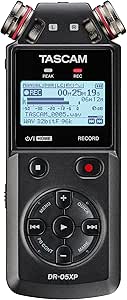 | Best Compact Recorder for Flexible Capture | Recording formats: 32-bit float, 24-bit, 16-bit, MP3, WAV | Sample rates: 96 kHz, 48 kHz, 44.1 kHz | Microphones: Built-in stereo omnidirectional condenser | VIEW LATEST PRICE | See Our Full Breakdown |
| Zoom H6 6-Track Portable Recorder with Interchangeable Stereo Microphones |  | Best for Multitrack Band Recording | Tracks: 6 simultaneous tracks | Inputs: 4 XLR/TRS mic/line inputs | Included microphone capsules: XYH-6 X/Y and MSH-6 Mid-Side | VIEW LATEST PRICE | See Our Full Breakdown |
| Zoom R4 Multi-Track Recorder with 32-Bit Float and USB Audio Interface |  | Best for Standalone Songwriting | Recording tracks: Up to 4 | Inputs: 2 XLR/TS combo inputs | Recording format: WAV | VIEW LATEST PRICE | See Our Full Breakdown |
| Tascam DR-2d Portable Digital Recorder |  | Best for Backup-Safe Stereo Recording | Recording formats: WAV and MP3 | Maximum recording resolution: 96 kHz/24-bit | Storage: SD card | VIEW LATEST PRICE | See Our Full Breakdown |
| Zoom H2n Handy Recorder (Renewed) |  | Best for Long Battery Life | Recording formats: WAV, MP3 | Maximum WAV quality: 24-bit/96 kHz | Maximum MP3 bitrate: 320 kbps | VIEW LATEST PRICE | See Our Full Breakdown |
| Zoom H1 XLR 2-Channel 32-Bit Float Recorder |  | Best Compact Recorder for External Mics | Channels: 2 | Recording resolution: 32-bit / 96 kHz | Inputs: 2 locking XLR/TRS combo inputs; 3.5 mm stereo input | VIEW LATEST PRICE | See Our Full Breakdown |
| TASCAM DR-05 Portable Digital Recorder (Version 2) |  | Best for Practice and Playback Tools | Recording formats: WAV, MP3 | Maximum recording resolution: 96 kHz/24-bit | Built-in microphones: Stereo omnidirectional condenser | VIEW LATEST PRICE | See Our Full Breakdown |
| Zoom H1essential Stereo Recorder |  | Best for Simple 32-Bit-Float Stereo Recording | Microphones: Built-in X/Y stereo microphones | Recording format: WAV, 32-bit float | Storage: SD card, up to 1 TB | VIEW LATEST PRICE | See Our Full Breakdown |
| Zoom H4n Pro 4-Track Portable Recorder with Stereo Microphones and 2 XLR/TRS Inputs |  | Best for Four-Track Band and Demo Sessions | Recording tracks: 4-track simultaneous recording | Microphones: Adjustable X/Y stereo microphones, 90° or 120° | Inputs: 2 XLR/TRS combo mic/line inputs; stereo 1/8-inch mic input | VIEW LATEST PRICE | See Our Full Breakdown |
| Zoom H4essential 4-Track Handy Recorder with 32-Bit Float, Stereo Microphones, and 2 XLR/TRS Inputs (Renewed) |  | Best for Long Sessions | Recording: 4-track WAV, 32-bit float | Microphones: Built-in stereo | Inputs: 2 XLR/TRS combo inputs; stereo mini-jack input | VIEW LATEST PRICE | See Our Full Breakdown |
| Xvive XV1-R Portable Stereo Audio Recorder with 32-Bit Float and X/Y Microphones |  | Best for USB Mic Flexibility | Recording formats: WAV (32-bit float or 24-bit PCM), AAC | Maximum sample rate: 96 kHz | Microphones: Built-in X/Y directional microphones | VIEW LATEST PRICE | See Our Full Breakdown |
| Zoom H4essential 4-Track Handheld Recorder | | Best for Connected Recording | Recording: 4-track WAV, 32-bit float | Maximum sample rate: 96 kHz | Microphones and inputs: Built-in stereo microphones; 2 XLR/TRS inputs | VIEW LATEST PRICE | See Our Full Breakdown |
| Tonfarb 64GB Digital Voice Recorder with Playback |  | Best for Simple Song Notes | Storage: 64 GB built-in | Recording formats: MP3, WAV | Maximum recording quality: 1536 kbps PCM | VIEW LATEST PRICE | See Our Full Breakdown |
| Zoom H1essential Voice Recorder Bundle with Lavalier Microphone and 32GB microSD Card |  | Best Ready-to-Record Bundle | Recording format: 32-bit float | Microphones: Built-in X/Y microphones | Maximum sound pressure level: 120 dB SPL | VIEW LATEST PRICE | See Our Full Breakdown |
| portable digital recorders for musician | Storage | Weight |
|---|---|---|
| TASCAM DR-05V2 Portable Digita | 2 GB Micro SD/SDHC | 0.3 kg |
| TASCAM DR-05XP 32-Bit Float Po | — | 4.48 oz |
| Zoom H6 6-Track Portable Recor | SD cards up to 128 GB | 9.92 oz |
| Zoom R4 Multi-Track Recorder w | — | 9.6 oz |
| Tascam DR-2d Portable Digital | SD card | 1.1 pounds |
| Zoom H2n Handy Recorder | — | 12.4 ounces |
| Zoom H1 XLR 2-Channel 32-Bit F | — | 6.4 ounces |
| TASCAM DR-05 Portable Digital | microSD/microSDHC | — |
| Zoom H1essential Stereo Record | SD card, up to 1 TB | 92 g |
| Zoom H4n Pro 4-Track Portable | — | — |
| Zoom H4essential 4-Track Handy | SD card | — |
| Xvive XV1-R Portable Stereo Au | microSD cards up to 128 GB | — |
| Zoom H4essential 4-Track Handh | SD card; listed capacity up to 1 TB | 243 g |
| Tonfarb 64GB Digital Voice Rec | 64 GB built-in | — |
| Zoom H1essential Voice Recorde | — | — |
More Details on Our Top Picks
TASCAM DR-05V2 Portable Digital Recorder
The TASCAM DR-05V2 suits musicians who want a straightforward handheld recorder for rehearsals, songwriting ideas, or stereo room capture. Its built-in portable-recorder design and USB 2.0 connectivity make it compatible with computers, smartphones, and other audio equipment. Compared with the newer TASCAM DR-05XP, however, it lacks listed 32-bit-float recording, a USB-C interface, and the newer model’s stated support for larger memory cards. Its 2 GB storage also makes the supplied capacity a constraint for extended sessions. The bigger buying concern is its status: this model is discontinued and has no warranty, so it makes more sense when a simple recording setup matters more than current support. I would skip it if dependable coverage or room for future expansion is a priority.
Pros:- Portable recorder design suits recording rehearsals and musical ideas away from a studio.
- USB 2.0 connectivity supports connection to computers and other audio equipment.
- Compatible with personal computers, smartphones, and other audio equipment.
Cons:- Discontinued and replaced by the DR-05X, limiting its appeal for buyers seeking a current model.
- No warranty is listed.
- The stated 2 GB Micro SD/SDHC storage is restrictive beside the DR-05XP’s support for cards up to 512 GB.
Best for: Musicians seeking a basic, compact stereo recorder for short rehearsals or songwriting notes who are comfortable buying a discontinued model without warranty.
Not ideal for: Performers who need current manufacturer support, substantial recording capacity, or 32-bit-float capture; the DR-05XP offers a more current feature set.
- Brand:TASCAM
- Model:DR-05V2
- Storage:2 GB Micro SD/SDHC
- Connectivity:USB 2.0
- Compatible devices:Personal computer, smartphone, other audio equipment
- Media speed:18 MB/s
- Weight:0.3 kg
- Dimensions:7.5 × 2.4 × 1.2 in
- Warranty:None
Our verdict“Choose the DR-05V2 for simple, short stereo captures only if its discontinued status and lack of warranty are acceptable.”
TASCAM DR-05XP 32-Bit Float Portable Handheld Field Recorder and USB-C Audio Interface
The TASCAM DR-05XP is a strong fit for musicians who want a small stereo recorder that can also connect to a computer as an interface. Its built-in omnidirectional microphones handle sources up to 125 dB SPL, while 32-bit-float recording gives more flexibility when a performance’s levels are hard to predict. That makes it easier to capture a loud rehearsal without relying on the same gain-setting routine as a conventional recording session. Unlike the Zoom H6, it does not offer four XLR/TRS inputs or six-track recording; its strength is a compact, self-contained stereo setup, not a multi-mic band rig. The USB-C 2-in/2-out interface adds a useful home-recording role, but users must supply both the SD card and two AA batteries. Choose it for portability and flexible stereo capture, not expanded input count.
Pros:- 32-bit-float recording provides flexible capture when performance levels are difficult to predict.
- Built-in stereo microphones support sources up to 125 dB SPL.
- Functions as a 2-in/2-out USB-C audio interface.
- Compact 4.48 oz body and stated battery life of up to 17.5 hours on alkaline batteries.
Cons:- Records stereo audio rather than the multiple isolated inputs and tracks offered by the Zoom H6.
- SD card is not included.
- Requires two AA batteries.
Best for: Songwriters, solo performers, and mobile musicians who need a lightweight stereo recorder for unpredictable levels and want USB-C interface functionality at a desk.
Not ideal for: Bands recording several microphones or instrument feeds at once; the Zoom H6 has four XLR/TRS inputs and can record six tracks simultaneously.
- Recording formats:32-bit float, 24-bit, 16-bit, MP3, WAV
- Sample rates:96 kHz, 48 kHz, 44.1 kHz
- Microphones:Built-in stereo omnidirectional condenser
- Maximum SPL:125 dB SPL
- USB interface:USB-C, 2-in/2-out
- Memory capacity:Up to 512 GB
- Battery:2 AA batteries; up to 17.5 hours with alkaline batteries
- Weight:4.48 oz
- Warranty:1 year manufacturer
Our verdict“Pick the DR-05XP for compact, flexible stereo recording and USB-C interface use, but choose the Zoom H6 for multi-microphone band sessions.”
Zoom H6 6-Track Portable Recorder with Interchangeable Stereo Microphones
For musicians recording a small ensemble or building a layered live take, the Zoom H6 earns its place through input capacity rather than pocketability. It records six tracks simultaneously and provides four XLR/TRS inputs with individual gain controls, pads, and phantom power, so a band can capture separate mic or line sources instead of relying on a stereo room mix. The included X/Y and Mid-Side capsules also give it more built-in stereo-miking options than the simpler DR-05XP. That versatility comes with a larger recording workflow: it weighs 9.92 oz, uses SD cards up to 128 GB, and its maximum quality is 24-bit/96 kHz rather than the DR-05XP’s 32-bit-float option. It also should not be treated as a splash-proof field unit. I’d choose it for input flexibility, not for the smallest kit.
Pros:- Records up to six tracks simultaneously, allowing more sources to remain separate for mixing.
- Four XLR/TRS inputs include individual gain controls, pads, and phantom power.
- Includes interchangeable X/Y and Mid-Side stereo microphone capsules.
- Can operate as a USB audio interface for PC, Mac, and iPad.
Cons:- At 9.92 oz, it is heavier than the 4.48 oz TASCAM DR-05XP.
- Maximum recording quality is 24-bit/96 kHz, without the DR-05XP’s 32-bit-float option.
- Not intended for very humid or splash-prone environments.
Best for: Small-band musicians and home-recording players who need several isolated mic or line sources captured at once, plus interchangeable stereo microphone options.
Not ideal for: Solo musicians prioritizing the simplest, smallest recorder or 32-bit-float capture; the DR-05XP is lighter and offers that recording format.
- Tracks:6 simultaneous tracks
- Inputs:4 XLR/TRS mic/line inputs
- Included microphone capsules:XYH-6 X/Y and MSH-6 Mid-Side
- Recording formats:WAV, MP3
- Maximum recording quality:24-bit/96 kHz
- Storage:SD cards up to 128 GB
- USB interface:USB 2.0; multichannel and stereo for PC, Mac, and iPad
- Power:4 AA batteries included
- Weight:9.92 oz
Our verdict“Choose the H6 when your musical recordings need multiple isolated inputs and interchangeable stereo capsules more than minimal weight or 32-bit-float recording.”
Zoom R4 Multi-Track Recorder with 32-Bit Float and USB Audio Interface
The Zoom R4 is aimed at musicians who want to build a song on the recorder itself, rather than simply capture a finished performance. It offers four tracks, two XLR/TS combo inputs, built-in stereo microphones, effects, and over 80 rhythm patterns. Bounce and undo functions let a player layer more parts while managing a limited track count, giving this workflow a different feel from the Zoom H6, which records up to six tracks simultaneously from a larger set of inputs. The R4’s 32-bit-float recording and USB-C power option add flexibility, but its four-track ceiling means overdubbing and bouncing matter more than keeping many sources isolated. Four AA batteries are needed when USB-C power is unavailable. It makes the most sense as a portable songwriting workstation, not as a substitute for a high-input-count band recorder.
Pros:- 32-bit-float recording supports flexible capture when input levels are unpredictable.
- Bounce and undo functions support layering parts within a four-track workflow.
- Two XLR/TS combo inputs accommodate microphones, instruments, and keyboards.
- Runs on four AA batteries or USB-C and functions as a 2-in/2-out USB audio interface.
Cons:- Recording is limited to four tracks, fewer than the Zoom H6’s six simultaneous tracks.
- Requires four AA batteries when USB-C power is unavailable.
- The track limit makes it less suited to keeping a larger ensemble’s sources isolated.
Best for: Solo musicians and small songwriting teams who want to record, layer, and bounce parts on a portable device without relying on a computer.
Not ideal for: Ensemble recordists who need more than four tracks captured or kept separate at once; the Zoom H6 supports six simultaneous tracks and four XLR/TRS inputs.
- Recording tracks:Up to 4
- Inputs:2 XLR/TS combo inputs
- Recording format:WAV
- Bit depth:32-bit float
- Built-in microphone:Stereo
- Rhythm patterns:Over 80
- USB audio interface:2-in/2-out
- Power:4 AA batteries or USB-C
- Weight:9.6 oz
Our verdict“Choose the R4 for portable, layer-by-layer songwriting and built-in musical tools, but choose the H6 when a band needs more sources recorded separately at once.”
Tascam DR-2d Portable Digital Recorder
The Tascam DR-2d is a stereo-focused choice for musicians who value a safety copy when recording a performance with changing dynamics. Its dual recording mode creates a lower-level backup, which can help preserve a usable take if a sudden loud passage distorts the main recording. Built-in stereo condenser microphones keep the setup self-contained, while WAV and MP3 recording up to 96 kHz/24-bit covers common rehearsal and performance capture needs. Compared with the newer TASCAM DR-05XP, the DR-2d offers dual recording and pitch-preserving variable-speed playback, but it lacks the newer model’s stated 32-bit-float format, USB-C interface, and much higher supported memory capacity. Its 1.1-pound weight is also substantial for a handheld portable recorder. I’d favor it for backup-minded stereo capture, provided its older design and AA power fit your setup.
Pros:- Dual recording creates a lower-level backup to help protect against sudden level increases.
- Built-in stereo condenser microphones support self-contained recording.
- Records WAV or MP3 audio up to 96 kHz/24-bit.
- Variable-speed playback changes speed without changing pitch.
Cons:- At 1.1 pounds, it is heavier than the 4.48 oz TASCAM DR-05XP.
- Uses SD card storage and lists no expanded capacity figure.
- Requires two AA batteries or an optional power supply.
Best for: Musicians recording live performances or rehearsals who want a lower-level backup take and pitch-preserving playback for learning parts.
Not ideal for: Players seeking a lightweight current recorder, USB-C interface functionality, or 32-bit-float capture; the DR-05XP is the more modern alternative.
- Recording formats:WAV and MP3
- Maximum recording resolution:96 kHz/24-bit
- Storage:SD card
- Microphones:Built-in stereo condenser microphones
- Recording mode:Dual recording with lower-level backup
- Playback feature:Variable speed without pitch change
- Connectivity:USB 2.0
- Power:Two AA batteries or optional power supply
- Weight:1.1 pounds
Our verdict“Choose the DR-2d for stereo recordings where a lower-level backup and pitch-preserving playback matter more than a lighter, newer feature set.”
Zoom H2n Handy Recorder (Renewed)
The Zoom H2n makes sense for musicians who want a self-contained recorder for rehearsals, songwriting ideas, and ambient sound without frequent battery changes. Its stated runtime of over 20 hours on two AA batteries is longer than the DR-05 and the H1essential, while WAV recording reaches 24-bit/96 kHz. Tools such as auto gain, pre-recording, and variable-speed playback help with capturing a take and learning a part afterward. Unlike the H4n Pro, it does not offer XLR/TRS inputs for connecting stage microphones or instruments, so it is less suited to a multi-source session. The key caveat is its renewed condition: buyers should check the seller’s condition and return terms, and be comfortable with a model that requires AA cells.
Pros:- Records WAV audio up to 24-bit/96 kHz.
- Stated battery life exceeds 20 hours on two AA batteries.
- Auto gain and pre-recording support quick, less hands-on capture.
- Variable-speed playback helps musicians study passages.
Cons:- No XLR/TRS inputs for external microphones or instruments.
- Requires two AA batteries rather than an internal rechargeable battery.
- Renewed condition may not suit buyers seeking a new unit.
Best for: Songwriters and rehearsal players who want a self-contained stereo recorder with extended AA-battery runtime.
Not ideal for: Musicians recording separate microphones or direct instrument sources, since it lacks the H4n Pro’s XLR/TRS inputs; also skip it if you only want a new-condition device.
- Recording formats:WAV, MP3
- Maximum WAV quality:24-bit/96 kHz
- Maximum MP3 bitrate:320 kbps
- Battery life:Over 20 hours
- Battery type:2 AA batteries
- Weight:12.4 ounces
- Dimensions:2.66 × 1.68 × 4.5 inches
- Condition:Renewed
Our verdict“Choose the renewed H2n for long-running, self-contained rehearsal and idea capture, but choose the H4n Pro if you need XLR inputs.”
Zoom H1 XLR 2-Channel 32-Bit Float Recorder
The Zoom H1 XLR is the compact pick here for musicians who already own microphones or want to record a pair of external sources. Its two locking XLR/TRS combo inputs accept microphones and instruments, while 32-bit-float WAV capture is designed to give more room for unpredictable level changes than the H4n Pro’s 24-bit recording. The smaller, 6.4-ounce body is easier to carry than that four-track model, but this is not a substitute for a recorder with built-in stereo microphones: you need suitable external sources for its main recording setup. A waveform display helps with monitoring, though it is a small 0.96-inch screen. Two AA batteries power the unit, and the listed 10-hour battery life is more limited than the H2n’s stated runtime.
Pros:- Two locking XLR/TRS inputs connect microphones and instruments.
- 32-bit-float recording is suited to performances with changing levels.
- Compact 6.4-ounce body is lighter than the H4n Pro.
- SDXC support extends to cards up to 1 TB.
Cons:- Does not list built-in stereo microphones, so external sources are needed for its main use.
- Listed battery life is 10 hours on two AA batteries.
- Small 0.96-inch display offers limited viewing area.
Best for: Gigging musicians and home-recording players who need a pocketable recorder with two locking inputs for microphones or instruments.
Not ideal for: Players who want to capture stereo room sound without bringing microphones, or who need more than two recorded channels at once.
- Channels:2
- Recording resolution:32-bit / 96 kHz
- Inputs:2 locking XLR/TRS combo inputs; 3.5 mm stereo input
- Output:3.5 mm headphone output
- Storage support:SDXC cards up to 1 TB
- Battery:2 AA batteries; 10 hours listed battery life
- Display:0.96-inch OLED waveform display
- Weight:6.4 ounces
Our verdict“Pick the H1 XLR when portable dual-input recording and 32-bit float matter more than built-in microphones or longer battery life.”
TASCAM DR-05 Portable Digital Recorder (Version 2)
The TASCAM DR-05 Version 2 is a straightforward choice for musicians who want built-in stereo recording plus useful tools for working through material. Its omnidirectional condenser microphones capture rehearsals and room sound without an external mic, and the chromatic tuner, looping, and pitch-preserving variable-speed playback make it more practice-focused than the H2n. It records WAV or MP3 up to 24-bit/96 kHz and offers several power options, including USB. Compared with the 32-bit-float H1essential, this TASCAM uses conventional 24-bit recording, so the newer Zoom is a better fit when levels may change sharply and capture flexibility is the priority. The DR-05’s stated battery life is up to 17.5 hours at CD quality. Its supplied card capacity is inconsistently listed, and the windscreen and AC adapter are separate.
Pros:- Built-in stereo microphones record ambient music without extra gear.
- Chromatic tuner, looping, and variable-speed playback support practice.
- WAV and MP3 recording reaches 24-bit/96 kHz.
- Can run on AA batteries, USB power, or an optional AC adapter.
Cons:- Conventional 24-bit recording lacks the H1essential’s 32-bit-float approach.
- Included microSD capacity is listed inconsistently as 2 GB or 4 GB.
- AC adapter is optional, and a windscreen is sold separately.
Best for: Students and practice-oriented musicians who want built-in stereo mics, a tuner, and playback features for learning songs.
Not ideal for: Musicians who need 32-bit-float capture or plan to connect XLR microphones; it has neither that recording mode nor XLR inputs.
- Recording formats:WAV, MP3
- Maximum recording resolution:96 kHz/24-bit
- Built-in microphones:Stereo omnidirectional condenser
- Maximum sound pressure level:125 dB SPL
- Input:1/8-inch stereo mic/line input with plug-in power
- Storage:microSD/microSDHC
- Power:2 AA batteries, USB, or optional AC adapter
- Battery life:Up to 17.5 hours at CD-quality recording
Our verdict“Choose the DR-05 for built-in stereo capture and practice tools, but favor the H1essential if 32-bit-float recording is your priority.”
Zoom H1essential Stereo Recorder
The Zoom H1essential is the easiest fit for musicians who want to press record and capture a stereo take without packing microphones. Its built-in X/Y microphones and 32-bit-float WAV recording pair a simple setup with headroom for performances that shift in loudness. Spoken menu guidance adds useful accessibility support, and USB-C lets it serve as a microphone with a computer or compatible mobile device. Compared with the DR-05, it gives up the tuner and several practice-oriented playback tools; compared with the H1 XLR, it trades external XLR/TRS inputs for built-in microphones and a simpler workflow. It runs on two AAA batteries for up to 10 hours, and an SD card is not included, so buyers need to supply storage before recording.
Pros:- Built-in X/Y microphones capture stereo sound without extra equipment.
- 32-bit-float WAV recording is designed to handle changing sound levels.
- USB-C microphone mode supports computer and compatible mobile-device use.
- Spoken menu guidance supports accessible operation.
Cons:- Two AAA batteries provide up to 10 hours of digital recording time.
- SD card must be purchased separately.
- Lacks the DR-05’s listed chromatic tuner and dedicated playback tools.
Best for: Solo musicians, students, and accessible-technology users who want a simple handheld stereo recorder for practice, demos, and ideas.
Not ideal for: Players who need XLR-connected microphones, multi-source recording, extended battery runtime, or included SD storage.
- Microphones:Built-in X/Y stereo microphones
- Recording format:WAV, 32-bit float
- Storage:SD card, up to 1 TB
- USB interface:USB Type-C
- Power:2 AAA batteries
- Digital recording time:Up to 10 hours
- Dimensions:5.38 × 2.12 × 1.14 inches
- Weight:92 g
Our verdict“Choose the H1essential for simple, built-in stereo recording with 32-bit float, but choose the H1 XLR when external microphones are central to your setup.”
Zoom H4n Pro 4-Track Portable Recorder with Stereo Microphones and 2 XLR/TRS Inputs
The Zoom H4n Pro is the most capable all-in-one session tool in this group for musicians who need built-in stereo capture and external inputs at the same time. Its four-track recording lets you combine the adjustable X/Y microphones with two XLR/TRS sources, while phantom power supports compatible condenser mics. It also doubles as a 2-in/2-out USB interface, making it more useful for a small home setup than the H2n or DR-05. The tradeoff is portability in practice: its stated battery life is only up to 5.5 hours in standard mode, well below those simpler handhelds, and storage support tops out at 32 GB. It records up to 24-bit/96 kHz, not 32-bit float like the H1essential or H1 XLR, so careful level setup remains part of the workflow.
Pros:- Records four tracks simultaneously using built-in mics and external inputs.
- Two XLR/TRS combo inputs and +24V or +48V phantom power support varied sources.
- Adjustable X/Y microphones handle stereo recording up to 140 dB SPL.
- Functions as a 2-in/2-out USB audio interface.
Cons:- Battery life is listed at up to 5.5 hours, or up to 8 hours in Stamina mode.
- 24-bit/96 kHz recording lacks the 32-bit-float format offered by the H1 XLR and H1essential.
- Storage capacity is limited to cards up to 32 GB.
Best for: Small-band players and solo artists who need to blend built-in stereo mics with two external microphone or instrument inputs.
Not ideal for: Musicians prioritizing long battery sessions, minimal setup, or 32-bit-float recording; the H2n lasts longer and the H1 XLR offers 32-bit float.
- Recording tracks:4-track simultaneous recording
- Microphones:Adjustable X/Y stereo microphones, 90° or 120°
- Inputs:2 XLR/TRS combo mic/line inputs; stereo 1/8-inch mic input
- Maximum audio quality:24-bit/96 kHz
- Phantom power:+24V or +48V
- USB interface:2-in/2-out
- Battery life:Up to 5.5 hours; up to 8 hours in Stamina mode
- Storage capacity:Up to 32 GB
Our verdict“Choose the H4n Pro when you need four-track flexibility and XLR inputs in one recorder, but skip it for long untethered sessions.”
Zoom H4essential 4-Track Handy Recorder with 32-Bit Float, Stereo Microphones, and 2 XLR/TRS Inputs (Renewed)
The renewed H4essential suits musicians who want room for both a spontaneous stereo capture and external microphones or instruments. Its two XLR/TRS inputs and four-track recording give it more ensemble flexibility than the Xvive XV1-R, which has built-in X/Y microphones but no listed XLR/TRS inputs. 32-bit float can reduce the risk of clipping when a rehearsal suddenly gets loud, while the SD-card workflow keeps recording self-contained. Its stated battery life of up to 20 hours is a strong fit for extended sessions. The tradeoff is buying a renewed unit with a 90-day limited warranty; the new H4essential listing also gives different battery-life and weight figures. I’d favor that standard listing if condition assurance matters more than this model’s stated runtime.
Pros:- 32-bit float recording helps manage sudden changes in performance level.
- Two XLR/TRS combo inputs complement the built-in stereo microphones.
- Listed battery life of up to 20 hours suits extended sessions.
- Records to SD card and includes a color LCD.
Cons:- Renewed condition comes with a 90-day limited warranty.
- Listed weight differs between the item specifications and the battery-equipped figure.
- The standard H4essential listing has a shorter stated recording time, making runtimes difficult to compare directly.
Best for: Musicians recording long rehearsals or small ensembles who want built-in stereo mics plus two inputs for external sources.
Not ideal for: Buyers who want a new recorder with a longer warranty, or those who need the published weight and battery figures to be consistent.
- Recording:4-track WAV, 32-bit float
- Microphones:Built-in stereo
- Inputs:2 XLR/TRS combo inputs; stereo mini-jack input
- Storage:SD card
- Display:2-inch full-color LCD
- Battery life:Up to 20 hours on lithium batteries
- Headphone jack:3.5 mm
- Condition and warranty:Renewed; 90-day limited warranty
Our verdict“Choose this renewed H4essential for flexible four-track rehearsal capture and its stated long runtime, provided the short warranty is acceptable.”
Xvive XV1-R Portable Stereo Audio Recorder with 32-Bit Float and X/Y Microphones
The Xvive XV1-R is the most adaptable choice here for musicians who move between field recording and computer or mobile setups. Its built-in X/Y microphones handle standalone stereo capture, while USB-C lets it work as a microphone with PCs, Macs, iOS devices, and Android devices. That gives it a different appeal from the Zoom H1essential bundle, which includes a lavalier mic and card but is presented more as a self-contained portable recorder. The Xvive also offers 32-bit float, 24-bit PCM, and AAC recording, plus auto-record and pre-record tools. Its key limitation is practical: there’s no headphone jack, so monitoring during a take is less convenient than on the Zoom models. It also relies on two AA batteries and records through microSD rather than full-size SD.
Pros:- 32-bit float and 24-bit PCM WAV recording options, with sample rates up to 96 kHz.
- Built-in X/Y microphones support sound levels up to 130 dB SPL.
- USB-C microphone compatibility spans computers, tablets, and smartphones.
- Auto-record, pre-record, and noise-reduction features support hands-free capture.
Cons:- No headphone jack for direct monitoring.
- Requires two AA batteries.
- Has no listed XLR/TRS inputs for external microphones or instruments.
Best for: Musicians who want one compact recorder to capture stereo takes and serve as a USB microphone with a computer, tablet, or phone.
Not ideal for: Performers who need to monitor recordings directly from the device or connect XLR microphones and other external sources.
- Recording formats:WAV (32-bit float or 24-bit PCM), AAC
- Maximum sample rate:96 kHz
- Microphones:Built-in X/Y directional microphones
- Maximum sound pressure level:130 dB SPL
- Storage:microSD cards up to 128 GB
- USB microphone support:PC, Mac, iOS, and Android; 48 kHz USB audio
- Battery and recording time:2 AA batteries; up to 12 hours
- Display:1.7 inches
- Headphone jack:None
Our verdict“Pick the XV1-R if USB microphone use and flexible onboard recording matter more than direct headphone monitoring or XLR inputs.”
Zoom H4essential 4-Track Handheld Recorder
The standard Zoom H4essential earns its place for musicians who want a handheld recorder that can also join a USB-C workflow. It captures up to four tracks at 32-bit float and 96 kHz, with built-in stereo microphones and two XLR/TRS inputs for external sources. Compared with the Xvive XV1-R, it is a better fit for connecting microphones or instruments directly; the Xvive’s strength is USB microphone versatility, but it has no listed XLR inputs or headphone jack. The H4essential can also record to a connected device while backing up to an SD card, adding a useful safety copy for sessions. The cost of that flexibility is a larger handheld body and a listed 10-hour recording time on two AA batteries, shorter than the renewed H4essential’s stated maximum.
Pros:- Four-track, 32-bit float recording up to 96 kHz.
- Two XLR/TRS inputs work alongside built-in stereo microphones.
- USB-C supports recording or streaming with compatible devices.
- Can record to a connected device while backing up to SD card.
Cons:- Listed recording time is 10 hours and it requires two AA batteries.
- Its 243 g handheld body is less compact than simpler stereo recorders.
- Two external inputs limit simultaneous connections compared with larger multitrack setups.
Best for: Musicians who need two external inputs, built-in stereo mics, and USB-C recording or streaming in one handheld device.
Not ideal for: Players who prioritize a tiny, low-power recorder or want more than two external inputs for a larger ensemble.
- Recording:4-track WAV, 32-bit float
- Maximum sample rate:96 kHz
- Microphones and inputs:Built-in stereo microphones; 2 XLR/TRS inputs
- Connectivity:USB-C
- Storage:SD card; listed capacity up to 1 TB
- Display:2-inch color LCD
- Power and recording time:2 AA batteries; listed recording time 10 hours
- Weight:243 g
- Headphone jack:3.5 mm
Our verdict“Choose the standard H4essential for connected four-track sessions with external mics or instruments, rather than for the lightest carry or longest listed runtime.”
Tonfarb 64GB Digital Voice Recorder with Playback
The Tonfarb 64GB recorder is better suited to capturing lyric ideas, lessons, and spoken rehearsal notes than to recording a band mix. Its one-click recording, built-in storage, and voice-activated mode make quick capture straightforward; unlike the Zoom H1essential bundle, though, it does not list 32-bit float recording or a dedicated lavalier microphone. MP3 and WAV support give it more file choice than a basic memo device, and the headphone jack allows playback without another accessory. Its headline runtime needs context: up to 48 hours applies to MP3 at 32 kbps, not high-quality WAV music recording. The small 1.44-inch screen and voice-recorder-focused feature set also make detailed session control less appealing. I’d choose it for convenience and notes, not as my main instrument recorder.
Pros:- One-click recording supports quick capture, including when powered off.
- Built-in 64 GB storage avoids the need to buy a separate memory card.
- MP3 and WAV recording with noise reduction.
- Voice activation, scheduled recording, and A-B loop playback add practical note-taking tools.
Cons:- The stated 48-hour runtime applies to MP3 recording at 32 kbps.
- A 1.44-inch screen can make navigation less convenient.
- No external audio inputs or 32-bit float recording are listed for music-focused capture.
Best for: Songwriters, students, and musicians who want a simple pocket recorder for lyric ideas, lessons, and spoken notes.
Not ideal for: Musicians recording performances who need high-resolution capture, external instrument inputs, or dependable monitoring during takes.
- Storage:64 GB built-in
- Recording formats:MP3, WAV
- Maximum recording quality:1536 kbps PCM
- Microphone:Built-in stereo
- Battery:600 mAh; 1 AAA battery included
- Battery life:Up to 48 hours continuous recording; stated for MP3 at 32 kbps
- Display:1.44 inches
- Connections:3.5 mm headphone jack; USB 2.0
- Dimensions:0.47 × 1.45 × 4 inches
Our verdict“Choose the Tonfarb for quick songwriting notes and spoken material, but not as your primary recorder for musical performances.”
Zoom H1essential Voice Recorder Bundle with Lavalier Microphone and 32GB microSD Card
This Zoom H1essential bundle is the easiest option here to take from the box to a solo vocal or instrument capture: it includes a lavalier microphone, windscreen, 32GB card, and four AAA batteries. Its 32-bit float recording reduces the need to set levels manually, while built-in X/Y microphones handle stereo recording without the lavalier. Compared with the Tonfarb, it is far more oriented toward music capture, though the Tonfarb offers much larger built-in storage and a longer stated voice-recording runtime. The H1essential is the more compact alternative to the H4essential, but it does not list the latter’s two XLR/TRS inputs or four-track recording. Its listed 10-hour digital recording time and four-battery power requirement are the main practical limits for longer sessions.
Pros:- 32-bit float recording reduces the need for manual level adjustment.
- Built-in X/Y microphones support stereo capture up to 120 dB SPL.
- Bundle includes a lavalier microphone, furry windscreen, 32GB card, and batteries.
- Pre-record, auto-record, overdubbing, and playback-speed adjustment support varied recording tasks.
Cons:- Listed digital recording time is 10 hours.
- Requires four AAA batteries.
- Does not list the H4essential’s two XLR/TRS inputs for connecting multiple external sources.
Best for: Solo musicians and vocalists who want a compact 32-bit float recorder with a lavalier, windscreen, and memory card included.
Not ideal for: Small groups needing multiple external inputs, or performers planning long sessions without access to spare AAA batteries.
- Recording format:32-bit float
- Microphones:Built-in X/Y microphones
- Maximum sound pressure level:120 dB SPL
- Included storage:32GB microSDHC card
- Recording time:10 hours
- Headphone jack:3.5 mm
- Included accessories:Lavalier condenser microphone, furry windscreen, 4 AAA batteries, cloth
- Recording features:Overdubbing, pre-record, auto record, playback speed adjustment, mono mode
- Compatibility:Smartphone
Our verdict“Pick this H1essential bundle for ready-to-go solo recording, and choose the H4essential instead if your sessions need external inputs or four tracks.”
How We Picked
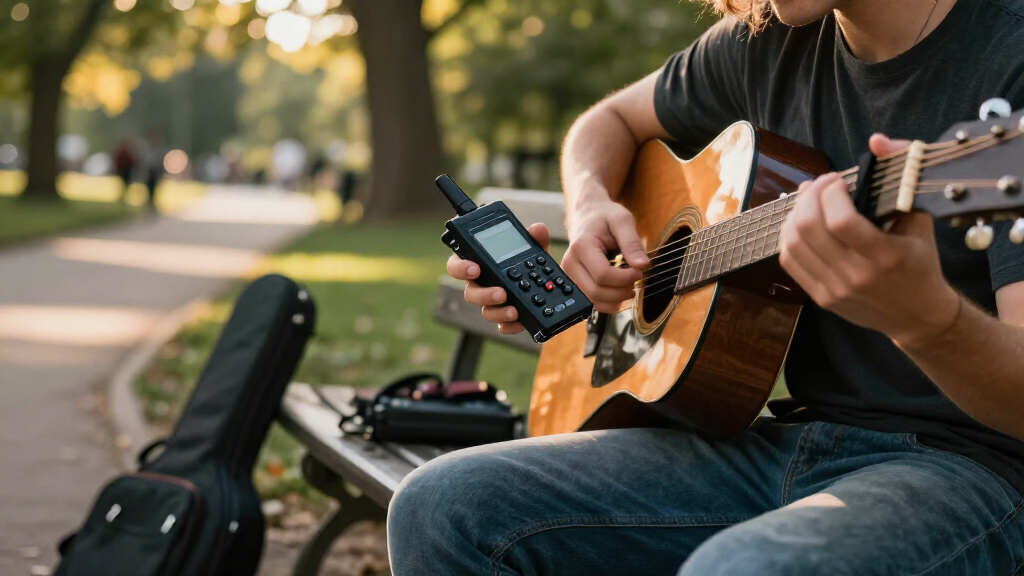
I ranked these portable digital recorders for musicians by how well their recording setup fits real musical tasks: capturing rehearsals, developing song ideas, recording acoustic performances, or connecting external microphones and instruments. I gave more weight to useful input choices, recording flexibility, and a musician-friendly workflow than to headline specifications alone. Portability, onboard microphone design, recording format, and potential usefulness across different session types also shaped the order.
The ranking favors recorders that can cover several musical situations without forcing buyers into unnecessary complexity. That puts the Zoom H6 ahead for broad versatility, while compact stereo models rank better for quick idea capture and multi-input models suit more elaborate setups. I placed speech-oriented devices lower because their strengths are less aligned with recording instruments, and treated renewed listings and bundles as distinct purchasing configurations rather than assuming they offer the same fit as standard models.
Factors to Consider When Choosing Portable Digital Recorders For Musicians
Choosing a recorder starts with the recording you actually expect to make, not the longest feature list. These broader questions can help you avoid paying for inputs you will not use—or buying a simple stereo model that cannot support your next setup.
Choose Between Onboard Stereo and External Microphones
Built-in stereo microphones are convenient for rehearsals, acoustic instruments, and capturing the sound of a room without extra cables. They also tie the recording to the recorder’s position, which may not be the best place for every instrument or player. External microphones let you position sources independently and can improve separation, but they add stands, cables, and setup time. A common mistake is buying a recorder with several inputs when the intended use is simply setting it on a music stand to capture a rehearsal. If you mainly want fast song notes, prioritize easy stereo capture; if you need control over mic placement, look for suitable external inputs.
Count Inputs for the Setup You Want to Record
Think about the maximum number of separate sources you want to record at once, not just how many musicians are in the room. A solo guitarist may need only a stereo pair, while a singer-songwriter could want a vocal mic and a separate instrument feed. Recording a small group may call for more inputs or a mixer feeding the recorder. More channels can support better separation and editing later, but they usually mean more setup and a larger device. Before choosing, list each source and how it will connect; do not assume that a recorder’s track count automatically means it has enough physical inputs.
Treat 32-Bit Float as Headroom, Not a Cure-All
32-bit float recording can make level management more forgiving when a performance is unpredictable, which can be useful for loud rehearsals or spontaneous sessions. It does not improve microphone placement, remove room noise, or make a poor source sound polished. Nor does the format matter as much if you routinely set levels carefully and record consistent performances. Buyers can over-prioritize a recording-format label while overlooking microphone quality and input count. Pay extra attention to 32-bit float when changing levels quickly is difficult; otherwise, choose based on the complete recording workflow.
Plan for the Recording After the Take
A recorder is only part of the process: you may also need a computer connection, a compatible memory card, batteries or another power source, and a way to monitor playback. If you plan to overdub or edit separate sources, confirm that the recording workflow supports the number of tracks you need. USB audio-interface capability can make a recorder more useful at a desk, but it will not replace the need for suitable software and monitoring. Check the included accessories carefully, since bundles can add useful items while renewed listings may differ from standard configurations. Choosing around your full path from capture to editing avoids a recorder that fits the session but complicates everything afterward.
Match Portability to How You Record
A smaller recorder is easier to carry and quicker to set up, but compactness can mean fewer inputs or fewer ways to expand a session. A larger handheld model may be more practical when it combines onboard microphones with connections for external sources. Consider whether you will keep the recorder in a gig bag, carry it in a pocket, or leave it ready on a stand at home. Extra capability is useful only if you are willing to bring and configure it. For a musician who records ideas on the move, simplicity may matter more than advanced routing; for planned sessions, flexibility can justify a larger unit.
Frequently Asked Questions
Is a stereo recorder enough to capture a band rehearsal?
It can be enough if your goal is to review the overall performance rather than adjust each musician independently. Place the recorder where the instruments and vocals balance naturally, then make a short test recording before the full rehearsal. A stereo capture is quick to set up, but it leaves limited options for fixing a loud instrument or quiet vocal afterward. Choose a multitrack recorder or a separate-input setup if you expect to mix sources individually. The right choice depends on whether convenience or control matters more for your rehearsal recordings.
Should I choose 32-bit float if I record loud instruments?
It may help when performance levels change quickly and you cannot monitor or adjust input gain throughout the take. That flexibility can be useful for loud, spontaneous sessions, but it does not remove distortion that occurs before the signal reaches the recorder or fix poor microphone placement. A properly positioned microphone and a suitable input setup still matter. If you record predictable takes and can set levels in advance, input count and microphone quality may have greater practical value. Treat 32-bit float as one part of the workflow rather than the main measure of recording quality.
When do I need XLR or combo inputs instead of built-in microphones?
Built-in microphones are a good fit when you want to capture a performance quickly from one position. XLR or combo inputs become useful when you need to connect external microphones, take a direct instrument feed, or place sources apart from the recorder. They can give you more control, though they also bring cables and setup choices. A musician recording solo ideas may not benefit from carrying extra input hardware. If you plan to record vocals and instruments separately or expand to a small group, external inputs are more likely to earn their place.
Can I use a portable recorder as a USB audio interface?
Some models in this roundup list USB audio-interface functionality, which can let the recorder connect to a computer for recording or playback tasks. Check the specific model’s supported connections and operating workflow before relying on it as your only interface. A portable recorder may not offer the same input layout or studio controls as a dedicated desktop interface. It can be a useful way to combine mobile recording and computer-based work, especially if your sessions are simple. For a permanent multi-microphone studio setup, compare the interface capabilities with the inputs and monitoring controls you need.
Is a voice recorder or lavalier bundle suitable for recording instruments?
It can work for a close, simple source, but speech-oriented recorders and lavalier bundles are not the most versatile choice for general music recording. A small lavalier microphone is designed for convenient close placement, which may not capture the tonal balance or room sound you want from an instrument. For rehearsals, acoustic performances, or multiple sources, a recorder with stereo microphones or music-focused external inputs is usually a better fit. The Tonfarb model is aimed more at voice capture, while the H1essential bundle’s lavalier can suit a specific close-miking task. Choose one of these only when that narrower use matches your recording plan.
Conclusion
For the widest range of musical sessions, I recommend the Zoom H6 as the best overall: its interchangeable stereo microphones and multiple inputs give it more room to adapt than a basic stereo recorder. The best premium-style choice for flexible capture is the Zoom H4essential, particularly for musicians who want onboard stereo recording plus XLR/TRS connections and 32-bit float. For best value in a straightforward setup, the TASCAM DR-05XP is a sensible pick for players who mainly need portable stereo recording and do not need several external sources. Beginners focused on capturing song ideas should start with a simpler model such as the Zoom H1essential or a TASCAM DR-05, rather than paying for inputs they will not use. Choose the Zoom H1 XLR for a compact two-XLR setup, and reserve the Tonfarb or lavalier bundle for voice-led or narrowly defined recording jobs. Match the recorder to your sources and workflow first; that is what separates a useful musical tool from unused extra capability.