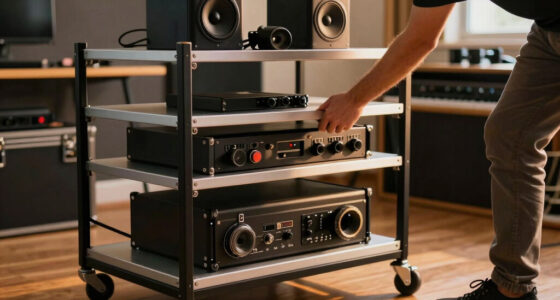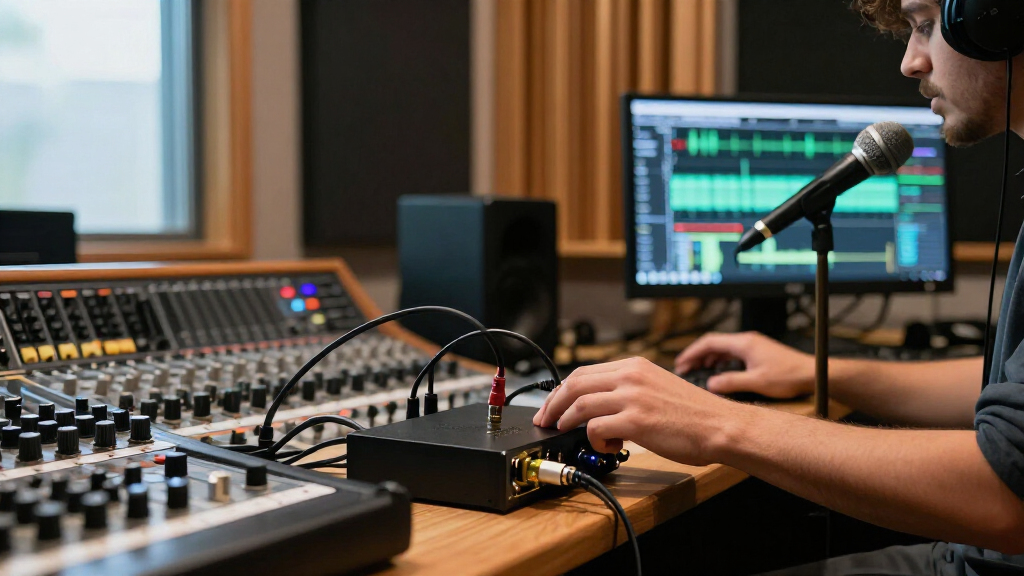
When I compare the best Ethernet audio interfaces here, I focus on what each one adds to a Dante network: analog inputs, headphone and monitor outputs, or microphone recording. The Focusrite RedNet X2P is my pick for recording because it combines two mic preamps with headphone and line outputs. For sending several analog sources onto a network, the MAXSQUARE MSQ-3900D offers four XLR inputs and both Dante and AES67 support. The RedNet AM2 is the more focused choice for a listening or monitor position.

Get audio and creator gear delivered free with Prime
- Fast, free delivery on millions of items
- Prime Video, Amazon Music and more included
- Member-only deals all year
These are not interchangeable desktop USB interfaces. Each relies on a compatible network-audio setup, and their channel layouts point to different jobs. I rank the X2P first for its broader recording and monitoring role, the MSQ-3900D second for its four-channel conversion and protocol flexibility, and the AM2 third because it is an output-focused device rather than a recording interface. The tradeoff is straightforward: choose by signal direction and workflow, not by the word “interface” alone.
Complete the kit


Key Takeaways
- The Focusrite RedNet X2P is the most versatile recording pick here, with two Red Evolution mic preamps, stereo headphones, and stereo line output.
- The MAXSQUARE MSQ-3900D converts four analog XLR inputs for Dante or AES67 networks, but it does not replace a mic-preamp-and-monitoring unit.
- The Focusrite RedNet AM2 suits a networked listening station, with headphone amplification and XLR line outputs rather than input channels.
- All three depend on a compatible network-audio setup; Ethernet connectivity by itself does not make them plug-and-play USB interfaces.
- Power options differ: the MSQ-3900D and AM2 support PoE, while the X2P’s supplied details do not specify its power method.
| Focusrite RedNet X2P 2×2 Dante Ethernet Audio Interface with Mic Preamps | 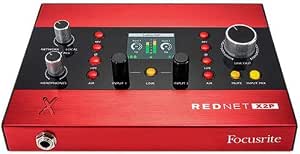 | Best Overall — recording and monitoring in one Dante endpoint | Connectivity: Ethernet | Channels: 2 | Microphone preamps: 2 Red Evolution | VIEW LATEST PRICE | See Our Full Breakdown |
| MAXSQUARE MSQ-3900D 4-Channel Dante Analog Audio Network Interface |  | Best for Multichannel Inputs — four XLR channels with Dante and AES67 | Channels: 4 | Inputs: Four 3-pin XLR | Connectivity: Ethernet, XLR | VIEW LATEST PRICE | See Our Full Breakdown |
| Focusrite RedNet AM2 Stereo Dante Headphone Amplifier and Line Output Interface with PoE |  | Best for Networked Monitoring — headphone and line outputs at a Dante listening point | Model: REDNET-AM2 | Connectivity: Dante, XLR | Headphone output: 1/4-inch TRS | VIEW LATEST PRICE | See Our Full Breakdown |
| Ethernet audio interface | Connectivity | Channels | Maximum sample rate | Power |
|---|---|---|---|---|
| Focusrite RedNet X2P 2×2 Dante | Ethernet | 2 | 96 kHz | — |
| MAXSQUARE MSQ-3900D 4-Channel | Ethernet, XLR | 4 | 96 kHz | PoE class 0 or USB Type-C |
| Focusrite RedNet AM2 Stereo Da | Dante, XLR | — | — | PoE or included external power supply |
More Details on Our Top Picks
Focusrite RedNet X2P 2×2 Dante Ethernet Audio Interface with Mic Preamps
I put the RedNet X2P first because it makes the strongest all-around case for a buyer who wants to add recording capability to an Ethernet audio system. Its two Red Evolution microphone preamps provide two XLR mic inputs, while a stereo headphone amplifier and stereo line output give the unit a way to serve a nearby performer or monitoring position. Against the MSQ-3900D, which brings four XLR inputs but is described as an analog network interface, the X2P is better suited to a small recording station that needs preamps and listening outputs together.
That combination gives the X2P a clear role without making it a universal solution. It supports sample rates up to 96 kHz, matching the MSQ-3900D’s stated ceiling, but it has two channels rather than the MAXSQUARE’s four input channels. The RedNet AM2 also provides headphones and line output, yet it is the more focused monitoring option: the supplied description does not give it microphone preamps. I would choose the X2P when recording microphones is part of the job, and the AM2 when the job is mainly listening to network audio.
The main limitation is that the supplied specifications are thinner than the other entries on a few setup details. They list Ethernet connectivity and Windows support, but do not name the power options, warranty, or AES67 compatibility. I would verify the operating-system, routing, and network requirements for the intended installation before buying. It is also a Dante device, not a general-purpose USB interface based on the information provided, so a laptop-only recording setup without a compatible Dante path is a poor match.
My ranking gives the X2P the lead for role breadth, not channel count or protocol range. The MSQ-3900D wins when four analog inputs or AES67 matter more, and the AM2 is easier to justify for a dedicated monitor point. For a compact Dante endpoint that can capture two microphones and feed headphones or line-level monitoring, however, the X2P covers the most useful combination in this group.
Pros:- Two Red Evolution microphone preamps provide dedicated mic-input capability.
- Stereo headphone amplifier supports local performer monitoring.
- Stereo line output adds a separate connection for monitors or other line-level equipment.
- Supports sample rates up to 96 kHz.
Cons:- Only two channels are specified, half the MSQ-3900D’s four XLR inputs.
- The supplied details do not list AES67 support or a power method.
- Requires a compatible Dante network rather than serving as a standalone USB interface.
Best for: A small studio, rehearsal room, or remote recording position that needs two Dante-connected mic inputs plus local headphone and stereo line monitoring.
Not ideal for: Buyers who need four analog inputs, AES67 compatibility, a conventional USB interface, or clearly documented power and operating-system support before purchase.
- Connectivity:Ethernet
- Channels:2
- Microphone preamps:2 Red Evolution
- Audio input:XLR
- Maximum sample rate:96 kHz
- Monitoring:Stereo headphone amplifier
- Line output:Stereo
- Supported operating system:Windows
Our verdict“I rank the RedNet X2P first for buyers who need Dante mic recording and local monitoring in one compact endpoint, provided its system requirements fit their network.”
MAXSQUARE MSQ-3900D 4-Channel Dante Analog Audio Network Interface
The MSQ-3900D is the input-count pick in this roundup. It sends four analog channels from four 3-pin XLR inputs over Dante or AES67 RTP, making it a better fit than either Focusrite when the task is to bring several existing analog sources onto an IP audio network. That could suit a fixed installation or a system with multiple analog feeds to route. Its four inputs give it twice the channel count of the X2P, while AES67 support adds a protocol option that the supplied X2P and AM2 details do not claim.
Its place at number two reflects that focused job. The X2P pairs its two inputs with microphone preamps and local headphone and line outputs, features that the MSQ-3900D description does not specify. The AM2, meanwhile, is built around playback and monitoring outputs. The MAXSQUARE is therefore the strongest match for four-channel analog-to-network conversion, but not the most complete choice for a performer who needs mic preamps and a headphone output at the same station.
Network configuration is part of ownership, not an optional extra. The device requires a compatible Dante or AES67 environment, so a standard Ethernet connection alone does not establish that audio will route into a computer or DAW. I would check how the planned network handles discovery, routing, and the required audio software before choosing it. It supports 44.1, 48, and 96 kHz, and its maximum of 96 kHz matches the X2P’s stated ceiling; it does not offer a higher listed rate than the leading pick.
Power flexibility is a practical advantage for installations: the MSQ-3900D can run on PoE or USB Type-C, and its aluminum housing keeps the listed weight to 10.56 ounces. The tradeoffs are a one-year limited warranty and a more specialized role than the X2P. I would rank it first only for buyers whose priority is four analog inputs and protocol choice; for a compact recording-and-monitoring position, the X2P is more useful, while the AM2 is the more direct listening endpoint.
Pros:- Four 3-pin XLR inputs handle more analog sources than either Focusrite device.
- Supports both Dante and AES67 RTP, unlike the protocols listed for the Focusrite models.
- PoE and USB Type-C offer two power approaches.
- Aluminum housing and a listed weight of 10.56 ounces suit compact installations.
Cons:- A compatible Dante or AES67 network setup is required for audio transmission.
- The supplied description does not specify mic preamps, headphone amplification, or local monitor outputs.
- One-year limited warranty is shorter than the AM2’s stated three-year warranty.
Best for: Installers and audio teams who need four analog XLR sources placed on a Dante or AES67 network, with PoE or USB Type-C power available.
Not ideal for: Anyone seeking built-in microphone preamps, headphone monitoring, a complete local recording station, or an interface that works without network-audio configuration.
- Channels:4
- Inputs:Four 3-pin XLR
- Connectivity:Ethernet, XLR
- Audio formats:Dante, AES67 RTP
- Supported sample rates:44.1 kHz, 48 kHz, 96 kHz
- Maximum sample rate:96 kHz
- Power:PoE class 0 or USB Type-C
- Housing and weight:Aluminum; 10.56 ounces
- Warranty:One-year limited
Our verdict“I recommend the MSQ-3900D when four analog inputs and Dante/AES67 flexibility outweigh the need for built-in recording preamps or monitoring.”
Focusrite RedNet AM2 Stereo Dante Headphone Amplifier and Line Output Interface with PoE
Best for Networked Monitoring — headphone and line outputs at a Dante listening point
View Latest PriceThe RedNet AM2 is the monitoring specialist here. It combines stereo headphone amplification with XLR line outputs, independent level controls for headphones and line output, and a mute switch. That makes it the most direct fit when a Dante installation needs a local place to listen and feed monitors, rather than another set of recording inputs. Compared with the RedNet X2P, it gives up the two Red Evolution mic preamps; compared with the MSQ-3900D, it gives up four XLR inputs. In return, its features are more tightly centered on playback and monitoring.
That narrower function is why I rank it third overall, even though it may be the right choice for a dedicated monitor position. The X2P can also feed headphones and line output, but adds microphone recording capability, so it suits a more varied task list. Buyers who will never use mic inputs may prefer the AM2’s clear output-oriented setup. Its independent level controls let a listener adjust the headphone and line feeds separately, while the mute switch offers a simple control for silencing the outputs without describing the device as a full recording interface.
The AM2 supports PoE or its included external power supply, giving it more than one installation path. Its stated three-year warranty is longer than the MSQ-3900D’s one-year limited warranty. The tradeoff is that this flexibility does not remove the requirement for a Dante-compatible system. The product details also do not specify a maximum sample rate or channel count, so I would confirm those points against the intended network and software rather than infer them from the word “stereo.”
For someone building a listening station in a Dante room, the AM2 is the simplest role match of the three. For a compact recording point, I would pay attention to the X2P instead; for several analog inputs or AES67, the MSQ-3900D is the relevant comparison. The AM2’s value in this lineup is its purpose-built monitoring layout, not broad input capability.
Pros:- Stereo headphone amplifier supports local listening from a Dante system.
- XLR line outputs provide a separate connection for monitors or other line-level equipment.
- Independent headphone and line-output level controls allow separate adjustment.
- PoE or included external power supply and a stated three-year warranty.
Cons:- No microphone inputs or preamps are specified, unlike the RedNet X2P.
- Requires a Dante-compatible setup for network audio.
- The supplied specifications do not state a maximum sample rate or channel count.
Best for: A Dante-system operator, performer, or engineer who needs stereo headphone listening and XLR line output at a remote monitor position.
Not ideal for: Buyers who need microphone inputs, multichannel analog input conversion, AES67 support, or a standalone interface for a computer without Dante networking.
- Model:REDNET-AM2
- Connectivity:Dante, XLR
- Headphone output:1/4-inch TRS
- Line outputs:XLR
- Controls:Independent headphone and line levels; mute switch
- Power:PoE or included external power supply
- Weight:1.8 pounds
- Warranty:Three years
- Compatible software:DAWs that support Dante and Focusrite drivers
Our verdict“I recommend the RedNet AM2 for a dedicated Dante headphone and line-monitoring station, not for recording microphones or converting multiple analog inputs.”
How We Picked
I ranked these products by how directly their features serve common Ethernet audio tasks: capturing microphones, moving existing analog sources onto a network, and monitoring audio at a remote position. I gave the highest place to the option that handles the most of those jobs in one device without pretending that all three serve the same purpose. That puts the RedNet X2P first for its two mic preamps plus stereo monitoring outputs, followed by the MSQ-3900D for four-channel input conversion and protocol support, then the RedNet AM2 for playback and headphone monitoring.
I also weighed protocol fit, channel count, stated sample-rate support, power flexibility, and the practical tradeoffs in the supplied product information. Dante compatibility matters because these devices need to join an appropriate Dante network and be routed within that system; the MSQ-3900D also lists AES67 RTP support. I treated stated omissions as limits on what I can recommend, rather than filling gaps with assumptions. For example, the X2P’s supplied details identify Windows support but do not describe its power arrangement, while the AM2 is described as an output interface, not a mic-input device.
This is a comparison of three network-audio tools, not a claim that one can replace every studio interface. I did not rank them by imagined sound tests or unsupported performance claims. Instead, I judged them by their documented inputs, outputs, operating fit, and the kind of system they ask the buyer to build around them. Network compatibility comes first; if a buyer needs a conventional USB interface, none of these descriptions establishes that as the intended connection.
| Ethernet audio interface | Connectivity | Power | Warranty |
|---|---|---|---|
| Focusrite RedNet X2P 2×2 Dante | Ethernet | — | — |
| MAXSQUARE MSQ-3900D 4-Channel | Ethernet, XLR | PoE class 0 or USB Type-C | One-year limited |
| Focusrite RedNet AM2 Stereo Da | Dante, XLR | PoE or included external power supply | Three years |
Factors to Consider When Choosing Best Ethernet Audio Interfaces
I would choose an Ethernet audio interface by tracing the signal path first. Decide whether audio needs to enter the network from microphones or other analog sources, leave the network for headphones and monitors, or do both at one location. Then check the network protocol and the power and software arrangements. In this group, the intended job separates the products more clearly than their shared Ethernet connection.
Start with the direction of audio
If you need to send several analog sources into a network, the MSQ-3900D is the only option here with four XLR inputs and explicit Dante plus AES67 support. If you need microphone capture and a way to monitor locally, the X2P combines two mic preamps with stereo headphone and line outputs. If you mainly need to listen to Dante audio and feed headphones or line-level monitors, the AM2 is the focused choice. I would not select a device by its channel count alone: an output-focused unit does not become a recording interface just because it connects over Ethernet.
Match the number and type of sources to the device’s documented inputs. The MAXSQUARE lists four 3-pin XLR inputs, while the X2P lists two Red Evolution preamps and XLR input. The AM2’s description centers on outputs. If your sources are microphones, verify that the selected unit provides suitable preamps; if you are routing existing analog line sources, check that the input design matches those sources before purchase.
Confirm the network protocol and software path
These products depend on network audio, so Ethernet is not the whole compatibility story. The AM2 and X2P are described as Dante devices, while the MSQ-3900D supports Dante and AES67 RTP. Confirm which protocol your other hardware and computer software use, and establish how audio will be routed to the DAW or destination. A physical network connection does not by itself guarantee a working audio path.
Check the supported computer operating system and any required drivers or network-audio software against your actual setup. The AM2 listing refers to DAWs that support Dante and Focusrite drivers; the X2P details specify Windows support. The MSQ-3900D’s supplied details identify Dante and AES67 but do not list a DAW or operating-system compatibility range. I would treat those gaps as questions to resolve with the manufacturer or seller before building a system around a device.
Choose channel count and sample rate for the task
The X2P and MSQ-3900D both list a maximum sample rate of 96 kHz, but their input capacity differs: two channels for the X2P and four XLR inputs for the MAXSQUARE. That difference matters more to many buyers than the shared rate ceiling. The AM2’s supplied specifications do not state a maximum sample rate or channel count, so I would confirm those details for a project with specific session requirements.
Think about how many sources must be active at once, not just how many connectors look useful. A two-microphone recording position may favor the X2P, while four separate analog feeds point toward the MSQ-3900D. A monitor position may not need input channels at all, which is where the AM2’s output layout makes more sense. Match the device to the workflow you need today, while checking whether future source counts would require another network endpoint.
Plan power and physical placement
PoE can simplify placement when a compatible network switch or injector is already available. The MSQ-3900D supports PoE or USB Type-C, and the AM2 supports PoE or its included external power supply. The X2P’s supplied information does not say how it is powered, so I would confirm that before planning a remote or rack-adjacent installation. Power options can influence cable runs and the need for local outlets even when the audio routing is settled.
Physical role matters too. The AM2 is described as a compact network device, while the listed weight is 1.8 pounds; the MAXSQUARE lists a lightweight aluminum enclosure at 10.56 ounces. The X2P is described as compact, but its supplied details do not include a weight. If the device will sit at a performer’s station or be mounted in a tight equipment area, check dimensions, mounting options, control access, and cable clearance rather than assuming “compact” means every placement will work.
Separate recording features from monitor features
Microphone preamps, headphone amplification, and line outputs solve different problems. The X2P is the only described option here with two microphone preamps as well as headphones and stereo line output. The AM2 has headphone and XLR line outputs with independent level controls, but no mic inputs are specified. The MSQ-3900D has four XLR inputs for network conversion, but its description does not specify headphone or monitor outputs.
That distinction can prevent a costly mismatch in workflow. A musician who needs to record microphones and hear a local headphone mix should look first at the X2P, then verify routing and compatibility. An engineer adding a headphone listening point to an existing Dante system should compare the AM2. A production or installation team distributing several analog signals over a network should compare the MSQ-3900D. None should be treated as a direct replacement for the others solely because each uses Ethernet audio.
Check support details before committing
Warranty and specification coverage vary. The AM2 lists a three-year warranty, while the MSQ-3900D lists a one-year limited warranty. The X2P details supplied here do not give a warranty period. The X2P information also leaves power and AES67 support unspecified, and the AM2 information leaves sample-rate details unspecified. I would verify any missing detail that affects the intended installation rather than assuming that another product in the same lineup shares it.
Also confirm the network environment, cable path, software routing, and destination device. A Dante endpoint needs to be part of an appropriately configured system; AES67 support can matter when systems use that interoperability standard. If the intended setup depends on a specific sample rate, operating system, or power arrangement, make that a buying requirement and check it in the current manufacturer documentation. Those checks are especially useful here because each product serves a narrower role than a general USB studio interface.
Frequently Asked Questions
Are these Ethernet audio interfaces suitable for a computer without a Dante network?
I would not assume so. The RedNet AM2 and RedNet X2P are described as Dante devices, and the MSQ-3900D requires a compatible Dante or AES67 network for audio transmission. A computer’s Ethernet port alone does not establish network-audio routing or DAW compatibility. Check the required software, drivers, and network configuration for the exact model and computer before planning a purchase.
Which of these three is best for recording microphones?
The RedNet X2P is the clearest microphone-recording choice because its supplied specifications list two Red Evolution microphone preamps. The MSQ-3900D provides four XLR inputs, but the product details do not specify microphone preamps, so I would not treat those inputs as equivalent for mic recording without confirmation. The AM2 is described as a headphone and line-output device rather than a microphone-input interface.
Which model supports the most analog input channels?
The MAXSQUARE MSQ-3900D has the highest stated input count, with four 3-pin XLR inputs. That makes it the most direct fit for sending multiple analog sources to a Dante or AES67 network. The X2P lists two microphone preamps, and the AM2’s described role is output and monitoring, so neither matches the MSQ-3900D’s specified four-input capacity.
Can I use the RedNet AM2 to record microphones?
The supplied description does not list microphone inputs or preamps for the AM2. It identifies stereo headphone amplification and XLR line outputs, which point to listening and monitoring rather than microphone capture. I would choose the RedNet X2P when recording microphones is required, since it explicitly includes two mic preamps, or verify with Focusrite whether another signal path can meet the recording need.
Which product is the strongest choice for AES67 systems?
The MSQ-3900D is the only option in this comparison whose supplied specifications explicitly list AES67 RTP alongside Dante. The X2P and AM2 descriptions identify Dante, but do not state AES67 support. If AES67 interoperability is a required part of the system, I would confirm current compatibility details and routing behavior before buying, rather than inferring support from Ethernet connectivity alone.
Conclusion
My recommendation depends on the signal path. Choose the Focusrite RedNet X2P if you need two Dante-connected microphone preamps with local headphones and stereo line output; it earns the top position for combining recording and monitoring in one endpoint. Choose the MAXSQUARE MSQ-3900D if four analog XLR inputs, AES67 support, and PoE or USB Type-C power matter more than built-in mic preamps or headphones. Choose the RedNet AM2 when your main job is monitoring Dante audio through headphones and XLR line outputs.
I would skip all three if the goal is a conventional USB interface that can plug directly into a computer without a network-audio workflow. Before choosing among them, confirm protocol, software, operating-system, power, and routing requirements for the complete system. The best Ethernet audio interface here is not the one with the broadest-sounding label; it is the one whose inputs and outputs match your exact network task.
Halloween Picks
halloween
As an affiliate, we earn on qualifying purchases.