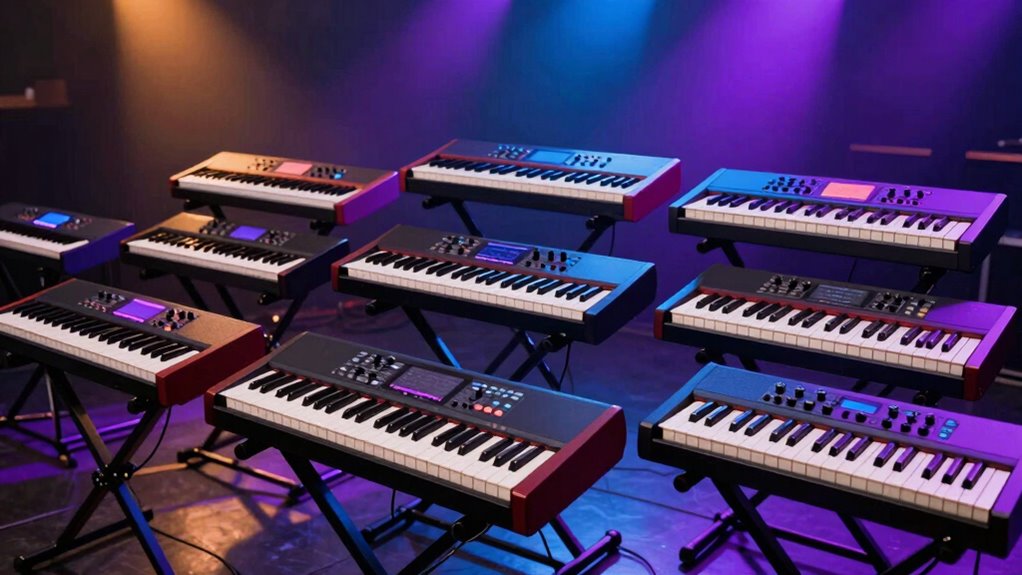
For an arranger keyboard for live performance, I’d choose the Yamaha PSR-SX920 as the best overall pick for its performance-focused arranger features, while the Korg Pa5X stands out for players who want a larger, more workstation-like setup and the Yamaha PSR-SX620 for a simpler, more approachable rig. The main tradeoff is between live control and depth on one side, and portability, ease of use, and cost on the other. A 61-key model is easier to transport, while a 76-key instrument gives more room for two-handed parts without changing octaves. This roundup includes a duplicate PSR-SX920 listing, so it represents 12 distinct models rather than 13. Read on for the full breakdown of which option fits your stage setup, experience, and musical needs.

Get audio and creator gear delivered free with Prime
- Fast, free delivery on millions of items
- Prime Video, Amazon Music and more included
- Member-only deals all year
Complete the kit


Key Takeaways
- The Yamaha PSR-SX920 is the strongest all-around live choice in this lineup, balancing arranger capability with a manageable 61-key format; the duplicate listing does not represent a second distinct model.
- The Korg Pa5X and Yamaha GENOS2 sit in a different class of stage setup: their 76-key formats better suit players who need more range and performance flexibility, but ask for more space and transport planning.
- The Yamaha PSR-SX620 offers a more focused middle ground than the entry-level PSR-E483, PSR-E583, Casio CT-X700, and CT-X5000 models, which suit simpler rigs and developing players better than demanding arranger workflows.
- Specialized needs can outweigh a general ranking: the Yamaha PSR-A5000 is the clear world-music-focused option, while the Korg Pa1000 and Korg i3 offer distinct alternatives to Yamaha’s lineup.
- Key count and control layout matter as much as sound variety on stage: portability favors 61-key instruments, while players who perform layered or wide-range parts may prefer a 76-key model despite its larger footprint.
| Yamaha PSR-SX720+ 61-Key Arranger Keyboard |  | Best Overall for Hands-On Live Control | Keys: 61 | Voices: Over 1,300 | Styles: 450 | VIEW ON AMAZON | See Our Full Breakdown |
| Yamaha PSR-SX620 61-Key Arranger Keyboard |  | Best Value for a Full-Featured Yamaha Arranger | Keys: 61 | Instrument Voices: Over 1,000 | Preset Styles: 450 | VIEW ON AMAZON | See Our Full Breakdown |
| Korg Pa1000 61-Key Professional Arranger Keyboard |  | Best for Vocal-Centered Live Sets | Keys: 61 | Sounds: Over 1,700 | Styles: Over 420 | VIEW ON AMAZON | See Our Full Breakdown |
| Yamaha PSR-E483 61-Key Touch-Sensitive Portable Keyboard |  | Best Lightweight Pick for Smaller Gigs | Keys: 61 | Voices: 860 | Styles: 345 | VIEW ON AMAZON | See Our Full Breakdown |
| Yamaha PSR-SX920 61-Key Arranger Keyboard |  | Best for Players Seeking a Genos-Inspired Sound Profile | Keys: 61 | Instrument: Electronic arranger keyboard | Sound profile: Diverse and up-to-date | VIEW ON AMAZON | See Our Full Breakdown |
| Yamaha PSR-A5000 61-Key World Music Arranger Keyboard |  | Best for World Music Performers | Keys: 61 | Weight: 25.4 pounds | Dimensions: 17 x 14.06 x 5.5 inches | VIEW ON AMAZON | See Our Full Breakdown |
| Korg Pa5X 76-Key Arranger Workstation |  | Best for Full-Range Arranger Workflows | Keys: 76 semi-weighted | Sounds: 2,000+ | Styles: 500+ | VIEW ON AMAZON | See Our Full Breakdown |
| Yamaha PSR-SX920 61-Key Arranger Keyboard |  | Best for Polished, Flexible Live Sets | Keys: 61 | Display: 7-inch TFT touchscreen | Weight: 15,536 g | VIEW ON AMAZON | See Our Full Breakdown |
| Yamaha PSR-E583 61-Key Touch-Sensitive Portable Keyboard |  | Best for Accessible, Self-Contained Gigs | Keys: 61 | Voices: 890 | Accompaniment styles: 345 | VIEW ON AMAZON | See Our Full Breakdown |
| Casio CT-X5000 61-Key Arranger Keyboard |  | Best for Built-In Live Connections and Recording | Keys: 61 | Tones: 800 editable | Rhythms: 235 | VIEW ON AMAZON | See Our Full Breakdown |
| Yamaha GENOS2 76-Key Arranger Keyboard |  | Best Premium Stage Arranger | Keys: 76 | Display: 9-inch touchscreen | Input: Combo XLR/1/4-inch mic/line input | VIEW ON AMAZON | See Our Full Breakdown |
| Casio CT-X700 61-Key Portable Arranger Keyboard with Stand |  | Best Value Starter Setup | Keys: 61 | Sounds: 600 | Rhythms: 195 | VIEW ON AMAZON | See Our Full Breakdown |
| Korg i3 Arranger Keyboard – Silver |  | Best Battery-Powered Portable Arranger | Keys: 61 full-sized, velocity-sensitive | Sounds: Over 800 | Sound set: GM2 | VIEW ON AMAZON | See Our Full Breakdown |
| arranger keyboard for live performance | Keys | Connectivity | Weight | Dimensions |
|---|---|---|---|---|
| Yamaha PSR-SX720+ 61-Key Arran | 61 | Auxiliary, Bluetooth | 25.6 pounds | 17 x 40.06 x 5.5 inches |
| Yamaha PSR-SX620 61-Key Arrang | 61 | Auxiliary, Bluetooth | — | — |
| Korg Pa1000 61-Key Professiona | 61 | USB | 33.2 pounds | — |
| Yamaha PSR-E483 61-Key Touch-S | 61 | USB | 15 pounds | 39.05 x 15.9 x 5.35 inches |
| Yamaha PSR-SX920 61-Key Arrang | 61 | — | — | 46.22 x 20.12 x 9.69 inches |
| Yamaha PSR-A5000 61-Key World | 61 | USB Type B, auxiliary, 3.5 mm headphone jack | 25.4 pounds | 17 x 14.06 x 5.5 inches |
| Korg Pa5X 76-Key Arranger Work | 76 semi-weighted | Auxiliary | 17.4 kg | — |
| Yamaha PSR-SX920 61-Key Arrang | 61 | USB | 15,536 g | 40.04 x 16.97 x 5.47 inches |
| Yamaha PSR-E583 61-Key Touch-S | 61 | USB | 16 pounds | 39.1 x 15.9 x 5.4 inches |
| Casio CT-X5000 61-Key Arranger | 61 | USB MIDI, USB device port, auxiliary input, headphone jack, 1/4-inch line outputs, microphone input | — | — |
| Yamaha GENOS2 76-Key Arranger | 76 | — | — | 48.56 × 5.43 × 17.93 inches |
| Casio CT-X700 61-Key Portable | 61 | Audio input and USB-MIDI | — | — |
| Korg i3 Arranger Keyboard | 61 full-sized, velocity-sensitive | USB-to-host, USB-to-device, headphones, foot controllers, MIDI | — | — |
More Details on Our Top Picks
Yamaha PSR-SX720+ 61-Key Arranger Keyboard
I’d put the PSR-SX720+ first for performers who want a broad backing-track palette without giving up real-time control. Its 1,300-plus Voices and 450 Styles offer more sound choices than the PSR-SX620’s stated 1,000-plus Voices, while the touchscreen, assignable knobs, and joystick make it easier to shape parts during a set. The chord looper can keep a progression moving while you play over it, a useful solo-performance option. Compared with the Korg Pa1000, this Yamaha is lighter and offers Bluetooth connectivity, but the Korg lists built-in 2 x 33W speakers and TC-Helicon vocal effects. The tradeoff here is transport and range: at 25.6 pounds it is not the lightest pick, and its 61 keys may constrain two-handed parts that need a wider span.
Pros:- More than 1,300 Voices and 450 accompaniment Styles provide broad set-list coverage.
- Touchscreen, assignable Live Control knobs, and joystick support hands-on adjustments.
- Chord looper can sustain a progression while the player performs another part.
- Bluetooth and auxiliary connectivity support audio playback options.
Cons:- At 25.6 pounds, it is heavier to transport than the 15-pound PSR-E483.
- The 61-key layout may restrict players who need a wider range for live parts.
Best for: Solo performers who want flexible accompaniment, quick sound adjustments, and a large range of Voices and Styles in a 61-key setup.
Not ideal for: Players who need a wider keyboard range or frequently carry their instrument between venues and want the lightest option.
- Keys:61
- Voices:Over 1,300
- Styles:450
- Controls:Touchscreen, assignable Live Control knobs, joystick
- Special features:Super Articulation+ Voices, chord looper, digital effects
- Connectivity:Auxiliary, Bluetooth
- Weight:25.6 pounds
- Dimensions:17 x 40.06 x 5.5 inches
Our verdict“Choose the PSR-SX720+ if live control and a deep sound library matter more than minimizing carry weight or gaining extra keys.”
Yamaha PSR-SX620 61-Key Arranger Keyboard
The PSR-SX620 is the practical pick for players who want a substantial arranger setup without stepping up to the SX720+’s larger Voice library. It still supplies 450 Styles, automatic rhythm, bass, and harmony, plus a chord looper—tools that can fill out a solo performance rather than leaving the keyboardist to cover every part. Built-in speakers with improved bass response are useful for rehearsal or smaller settings where bringing a separate monitor is inconvenient. Compared with the PSR-SX720+, it lists fewer Voices, but keeps Bluetooth, a touchscreen, assignable knobs, and a joystick according to its description. Its 61-key range and corded power are the main limits: it suits a set built around accompaniment more than parts needing a broad keyboard span or power away from an outlet.
Pros:- 450 preset Styles provide extensive accompaniment choices.
- Automatic rhythm, bass, and harmony can support a one-player performance.
- Built-in speakers with improved bass response reduce reliance on external playback for practice.
- Bluetooth audio and chord looper add useful playback and performance options.
Cons:- Its stated 1,000-plus Voices are fewer than the PSR-SX720+’s 1,300-plus.
- The 61-key layout may limit parts that need a broader range.
- Corded electric power limits use where an outlet is unavailable.
Best for: Gigging soloists and home performers who want Yamaha accompaniment, onboard speakers, Bluetooth audio, and a chord looper in one 61-key instrument.
Not ideal for: Players who need a larger key range, battery-powered operation, or the PSR-SX720+’s higher stated Voice count.
- Keys:61
- Instrument Voices:Over 1,000
- Preset Styles:450
- Accompaniment:Rhythm, bass, and harmonies respond to played chords
- Special features:Chord looper, Smart Chord, digital effects
- Connectivity:Auxiliary, Bluetooth
- Power source:Corded electric
- Warranty:1 year manufacturer
Our verdict“Pick the PSR-SX620 for a capable Yamaha arranger with strong accompaniment features when the SX720+’s expanded Voice count is not a priority.”
Korg Pa1000 61-Key Professional Arranger Keyboard
For performers who sing as well as play, the Korg Pa1000 earns its place through a combination that none of the listed Yamaha models match: TC-Helicon vocal effects and a built-in 2 x 33W speaker system. Those additions can make a self-contained setup more useful for small performances, while more than 1,700 sounds and over 420 Styles give the keyboardist plenty of material to shape a set. Compared with the PSR-SX720+, the Pa1000 lists more sounds and dedicated vocal processing, but it is substantially heavier at 33.2 pounds and its dimensions point to a larger instrument. Its 600 MB of user-sample storage is a draw for players building custom sounds; the tradeoff is that the provided connectivity details list USB, rather than the Yamaha’s Bluetooth. This is the specialist choice, not the easiest carry-on option.
Pros:- TC-Helicon vocal effects are tailored to performers who sing while playing.
- Built-in 2 x 33W speakers support a more self-contained performance setup.
- Over 1,700 sounds and more than 420 Styles offer broad musical coverage.
- 600 MB of user-sample storage supports custom sound use.
Cons:- At 33.2 pounds, it is heavier than the PSR-SX720+ and PSR-E483.
- Its listed dimensions make it a sizable instrument to transport and position.
- The supplied connectivity data lists USB but not Bluetooth.
Best for: Singers who accompany themselves and want vocal effects, onboard speakers, and room for user samples in a performance arranger.
Not ideal for: Gigging keyboardists who prioritize a lighter instrument, compact transport, or listed Bluetooth connectivity.
- Keys:61
- Sounds:Over 1,700
- Styles:Over 420
- User sample storage:600 MB
- Display:7-inch TFT color touchscreen
- Vocal processing:TC-Helicon effects
- Speakers:2 x 33W
- Weight:33.2 pounds
- Connectivity:USB
Our verdict“Choose the Pa1000 if vocal processing and onboard speaker power outweigh its heavier, larger build.”
Yamaha PSR-E483 61-Key Touch-Sensitive Portable Keyboard
The PSR-E483 is the portability-minded choice in this group: at 15 pounds, it is notably lighter than the PSR-SX720+ and Korg Pa1000, while still offering 860 Voices and 345 Styles. That makes it a sensible fit for players who need arranger backing for rehearsals, casual performances, or smaller venues, rather than the most expansive sound library available. Its Auto Chord Play can handle preset progressions while a style runs, and the pitch bend wheel and Live Control knob give players a way to add expression without reaching for a touchscreen. The Mega Boost button adds 6 dB of volume, though it is not a substitute for a full PA in louder rooms. Compared with the PSR-SX620, it is lighter but lists fewer Styles and does not list Bluetooth.
Pros:- At 15 pounds, it is lighter than the PSR-SX720+ and Pa1000.
- 860 Voices and 345 Styles provide varied material for compact live sets.
- Auto Chord Play can run preset progressions alongside accompaniment.
- Pitch bend wheel, Live Control knob, and 6 dB Mega Boost add practical performance controls.
Cons:- Its 345 Styles are fewer than the 450 listed for the PSR-SX620 and PSR-SX720+.
- USB is the listed connectivity; Bluetooth is not specified.
- The 39.05-inch length may still take up space during transport.
Best for: Players who carry their keyboard to rehearsals and small performances and want built-in speakers, accompaniment Styles, and expressive controls.
Not ideal for: Performers who need Bluetooth audio, a deeper Style library, or a keyboard intended to cover louder rooms without external amplification.
- Keys:61
- Voices:860
- Styles:345
- Weight:15 pounds
- Dimensions:39.05 x 15.9 x 5.35 inches
- Performance controls:Pitch bend wheel, Live Control knob, Auto Chord Play, Mega Boost
- Connectivity:USB
- Headphone jack:3.5 mm
Our verdict“Choose the PSR-E483 when lower carry weight matters more than the larger libraries and Bluetooth features of the SX-series models.”
Yamaha PSR-SX920 61-Key Arranger Keyboard
The PSR-SX920 is the most appealing option here for buyers drawn to a modern sound profile inspired by Yamaha’s Genos-2 line. That positioning may suit performers who want a contemporary arranger at the center of a polished set, but the supplied product details are much thinner than those for the PSR-SX720+ or Korg Pa1000: they name a 61-key layout and a diverse, up-to-date sound profile without specifying Voice or Style counts, controls, speakers, or connectivity. I would not rank it above those better-documented alternatives for a feature-led live setup. Its listed dimensions—46.22 inches long—also suggest more transport burden than the lighter PSR-E483. This pick makes sense when the Genos-2-inspired sound direction is the main draw; buyers who need confirmed live controls or accompaniment details should compare the SX720+ first.
Pros:- Genos-2-inspired sound direction offers a modern alternative to the documented SX720+ feature set.
- 61 keys provide a familiar format for arranger performance.
- The product description identifies a diverse, up-to-date sound profile.
Cons:- The supplied specifications do not state Voice or Style counts.
- Controls, speaker details, and connectivity are not specified in the supplied product data.
- At 46.22 inches long, it may be less convenient to transport than the 15-pound PSR-E483.
Best for: Yamaha players who prioritize a modern, Genos-2-inspired sound direction and are comfortable checking detailed performance features before buying.
Not ideal for: Buyers who need clearly specified Voice and Style counts, live-control details, connectivity information, or a compact instrument for frequent transport.
- Keys:61
- Instrument:Electronic arranger keyboard
- Sound profile:Diverse and up-to-date
- Style:Modern
- Dimensions:46.22 x 20.12 x 9.69 inches
- Color:Multicoloured
- Unit count:1
Our verdict“Consider the PSR-SX920 for its stated Genos-2-inspired sound profile, but favor the SX720+ if confirmed live features and accompaniment details are your priority.”
Yamaha PSR-A5000 61-Key World Music Arranger Keyboard
The PSR-A5000 is the clearest choice here for performers whose repertoire calls for regional sounds and tunings. Its voices include instruments such as oud, qanun, and nay, while scale-tuning presets help adapt the keyboard to traditions that do not use standard equal temperament. The assignable joystick and knobs give players ways to shape sounds during a set rather than stopping to edit menus. Compared with the Yamaha PSR-SX920, this model puts more emphasis on world-music resources than on its Chord Looper and broader general-purpose workflow. The tradeoff is its 61-key range and 25.4-pound weight: it is not the easiest option to carry, and players needing a wider compass may prefer the 76-key Korg Pa5X. Its specialized focus is less useful for conventional pop-only sets.
Pros:- World-music voices and styles include oud, qanun, nay, and Turkish strings.
- Scale-tuning presets support repertoire outside standard equal temperament.
- Assignable joystick and knobs provide hands-on sound and effect control.
- Expressive articulation and velocity-sensitive portamento add performance nuance.
Cons:- At 25.4 pounds, it is relatively demanding to transport.
- The 61-key range may restrict players who need a wider register.
- Its specialized sound palette may be less useful for general-purpose cover sets.
Best for: Live performers whose setlists use Middle Eastern or other world-music sounds and nonstandard tunings.
Not ideal for: Players who need 76 keys, a lighter keyboard for frequent travel, or mainly standard pop and rock sounds.
- Keys:61
- Weight:25.4 pounds
- Dimensions:17 x 14.06 x 5.5 inches
- Model:PSR-A5000
- Performance controls:Assignable joystick and knobs
- Tuning features:Scale tuning presets
- Connectivity:USB Type B, auxiliary, 3.5 mm headphone jack
- Power source:USB
Our verdict“Choose the PSR-A5000 when world-music voices and alternate tunings matter more than a wider keyboard or lighter gig load.”
Korg Pa5X 76-Key Arranger Workstation
For players who want an arranger to serve as the center of a demanding live setup, the Korg Pa5X offers the broadest stage-oriented workstation approach in this group. Its 76 semi-weighted keys provide more room for two-handed parts and splits than the 61-key Yamaha PSR-SX920 or PSR-A5000. The large library of sounds, styles, and keyboard sets gives performers many ready-made starting points, while sound transition support helps avoid abrupt changes when moving between parts of a set. Dual sequencers also suit players who build performance material on the instrument. That breadth comes with a substantial 17.4 kg weight, making it less appealing for frequent load-ins than lighter options. The listed connectivity is limited to auxiliary, so buyers who need clearly specified USB or dedicated output options should check their setup requirements before choosing it.
Pros:- 76 semi-weighted keys offer more range and a firmer playing feel than the 61-key models here.
- Large sound, style, and keyboard-set libraries provide extensive live setup choices.
- Sound transition support helps maintain continuity when changing styles, songs, or keyboard sets.
- Dual sequencers support performance arrangements prepared on the instrument.
Cons:- At 17.4 kg, it is a heavy choice for regular transport.
- Auxiliary is the only connection type specified in the supplied product data.
- Its extensive workstation feature set may be more than a straightforward accompaniment player needs.
Best for: Gigging keyboardists who need a wider playing range, many ready-to-call-up sounds, and sequencer tools in one instrument.
Not ideal for: Frequent public-transit performers or players who need a lightweight keyboard and clearly documented USB or multiple output connections.
- Keys:76 semi-weighted
- Sounds:2,000+
- Styles:500+
- Keyboard sets:400+
- Display:8-inch high-resolution tiltable touchscreen
- Maximum polyphony:160 voices
- Weight:17.4 kg
- Connectivity:Auxiliary
Our verdict“Pick the Pa5X if you value a 76-key range and workstation flexibility enough to accept a heavier, more involved setup.”
Yamaha PSR-SX920 61-Key Arranger Keyboard
The PSR-SX920 earns this spot by balancing hands-on control with practical tools for changing material onstage. Its 7-inch touchscreen, programmable knobs, and joystick make sound adjustments accessible during performance, while the Chord Looper can capture a chord sequence for repeated use. Expressive voices and accompaniment styles suit players who want arrangements to feel more developed than a basic backing pattern. Compared with the world-focused PSR-A5000, the SX920 is the more general-purpose pick; compared with the PSR-E583, it offers a more performance-oriented control and sequencing setup. The main compromise is its 61-key layout, which can feel cramped for wide splits or extensive two-handed parts. At about 15.5 kg, it also demands more effort to move than its portable designation might suggest.
Pros:- Chord Looper supports repeating chord progressions during live arrangements.
- Joystick and programmable knobs allow real-time performance adjustments.
- Seven-inch touchscreen provides a substantial interface for selecting and managing sounds.
- Expressive voices and accompaniment styles suit polished solo or small-band parts.
Cons:- The 61-key range may limit wide splits and extended two-handed playing.
- Its listed weight of 15,536 g makes frequent transport less convenient.
- USB is the only connectivity type specified in the supplied product data.
Best for: Professional solo performers and small-band keyboardists who want responsive live controls, accompaniment styles, and chord-looping tools.
Not ideal for: Players who need 76 keys or regularly carry their keyboard without a vehicle.
- Keys:61
- Display:7-inch TFT touchscreen
- Weight:15,536 g
- Dimensions:40.04 x 16.97 x 5.47 inches
- Connectivity:USB
- Headphone jack:3.5 mm
- Special features:Chord Looper, advanced sequencer, programmable controls, recording
- Supported software:EXPANSION EXPLORER App
Our verdict“Choose the PSR-SX920 for a feature-rich 61-key live setup with chord looping and direct controls, provided its weight and range fit your gigs.”
Yamaha PSR-E583 61-Key Touch-Sensitive Portable Keyboard
The PSR-E583 is the approachable pick for players who want arranger backing without stepping up to the more elaborate controls of the PSR-SX920. Its 890 voices and 345 styles cover a broad range of material, while Auto Chord Play can provide chord progressions alongside a selected style. Built-in speakers let a player practice or play in a small setting without assembling a separate sound system, and Mega Boost adds volume when more projection is needed. Live Control knobs and pitch and modulation wheels offer more expression than a basic home keyboard. Compared with the Casio CT-X5000, the E583 has fewer listed rhythm options and lacks the Casio’s 17-track recorder and specified line and microphone connections. Its 16-pound weight and 61-key range also make it less convenient for some travel and larger arrangements.
Pros:- 890 voices and 345 accompaniment styles cover varied performance needs.
- Auto Chord Play supplies chord progressions while a style is running.
- Built-in speakers support practice and small settings without separate amplification.
- Live Control knobs and pitch and modulation wheels add hands-on expression.
Cons:- The 61-key layout may restrict wide splits or parts requiring more range.
- At 16 pounds, it is not the lightest option for frequent carrying.
- The specified headphone connection is a 3.5 mm jack, and USB is the listed connectivity.
Best for: Developing performers and casual gigging players who want built-in speakers, broad accompaniment choices, and simple live controls.
Not ideal for: Players who need a 76-key range, extensive recording tools, or a clearly specified set of dedicated line and microphone connections.
- Keys:61
- Voices:890
- Accompaniment styles:345
- Weight:16 pounds
- Dimensions:39.1 x 15.9 x 5.4 inches
- Connectivity:USB
- Headphone jack:3.5 mm
- Special features:Built-in speakers, Auto Chord Play, Live Control knobs, Pitch Bend wheel, Mega Boost
Our verdict“Choose the PSR-E583 for accessible accompaniment, onboard sound, and practical live controls rather than advanced sequencing or a wide keybed.”
Casio CT-X5000 61-Key Arranger Keyboard
The Casio CT-X5000 stands apart from the Yamaha PSR-E583 by focusing on stage connections and onboard production tools. Its 30 W speakers, microphone input, auxiliary input, and quarter-inch line outputs make it easier to build a self-contained setup or connect directly to live sound gear. The 17-track recorder and 128 registration slots also help players prepare and recall material without relying only on a computer. With 800 editable tones, 235 rhythms, and editable DSP effects, there is room to tailor sounds, though the E583 lists more voices and accompaniment styles. The CT-X5000 remains a 61-key instrument, so it cannot match the wider playing range of the Korg Pa5X. Its stated weight of 1 kg is unusually low for this class; buyers may want to verify that figure before planning transport.
Pros:- Quarter-inch line outputs and a microphone input support practical live setups.
- 30 W onboard speakers can reduce the need for separate amplification in smaller settings.
- 17-track recorder and 128 registration slots support prepared sets and quick recall.
- Editable tones and DSP effects allow substantial sound customization.
Cons:- The 61-key range is narrower than the Korg Pa5X’s 76-key layout.
- Its 235 rhythms are fewer than the 345 styles listed for the Yamaha PSR-E583.
- The supplied 1 kg weight is unusually low for this keyboard and should be verified before transport planning.
Best for: Solo performers and small acts who want onboard speakers, a microphone input, direct line outputs, and recording features in one keyboard.
Not ideal for: Players who need more than 61 keys, a larger listed accompaniment library, or want to rely on the supplied weight figure without checking it.
- Keys:61
- Tones:800 editable
- Rhythms:235
- DSP effects:100 editable
- Recorder:17-track
- Registration slots:128
- Speakers:30 W
- Connectivity:USB MIDI, USB device port, auxiliary input, headphone jack, 1/4-inch line outputs, microphone input
Our verdict“Pick the CT-X5000 if built-in audio, microphone and line connections, and onboard recording matter more than a larger accompaniment library.”
Yamaha GENOS2 76-Key Arranger Keyboard
The GENOS2 is the premium live-performance choice here for players who want broad accompaniment and expressive sounds in a single instrument. Its 76 keys provide more room for two-handed parts than the 61-key Korg i3, while the 9-inch touchscreen gives performers a large control surface for selecting sounds and styles. Super Articulation 2 voices add performance nuances to instrument parts, and the adjustable drum-mic blend lets players shape the balance between close and room ambience. A combo input also supports a microphone or instrument, with optional phantom power for compatible microphones. Those stage-focused tools come with tradeoffs: it needs corded power, phantom power is optional, and the provided details do not establish portability or built-in amplification. Compared with the Casio CT-X700, this is a more performance-oriented pick, not the simpler, stand-included option.
Pros:- 76 keys offer more range for live parts than 61-key options such as the Korg i3.
- Super Articulation 2 voices add expressive nuances to non-keyboard instrument sounds.
- Adjustable close-mic and ambient drum blend provides control over accompaniment character.
- Combo XLR/quarter-inch input accepts a microphone or instrument.
Cons:- Corded-electric power limits use away from a suitable outlet.
- 48V phantom power is optional rather than included as a standard feature.
- The large feature set and listed dimensions may be a poor fit for players prioritizing a compact, simple setup.
Best for: Gigging keyboardists who want 76 keys, extensive arranger content, expressive voices, and an input for a microphone or instrument.
Not ideal for: Players who need a battery-powered setup, a low-complexity portable keyboard, or confirmed built-in speakers for quick rehearsals without external gear.
- Keys:76
- Display:9-inch touchscreen
- Input:Combo XLR/1/4-inch mic/line input
- Phantom power:Optional 48V
- Special features:Chord looper, accompaniment styles, Super Articulation 2 voices, adjustable ambient drum mic blend
- Power:Corded electric
- Dimensions:48.56 × 5.43 × 17.93 inches
- Color:Black
Our verdict“Choose the GENOS2 if your live rig benefits from 76 keys, detailed arranger control, and expressive voices more than from battery portability or simplicity.”
Casio CT-X700 61-Key Portable Arranger Keyboard with Stand
The CT-X700 makes sense for a newer performer who wants a broad palette of sounds and rhythms without assembling every part of a practice setup separately. Its 600 sounds and 195 rhythms offer room to try different arrangements, and the included X-style stand means one less essential piece of gear to source. The larger LCD and enhanced effects support hands-on sound selection, while audio input and USB-MIDI cover basic connections to external audio and a computer. Compared with the more stage-focused Yamaha GENOS2, the Casio is a simpler, lighter-on-specification option; it does not list the GENOS2’s 76 keys, combo mic/line input, or specialized drum ambience controls. The listed details also do not confirm built-in speakers, amplification, or battery operation, so I would not assume it can serve as a self-contained busking rig. Its appeal is the included stand and creative range, not proof of full live-stage readiness.
Pros:- 600 sounds and 195 rhythms provide a wide range of starting points for arrangements.
- Included X-style stand reduces the need to source a separate support.
- Larger LCD and enhanced effects support sound selection and tone shaping.
- USB-MIDI and audio input offer useful connections for computer-based work and external audio.
Cons:- Product details do not confirm built-in speakers or amplification.
- Battery and power options are not specified in the provided information.
- Its 61-key layout and listed features are less stage-specialized than the Yamaha GENOS2.
Best for: Beginning performers and home-to-small-gig players who want many rhythms and sounds plus an included stand for a ready-to-assemble setup.
Not ideal for: Buskers or gigging players who need confirmed built-in speakers, specified battery power, or dedicated microphone inputs for a self-contained stage rig.
- Keys:61
- Sounds:600
- Rhythms:195
- Display:Larger LCD display
- Effects:Enhanced digital effects
- Connectivity:Audio input and USB-MIDI
- Included accessory:X-style stand
Our verdict“Pick the CT-X700 for an accessible, stand-included arranger with plenty of sounds, but choose a better-documented stage rig if amplification and power flexibility matter.”
Korg i3 Arranger Keyboard – Silver
The Korg i3 stands out for performers who value a portable setup and a large sound library more than an extended keyboard range. It pairs over 800 sounds and 59 custom drum kits with 61 velocity-sensitive keys, giving players plenty of material for live parts while keeping the instrument more compact than the 76-key Yamaha GENOS2. Its support for six AA batteries is a useful distinction for rehearsals or locations where mains power is inconvenient; USB connections, MIDI, foot-controller support, and performance recording broaden its role beyond playing accompaniment. The tradeoff is that the supplied details say it has no built-in speakers, so live performance still calls for external amplification. Players who need extra range may prefer the GENOS2, while anyone wanting a stand included should look at the Casio CT-X700. The i3’s controls may also take time to learn, and its display is described as bright but not specified by size.
Pros:- Battery operation with six AA batteries supports use away from a mains outlet.
- Over 800 sounds and 59 custom drum kits offer broad material for live arrangements.
- Velocity-sensitive keys respond to playing dynamics.
- Performance recording, MIDI connectivity, and USB connections add options for capturing and transferring work.
Cons:- No built-in speakers are specified, so live use requires external amplification.
- The 61-key range may limit players who need a wider two-handed span.
- The interface may take time to learn, especially for performers seeking immediate, simple control.
Best for: Portable performers and songwriters who want battery operation, a large sound and drum selection, and recording or MIDI export for developing arrangements.
Not ideal for: Players who need more than 61 keys, built-in speakers for unamplified playing, or a highly familiar interface from the start.
- Keys:61 full-sized, velocity-sensitive
- Sounds:Over 800
- Sound set:GM2
- Drum kits:59 custom
- Power:6 × AA batteries
- Connectivity:USB-to-host, USB-to-device, headphones, foot controllers, MIDI
- Recording:Performance recording and MIDI export
- Display and controls:Bright display, illuminated buttons
Our verdict“Choose the i3 if battery-powered portability and its extensive sound library matter more than built-in amplification or the GENOS2’s wider keyboard.”

How We Picked
I ranked these keyboards for actual live-performance priorities: how well each model fits a stage rig, how much control and arranging capability it offers, how manageable it is to transport, and how approachable it is to operate during a set. I also weighed key count, the likely learning curve, and whether a model appears better suited to a focused role—such as world-music performance or entry-level playing—than to broad professional use. I did not treat a long feature list as a substitute for practical stage fit.
The order favors instruments that balance live capability, usability, and portability, then places more specialized, premium, and beginner-oriented choices according to the players they serve best. The PSR-SX920 appears twice in the supplied list; I treat those entries as one model, not two separate recommendations. Exact ranking can still depend on a player’s preferred controls, repertoire, sound requirements, and the rest of their rig, so I call out cases where a lower-ranked or more specialized keyboard may be the better match.
Factors to Consider When Choosing Arranger Keyboard For Live Performance
Choosing a stage arranger involves more than picking the model with the broadest feature set. I’d start with how you perform, how much you need to carry, and whether you want the keyboard to handle the whole arrangement or simply support a band or solo set.
Match the Keyboard to Your Live Arrangement
First decide how much of the performance the keyboard needs to cover. A solo performer may rely on arranger accompaniment to fill out a complete song, while a band player may use the same instrument mainly for sounds, fills, and occasional backing parts. These jobs place different demands on controls and setup: a solo act benefits from quick access to accompaniment changes, while a band player may care more about selecting sounds without interrupting a performance. A common mistake is buying for the most elaborate possible arrangement, then finding the interface slower than the set requires. Make a shortlist of the changes you need to trigger during a song, and favor a layout that makes those actions easy to reach. If your show uses backing tracks or external gear, check how the keyboard fits that workflow before paying for arranger functions you may rarely use.
Choose 61 or 76 Keys Around Your Repertoire
Key count changes both your playing options and your load-in. A 61-key instrument is easier to fit into a compact stand setup and easier to move between rehearsals, but wide-range parts may require octave shifts or careful compromises. A 76-key model gives your hands more room for piano-style playing, splits, and layered parts without reaching for an octave button as often. More keys do not automatically make a keyboard better for every gig; they can add bulk that matters when you travel alone or have limited stage space. Think through the parts you actually play at once rather than choosing by key count as a proxy for quality. If your set depends on extensive two-handed parts, test whether a 61-key layout feels restrictive before committing to a smaller footprint.
Prioritize Stage Control Over a Long Feature List
During a live set, the best feature is often the one you can reach and use without losing your place. Look at how the instrument organizes sounds, accompaniment changes, and other controls you expect to use on stage; a deep feature set can slow down a player if important functions are buried. Build a practical checklist around your set: changing styles, calling up sounds, adjusting levels, and recovering quickly if you select the wrong setting. Do not assume that a keyboard with more functions will be more flexible under pressure. If possible, inspect the control layout or manual before buying, and map your most common live actions to specific buttons or menus. A simpler instrument may serve a tightly structured performance better than a more elaborate workstation.
Account for Transport, Setup, and Stage Space
A keyboard that works well at home can become a poor gig choice if it complicates every load-in. Include the instrument’s footprint, stand, case, power, and any pedals or other gear in your setup plan rather than considering the keyboard alone. Compact 61-key models can make a small stage or quick setup easier, while larger 76-key boards may justify their space for players who need the extra range. Another common mistake is forgetting that frequent transport makes protection and handling part of the ownership decision. Check that your stand can support the instrument securely and that your vehicle or storage area can accommodate the complete rig. For regular gigs, prioritize a setup you can carry, assemble, and pack consistently.
Spend More Only for Capabilities You Will Use
A premium arranger makes the most sense when its added performance depth solves a real problem in your set. Players who need extensive control, broader keyboard range, or a more workstation-oriented approach may get meaningful value from a higher-tier instrument. A beginner, occasional performer, or player with a simple backing setup may be better served by an approachable model that leaves more room to learn and refine the rig. Avoid paying for features just because they sound impressive in a specification list; ask how often they will appear in your actual performance. Consider maintenance and support too, especially if the keyboard is central to your income and downtime would disrupt booked work. The right upgrade is the one that removes a recurring limitation, not the one with the longest feature sheet.
Check Fit for Your Music and External Setup
Arranger keyboards differ in how well they match particular repertoires and working habits, so start with the sounds and accompaniment styles your audience expects. A specialized instrument may be a stronger choice than a general-purpose model when your music has distinctive regional or stylistic needs. Also check how the keyboard will work with your existing mixer, amplification, pedals, and any external sound sources; compatibility affects setup time and the number of extra devices you need. Do not assume that every model handles your preferred workflow in the same way simply because each is called an arranger keyboard. If you depend on a specific sound or connection, verify that detail in the manufacturer documentation before purchase. This step can prevent a mismatch that a broad category ranking cannot resolve.
Frequently Asked Questions
Is a 61-key arranger keyboard enough for playing live?
For many solo and band performances, 61 keys are enough, especially when the keyboard is used for accompaniment, melody, and layered sounds rather than extended piano parts. The smaller format can be easier to transport and fit on crowded stages. It may feel limiting if you play wide-range parts with both hands or need to keep a bass line and upper-register part available at once. Before choosing, list the parts you perform simultaneously and check whether octave shifts would interrupt your playing. If you regularly need more range under your hands, a 76-key option such as the Pa5X or GENOS2 may fit better.
Should I choose a premium arranger or a beginner-friendly model for my first gigs?
Choose based on the demands of your set, not on the idea that professional gigs always require the most advanced keyboard. A beginner-friendly model can work well when you need straightforward sounds and a manageable setup, while a premium arranger is easier to justify if you rely on advanced live control or broader performance flexibility. A more complex interface may add learning time, particularly if you need to make changes quickly during songs. Consider whether your current instrument is already limiting the performance, and identify the exact task you want an upgrade to improve. If you cannot name that limitation, a simpler model may be the more practical starting point.
What should a solo performer check before buying an arranger keyboard?
A solo performer should focus on how quickly the keyboard supports the full set, from choosing a backing style to changing accompaniment and sounds between songs. Check whether the controls you need are easy to access while playing and whether the available arrangement workflow matches your repertoire. Also plan for the rest of the rig: amplification, a stand, sustain or other pedals, and a way to transport the keyboard safely. A feature-rich instrument can be less useful if preparing or changing songs takes too long. If possible, review the manual and test the control flow with a song from your actual set list.
Is the Yamaha PSR-SX920 listed twice a different version?
No: the supplied product list names the Yamaha PSR-SX920 twice with the same 61-key arranger keyboard description. I count it as one distinct model rather than presenting the repeated listing as a separate choice. That means this roundup covers 12 distinct keyboards, despite the requested count of 13. Buyers should compare the PSR-SX920 with other models in the list rather than treating the duplicate entry as a separate configuration. Check the exact product listing and manufacturer details when comparing versions or included accessories.
When should I choose a specialized model instead of the best all-around pick?
A specialized model makes sense when it directly supports the music you perform or the way you work. For example, a world-music-focused keyboard may be a better fit for a repertoire that depends on those sounds and styles than a broadly capable general-purpose arranger. A larger workstation-style instrument can also be the better match if your playing needs more key range or a different performance workflow. The all-around choice is a useful starting point, not a rule that every performer should follow. Compare the specialist’s strengths with the specific requirements of your set, stage, and transport routine.
Conclusion
Best overall: I’d start with the Yamaha PSR-SX920 for a balanced live setup, while treating the repeated listing as the same model. Best value for a capable, straightforward rig: the Yamaha PSR-SX620 is a sensible middle-ground pick. Best premium: I’d look at the Korg Pa5X or Yamaha GENOS2 if you need a 76-key format and a more expansive performance instrument. Best for beginners: the Yamaha PSR-E483, PSR-E583, and Casio CT-X700 are more approachable starting points, with the right choice depending on your preferred workflow. Best for specific needs: the Yamaha PSR-A5000 suits world-music-focused players, while the Korg Pa1000 and Korg i3 offer alternatives for buyers drawn to Korg’s range. Choose the model that fits your repertoire, stage space, and control needs; the best live arranger is the one you can operate confidently throughout your set.