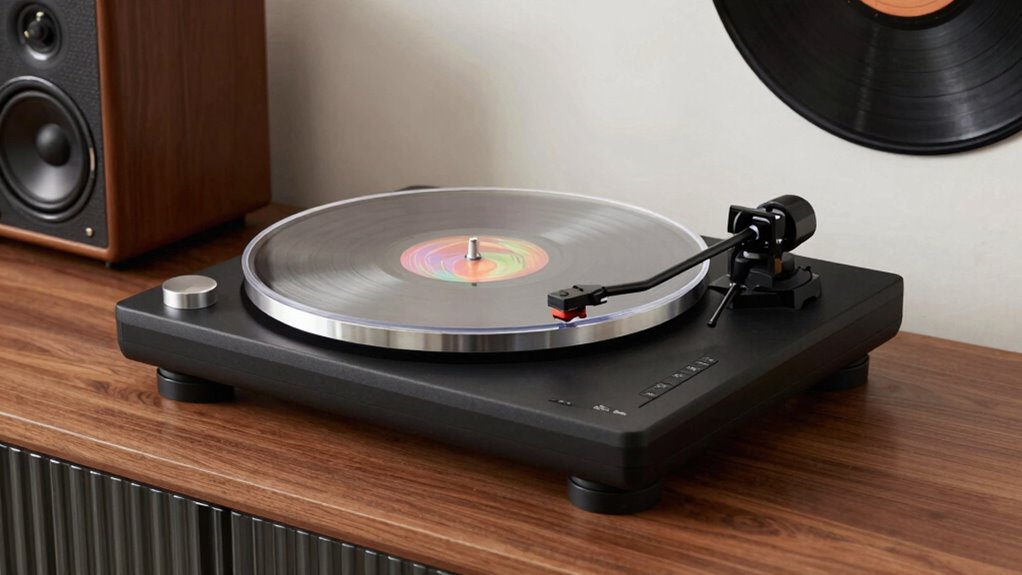

Choosing the right audiophile turntable under 1000 dollars requires balancing mechanical precision with sonic character. My top recommendation for most listeners is the Pro-Ject Debut Carbon EVO, which offers an exceptional carbon-fiber tonearm and a factory-mounted Sumiko Rainier cartridge that punches well above its price point. For those who prefer direct-drive mechanics and digital conversion capabilities, the Audio-Technica AT-LP120XUSB remains a versatile workhorse. The primary tradeoff in this bracket often lies between plug-and-play convenience and pure analog fidelity; automatic belt-drive models offer ease of use but may lack the granular detail of manual setups. Continue reading to see how these ten models stack up against each other in build quality, soundstage, and long-term value.

Get audio and creator gear delivered free with Prime
- Fast, free delivery on millions of items
- Prime Video, Amazon Music and more included
- Member-only deals all year
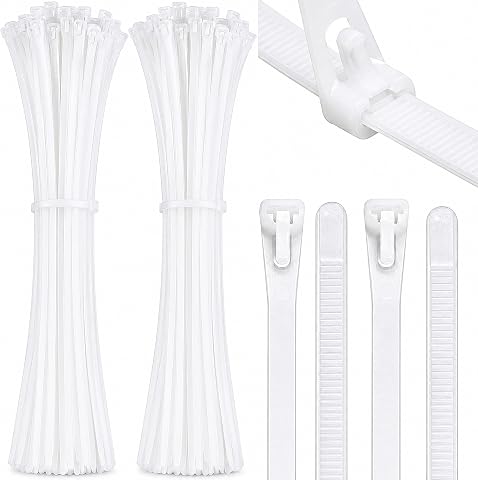
Complete the kit


Key Takeaways
- Manual belt-drive turntables like the Pro-Ject series generally offer superior soundstage separation compared to fully automatic models in this price range.
- Direct-drive motors, found in Pioneer and Technics models, provide higher torque and speed stability, making them better suited for DJing but sometimes introducing motor hum if not properly isolated.
- Cartridge quality is the single biggest variable in sound performance; upgrading a stock cartridge on a lower-tier deck often yields better results than buying a mid-tier deck with a basic stock cartridge.
- Bluetooth integration, seen in the Technics SL-40CBT, adds convenience but introduces compression that audiophiles should avoid by using wired connections to their amplifier.
- Build materials matter; carbon fiber and acrylic platters in models like the Pro-Ject Debut Carbon EVO reduce resonance more effectively than aluminum or plastic platters found on budget competitors.





| audiophile turntable under 1000 | Dimensions | Connectivity | Drive type | Speeds |
|---|---|---|---|---|
| Audio-Technica AT-LP70X Automa | 16 x 13 x 4.3 inches | — | Belt drive | 33-1/3 and 45 RPM |
| Gemini TT-5000 Direct-Drive Tu | — | — | Direct drive | 33, 45, and 78 RPM |
| 1 BY ONE High Fidelity Belt Dr | 17.32 x 7.56 x 14.57 inches | Bluetooth, RCA, and auxiliary input | Belt drive | 33 and 45 RPM |
| Audio-Technica AT-LP120XUSB-BK | — | USB and RCA output | Direct drive | 33, 45, and 78 RPM |
| Audio-Technica AT-LP60X-BK Ful | — | — | Belt drive | 33-1/3 and 45 RPM |
| Pioneer DJ PLX-500 Direct Driv | 17.72 × 14.49 × 6.26 inches | Wired; USB output | — | — |
| Technics SL-40CBT Premium Clas | 16.9 inches W × 5.0 inches H × 13.9 inches D | Bluetooth | — | — |
| Pro-Ject Debut Carbon EVO Turn | 16.3 × 4.6 × 12.6 inches | Wired; RCA output | — | — |
| Pro-Ject Debut Evo 2 Turntable | — | — | — | — |
| Pioneer DJ PLX-1000 Profession | 17.83 × 13.9 × 6.26 inches | Analog; compatible with mixer, PC, and speaker | — | — |
More Details on Our Top Picks
Audio-Technica AT-LP70X Automatic Turntable (Black/Bronze)
The AT-LP70X is the most approachable step into this group for listeners who want vinyl playback without managing a manual tonearm. Its automatic operation handles record start and return, while the AT-VM95C cartridge and upgradeable stylus give it more room to grow than the simpler AT-LP60X. A switchable preamp also lets me connect it to a system without a dedicated phono input. Its dampened, anti-resonance chassis supports a more considered setup than an all-in-one player, but this is still an entry-level design, not a substitute for the adjustment options on the manual AT-LP120XUSB. I would pick it for convenient, everyday listening; buyers focused on fine-tuning, 78 RPM records, or a more substantial audiophile platform should look elsewhere.
Pros:- Fully automatic start and return reduce handling for everyday listening.
- Switchable built-in preamp supports connection to systems without a phono input.
- AT-VM95C stylus is upgradeable, offering a path to later cartridge-family stylus changes.
- Dampened anti-resonance chassis is designed to limit unwanted vibration.
Cons:- Plays only 33-1/3 and 45 RPM records, unlike the AT-LP120XUSB’s 78 RPM support.
- Manual pitch and tracking adjustments are not part of its feature set.
- A stylus upgrade requires an additional purchase.
Best for: New vinyl listeners who want automatic operation, straightforward connection to an existing stereo, and a cartridge they can upgrade later.
Not ideal for: Hands-on listeners who want pitch adjustment, 78 RPM playback, or the more configurable manual setup of the AT-LP120XUSB.
- Drive type:Belt drive
- Operation:Fully automatic
- Speeds:33-1/3 and 45 RPM
- Cartridge:AT-VM95C
- Stylus:Conical 0.6 mil, upgradeable
- Preamp:Built-in, switchable
- Chassis:Dampened anti-resonance
- Dimensions:16 x 13 x 4.3 inches
- Warranty:2 years
Our verdict“Choose the AT-LP70X if convenient automatic playback matters more than advanced setup controls or 78 RPM support.”
Gemini TT-5000 Direct-Drive Turntable with 3-Speed, USB Recording & Built-in Preamp
The Gemini TT-5000 earns its place through flexibility rather than a strictly audiophile-first feature set. Its direct-drive motor, three speeds including 78 RPM, and pitch control suit collections that mix newer LPs with older records. USB output and a built-in preamp also make it easier to record vinyl to a computer or connect to a system without a phono stage. That makes it a more versatile archiving tool than the AT-LP70X, which prioritizes automatic listening and supports only two speeds. The tradeoff is that the supplied details offer fewer assurances about refinement and long-term support than the Audio-Technica options, and its one-year limited warranty is short. I would favor it for practical playback and digitization, not for buyers seeking the most polished enthusiast setup.
Pros:- Three-speed playback includes 78 RPM for compatible records.
- USB audio interface supports digital archiving.
- Built-in preamp and switchable RCA output broaden connection options.
- Direct drive and pitch control provide speed adjustment.
Cons:- One-year limited warranty is shorter than the AT-LP70X’s stated two-year warranty.
- Build and feature details may not satisfy buyers seeking a more refined enthusiast deck.
- Manual operation requires more involvement than the fully automatic AT-LP70X.
Best for: Vinyl collectors who need 78 RPM playback and want USB output for transferring records to a computer.
Not ideal for: Listeners prioritizing automatic operation, a longer stated warranty, or a turntable designed around extensive audiophile adjustment.
- Drive type:Direct drive
- Speeds:33, 45, and 78 RPM
- Built-in features:Preamp and USB audio interface
- Platter:Die-cast aluminum
- Pitch control:Included
- Included cartridge:Headshell with cartridge and stylus
- Outputs:USB and RCA
- Warranty:1-year limited
Our verdict“Pick the TT-5000 if 78 RPM playback and USB archiving matter more to you than automatic convenience or a more polished audiophile-focused design.”
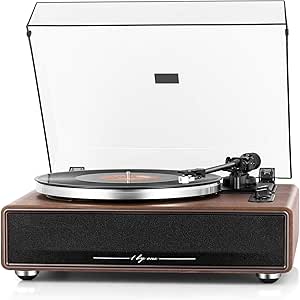
1 BY ONE High Fidelity Belt Drive Turntable with Built-in Speakers
The 1 BY ONE belt-drive turntable is the convenience pick for someone who wants a record player and speakers in one package. Its built-in speakers, Bluetooth connectivity, and auxiliary input reduce the need to assemble a separate system, while the adjustable counterweight and replaceable stylus offer more setup involvement than the automatic AT-LP60X. But that convenience sets a ceiling: built-in speakers are less suited to revealing the improvements a stronger cartridge or external system can bring. Unlike the AT-LP70X, the listed details do not specify a built-in phono preamp, so I would check system compatibility before planning a direct RCA connection to powered speakers. This is a practical first step for casual listening, not my pick for someone building a component-based audiophile system.
Pros:- Built-in speakers allow playback without a separate speaker purchase.
- Bluetooth and auxiliary input offer more listening options than the AT-LP60X.
- Adjustable counterweight gives users some control over setup.
- Replaceable Audio-Technica diamond-tipped stylus supports stylus replacement.
Cons:- Built-in speakers limit how much detail and soundstage a separate system could deliver.
- Supplied details do not specify a built-in phono preamp.
- Its 13.3-pound weight and larger footprint make it less convenient to move than a compact starter setup.
Best for: First-time listeners in a small room who want built-in speakers and Bluetooth without buying a separate stereo immediately.
Not ideal for: Audiophile listeners planning to use revealing external speakers or prioritizing a clearly specified preamp and a more upgrade-focused component system.
- Drive type:Belt drive
- Speeds:33 and 45 RPM
- Built-in speakers:Yes
- Connectivity:Bluetooth, RCA, and auxiliary input
- Stylus:Replaceable Audio-Technica diamond-tipped stylus
- Signal-to-noise ratio:60 dB
- Dimensions:17.32 x 7.56 x 14.57 inches
- Weight:13.3 pounds
Our verdict“Choose the 1 BY ONE for a self-contained first record player, but look to the AT-LP70X or a component turntable if sound-system upgrades are the priority.”
Audio-Technica AT-LP120XUSB-BK Direct-Drive Turntable (Analog & USB), Fully Manual, Hi-Fi, 3 Speed, Convert Vinyl to Digital, Anti-Skate and Variable Pitch Control, Black
The AT-LP120XUSB is the most adjustable option here, making it my pick for listeners who want to shape their setup rather than simply press play. Its direct-drive design, quartz speed lock, variable pitch, and adjustable anti-skate provide controls absent from the automatic AT-LP70X and AT-LP60X. It also plays 78 RPM records and includes USB output for archiving, so it can serve both a listening system and a digital library. The AT-VM95E cartridge adds a strong starting point, while a built-in preamp supports broader system compatibility. The cost of that flexibility is fully manual operation: there is no automatic start or return, and setup demands more attention. Compared with the simpler Gemini TT-5000, Audio-Technica specifies more adjustment and tonearm features, but neither is the low-effort choice.
Pros:- Direct drive with quartz speed lock supports stable speed control.
- Three speeds include 78 RPM playback.
- USB output supports converting records to digital files.
- Adjustable anti-skate and variable pitch offer control beyond the AT-LP70X.
Cons:- Fully manual operation requires hands-on record placement and tonearm handling.
- Pitch and tracking controls add setup complexity for beginners.
- The supplied product details state a one-year warranty.
Best for: Vinyl enthusiasts who want manual control, 78 RPM playback, USB transfers, and a turntable that can connect to varied audio systems.
Not ideal for: Listeners who want automatic operation or a simple plug-and-play player with minimal setup and handling.
- Drive type:Direct drive
- Operation:Fully manual
- Speeds:33, 45, and 78 RPM
- Cartridge:AT-VM95E dual magnet phono cartridge
- Connectivity:USB and RCA output
- Speed features:Quartz speed lock and variable pitch control
- Tracking features:Adjustable anti-skate
- Included accessories:USB cable, RCA cable, AC adapter, 45 RPM adapter, counterweight, felt mat, and dust cover
Our verdict“Choose the AT-LP120XUSB if you want hands-on control and digital archiving; skip it if automatic, low-effort playback is your main goal.”
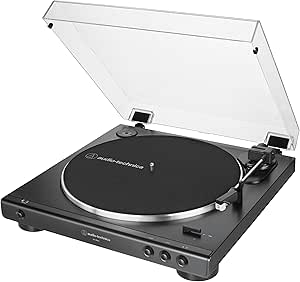
Audio-Technica AT-LP60X-BK Fully Automatic Belt-Drive Stereo Turntable, Black
The AT-LP60X is the straightforward automatic choice for buyers who want basic record playback without a manual tonearm or a built-in speaker system. Its switchable preamp makes it easy to connect to compatible speakers or an amplifier, while the die-cast aluminum platter and redesigned tonearm aim to support steadier tracking than a bare-bones player. Compared with the AT-LP70X, it offers a simpler package and lacks the specified AT-VM95C cartridge and upgrade path described for that model. It also cannot match the manual controls, USB output, or 78 RPM playback of the AT-LP120XUSB. I would choose it when ease and a familiar brand matter more than fine adjustment or expansion. The plastic enclosure and two-speed limit make it a less compelling foundation for a system meant to grow.
Pros:- Fully automatic operation reduces the chance of mishandling records during playback.
- Switchable built-in phono preamp supports connection to systems without a phono input.
- Die-cast aluminum platter is a more substantial listed component than a basic lightweight platter.
- Includes a dust cover, 45 RPM adapter, and RCA output cable.
Cons:- Playback is limited to 33-1/3 and 45 RPM.
- Plastic enclosure is less substantial than the metal and wood construction of some alternatives.
- Lacks the USB output and manual adjustment features of the AT-LP120XUSB.
Best for: Budget-conscious beginners who want automatic playback and a built-in preamp for a simple home stereo connection.
Not ideal for: Listeners seeking 78 RPM playback, USB archiving, manual control, or a more upgrade-oriented starting point like the AT-LP70X.
- Drive type:Belt drive
- Operation:Fully automatic
- Speeds:33-1/3 and 45 RPM
- Platter:Die-cast aluminum
- Preamp:Built-in, switchable phono preamp
- Cartridge:Dual magnet cartridge
- Included accessories:Dust cover, 45 RPM adapter, and RCA output cable
- Warranty:1 year
Our verdict“Pick the AT-LP60X for simple automatic playback and direct system connection, but choose the AT-LP70X if a clearer stylus-upgrade path matters.”
Pioneer DJ PLX-500 Direct Drive Turntable
The PLX-500 is the most flexible choice here for someone who wants to play records at home but also values DJ-style controls and a straightforward route to digitizing a collection. Its direct-drive motor and familiar layout suit cueing and hands-on playback better than the belt-driven Pro-Ject Debut Carbon EVO, while the USB output adds a useful archiving option. It can connect directly to speakers or a sound system, which may reduce setup friction, though the supplied information does not specify the connection requirements for every system. The tradeoff is a plastic enclosure and substantial 12.7 kg weight; it feels less like a refined, compact hi-fi centerpiece than the Technics SL-40CBT. I’d choose it for mixed listening and beginner DJ use, not for a minimalist audiophile setup.
Pros:- USB output supports digitizing records
- Direct-drive design and DJ-style controls suit hands-on playback
- Can connect directly to speakers or sound systems
- Starter accessories are included
Cons:- Plastic enclosure is less substantial than the metal and wood construction cited for the Pro-Ject Debut Evo 2
- At 12.7 kg, it is cumbersome to move
- Listed maximum speed is 33.3 rpm, limiting playback flexibility compared with models that support 45 rpm
Best for: Vinyl listeners who want DJ-style controls, USB record digitizing, and a turntable that can serve both home playback and practice.
Not ideal for: Listeners prioritizing a refined enclosure or a compact, easy-to-move setup; its plastic construction and 12.7 kg weight work against those needs.
- Drive:Direct drive
- Maximum rotational speed:33.3 rpm
- Signal-to-noise ratio:75 dB
- Connectivity:Wired; USB output
- Power source:Corded electric
- Weight:12.7 kg
- Dimensions:17.72 × 14.49 × 6.26 inches
- Enclosure material:Plastic
Our verdict“Choose the PLX-500 if you want an adaptable, DJ-oriented turntable with USB digitizing; choose a Pro-Ject model instead for a more focused wired hi-fi setup.”
Technics SL-40CBT Premium Class HiFi Turntable with Bluetooth and Coreless Direct Drive Motor
The Technics SL-40CBT is the clearest fit for listeners who want coreless direct drive and wireless playback in a tidy home system. Its included Audio-Technica AT-VM95C cartridge and precision tonearm give it a more hi-fi-oriented brief than the DJ-focused Pioneer DJ PLX-500, while Bluetooth can simplify connection to compatible wireless audio gear. That convenience comes with a meaningful limitation: the supplied product information lists Bluetooth but does not specify wired output options, so buyers building a traditional amplifier-and-speaker chain should verify compatibility before choosing it. The Pro-Ject Debut Carbon EVO is the safer match for a wired, analog setup with stated RCA output, while the Technics is more appealing when fewer cables and a compact footprint matter. I’d shortlist it for convenient living-room listening, not for buyers who need documented connection flexibility.
Pros:- Coreless direct-drive motor is designed for stable playback with minimal vibration
- Bluetooth supports wireless connection to compatible equipment
- Includes an Audio-Technica AT-VM95C cartridge and precision tonearm
- Compact dimensions and multiple finish options suit modern living spaces
Cons:- The supplied connectivity details do not list wired output options
- Speed options and included accessories beyond the cartridge are not specified
- Bluetooth-focused setup is less suitable for buyers building a traditional wired system than the Pro-Ject Debut Carbon EVO
Best for: Listeners with compatible Bluetooth audio equipment who want a compact direct-drive turntable and an included cartridge for everyday hi-fi playback.
Not ideal for: Buyers assembling a conventional wired system or needing clearly specified RCA or phono outputs; those connections are not listed in the supplied data.
- Motor:Coreless direct drive
- Connectivity:Bluetooth
- Included cartridge:Audio-Technica AT-VM95C
- Dimensions:16.9 inches W × 5.0 inches H × 13.9 inches D
- Finish options:Terracotta Brown, Black, Gray
- Turntable type:Hi-fi turntable
Our verdict“Pick the SL-40CBT if wireless convenience and a compact direct-drive design matter more to you than clearly documented wired connections.”
Pro-Ject Debut Carbon EVO Turntable with Sumiko Rainier Cartridge (Walnut)
The Debut Carbon EVO is the most straightforward fit in this group for a listener building a wired analog hi-fi system. It supports 33 and 45 rpm records, includes a Sumiko Rainier cartridge, and lists RCA output, giving buyers a clear path to connect it to compatible audio equipment. Its 6 g effective tonearm mass and 68 dB signal-to-noise specification make it a more detail-focused alternative to the DJ-oriented Pioneer DJ PLX-500, which adds USB and direct-drive convenience but has a plastic enclosure. The EVO’s tradeoffs are practical: it is manual and wired, and its 7.76 kg weight does not make it an easy portable source. Compared with the Technics SL-40CBT, it gives up Bluetooth convenience in favor of stated analog connectivity. I’d choose it when sound-system integration matters more than wireless ease.
Pros:- Includes a Sumiko Rainier cartridge
- Supports 33 and 45 rpm playback
- RCA output is specified for wired system connection
- Walnut finish and dust cover suit a dedicated home listening setup
Cons:- No wireless connectivity is listed, unlike the Technics SL-40CBT
- Manual operation asks for more involvement than an automatic turntable
- At 7.76 kg, it is not a particularly portable option
Best for: Vinyl listeners with a compatible wired amplifier or phono setup who want a supplied Sumiko cartridge and support for both 33 and 45 rpm records.
Not ideal for: Buyers who want Bluetooth, automatic operation, USB digitizing, or a lightweight turntable they can move frequently.
- Nominal speeds:33 and 45 rpm
- Drive:Wired analog turntable
- Cartridge:Sumiko Rainier
- Effective tonearm mass:6 g
- Effective tonearm length:8.6 inches (218.5 mm)
- Signal-to-noise ratio:68 dB
- Connectivity:Wired; RCA output
- Weight:7.76 kg
- Dimensions:16.3 × 4.6 × 12.6 inches
Our verdict“Choose the Debut Carbon EVO if you want a well-specified wired turntable with a supplied cartridge and 45 rpm support, rather than Bluetooth or DJ features.”
Pro-Ject Debut Evo 2 Turntable (Gloss Black)
The Debut Evo 2 is the most build-focused option in this selection, with a listed mix of aluminum, carbon fiber, metal, and wood and an included Pick it MM EVO cartridge. That makes it a compelling choice for a listener who wants a refined, dedicated vinyl source rather than the PLX-1000’s DJ controls or the PLX-500’s USB digitizing. Its belt-driven design and vibration-control emphasis point toward steady home listening, but the provided data is less complete than the Debut Carbon EVO’s: it does not clearly list supported record speeds, dimensions appear unusually small, and the stated maximum speed of 7800 rpm is not a useful record-playback specification. I would verify those details before buying. At 8 kg and with manual operation, it also asks for a stable home setup rather than portability or casual convenience.
Pros:- Includes a high-precision Pick it MM EVO cartridge
- Lists aluminum, carbon fiber, metal, and wood in its construction
- Belt-driven design with vibration-control emphasis
- Gloss black finish suits a dedicated hi-fi system
Cons:- Provided speed data is unclear: the listed 7800 rpm maximum does not describe standard record playback
- Listed dimensions of 1.26 × 1.63 × 0.44 inches appear implausibly small and should be checked
- Manual operation and 8 kg weight are less convenient than a simple, portable setup
Best for: Dedicated listeners who value a premium-material build and included Pick it MM EVO cartridge, and who can confirm the playback specifications with the seller.
Not ideal for: Buyers who need clearly documented speeds, dimensions, wireless connectivity, or automatic operation; the supplied data leaves key setup details unclear.
- Drive:Belt-driven
- Included cartridge:Pick it MM EVO
- Signal format:Phono
- Signal-to-noise ratio:70 dB
- Listed maximum rotational speed:7800 rpm
- Listed materials:Aluminum, carbon fiber, metal, wood
- Weight:8 kg
- Power:15 volts DC
- Color:High Gloss Black
Our verdict“Consider the Debut Evo 2 for its materials and cartridge, but verify its speed and dimensions before choosing it over the better-documented Debut Carbon EVO.”
Pioneer DJ PLX-1000 Professional Direct-Drive Turntable, Black
The PLX-1000 is the specialist choice here: its high-torque direct-drive motor, multi-pitch control, and DVS compatibility are aimed at DJs and turntablists, not listeners seeking the easiest route to casual home playback. Compared with the PLX-500, it adds a more professional DJ brief and a zinc enclosure, but gives up the PLX-500’s stated USB digitizing and direct-to-speaker convenience. It also differs from both Pro-Ject Debut models, which are better aligned with dedicated wired hi-fi listening than mixing or digital-vinyl control. The substantial 38-pound weight supports a stable setup but makes relocation awkward, and the product data lists no built-in speakers or digital display. Since the description gives a maximum speed of 33 rpm only, buyers who need clearly specified 45 rpm playback should confirm that detail before purchase.
Pros:- High-torque direct drive supports quick start-up and stable rotation
- Multi-pitch control and familiar DJ layout suit hands-on mixing
- DVS compatibility supports digital-vinyl system integration
- Zinc enclosure is a more substantial material choice than the PLX-500’s plastic enclosure
Cons:- At 38 pounds, it is difficult to move frequently
- Requires external audio equipment; no built-in speakers are listed
- USB output is not listed, unlike the PLX-500
Best for: DJs and turntablists building a mixer-based home or club setup who want direct drive, pitch control, and DVS compatibility.
Not ideal for: Casual listeners seeking a simple, self-contained hi-fi turntable, USB record archiving, or a lightweight unit for frequent moves.
- Drive:Direct drive
- Listed maximum rotational speed:33 rpm
- Signal-to-noise ratio:60 dB
- Enclosure material:Zinc
- Connectivity:Analog; compatible with mixer, PC, and speaker
- Power source:Corded electric
- Weight:38 pounds
- Dimensions:17.83 × 13.9 × 6.26 inches
- Additional features:Multi-pitch control; DVS compatible
Our verdict“Choose the PLX-1000 for a serious mixer-based DJ system; for straightforward home listening or record digitizing, the PLX-500 is the more practical Pioneer option.”
How We Picked
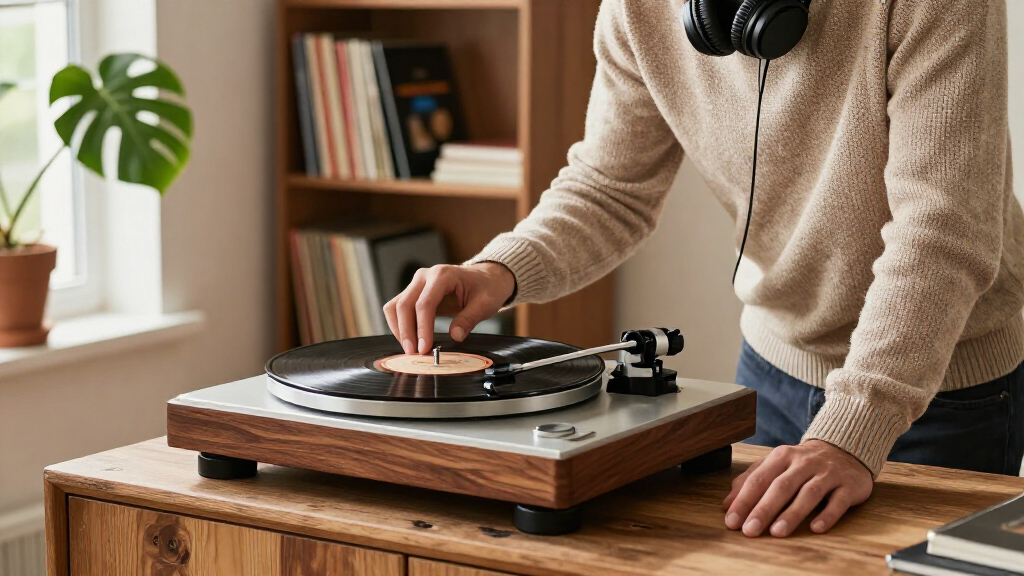
I evaluated these ten turntables by analyzing their mechanical architecture, specifically looking at platter mass, tonearm geometry, and motor type. In the sub-$1000 category, the line between ‘toy’ and ‘high-fidelity’ is defined by resonance control and tracking accuracy. I prioritized models that minimize vibration transfer from the motor to the stylus, as this directly impacts the clarity of the midrange and treble.
Ranking logic favored manual belt-drive decks for pure listening experiences because they typically feature better tonearms and allow for easier cartridge upgrades. However, I also ranked high-quality direct-drive models highly for their durability and speed consistency, acknowledging that they serve a different use case. I excluded units that rely heavily on digital processing for their core analog output, ensuring that every pick here delivers a genuine analog signal path.
| audiophile turntable under 1000 | Drive type | Connectivity |
|---|---|---|
| Audio-Technica AT-LP70X Automa | Belt drive | — |
| Gemini TT-5000 Direct-Drive Tu | Direct drive | — |
| 1 BY ONE High Fidelity Belt Dr | Belt drive | Bluetooth, RCA, and auxiliary input |
| Audio-Technica AT-LP120XUSB-BK | Direct drive | USB and RCA output |
| Audio-Technica AT-LP60X-BK Ful | Belt drive | — |
| Pioneer DJ PLX-500 Direct Driv | — | Wired; USB output |
| Technics SL-40CBT Premium Clas | — | Bluetooth |
| Pro-Ject Debut Carbon EVO Turn | — | Wired; RCA output |
| Pro-Ject Debut Evo 2 Turntable | — | — |
| Pioneer DJ PLX-1000 Profession | — | Analog; compatible with mixer, PC, and speaker |
Factors to Consider When Choosing Audiophile Turntable Under 1000
Selecting a turntable isn’t just about picking the brand with the best logo. It involves understanding how mechanical choices translate to audible differences. Here are the critical factors you need to weigh before making a purchase.
Belt-Drive vs. Direct-Drive Mechanics
The motor type dictates the character and application of the turntable. Belt-drive systems use a rubber belt to isolate the platter from the motor, significantly reducing rumble and vibration. This makes them ideal for critical listening, as they tend to produce a smoother, more relaxed sound. Direct-drive systems connect the motor directly to the platter, offering higher torque and faster spin-up times. While traditionally associated with DJing due to their durability and ability to stop on a dime, modern direct-drive units like the Technics SL-40CBT have improved vibration isolation enough to compete in audiophile circles. Choose belt-drive for home listening and direct-drive if you need to manipulate records or require absolute speed stability.
The Importance of Platter Mass and Material
A heavy platter acts as a flywheel, maintaining consistent rotational speed despite minor fluctuations in motor power. In this price bracket, look for platters made from acrylic, carbon fiber, or heavy aluminum. These materials dampen resonance better than plastic or thin steel. A lighter platter might spin up quickly but can suffer from ‘wow and flutter,’ which manifests as a slight wavering in pitch. For the best fidelity, prioritize models with at least a 1.5 kg platter mass, or those utilizing composite materials designed to absorb unwanted vibrations rather than transmitting them to the stylus.
Tonearm Quality and Adjustability
The tonearm is the bridge between your record and your cartridge, and its quality often dictates the ceiling of your system’s performance. A rigid arm with low friction bearings allows the stylus to track complex grooves accurately without skipping or distortion. Key features to look for include azimuth adjustment (to ensure the cartridge is perfectly perpendicular to the record) and anti-skate controls. Many entry-level decks lack these adjustments, limiting your ability to fine-tune the sound. If you plan to upgrade your cartridge later, ensure the tonearm is compatible with a wide range of cartridge weights, particularly if you intend to use heavier Moving Coil (MC) models.
Pre-Amplifier Integration and Output Types
Most modern active speakers and powered monitors require a specific signal level. Turntables with a built-in pre-amplifier can connect directly to these devices, simplifying your setup. However, audiophiles often prefer ‘Passive’ or ‘Phono’ outputs, which send a raw, low-level signal to an external phono stage. External phono stages are generally superior in sound quality because they are not subject to the electrical noise inside the turntable chassis. If your budget allows, I recommend buying a turntable with a switchable pre-amp. This gives you the flexibility to start simple with the built-in stage and upgrade to an external unit later for a noticeable jump in detail and dynamic range.
Cartridge Compatibility and Upgradability
The cartridge (and its attached stylus) is the component that actually reads the music. While many turntables under $1000 come with decent stock Moving Magnet (MM) cartridges, the ability to swap them is critical for future-proofing. Some proprietary tonearms lock you into specific brands or models, creating a dead end. Look for decks that use standard SME-style mounting or provide easy access to the headshell. This allows you to experiment with different sounds without replacing the entire turntable. A high-end MM cartridge can often rival entry-level Moving Coil cartridges, providing significant sonic improvements without breaking the bank.
Isolation and Footing Stability
Vibration is the enemy of vinyl playback. External vibrations from footsteps, speakers, or even air conditioning units can travel through the turntable plinth and reach the stylus, causing audible noise. High-quality turntables address this with adjustable isolation feet and decoupled platters. When setting up your new deck, place it on a sturdy, vibration-free surface. If you notice feedback when your speakers are loud, consider adding an isolation platform or using heavier feet. Proper leveling is also mandatory; a tilted turntable causes uneven tracking force, leading to premature record wear and distorted sound.
Frequently Asked Questions
Do I need an external phono stage if my turntable has a built-in preamp?
You do not strictly need one, as the built-in preamp allows you to connect directly to passive speakers or an amplifier with a line-level input. However, built-in preamps are often compromised by space and cost constraints, leading to higher noise floors and less dynamic range. An external phono stage typically offers superior component quality and better shielding from electrical interference. If you are serious about audio fidelity, using a turntable with a switchable preamp and eventually upgrading to an external unit is the most effective path to better sound.Is Bluetooth transmission on a turntable acceptable for audiophile listening?
Bluetooth transmission involves data compression, which inherently discards some audio information to maintain a stable wireless connection. While modern codecs like aptX HD or LDAC mitigate this, they cannot match the fidelity of a wired analog connection. For casual background listening, Bluetooth is convenient and sounds decent. For critical audiophile listening, I strongly recommend using the analog RCA outputs connected to a wired amplifier. Treat Bluetooth as a secondary convenience feature rather than a primary audio path if you care about detail retrieval and soundstage depth.How does a direct-drive turntable compare to a belt-drive for pure music listening?
Historically, direct-drive motors introduced rumble and vibration that degraded musical detail, making belt-drive the preferred choice for audiophiles. However, modern engineering, particularly in units like the Technics SL-40CBT, uses coreless motors and sophisticated isolation to minimize these issues. Direct-drive offers superior speed stability and consistency, which can be beneficial for complex musical passages. Belt-drive still tends to offer a slightly more organic, relaxed presentation due to the physical isolation of the motor. The choice now depends more on whether you value the mechanical precision of direct-drive or the traditional sonic signature of belt-drive.Can I upgrade the cartridge on any turntable in this list?
Most turntables in this category allow cartridge upgrades, but the ease and compatibility vary. Manual decks like the Pro-Ject Debut series usually come with standard headshells that accept a wide variety of cartridges. Fully automatic decks may have proprietary designs or lighter tonearms that cannot support the weight of high-end cartridges. Before purchasing a new cartridge, check the effective mass of your tonearm to ensure compatibility. If the tonearm is too light, a heavy cartridge will cause resonance issues; if too heavy, it may not track properly. Always verify the manufacturer’s recommended cartridge weight range.Is it worth spending more than $1000 for a turntable, or is this bracket sufficient?
The $500 to $1000 bracket represents a sweet spot where you get significant build quality and performance improvements over entry-level decks. Going above $1000 often yields diminishing returns in terms of audible differences per dollar spent. You might gain marginal improvements in platter mass, tonearm rigidity, or aesthetic materials. For most listeners, a well-tuned $800 turntable with a quality $150 cartridge will outperform a generic $1500 system with a stock cartridge. Focus your budget on the cartridge and phono stage rather than chasing ultra-premium turntable brands unless you are seeking specific sonic characteristics or build prestige.Conclusion
Selecting the right audiophile turntable under 1000 depends largely on your listening habits and technical comfort level. If you want the best balance of fidelity, build quality, and ease of setup, the Pro-Ject Debut Carbon EVO is my best overall pick. It delivers a refined sound that competes with much more expensive decks. For those who need versatility, such as digitizing records or DJing, the Audio-Technica AT-LP120XUSB is the best value option, offering robust direct-drive performance and USB connectivity. Beginners who prioritize simplicity should look at the Audio-Technica AT-LP60X, though it sacrifices some high-end detail for convenience. If you want a modern twist on the classic direct-drive, the Technics SL-40CBT offers premium engineering and Bluetooth flexibility. Ultimately, prioritize the tonearm and platter quality over brand name, and remember that a good cartridge upgrade is often the most cost-effective way to improve your sound.
Columbus Day / Indigenous Peoples' Day Picks
long weekend sales
As an affiliate, we earn on qualifying purchases.