A drone for beginners with obstacle avoidance can add a buffer against bumps, but the feature works differently across this lineup and cannot replace careful flying. My best overall pick is the GPS Drone with 4K Camera, 3-Axis Gimbal, and 40-Minute Flight, which pairs obstacle sensing with GPS, a stabilized camera, and a controller screen. The Zoiskn GPS Drone stands out for its advertised 360° avoidance, while the DJI Mini 5 Pro Fly More Combo is the premium choice for buyers who want a more capable camera platform. The main tradeoffs are sensing coverage, camera stabilization, flight support, portability, and how much a beginner should spend before learning the controls. Read on for the full comparison, buying advice, and picks by flyer type.

Get audio and creator gear delivered free with Prime
- Fast, free delivery on millions of items
- Prime Video, Amazon Music and more included
- Member-only deals all year
Complete the kit


Key Takeaways
- The best balance comes from combining safety and flight support: the 3-axis-gimbal GPS pick adds GPS, auto return, and a controller screen alongside obstacle avoidance.
- Obstacle-avoidance claims are not interchangeable: the Zoiskn advertises 360° sensing, while the foldable FPV pick lists 270°; buyers should check which directions are covered and under what conditions.
- A screen on the controller can simplify a first flight: several options include one, but screen presence alone does not establish camera quality, sensing performance, or flight stability.
- More camera resolution does not settle the beginner decision: gimbal stabilization, reliable positioning, and understandable controls can matter more for usable footage and confidence.
- The lineup spans very different learning needs: the SYMA X100 is an indoor practice drone, while the DJI Mini 5 Pro is a premium camera-focused choice rather than the simple, low-commitment starting point.
| XT606 GPS Drone with 4K Camera and 4.3″ HD Screen |  | Best for Extended Practice Flights | Camera: 4K HD, 120° wide-angle lens | Controller display: 4.3-inch HD LCD | Obstacle avoidance: 4-way | VIEW ON AMAZON | See Our Full Breakdown |
| GPS Drone with 4K Camera, 3-Axis Gimbal, Dual Cameras, Obstacle Avoidance, 4.3-Inch Screen, Follow Me, Auto Return, 40 Min Flight, Foldable, Under 249g |  | Best for Steadier 4K Footage | Camera: 4K dual-camera system with 90° adjustable angle | Gimbal: 3-axis mechanical | Obstacle avoidance: 360° laser sensor | VIEW ON AMAZON | See Our Full Breakdown |
| KMAX Drone with Camera for Adults and Beginners, 2K Foldable RC Drone Gift |  | Best for Beginner-Friendly Controls | Camera: 2K, 110° wide-angle lens | Lens adjustment: 90° | Controller display: 4.3-inch HD | VIEW ON AMAZON | See Our Full Breakdown |
| Zoiskn GPS Drone with 4K Camera and 360° Obstacle Avoidance |  | Best for GPS-Assisted Hovering | Camera: 4K video; 33MP effective still resolution | Camera angle adjustment: 90° | Obstacle avoidance: 360° | VIEW ON AMAZON | See Our Full Breakdown |
| Foldable FPV Camera Drone with LCD Controller, Brushless Motors, and 270° Obstacle Avoidance |  | Best for Protected Indoor Practice | Camera: FPV HD camera with 90° electrically adjustable lens | Controller display: 2.8-inch HD screen | Obstacle avoidance: 270° | VIEW ON AMAZON | See Our Full Breakdown |
| SJsharp Foldable FPV Camera Drone with LCD Controller |  | Best for Phone-Free FPV | Camera resolution: 4K | Camera adjustment: 90° electrically adjustable | Controller display: 2.8-inch LCD | VIEW ON AMAZON | See Our Full Breakdown |
| Drones with Camera for Adults 4K (Dark Gray, 3-Battery Set) |  | Best for GPS-Assisted Outdoor Practice | Camera: 8K HD, 90° adjustable, 120° wide-angle lens | Obstacle avoidance: 360° all-round | Controller display: 12.8 cm large screen | VIEW ON AMAZON | See Our Full Breakdown |
| S166MAX Foldable FPV Drone with 720p Camera and Remote Controller Screen |  | Best Beginner Starter Kit | Camera resolution: 720p | Camera angle: 90° adjustable | FPV transmission: 5GHz | VIEW ON AMAZON | See Our Full Breakdown |
| V918 GPS Drone with 8K Camera for Adults, RC Drones with 5-inch HD Screen |  | Best for Longer Outdoor Sessions | Camera resolution: 8K | Lens: 90° adjustable, 120° wide-angle | Obstacle avoidance: 360°, indoor only | VIEW ON AMAZON | See Our Full Breakdown |
| SYMA X100 Indoor Drone for Kids |  | Best for Protected Indoor Learning | Obstacle avoidance: Four-way infrared sensors; detects obstacles within about 12 inches | Propeller protection: Fully enclosed guard | Safety feature: 180° flip-to-stop | VIEW ON AMAZON | See Our Full Breakdown |
| Drone with Camera for Adults LCD Screen on Controller Foldable RC Mini FPV Drones for Beginners |  | Best for Smartphone-Free Flying | Camera: HD FPV with 90° adjustable lens | Controller display: 2.8-inch HD LCD | Obstacle avoidance: 270° intelligent system | VIEW ON AMAZON | See Our Full Breakdown |
| TODAMU H16 Foldable 4K Camera Drone with Obstacle Avoidance |  | Best for Beginner Flight Assistance | Model: H16 | Camera: 4K listed; video capture resolution listed as 720p | Effective still resolution: 0.92 MP | VIEW ON AMAZON | See Our Full Breakdown |
| Yakosrsin Drone with Controller Screen and Obstacle Avoidance |  | Best for Kids Who Want a Built-In Screen | Video resolution: 4K | Still resolution: 8 MP | Controller screen: 3.15 inches | VIEW ON AMAZON | See Our Full Breakdown |
| KMAX Drone with Camera for Adults and Beginners, 2K Foldable RC Drone Gift |  | Best for Screen-and-Endurance Balance | Camera resolution: 2K | Camera adjustment: 90° | Wide-angle lens: 110° | VIEW ON AMAZON | See Our Full Breakdown |
| DJI Mini 5 Pro Fly More Combo with DJI RC 2 |  | Best Premium Beginner Upgrade | Sensor: 1-inch CMOS | Video: 4K/60fps HDR | Still resolution: 50 MP | VIEW ON AMAZON | See Our Full Breakdown |
| drone for beginners with obstacle avoidance | Obstacle avoidance | Weight | Camera | Controller display |
|---|---|---|---|---|
| XT606 GPS Drone with 4K Camera | 4-way | 249g | 4K HD, 120° wide-angle lens | 4.3-inch HD LCD |
| GPS Drone with 4K Camera | 360° laser sensor | Under 249g | 4K dual-camera system with 90° adjustable angle | 4.3-inch HD screen |
| KMAX Drone with Camera for Adu | 360° | 249g | 2K, 110° wide-angle lens | 4.3-inch HD |
| Zoiskn GPS Drone with 4K Camer | 360° | 242g | 4K video; 33MP effective still resolution | — |
| Foldable FPV Camera Drone with | 270° | — | FPV HD camera with 90° electrically adjustable lens | 2.8-inch HD screen |
| SJsharp Foldable FPV Camera Dr | 270° | — | — | 2.8-inch LCD |
| Drones with Camera for Adults | 360° all-round | 249 g | 8K HD, 90° adjustable, 120° wide-angle lens | 12.8 cm large screen |
| S166MAX Foldable FPV Drone wit | Included; coverage details not specified | 187 g | — | — |
| V918 GPS Drone with 8K Camera | 360°, indoor only | 226 g | — | — |
| SYMA X100 Indoor Drone for Kid | Four-way infrared sensors; detects obstacles within about 12 inches | 58 g | — | — |
| Drone with Camera for Adults L | 270° intelligent system | Under 250 grams | HD FPV with 90° adjustable lens | 2.8-inch HD LCD |
| TODAMU H16 Foldable 4K Camera | Front, rear, left, and right sensors | Under 0.55 lb (249g) | 4K listed; video capture resolution listed as 720p | — |
| Yakosrsin Drone with Controlle | Yes; sensor coverage not specified | 4.8 ounces | — | — |
| KMAX Drone with Camera for Adu | 360° | Under 249g | — | 4.3-inch HD built-in |
| DJI Mini 5 Pro Fly More Combo | — | Approximately 249.9g ± 4g | — | — |
More Details on Our Top Picks
XT606 GPS Drone with 4K Camera and 4.3″ HD Screen
The XT606 pairs four-way obstacle avoidance with GPS return and a controller screen, giving a beginner several layers of assistance without relying on a phone for the live view. Its standout is the stated up to 90 minutes across three batteries, which leaves more time to practice than the KMAX 2K, also bundled with three batteries. The XT606 also offers 4K capture and follow-me and orbit modes, so it can grow with someone who wants more than basic hovering. That said, obstacle sensors do not replace careful piloting: the listing calls for calibration, and it recommends calm outdoor conditions. I would choose this over the KMAX for longer practice sessions and 4K, but skip it if a first-time flyer wants the simplest possible controls.
Pros:- Four-way obstacle avoidance is paired with GPS auto return.
- Three batteries are listed for up to 90 minutes of combined flight time.
- Built-in 4.3-inch HD display avoids depending on a phone for viewing.
- Foldable design, carrying case, and 4K camera suit travel and outdoor shooting.
Cons:- Requires pre-flight calibration for best safety.
- The stated flight time is combined across three batteries, not a single flight.
- Best performance is described for calm outdoor conditions, and controls may take practice.
Best for: New outdoor pilots who want a built-in viewing screen, GPS assistance, and multiple batteries for longer practice sessions.
Not ideal for: Complete beginners who want a simple indoor trainer or expect obstacle avoidance to make flying in wind or without calibration risk-free.
- Camera:4K HD, 120° wide-angle lens
- Controller display:4.3-inch HD LCD
- Obstacle avoidance:4-way
- Flight time:Up to 90 minutes with three batteries
- Batteries:3 × 2500mAh
- Weight:249g
- Maximum range:Up to 3937 ft
- Flight assistance:GPS auto return, follow me, and orbit
- Design and charging:Foldable; USB-C charging
Our verdict“Choose the XT606 if your priority is extended outdoor practice with GPS and obstacle assistance, rather than the KMAX’s beginner-focused 2K setup.”
GPS Drone with 4K Camera, 3-Axis Gimbal, Dual Cameras, Obstacle Avoidance, 4.3-Inch Screen, Follow Me, Auto Return, 40 Min Flight, Foldable, Under 249g
Among these five, this GPS model makes the strongest case for buyers who care about smooth aerial video: its 3-axis mechanical gimbal addresses camera shake in a way the XT606’s adjustable camera does not. It also combines a 360° laser obstacle sensor, GPS return, and a 4.3-inch controller display, so the pilot can view footage without mounting a phone. Those camera and control advantages come with a clear compromise: the two-battery flight time is listed at 40 minutes, well below the XT606’s stated 90-minute combined time and the KMAX’s 60 minutes. Its waypoint and tracking modes add flexibility but may demand more setup than a beginner wants. I would pick it for footage quality, not for the longest practice sessions or the simplest learning curve.
Pros:- 3-axis mechanical gimbal is designed to stabilize footage.
- 360° laser obstacle sensing is paired with GPS auto return.
- Built-in 4.3-inch HD screen provides a phone-free live view.
- Foldable body weighs under 249g and includes follow-me and waypoint modes.
Cons:- Listed flight time is 40 minutes across two batteries, shorter than the XT606 and KMAX claims.
- Autonomous modes may take practice to configure and use.
- The feature-rich camera and flight system may be more than a first-time pilot needs.
Best for: Beginner outdoor videographers who want a controller screen and a mechanical gimbal to reduce camera shake.
Not ideal for: New pilots who value long practice time over stabilized footage, or who prefer basic controls over setup for waypoint and tracking modes.
- Camera:4K dual-camera system with 90° adjustable angle
- Gimbal:3-axis mechanical
- Obstacle avoidance:360° laser sensor
- Controller display:4.3-inch HD screen
- Flight time:40 minutes with two batteries
- Weight:Under 249g
- Connectivity:5G WiFi
- Flight modes:Follow Me, auto-tracking, waypoint planning, and auto return
Our verdict“Pick this model over the XT606 or KMAX when steadier 4K video matters more than longer battery time or simpler beginner controls.”
KMAX Drone with Camera for Adults and Beginners, 2K Foldable RC Drone Gift
The KMAX is the most approachable pick here for a newcomer who wants a screen on the controller and basic flight aids before stepping up to more complex GPS modes. One-key takeoff and landing and altitude hold help reduce the early workload, while its 360° obstacle avoidance and 4.3-inch display provide useful support for practice. The 2K camera is a step down from the XT606’s 4K image and the gimbal-equipped GPS model’s stabilized footage, but that tradeoff makes sense if learning to fly matters more than polished video. Its stated up to 60 minutes from three batteries also gives it more practice time than the 40-minute GPS model. Calibration is still required, and the recommended beginner range is limited to 30 meters.
Pros:- One-key takeoff and landing plus altitude hold simplify early practice.
- 360° obstacle avoidance and a controller display support more confident flying.
- Three batteries are listed for up to 60 minutes of combined flight time.
- Foldable body and adjustable 2K camera offer a practical starter setup.
Cons:- 2K resolution trails the 4K cameras on the XT606 and GPS gimbal model.
- Pre-flight calibration is recommended.
- Beginner flights are recommended within 30 meters, and the controls may take time to learn.
Best for: First-time flyers who want one-key launch and landing, a built-in screen, and several batteries for short-range practice.
Not ideal for: Buyers seeking 4K footage, a mechanical gimbal, or longer-range flights; the KMAX is 2K and recommends a 30-meter range for beginners.
- Camera:2K, 110° wide-angle lens
- Lens adjustment:90°
- Controller display:4.3-inch HD
- Obstacle avoidance:360°
- Flight time:Up to 60 minutes
- Batteries:3 × 1800mAh
- Weight:249g
- Beginner range guidance:30 meters
- Flight aids:One-key takeoff and landing; altitude hold
Our verdict“Choose the KMAX over the XT606 if approachable takeoff and landing controls matter more than 4K capture and longer stated flight time.”
Zoiskn GPS Drone with 4K Camera and 360° Obstacle Avoidance
The Zoiskn’s beginner appeal comes from combining GPS return-to-home with optical-flow hover, which can help a new pilot maintain position and recover the aircraft. Its 360° obstacle avoidance and large-screen controller add useful support, while the 242g body is lighter than the XT606 and KMAX listings. Camera resolution is listed as 4K, with a 90° remote angle adjustment, but the product data does not describe a mechanical gimbal; buyers seeking steadier footage should look instead at the GPS model with a 3-axis gimbal. Three batteries provide a stated total of up to 75 minutes, though each is rated for up to 25 minutes. Some intelligent features also require a smartphone, making the controller less self-contained than it first appears.
Pros:- GPS return-to-home and optical-flow hover support basic flight control.
- 360° obstacle avoidance provides sensing around the drone.
- Three batteries are listed for up to 75 minutes of combined flight time.
- 242g weight and a large-screen controller support portable, phone-light operation.
Cons:- Each battery is rated for up to 25 minutes, so longer sessions require battery changes.
- Gesture photography, intelligent following, and surround shooting require a smartphone.
- No mechanical gimbal is listed, unlike the GPS model with 3-axis stabilization.
Best for: New outdoor pilots who want GPS return, hover assistance, and a large-screen controller in a lightweight drone.
Not ideal for: Phone-free flyers who want every smart feature available on the controller, or video creators who prioritize gimbal-stabilized footage.
- Camera:4K video; 33MP effective still resolution
- Camera angle adjustment:90°
- Obstacle avoidance:360°
- Flight assistance:GPS return-to-home, optical-flow hover, Follow Me
- Controller:Large-screen remote control
- Flight time:Up to 25 minutes per battery; up to 75 minutes total
- Batteries:3 × 3000mAh lithium-polymer
- Weight:242g
- Motor:Brushless
Our verdict“Choose the Zoiskn over the gimbal-equipped GPS model if hover and return assistance matter more to you than documented mechanical camera stabilization.”
Foldable FPV Camera Drone with LCD Controller, Brushless Motors, and 270° Obstacle Avoidance
This foldable FPV model suits a different kind of beginner: someone learning basic orientation and hovering in a protected space, rather than chasing GPS-assisted outdoor photography. Four propeller guards, optical-flow hovering, and one-key takeoff and landing help make early practice less intimidating, while the 2.8-inch controller display keeps the live view off a phone. Its 270° obstacle avoidance is not full 360° coverage like the KMAX or Zoiskn, and the camera is listed as HD rather than 4K. That makes it a more basic choice than the XT606, whose GPS and return features are better suited to outdoor outings. The listing gives no flight-time figure, so I would not choose it when extended practice between charges is a priority.
Pros:- Four propeller guards add protection during accidental bumps.
- Optical-flow hovering supports steadier practice in small indoor spaces.
- Built-in 2.8-inch display shows live video without a smartphone.
- Foldable design, carrying case, and brushless motors make it a portable starter option.
Cons:- Obstacle avoidance covers 270°, less than the 360° systems on the KMAX and Zoiskn.
- Camera is HD, not 4K like the XT606 and several GPS alternatives.
- No flight-time figure is provided in the product data.
Best for: New pilots who want to practice hovering and basic controls in a protected indoor area with propeller guards and a controller screen.
Not ideal for: Outdoor photography buyers who want GPS return-to-home, 360° obstacle sensing, 4K video, or a stated long flight time.
- Camera:FPV HD camera with 90° electrically adjustable lens
- Controller display:2.8-inch HD screen
- Obstacle avoidance:270°
- Motors:Brushless
- Flight assistance:Optical-flow hovering, route flying, headless mode, one-key takeoff and landing
- Propeller guards:4
- Storage support:Up to 32GB
- Design:Foldable arms with modular battery and carrying case
- Weight class:Under 250g
Our verdict“Choose this over the XT606 for guarded, basic indoor practice, but pick a GPS model for outdoor flights and return-to-home assistance.”
SJsharp Foldable FPV Camera Drone with LCD Controller
The SJsharp is a practical pick for beginners who want to see the live view without mounting a phone: its controller has a built-in 2.8-inch screen, unlike the larger-screen V918 GPS Drone. Its 270° obstacle avoidance offers a useful layer of collision awareness, though it does not cover every direction and should not replace careful piloting. Optical-flow hovering can help the drone hold position, while guarded propellers and one-key takeoff and landing make early practice less intimidating. The foldable frame and carrying case suit occasional trips, but the 80-meter maximum range limits how far it can roam compared with the V918. I’d choose it for straightforward nearby flights, not for long-range outdoor exploring; its controller also supports only up to 32 GB of storage.
Pros:- Built-in 2.8-inch controller display shows live video without a phone
- 270° obstacle avoidance adds collision awareness around much of the drone
- Optical-flow hovering can help maintain position during practice
- Foldable design, carrying case, and propeller guards support portable, cautious use
Cons:- Maximum control range is limited to 80 meters
- Obstacle avoidance covers 270°, not all directions
- Controller storage support is limited to 32 GB
Best for: Beginners who want a self-contained controller screen and a foldable drone for nearby practice flights
Not ideal for: Pilots seeking long-range outdoor flights or all-around obstacle coverage
- Camera resolution:4K
- Camera adjustment:90° electrically adjustable
- Controller display:2.8-inch LCD
- Obstacle avoidance:270°
- Maximum range:80 meters
- Battery capacity:1500 mAh lithium-ion
- Motors:Brushless
- Storage support:Up to 32 GB
Our verdict“Choose the SJsharp if you want a phone-free FPV screen and nearby beginner flights, but skip it for extended range.”
Drones with Camera for Adults 4K (Dark Gray, 3-Battery Set)
This foldable model is aimed at beginners ready to move beyond short indoor sessions: GPS auto-return can provide a recovery option, and follow-me and waypoint modes offer more structured outdoor flying. Its listed 360° obstacle avoidance is broader than the SJsharp’s 270° coverage, but beginners should still treat sensing as assistance rather than a guarantee, especially indoors. Three batteries are listed for up to 75 minutes total flight time, a useful advantage for travel days over the S166MAX’s stated 30-minute total. The large-screen controller also keeps live viewing off a phone. The tradeoff is a more involved setup: some functions require an app, and the advanced modes may be less straightforward for a first flight. I’d favor it for outdoor learners who want room to grow, not for someone seeking the simplest controls.
Pros:- GPS auto-return offers a useful recovery feature for outdoor practice
- Three batteries are listed for up to 75 minutes of total flight time
- Large-screen controller supports real-time viewing
- Foldable design and 249 g listed weight suit travel
Cons:- Some advanced features require app setup
- Manual control and feature setup may take practice for a beginner
- Obstacle avoidance performance should not be relied on as a substitute for piloting
Best for: Outdoor beginners who want GPS return features, a controller display, and multiple batteries for longer practice sessions
Not ideal for: First-time indoor flyers who want minimal setup and simple, close-range controls
- Camera:8K HD, 90° adjustable, 120° wide-angle lens
- Obstacle avoidance:360° all-round
- Controller display:12.8 cm large screen
- GPS features:Auto-return, follow-me, waypoint, circle-fly
- Transmission:5G low-latency
- Motors:Brushless
- Weight:249 g
- Battery and listed flight time:Three batteries, 25 minutes each; up to 75 minutes total
Our verdict“Pick this model for GPS-supported outdoor practice and longer sessions, rather than the simpler indoor learning offered by the SYMA X100.”
S166MAX Foldable FPV Drone with 720p Camera and Remote Controller Screen
The S166MAX puts beginner controls ahead of camera detail: one-key takeoff and landing, altitude hold, three speed settings, and optical-flow hovering help make basic practice more approachable. Its obstacle avoidance adds another layer of awareness, while the controller’s screen receives 5GHz FPV video without requiring a phone for viewing. That makes it a more beginner-oriented choice than the GPS-feature-rich 8K Drones with Camera for Adults, though it lacks that model’s listed GPS return and follow-me modes. The main compromise is the 720p camera, which is less suited to buyers prioritizing detailed footage. Two batteries provide up to 30 minutes total, but each flight is listed at up to 15 minutes, so practice will involve pauses to swap batteries. It fits learning and casual viewing better than serious aerial photography.
Pros:- One-key takeoff and landing, altitude hold, and three speeds support beginner practice
- Obstacle avoidance and optical-flow hovering add assistance during flight
- Controller screen receives 5GHz FPV video
- Two batteries provide up to 30 minutes of listed total flight time
Cons:- 720p camera resolution limits detail in photos and video
- Each battery provides up to 15 minutes of flight time
- No GPS features are listed
Best for: First-time pilots who want simple controls, a controller screen, and spare batteries for short practice flights
Not ideal for: Buyers who prioritize high-resolution photos, long individual flights, or GPS-assisted return features
- Camera resolution:720p
- Camera angle:90° adjustable
- FPV transmission:5GHz
- Obstacle avoidance:Included; coverage details not specified
- Flight time:Up to 30 minutes total; up to 15 minutes per battery
- Batteries:Two rechargeable 4800mAh batteries
- Weight:187 g
- Flight features:Optical-flow hovering, orbit flight, altitude hold, one-key takeoff and landing, 3-speed adjustment
Our verdict“Choose the S166MAX for simple, short beginner flights with controller-screen FPV, not for high-detail camera work.”
V918 GPS Drone with 8K Camera for Adults, RC Drones with 5-inch HD Screen
The V918 is the endurance-focused option here, with three batteries rated for up to 90 minutes total and GPS functions such as auto-return, follow-me, and waypoint flight. That combination gives outdoor learners more time to practice than the SJsharp’s 80-meter-range setup or the S166MAX’s shorter battery sessions. A 5-inch HD display provides live viewing, and its foldable 226 g design is portable. The key caveat is the obstacle sensing: the listed 360° avoidance is indoor-only, while the advertised GPS features are better suited to outdoor use. That split makes it less straightforward for beginners expecting obstacle protection everywhere. I’d pick it for learners who want long sessions and are willing to understand the limits of each mode, rather than anyone relying on sensors to prevent every collision.
Pros:- Three batteries are listed for up to 90 minutes of total flight time
- GPS auto-return, follow-me, and waypoint functions support outdoor flying
- Built-in 5-inch HD display provides real-time FPV viewing
- Foldable design and 226 g weight support portability
Cons:- 360° obstacle avoidance is listed for indoor use only
- Flight modes and controls may require practice for new pilots
- Obstacle sensing does not provide the same stated coverage outdoors
Best for: Outdoor learners who want GPS flight modes, a built-in display, and multiple batteries for extended practice
Not ideal for: Beginners who expect 360° obstacle avoidance to work outdoors or want a low-complexity first drone
- Camera resolution:8K
- Lens:90° adjustable, 120° wide-angle
- Obstacle avoidance:360°, indoor only
- Flight time:Up to 90 minutes with three batteries
- Battery capacity:3 × 3000mAh
- Maximum range:9842 feet
- Control system:5G Wi-Fi with HD display
- Weight:226 g
Our verdict“Choose the V918 for long, GPS-supported outdoor practice only if you are comfortable with obstacle avoidance being indoor-only.”
SYMA X100 Indoor Drone for Kids
The SYMA X100 takes a different approach from the camera-focused SJsharp and V918: it is a small indoor-first trainer, with no camera listed and obstacle sensing designed for close quarters. Its four-way infrared sensors detect obstacles within about 12 inches, while the fully enclosed propeller guard helps protect both the drone and nearby objects during early practice. One-key takeoff and landing, altitude hold, and headless mode keep the controls approachable. The 180° flip-to-stop adds a specific safety response that the larger foldable models do not list. Its limitations are just as clear: sensing is short-range, the X100 is designed for indoor use, and its up-to-20-minute total flight time varies with use. I’d choose this for a child learning basic control at home, not for aerial video or outdoor flights.
Pros:- Four-way infrared sensing detects nearby obstacles within about 12 inches
- Fully enclosed propeller guard helps protect people and surroundings
- One-key controls, altitude hold, and headless mode simplify early practice
- Two rechargeable batteries provide up to 20 minutes total flight time
Cons:- Designed for indoor use, with obstacle detection limited to about 12 inches
- No camera or FPV viewing is listed
- Total flight time varies depending on use
Best for: Children and first-time pilots learning basic control in a clear indoor space
Not ideal for: Buyers seeking camera footage, outdoor GPS functions, or obstacle sensing beyond close indoor distances
- Obstacle avoidance:Four-way infrared sensors; detects obstacles within about 12 inches
- Propeller protection:Fully enclosed guard
- Safety feature:180° flip-to-stop
- Flight controls:One-key takeoff and landing, altitude hold, headless mode, two speed modes, gesture control
- Batteries:Two rechargeable lithium-ion batteries
- Total flight time:Up to 20 minutes; varies by use
- Connectivity:2.4GHz radio frequency
- Weight:58 g
Our verdict“Choose the SYMA X100 for protected indoor control practice, but pick a camera-equipped foldable model for photography or outdoor flying.”
Drone with Camera for Adults LCD Screen on Controller Foldable RC Mini FPV Drones for Beginners
I’d choose this model when keeping the live view off a phone matters more than having the most fully specified sensor coverage. Its 2.8-inch controller screen makes FPV viewing self-contained, and the 270° obstacle-avoidance system offers a useful buffer around much of the drone. The foldable body and under-250-gram listed weight also suit casual travel. Compared with the Yakosrsin, it lists brushless motors and an adjustable camera lens, while the Yakosrsin has a larger controller display and stated 8 MP still resolution. The tradeoff is that this product’s camera is described only as HD, and its battery life is not specified. Obstacle avoidance can help a new pilot, but it does not replace open-space practice or attention to hazards outside the sensor coverage.
Pros:- Built-in 2.8-inch LCD supports FPV viewing without a phone.
- 270° obstacle avoidance adds coverage around much of the aircraft.
- Foldable design and listed weight under 250 grams suit portable use.
- Brushless motors and a modular rechargeable battery are specified.
Cons:- Battery life is not provided, making flight planning less predictable.
- Camera is described as HD without a stated resolution, and SD support tops out at 32GB.
- The listed 270° sensing leaves some directions uncovered, so beginners still need room to maneuver.
Best for: Beginners who want a foldable drone with a built-in controller display and do not want to rely on a smartphone.
Not ideal for: Buyers who need a clearly specified flight duration, higher-resolution camera details, or obstacle sensing on every side.
- Camera:HD FPV with 90° adjustable lens
- Controller display:2.8-inch HD LCD
- Obstacle avoidance:270° intelligent system
- Weight:Under 250 grams
- Motor:Brushless
- Battery:Modular rechargeable
- Foldable:Yes
- SD card support:Up to 32GB
Our verdict“Pick this if you want a portable beginner drone with a built-in screen, but skip it if camera specifications or flight time need to be precise.”
TODAMU H16 Foldable 4K Camera Drone with Obstacle Avoidance
The H16 is the clearest fit here for a new pilot who values help with basic control more than a polished camera spec. Optical-flow hovering, altitude hold, speed adjustment, and one-key takeoff and landing can make early practice less demanding; its sensors cover the front, rear, left, and right. Two batteries are listed for up to 30 minutes total in calm conditions, split into flights of up to 15 minutes each. That gives it a practical advantage over the first LCD-screen drone, whose battery duration is unspecified, though the H16 relies on Wi-Fi FPV rather than a built-in controller display. The camera listing also needs care: it says 4K, but video capture is listed as 720p and effective still resolution as 0.92 MP. Sensors may miss wires, thin branches, and glass, and wind can cut flight time.
Pros:- Optical-flow hover, altitude hold, and speed adjustment support gradual skill-building.
- Obstacle sensors are listed on the front, rear, left, and right.
- Two removable batteries provide up to 30 minutes total in calm conditions.
- Foldable design and included carrying case make transport straightforward.
Cons:- Camera specifications are mixed: 4K is advertised, but video capture is listed as 720p and still resolution as 0.92 MP.
- Sensors may miss thin, transparent, or low-visibility obstacles and work best in daylight.
- Each battery is listed for up to 15 minutes, and wind or cold can shorten that time.
Best for: First-time flyers who want basic hovering and takeoff assistance, four-direction sensing, and spare battery capacity for calm-day practice.
Not ideal for: Beginners seeking dependable 4K footage, a controller-mounted screen, or confident obstacle sensing around wires, glass, and small branches.
- Model:H16
- Camera:4K listed; video capture resolution listed as 720p
- Effective still resolution:0.92 MP
- Obstacle avoidance:Front, rear, left, and right sensors
- Camera tilt:Up to 148°
- Batteries:Two removable 3.7V 2000mAh batteries
- Maximum flight time:Up to 15 minutes per battery; up to 30 minutes total in calm air
- Positioning and controls:Optical-flow hover, altitude hold, headless mode, one-key takeoff and landing
- Weight:Under 0.55 lb (249g)
Our verdict“Choose the H16 for beginner control aids and four-direction sensing, not for a confidently specified high-resolution camera.”
Yakosrsin Drone with Controller Screen and Obstacle Avoidance
The Yakosrsin keeps the beginner setup simple with one-touch takeoff and landing, optical-flow positioning, and a 3.15-inch controller screen for viewing without a phone. That larger display edges out the 2.8-inch screen on the first drone in this batch, while the Yakosrsin also lists an 8 MP still resolution. Its obstacle avoidance is included, but the supplied details do not describe sensor coverage or performance, so I would not treat it as equivalent to the H16’s stated four-direction sensors. The 200-foot maximum range is also a constraint for anyone hoping to explore farther afield. Although 4K video is listed, recording features are not explained. This makes the model more convincing as a straightforward, close-range learning drone than as a camera-first choice.
Pros:- 3.15-inch controller screen allows FPV viewing without a smartphone.
- Optical-flow positioning and one-touch takeoff and landing simplify basic operation.
- Obstacle avoidance is included.
- Two batteries are included.
Cons:- Maximum stated range is 200 feet, limiting flights farther from the pilot.
- Obstacle-sensor coverage and capabilities are not specified.
- The 4K video listing does not detail recording features, while still resolution is listed as 8 MP.
Best for: Kids and families seeking a close-range starter drone with a controller screen, basic positioning help, and simple takeoff and landing.
Not ideal for: Buyers who need documented sensor coverage, longer control range, or detailed evidence of camera recording capabilities.
- Video resolution:4K
- Still resolution:8 MP
- Controller screen:3.15 inches
- Maximum range:200 feet
- Positioning:Optical flow
- Obstacle avoidance:Yes; sensor coverage not specified
- Batteries:Two lithium-polymer batteries
- Weight:4.8 ounces
- Dimensions:9.2 × 7.2 × 3.5 inches
Our verdict“This is a sensible close-range pick for kids who want screen-based flying, but the H16 gives clearer obstacle-sensor coverage details.”
KMAX Drone with Camera for Adults and Beginners, 2K Foldable RC Drone Gift
The KMAX combines a 4.3-inch built-in display with a listed 40 minutes of flight time across two batteries, giving beginners more room to practice without putting a phone in the control loop. Its 360° obstacle avoidance is broader on paper than the 270° system on the first drone in this batch, and the adjustable 2K camera offers a more specific video resolution. Still, that feature set does not make it the strongest choice for every new pilot: the recommended beginner range is limited to 30 meters, there is no GPS, and pre-flight calibration is required for best safety. Compared with the TODAMU H16, KMAX offers a built-in screen and longer stated flight time, while the H16 provides clearer details about its four-direction sensors and optical-flow hover. I’d treat obstacle avoidance as a backup, not a substitute for careful flying.
Pros:- Built-in 4.3-inch HD display provides FPV viewing without a smartphone.
- Listed 360° obstacle avoidance offers broad directional coverage.
- Two batteries are listed for up to 40 minutes of flight time.
- Foldable, under-249-gram design includes an adjustable 2K camera.
Cons:- No GPS is listed, so precise positioning features should not be expected.
- The product recommends a short 30-meter range for beginners.
- Pre-flight calibration is required for optimal safety, adding setup before flight.
Best for: New pilots who want a larger controller display, a stated 2K camera, and extended practice time in a foldable package.
Not ideal for: Pilots who want GPS positioning, a longer beginner operating range, or a model with detailed obstacle-sensor behavior.
- Camera resolution:2K
- Camera adjustment:90°
- Wide-angle lens:110°
- Controller display:4.3-inch HD built-in
- Obstacle avoidance:360°
- Flight time:Up to 40 minutes
- Batteries:Two 1800mAh batteries
- Weight:Under 249g
- Flight modes:One-key takeoff and landing, headless mode, altitude hold
Our verdict“Pick the KMAX if a built-in screen and longer listed flight time matter most, but choose another model if GPS or clear sensor details are a priority.”
DJI Mini 5 Pro Fly More Combo with DJI RC 2
For a beginner who wants room to grow into more serious aerial filming, the Mini 5 Pro is the standout on camera capability and obstacle sensing. Its 1-inch CMOS sensor, 4K/60fps HDR video, and 50 MP stills are a clear step beyond the KMAX’s listed 2K camera. Omnidirectional obstacle sensing, including forward-facing LiDAR and vision sensors, also gives it a more developed safety system than the simpler directional claims elsewhere in this batch. The tradeoff is that this is a more capable, feature-rich aircraft rather than the simplest learning toy; beginners still need to learn flight controls and local rules. The Fly More Combo includes three batteries and a charging hub, though each battery is listed for up to 36 minutes. At approximately 249.9 grams ± 4 grams, its weight is not a guaranteed under-250-gram figure.
Pros:- 1-inch CMOS sensor supports 4K/60fps HDR video and 50 MP stills.
- Omnidirectional obstacle sensing includes forward-facing LiDAR and vision sensors.
- DJI RC 2 controller and 42 GB internal storage support a phone-free setup.
- Combo includes three batteries, spare propellers, a charging hub, and ND filters.
Cons:- Its advanced feature set may be more than a casual beginner needs to learn basic control.
- Listed weight is approximately 249.9 grams with a ± 4-gram tolerance.
- DJI Fly must be downloaded from DJI’s website rather than Google Play.
Best for: Beginners ready to invest in stronger camera tools, omnidirectional sensing, and a kit that can support more advanced filming as their skills improve.
Not ideal for: Casual first-time flyers who want the simplest low-commitment practice drone, or buyers who require a guaranteed weight under 250 grams.
- Sensor:1-inch CMOS
- Video:4K/60fps HDR
- Still resolution:50 MP
- Obstacle sensing:Omnidirectional; includes forward-facing LiDAR and vision sensors
- Gimbal rotation:225°
- Flight time:Up to 36 minutes per battery
- Internal storage:42 GB
- Weight:Approximately 249.9g ± 4g
- Included components:DJI RC 2, three batteries, spare propellers, charging hub, ND filters
Our verdict“Choose the Mini 5 Pro if you want a premium camera drone with broad obstacle sensing to grow into, not just a basic practice flyer.”
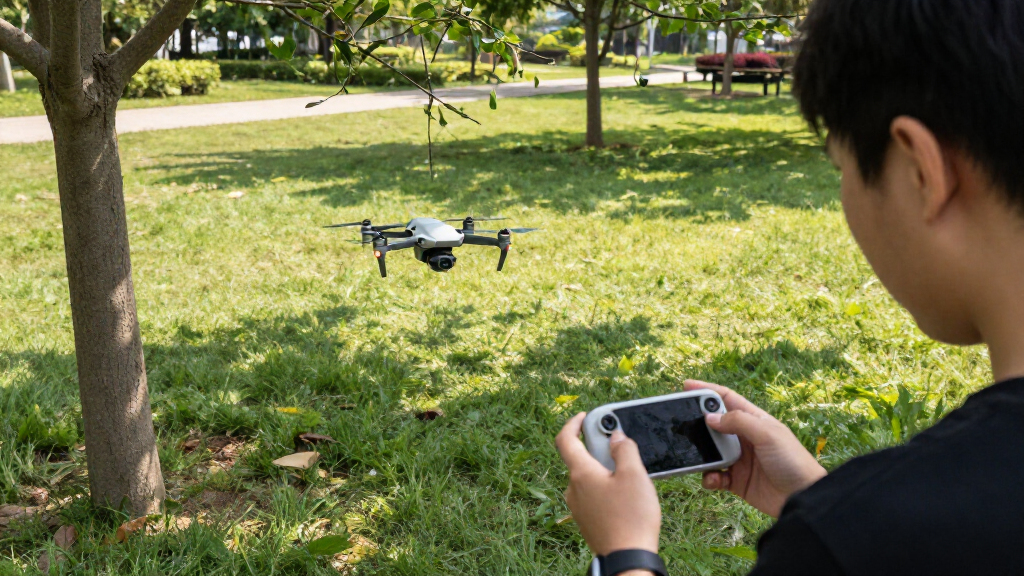
How We Picked
I ranked these models around the problems a first-time flyer is most likely to face: keeping the aircraft oriented, controlling it predictably, avoiding collisions, and getting it back safely. I gave more weight to a combination of obstacle sensing, GPS or other stated flight aids, clear controller feedback, and camera stabilization than to headline camera-resolution claims alone. I also weighed portability, battery information, indoor-versus-outdoor suitability, and whether the listed features appear to serve a real beginner need.
The ranking favors products whose stated features work together rather than a single standout spec. The 3-axis-gimbal GPS model leads for its unusually balanced feature set; the Zoiskn is positioned for buyers drawn to broader stated sensing coverage, and screen-equipped FPV models offer a simpler all-in-one control setup with more uncertainty around their sensing and flight support. The DJI option ranks as a premium camera choice, not the default starter, while the SYMA is included for indoor learning despite lacking the outdoor GPS and camera strengths of higher-ranked picks. Product names and listings do not establish independent performance, so I treat advertised obstacle coverage and camera figures as claims to verify before purchase.
Factors to Consider When Choosing Drone For Beginners With Obstacle Avoidance
Obstacle avoidance is one part of a beginner setup, not a guarantee that a drone will stop before every object. I would choose around the places you plan to fly, the kind of practice you need, and how much control help you want before comparing camera numbers.
Check What the Obstacle Sensors Actually Cover
A listing that says “obstacle avoidance” may refer to sensing in only certain directions, and a 270° or 360° label still needs context about blind spots. Look for the sensor locations, whether sensing works while moving in every flight mode, and any stated limits for thin branches, wires, glass, or low light. Avoid treating avoidance as a collision-proof feature; sensors may not recognize every surface or react quickly enough during fast flight. For a first drone, a model with clearly described coverage and conservative controls is a safer bet than one relying on a broad but unexplained claim. Leave extra space around people and property even when the sensors are active.
Prioritize Flight Stability Before Camera Resolution
Camera figures can be hard to compare when listings mix still-photo resolution, video resolution, and marketing labels. For learning and recording, GPS positioning can help a drone hold its place outdoors, while a gimbal can reduce visible shake in footage. A high-resolution camera without stabilization may produce less useful video than a lower-resolution camera with steadier support. Check whether the product specifies a mechanical gimbal or only electronic processing, and look for sample footage from a credible source. If flying is the main goal, put stable hovering and responsive controls ahead of a larger number on the camera spec.
Match Flight Assistance to Your Practice Space
GPS and return-to-home features are most useful outdoors, where a drone can establish a positioning signal and has room to move. They are not substitutes for knowing how to stop, land, or respond if the signal is weak. Indoor practice calls for a smaller, slower aircraft and enough open space; GPS-oriented outdoor models may be awkward inside. Before buying, check whether the drone offers beginner speed settings, altitude hold, or a clear emergency stop, and learn what each mode actually does. Pick the environment first, then choose the flight aids that fit it.
Read Battery Claims as a Whole-Flight Plan
Advertised flight time is not the same as uninterrupted time in the air under every condition. Wind, temperature, flying style, and battery age can change how long a flight lasts, so plan to land with reserve rather than pushing the remaining charge. Multiple batteries can make practice sessions less stop-and-start, but they also add charging and storage needs. Check whether the package includes extra batteries, how long charging takes, and whether replacement batteries are easy to obtain. For a beginner, predictable short flights with a safe landing margin are more useful than chasing a maximum-duration claim.
Decide Whether a Built-In Controller Screen Helps You
A controller screen can make setup feel simpler by putting the live view and flight information in one place. It can also limit flexibility compared with a phone-based app, and a screen does not tell you whether the transmission, interface, or camera feed is good. Check screen size, brightness, control layout, app requirements, and how the system behaves if the feed drops. If you already have a compatible phone and prefer a familiar interface, a bundled screen may add little value. If you want fewer devices to mount and connect, it may be worth prioritizing.
Spend for the Features You Will Use Now
A premium camera drone can make sense when aerial footage is a real priority, but it raises the stakes for a new pilot who is still learning basic control. A lower-cost practice model can reduce the worry of early bumps, though very inexpensive listings may leave sensing coverage, support, or replacement parts unclear. Compare the complete setup—controller, batteries, charger, spare parts, and any required phone—rather than judging the aircraft alone. Buyers who mainly want safe practice should favor clear flight aids and manageable handling over advanced imaging. Pay more when better camera stabilization, documented support, or a feature you will use regularly justifies the added commitment.
Frequently Asked Questions
Does obstacle avoidance make a beginner drone safe to fly near trees or people?
No. Obstacle sensors can miss thin, transparent, low-contrast, or poorly lit objects, and their coverage may not include every direction. They also cannot prevent every collision during a fast maneuver or in a crowded space. Keep a wide buffer from people, animals, trees, and buildings, and follow local flight rules. Treat avoidance as an extra aid while you learn, not permission to fly closer.
Should I choose 360° obstacle avoidance or GPS and return-to-home?
They address different risks, so the right choice depends on where you plan to fly. Broader obstacle sensing may help reduce contact with objects around the aircraft, while GPS and return-to-home support outdoor positioning and recovery. Neither feature replaces the other, and both depend on operating conditions and the drone’s implementation. For an outdoor beginner, I would favor a model with clear sensing details plus GPS-based flight support over choosing by a single feature label.
Is a controller with a built-in screen better than using my phone?
It can be more convenient if you want the live view and flight information on one device without mounting a phone. A phone-based setup may be easier to update or replace, and it can offer a familiar interface if the drone’s app works with your device. Check whether the controller screen is bright enough for your usual flying conditions and whether it shows useful flight details. The built-in display should be a convenience factor, not a substitute for checking control quality and camera-feed reliability.
Can I learn indoors with one of the GPS camera drones in this roundup?
Some compact drones can be flown indoors, but GPS-focused camera models are generally better matched to open outdoor spaces. Indoors, satellite positioning may be unavailable, and walls, furniture, and people leave little room to recover from a mistake. A small practice drone such as the SYMA X100 is more aligned with indoor learning than a camera-focused outdoor model. Whichever aircraft you choose, use a clear area and check the manual for indoor mode and propeller protection guidance.
Is the premium DJI option a good first drone, or should I start with a simpler model?
The DJI Mini 5 Pro Fly More Combo makes more sense for a beginner who already values camera capability and wants a longer-term platform, rather than someone who only wants to learn basic controls. A simpler, less camera-focused drone can be a more comfortable practice choice if early bumps or lost interest are concerns. Compare included flight aids, sensor coverage, controller setup, battery needs, and the cost of replacing parts before deciding. If you are unsure how often you will fly, start with the type of drone you can confidently practice with, then upgrade when your needs become clearer.
Conclusion
For the best overall balance, I would choose the GPS Drone with 4K Camera, 3-Axis Gimbal, and 40-Minute Flight, since its stated mix of GPS, sensing, stabilization, and screen-equipped control addresses more beginner needs than a single-spec pick. The best value direction is a simpler foldable FPV model if you want an accessible practice setup and can accept less evidence of advanced flight support. For best for beginners, favor the option with clear controls and the flight aids that match your space; choose the SYMA X100 for indoor practice rather than expecting it to serve as an outdoor camera drone. The best premium choice is the DJI Mini 5 Pro Fly More Combo for buyers who prioritize a more capable camera platform and are ready for a larger commitment. For a specific sensing preference, the Zoiskn GPS Drone is the pick to investigate for its advertised 360° avoidance, while buyers seeking a screen-first setup can compare the LCD-controller models. Before ordering, verify the exact sensor coverage, camera stabilization, battery package, and operating limits in the current listing and manual.