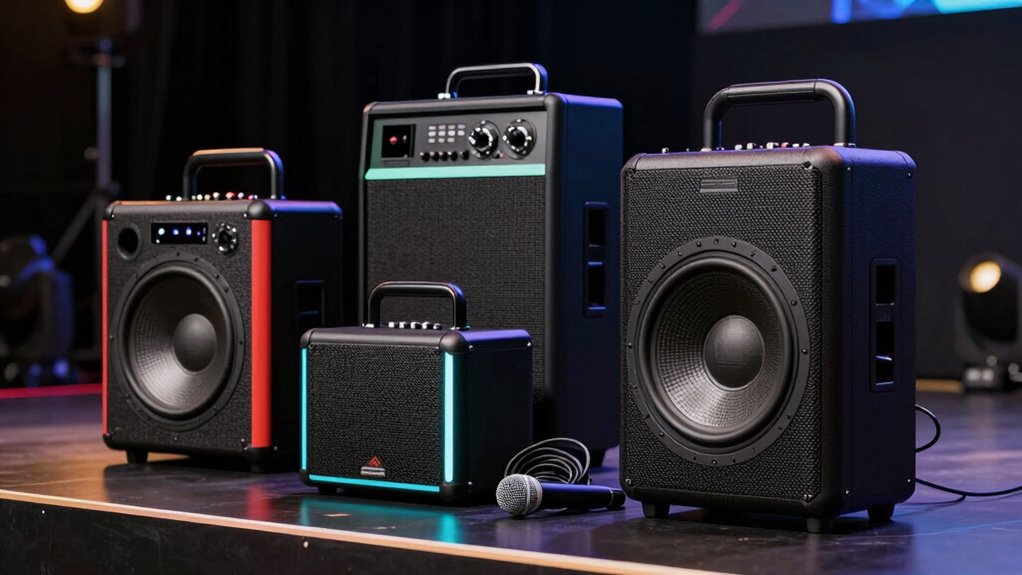

A portable PA system with a subwoofer can add the low-end weight a standalone speaker often lacks, but portability, coverage, and setup complexity vary widely. My best overall pick is the NBVOICE Professional Portable All-in-One for its integrated mixer, stands, and performance-ready accessories. The Mackie SRM-Flex is a more streamlined column-system option, while the PRORECK Club 6000 suits buyers who need a larger multi-speaker setup for DJ events. The main tradeoff is choosing between easy transport and setup, deeper bass and broader coverage, or a simpler system with fewer connections. Read on for the full comparison and guidance on matching a system to your venue and audience.

Get audio and creator gear delivered free with Prime
- Fast, free delivery on millions of items
- Prime Video, Amazon Music and more included
- Member-only deals all year
Complete the kit


Key Takeaways
- The NBVOICE All-in-One earns the overall lead on readiness: its mixer, two stands, Bluetooth, and microphone reduce the number of separate items a buyer must source.
- Portable means different things across this lineup: the battery-powered Pyle 1200W is suited to untethered use, while the PRORECK and EXOTON line-array systems are larger event setups rather than grab-and-go choices.
- A stated wattage figure does not settle the performance question: look at speaker configuration, intended venue, and usable connections instead of comparing headline wattage alone.
- Subwoofer size and system layout affect more than bass: a 15-inch powered subwoofer setup such as the EXOTON S-1503 takes more space than a compact column system, but fits buyers prioritizing a fuller event rig.
- Included accessories can shape real value: stands and microphones simplify a first setup, while buyers with existing gear may prefer to prioritize control, expandability, or battery operation.
| NBVOICE Professional Portable All-in-One Integrated 2-Way PA System |  | Best Complete Kit for Speech and Small Events | Output power: 300 watts | Speakers: Two 8-inch two-way speakers | Mixer: Detachable 8-channel mixer | VIEW ON AMAZON | See Our Full Breakdown |
| NBVOICE PRX ONE 15 inch Stage PA Speaker System |  | Best for High-Output Events | Peak power: 2400 watts | Sound pressure level: 131dB | Frequency response: 38Hz–20kHz | VIEW ON AMAZON | See Our Full Breakdown |
| PRORECK Club 6000 15-inch Stereo PA Speaker System Combo Set |  | Best for DJ and Party Coverage | Advertised peak power: 6000 watts | Subwoofers: Two 15-inch units, one active and one passive | Line-array speakers: Four 6-inch speakers | VIEW ON AMAZON | See Our Full Breakdown |
| Mackie SRM-Flex Portable Column PA System |  | Best Compact Column System | Power: 1300 watts | Subwoofer: 10-inch | Driver array: Six-driver wide-dispersion array | VIEW ON AMAZON | See Our Full Breakdown |
| EXOTON S-1503 Line Array Column DJ System with 15-Inch Powered Subwoofer |  | Best Modular 15-Inch Column System | Power: 1000W RMS / 2000W maximum | Maximum sound pressure level: 125dB | Drivers: Eight 3.5-inch full-range drivers | VIEW ON AMAZON | See Our Full Breakdown |
| Pyle 1200W Portable Bluetooth PA Speaker – 12’’ Subwoofer, LED Battery Indicator, Rechargeable Battery, MP3/USB/SD Card Reader, UHF Wireless Microphone |  | Best for Battery-Powered Single-Speaker Use | Power output: 1200 watts | Subwoofer: 12 inches | Tweeter: 3 inches | VIEW ON AMAZON | See Our Full Breakdown |
| EXOTON LVP-18 8000W P.M.P.O Active Line Array PA System |  | Best for Large-Scale Bass-Forward Events | Power output: 8000W P.M.P.O | Maximum SPL: 128 dB | Subwoofers: Dual 18-inch | VIEW ON AMAZON | See Our Full Breakdown |
| Pyle 10″ Wireless Portable PA System – 1000W Bluetooth Active + Passive Speakers with Stands, Microphone, Remote |  | Best for a Ready-to-Set-Up Two-Speaker PA | Power output: 1000W peak / 500W RMS | Speakers: Dual 10-inch speakers | Tweeter: 1-inch titanium diaphragm | VIEW ON AMAZON | See Our Full Breakdown |
| portable pa system with subwoofer | Weight | Connectivity | Frequency response | Subwoofer |
|---|---|---|---|---|
| NBVOICE Professional Portable | 44 pounds | — | — | — |
| NBVOICE PRX ONE 15 inch Stage | 128 pounds | Bluetooth 5.3, USB, RCA, XLR, 3.5mm AUX | 38Hz–20kHz | 15-inch |
| PRORECK Club 6000 15-inch Ster | — | — | 50Hz–20kHz | — |
| Mackie SRM-Flex Portable Colum | 42.2 pounds | XLR, AUX, Bluetooth | — | 10-inch |
| EXOTON S-1503 Line Array Colum | — | Bluetooth, USB, XLR, RCA | — | 15-inch powered subwoofer |
| Pyle 1200W Portable Bluetooth | — | Bluetooth 4.2, USB, SD, auxiliary, 1/4-inch mic/guitar input, RCA | 55 Hz–20 kHz | 12 inches |
| EXOTON LVP-18 8000W P.M.P.O Ac | 163 pounds | Bluetooth, USB, wired | — | — |
| Pyle 10" Wireless Portable PA | 5.98 pounds per speaker | — | 65 Hz–18 kHz | — |
More Details on Our Top Picks
NBVOICE Professional Portable All-in-One Integrated 2-Way PA System
The NBVOICE is the lineup’s most ready-to-deploy package: it includes two 8-inch speakers, stands, a wired microphone, cables, and an 8-channel detachable mixer that can handle several sources. Bluetooth and a hidden accessory compartment also help keep setup straightforward for presentations, karaoke, and smaller performances. Its suitcase-style design is easier to organize than the separate subwoofer-and-array components of the PRORECK Club 6000, though the NBVOICE weighs 44 pounds and still requires carrying multiple pieces.
The main limitation for a subwoofer-focused roundup is that this system has no dedicated subwoofer; its 8-inch speakers prioritize an all-in-one vocal and general-purpose setup over deep bass. It also cannot power additional passive speakers, so expansion is limited. I’d choose it for convenience and input flexibility, not for bass-heavy music or larger crowds.
Pros:- Includes two speakers, two stands, mixer, wired microphone, and cables
- Eight-channel mixer supports multiple microphones and audio sources
- Bluetooth 5.3 and a hidden compartment simplify playback and packing
- Suitcase-style package keeps accessories together
Cons:- No dedicated subwoofer for bass-heavy music
- Cannot power additional passive speakers, limiting expansion
- The 44-pound system and separate components still take effort to transport
Best for: Presenters, instructors, and small-event hosts who want speakers, stands, mixer, and microphone in one organized kit.
Not ideal for: DJs or bands seeking strong low-frequency output, or buyers who want to add passive speakers later; this system has no subwoofer and cannot power passive add-ons.
- Output power:300 watts
- Speakers:Two 8-inch two-way speakers
- Mixer:Detachable 8-channel mixer
- Inputs:4 combo 1/4-inch/XLR, 4 balanced 1/4-inch TRS, RCA pair, 3.5mm
- Wireless connectivity:Bluetooth 5.3
- Weight:44 pounds
- Dimensions:22 x 12 x 22 inches
- Included components:Two speaker stands, wired microphone, speaker and microphone cables, remote
Our verdict“Choose the NBVOICE when a complete, organized speech and small-event PA kit matters more than dedicated subwoofer bass.”
NBVOICE PRX ONE 15 inch Stage PA Speaker System
The NBVOICE PRX ONE is aimed at buyers who put output and a 15-inch subwoofer ahead of easy solo transport. Its listed 2400W peak power and 131dB sound-pressure level point toward larger venues and outdoor events, while Bluetooth DSP control offers a more convenient way to select settings than a basic playback-only system. Compared with the Mackie SRM-Flex, this is the more large-scale, bass-oriented choice; the Mackie is far lighter and built around a compact column format.
That scale has a real cost in portability: at 128 pounds, the PRX ONE is not a casual carry, and its two input channels are less accommodating for several live sources than the NBVOICE 8-channel kit. The supplied description also gives limited detail about the system’s exact speaker configuration, so I would verify the package contents before buying. It suits venues that can accommodate heavy gear, not frequent one-person load-ins.
Pros:- 15-inch subwoofer and listed 2400W peak output target high-output applications
- Listed 131dB sound-pressure level suits larger spaces
- Bluetooth DSP control with presets supports convenient setup
- Seven-year warranty is longer than the EXOTON S-1503’s listed two-year term
Cons:- At 128 pounds, transport likely requires help or suitable handling equipment
- Two input channels offer less source flexibility than the NBVOICE 8-channel mixer
- The product description provides limited detail on speaker configuration and included accessories
Best for: Event crews and performers covering large indoor venues or outdoor gatherings who need substantial output and can arrange assisted transport.
Not ideal for: Solo performers, mobile presenters, or small-room users who need a light system with several mixer channels.
- Peak power:2400 watts
- Sound pressure level:131dB
- Frequency response:38Hz–20kHz
- Subwoofer:15-inch
- Input channels:2
- Connectivity:Bluetooth 5.3, USB, RCA, XLR, 3.5mm AUX
- Weight:128 pounds
- Dimensions:23.28 x 20.58 x 24.41 inches
- Warranty:7 years
Our verdict“Pick the PRX ONE for high-output events when you have help moving it and do not need a many-channel mixer.”
PRORECK Club 6000 15-inch Stereo PA Speaker System Combo Set
The PRORECK Club 6000 is the most expansive multi-box setup here: it pairs two 15-inch subwoofers with four line-array speakers, giving DJs and event hosts a broad speaker layout for music and announcements. Bluetooth, USB, and SD playback let a host run music without a separate player, while combo microphone inputs and balanced XLR outputs make it more adaptable to a mixed event than the Mackie SRM-Flex, which is a single column system.
The tradeoff is that “portable” means transportable in separate pieces, not quick to carry in one trip. The three-package shipment and listed component weights make planning storage and load-in part of the purchase. Its advertised 6000W figure is described as peak power, so I would not compare it directly with continuous or RMS ratings on other systems. Choose this when multiple speakers and substantial bass matter more than a compact footprint; skip it for quick solo setups.
Pros:- Two 15-inch subwoofers provide a bass-focused layout
- Four line-array speakers distribute sound across multiple positions
- Bluetooth, USB, and SD playback provide flexible music sources
- Microphone inputs and balanced XLR outputs support event and PA connections
Cons:- Multiple large components make transport and setup less convenient than the Mackie SRM-Flex
- The listed 6000W figure is peak power, so it is not directly comparable to RMS ratings
- The system’s size and coverage may be excessive for small rooms or simple speech use
Best for: Mobile DJs and party or wedding hosts who want dual subwoofers, several speaker positions, and onboard playback options.
Not ideal for: Solo performers with limited vehicle space or buyers who need one-person, one-trip setup; the system ships as several large components.
- Advertised peak power:6000 watts
- Subwoofers:Two 15-inch units, one active and one passive
- Line-array speakers:Four 6-inch speakers
- Frequency response:50Hz–20kHz
- Audio inputs:Bluetooth, USB, SD card, stereo RCA, 3.5mm AUX, 6.35mm/XLR combo, two-channel mic
- Outputs:Two-channel balanced XLR
- Bluetooth range:Up to 66 feet
- Package dimensions:Subwoofers: 20 x 22 x 23 inches each; array section: 36 x 11 x 20 inches
Our verdict“Choose the Club 6000 for DJ and event setups that benefit from dual 15-inch subs and multiple speakers, provided you can manage the load-in.”
Mackie SRM-Flex Portable Column PA System
The Mackie SRM-Flex is the lineup’s clearest choice for buyers who want a 10-inch subwoofer in a column PA without stepping up to the much heavier NBVOICE PRX ONE or the multi-piece PRORECK Club 6000. Its six-driver array is designed for wide sound distribution, while a built-in six-channel digital mixer gives a solo act or small group room for several sources. Bluetooth streaming and smartphone control also let an operator adjust the mix from elsewhere in the room rather than staying beside the speaker.
At 42.2 pounds, it is a more manageable package than those larger bass systems, but it is still tall and requires mains power. The 10-inch subwoofer is a more restrained bass choice than either 15-inch system here, and six channels may feel limiting for a larger band. I’d favor it for portability and speech-plus-music versatility, not maximum low-end impact.
Pros:- 10-inch subwoofer and column array combine bass support with a compact system format
- Six-channel digital mixer suits solo acts and smaller groups
- Smartphone control allows adjustments away from the physical mixer
- At 42.2 pounds, it is lighter than the NBVOICE PRX ONE and PRORECK Club 6000
Cons:- Smaller subwoofer than the 15-inch options in this roundup
- Six channels may not cover a larger band or complex event setup
- Requires an external power source and has a tall assembled profile
Best for: Solo performers, small groups, and event hosts who need a column PA with a subwoofer and mixer in a comparatively manageable package.
Not ideal for: DJs seeking the stronger low-frequency emphasis of a 15-inch subwoofer, or bands needing more than six mixer channels.
- Power:1300 watts
- Subwoofer:10-inch
- Driver array:Six-driver wide-dispersion array
- Mixer channels:6
- Connectivity:XLR, AUX, Bluetooth
- Weight:42.2 pounds
- Dimensions:13 x 14.4 x 78.8 inches
- Control compatibility:iOS 11 or later and Android 6 or later
Our verdict“Choose the SRM-Flex for a more manageable column PA with a mixer and subwoofer, rather than maximum bass or channel capacity.”
EXOTON S-1503 Line Array Column DJ System with 15-Inch Powered Subwoofer
The EXOTON S-1503 brings a 15-inch powered subwoofer together with eight full-range drivers in a column format, making it a middle ground between the Mackie SRM-Flex’s lighter 10-inch sub and the sprawling, dual-sub PRORECK Club 6000. Its 1000W RMS rating gives buyers a more useful continuous-power reference than a peak-only figure, and the included short and long extension poles let the array height adapt to different rooms. Bluetooth, USB, XLR, and RCA cover everyday playback and common PA connections.
Its modular pieces and travel bag support transport, but the product data does not give a system weight, so buyers should not assume it is easy to carry. The 15-inch subwoofer also does not make it as compact as a smaller column system, and the listed controls are not described in much detail. I’d pick it for column-array coverage with larger-subwoofer potential, while the Mackie is the safer choice when documented weight matters.
Pros:- 15-inch powered subwoofer paired with eight full-range column drivers
- 1000W RMS rating provides a continuous-power figure alongside the 2000W maximum
- Short and long extension poles allow different array heights
- Bluetooth, USB, XLR, and RCA suit both casual playback and PA connections
Cons:- System weight is not provided, making transport planning harder than with the Mackie SRM-Flex
- A 15-inch subwoofer and modular parts are less compact than a smaller column setup
- Available information gives limited detail about fine sound adjustment
Best for: DJs and live performers who want a column-array layout, a 15-inch powered subwoofer, and adjustable speaker height for different venues.
Not ideal for: Buyers who need a clearly documented lightweight system or detailed mixer controls; the available specs do not provide a system weight or much control detail.
- Power:1000W RMS / 2000W maximum
- Maximum sound pressure level:125dB
- Drivers:Eight 3.5-inch full-range drivers
- Subwoofer:15-inch powered subwoofer
- Connectivity:Bluetooth, USB, XLR, RCA
- Enclosure material:Wood
- Included components:Subwoofer, short and long extension poles, travel bag
- Warranty:2 years
Our verdict“Choose the S-1503 for a modular column PA with a 15-inch subwoofer, but compare its transport needs carefully if you load in alone.”
Pyle 1200W Portable Bluetooth PA Speaker – 12’’ Subwoofer, LED Battery Indicator, Rechargeable Battery, MP3/USB/SD Card Reader, UHF Wireless Microphone
The Pyle 1200W is the most self-contained pick here for buyers who want one speaker with a 12-inch subwoofer, rechargeable battery, and several ways to play music. Bluetooth, USB, SD, auxiliary, and mic/guitar inputs make it easier to run a small event without building a separate source setup. Its battery is rated at 2200mAh across two cells, but runtime is not specified, so I would not choose it for an event where all-day unplugged operation is a must. Compared with the Pyle 10-inch system, this model puts the subwoofer and controls in a single cabinet rather than supplying two speakers and stands. That saves setup steps but gives up stereo coverage. At 8.29 kg, it is portable for short moves, not a lightweight carry.
Pros:- 12-inch subwoofer in a single portable cabinet
- Rechargeable battery supports use away from an outlet
- Bluetooth, USB, SD, auxiliary, RCA, and mic/guitar connections
- Bass, treble, and echo controls allow basic sound adjustment
Cons:- Battery runtime is not specified, making event planning harder
- A single cabinet does not provide the stereo spread of the Pyle 10-inch two-speaker set
- The included wireless microphone requires two AA batteries, which are not supplied
Best for: Hosts, instructors, and small-event organizers who need one rechargeable speaker with a built-in subwoofer and flexible playback inputs
Not ideal for: Buyers needing verified long battery runtime, broad stereo coverage, or a rig that is easy to carry over long distances
- Power output:1200 watts
- Subwoofer:12 inches
- Tweeter:3 inches
- Frequency response:55 Hz–20 kHz
- Battery:3.7V Li-ion, 2200mAh (2 cells)
- Media support:MP3, WMA, WAV; USB and SD cards up to 32GB
- Connectivity:Bluetooth 4.2, USB, SD, auxiliary, 1/4-inch mic/guitar input, RCA
- Dimensions and weight:15 x 12 x 23 inches; 8.29 kg
Our verdict“Choose this Pyle when a rechargeable, single-cabinet PA with a 12-inch subwoofer matters more than stereo coverage or confirmed battery runtime.”
EXOTON LVP-18 8000W P.M.P.O Active Line Array PA System
For buyers who need substantial bass and audience reach, the EXOTON LVP-18 is in a different class of setup from the portable single-cabinet Pyle options. Its dual 18-inch subwoofers and six line-array modules are aimed at live performances, DJ sets, and larger events where deep low end and elevated coverage matter more than quick, solo setup. The listed 128 dB maximum SPL gives buyers a useful output reference, while the 5-band EQ and digital effects add room to shape a performance mix. The tradeoff is substantial: at 163 pounds, this is a two-person or equipment-assisted move, not a grab-and-go portable PA. Unlike the Pyle 1200W, it also has no stated rechargeable battery. I would skip it for small rooms or casual speech events where its scale becomes a burden.
Pros:- Dual 18-inch subwoofers provide substantial low-frequency capability
- Six line-array modules are designed to spread sound across an event space
- Listed maximum SPL of 128 dB suits higher-output applications
- 5-band EQ, digital effects, and Bluetooth, USB, and wired connections offer mix flexibility
Cons:- At 163 pounds, transport and setup can require extra people or equipment
- The large system is excessive for small rooms and speech-focused events
- No rechargeable battery or battery runtime is specified
Best for: DJs, bands, and event crews serving large audiences who can transport and set up a heavy subwoofer-and-array system
Not ideal for: Solo presenters, small-venue users, and anyone who needs battery-powered operation or quick, simple setup
- Power output:8000W P.M.P.O
- Maximum SPL:128 dB
- Subwoofers:Dual 18-inch
- Line-array modules:6
- Weight:163 pounds
- Enclosure:Multi-layer plywood
- Connectivity:Bluetooth, USB, wired
- Adjustable height:78.74–90.55 inches
Our verdict“Pick the EXOTON when large-event bass and array-style coverage outweigh portability, battery operation, and simple setup.”
Pyle 10″ Wireless Portable PA System – 1000W Bluetooth Active + Passive Speakers with Stands, Microphone, Remote
The Pyle 10-inch system is the practical choice for buyers who want a two-speaker PA package rather than the single-box format of the Pyle 1200W. It includes two stands, a microphone, and a remote, so the core pieces for a basic event setup arrive together; the stands also let users raise the speakers for clearer coverage over a crowd. Bluetooth, USB, SD, AUX, and XLR microphone input support several common sources. Although it is marketed in a roundup focused on subwoofers, the supplied data lists 10-inch speakers and a 1-inch tweeter, not a separate subwoofer. Its 65 Hz lower frequency limit also makes it less suited to bass-heavy DJ playback than the EXOTON dual-18 system. The per-speaker weight is listed at 5.98 pounds, but no battery is specified, so plan for power access.
Pros:- Two speakers and two stands provide wider placement options than a single-cabinet PA
- Microphone, remote, and power cable are included
- Bluetooth, USB, SD, AUX, and XLR microphone input support varied sources
- Listed Bluetooth range exceeds 100 feet
Cons:- Product data lists 10-inch speakers but does not specify a dedicated subwoofer
- 65 Hz lower frequency response is less suited to deep bass than the EXOTON system
- Battery operation is not specified, so portable use may require an external power source
Best for: Community organizers, instructors, and small-event hosts who want a two-speaker PA with stands and a microphone included
Not ideal for: DJs seeking deep sub-bass, buyers who require a dedicated subwoofer, or users who need documented battery-powered operation
- Power output:1000W peak / 500W RMS
- Speakers:Dual 10-inch speakers
- Tweeter:1-inch titanium diaphragm
- Frequency response:65 Hz–18 kHz
- Inputs:USB, SD card, AUX, 1/4-inch SpeakOn, XLR microphone
- Included accessories:2 stands, microphone, remote, power cable
- Bluetooth range:100+ feet
- Weight:5.98 pounds per speaker
Our verdict“Choose this Pyle for a bundled two-speaker event setup, but look elsewhere if a dedicated subwoofer or deep bass is your priority.”

How We Picked
I ranked these systems around the practical demands of a portable PA with subwoofer: how easily a buyer can transport and set up the equipment, how well the configuration fits likely venues, and whether the controls and included accessories suit the intended use. I also weighed power-source options, input and playback features, construction details, and how much space each system is likely to require. A portable PA is only useful if it can be moved, connected, and operated comfortably in the settings where it will be used.
The ranking favors systems with a clear use case and a sensible balance of setup convenience, flexibility, and sound-system scale. The NBVOICE all-in-one ranks first for its ready-to-use bundle; the Mackie offers a more focused column-system alternative; and the PRORECK and EXOTON line arrays suit larger event needs but carry greater setup and transport demands. Battery-powered Pyle models receive attention for mobility, though their compact format is not a substitute for a larger event rig. Where product details do not establish a specific performance advantage, I avoid treating headline wattage as proof of real-world loudness.
| portable pa system with subwoofer | Connectivity |
|---|---|
| NBVOICE Professional Portable | — |
| NBVOICE PRX ONE 15 inch Stage | Bluetooth 5.3, USB, RCA, XLR, 3.5mm AUX |
| PRORECK Club 6000 15-inch Ster | — |
| Mackie SRM-Flex Portable Colum | XLR, AUX, Bluetooth |
| EXOTON S-1503 Line Array Colum | Bluetooth, USB, XLR, RCA |
| Pyle 1200W Portable Bluetooth | Bluetooth 4.2, USB, SD, auxiliary, 1/4-inch mic/guitar input, RCA |
| EXOTON LVP-18 8000W P.M.P.O Ac | Bluetooth, USB, wired |
| Pyle 10" Wireless Portable PA | — |
Factors to Consider When Choosing Portable Pa System With Subwoofer
Choosing a portable PA with a subwoofer starts with the venue and the way you will move the system—not a wattage number. Use these factors to decide how much bass, coverage, setup help, and transport effort you actually need.
Match the system size to the room and audience
Start with the largest space and audience you expect to serve, then check whether the system’s speaker layout suits that setting. A compact column PA can be easier to place in a small room, while multi-speaker line arrays may make more sense for events needing broader coverage. More cabinets can bring flexibility, but they also mean more pieces to carry and position. A common mistake is buying the biggest-looking system for a small room, where placement and feedback control may matter more than extra hardware. Ask the seller or manufacturer for coverage guidance rather than relying on a wattage label alone. If your venues vary, give more weight to a system that is easy to reconfigure.
Decide how much low-frequency output you need
A subwoofer is most useful when music, DJ playback, or fuller backing tracks need noticeable low end. Speech-led presentations and acoustic sets may benefit less, so a large sub can add carrying weight without improving the part of the sound you care about most. Check whether the subwoofer is powered and how it connects to the other speakers; the complete signal path matters as much as the driver size. Bigger subwoofers and separate cabinets often need more floor space and careful placement. Buyers sometimes focus on the subwoofer diameter alone, but enclosure design, system tuning, and venue acoustics also affect the result. Choose the smallest setup that meets your real bass needs rather than paying in transport effort for unused capacity.
Treat portability as a full setup task
Portability includes loading, carrying, assembling, connecting, and packing away—not just whether a product is called portable. An all-in-one bundle with stands and a microphone can cut down on separate purchases, while a line array with several cabinets may take more time and vehicle space. Battery operation is particularly useful when power outlets are unavailable, but verify what the battery runs and how the system is charged before relying on it for an event. Check product dimensions, component count, and available handles or cases against your storage and transport situation. If one person will set up alone, fewer components and simpler connections can matter more than extra features. For frequent travel, account for protective bags or cases too.
Choose controls and connections for your actual sources
List what you plan to connect: microphones, instruments, a mixer, a phone, or stored music. Then confirm the input types and the number of channels, since Bluetooth playback does not replace microphone or instrument connections. An integrated mixer can simplify a presentation or small performance by reducing the gear needed, while a separate mixer may suit a band that needs more control. Check whether the system offers the playback formats and wireless features you will use, not just a long feature list. Buyers can overlook the need to adjust multiple sources independently, which can make a basic setup frustrating during a live event. Favor controls that match your skill level and the number of people operating the PA.
Separate claimed power from usable performance
Headline wattage figures are not a reliable way to rank systems when manufacturers may describe power differently. Compare system architecture, speaker count, intended application, and any published specifications that use consistent measurement methods. A higher number does not automatically mean clearer vocals, better coverage, or more useful bass. Look for practical details such as available DSP controls, limiter behavior, and manufacturer guidance for venue size. If those details are missing, avoid assuming that a large peak or PMPO figure predicts sustained output. A buyer planning frequent loud events should seek independent technical measurements or an audition under conditions close to the intended use.
Pay for capacity you can use and support you can access
A higher-end system makes sense when its control options, construction, expansion possibilities, or service support address a real need. A buyer who performs regularly may value a road-ready enclosure and a stated warranty, while a first-time presenter may get more practical value from included stands and a microphone. Check what the warranty covers, how service is handled, and whether replacement parts are available in your region. Also account for cables, cases, stands, and adapters that may not come in the box. The common misstep is comparing bundles by included item count without checking whether each accessory fits the intended job. Spend more for a specific advantage you expect to use, not simply a larger specification headline.
Frequently Asked Questions
Can a battery-powered PA system with a subwoofer handle a DJ event?
It can suit a small, informal event where mobility and access to power matter more than room-filling bass. Battery operation does not by itself indicate how loudly or how long a system can play, so check the manufacturer’s runtime conditions and whether a subwoofer is part of the powered setup. DJ playback often places more demand on low frequencies than speech or acoustic music. For a larger crowd or extended event, a mains-powered system with a separate subwoofer is generally the safer direction. Match the system to the audience size and venue rather than assuming a portable label guarantees event-scale output.
Is a column PA or a multi-speaker line array easier to move?
A column system is often simpler to store and assemble because it uses a more compact arrangement of components. A multi-speaker line array can provide a broader or more adaptable event setup, but separate cabinets add carrying, cabling, and setup work. Ease of transport also depends on component weight, handles, bags, and vehicle space, so check those details for the exact model. If you set up alone or move between venues often, fewer pieces may be worth more than extra coverage options. If event scale is the priority, the added effort of a larger array may be justified.
Do I need a separate mixer if the PA includes one?
An integrated mixer can be enough for straightforward setups with a few microphones, a phone, or a playback device. It can reduce cables and make the system quicker to deploy, especially for a presenter or solo performer. A band or event with several instruments may need more channels, dedicated effects, or more detailed routing than the built-in controls provide. Check the mixer’s inputs and controls against every source you expect to use at once. You can also use an external mixer with many systems, but confirm the correct input connection and gain setup first.
Should I choose a system with a larger subwoofer for more bass?
A larger driver can be part of a system designed for deeper, more forceful low-frequency output, but size alone does not predict the bass you will hear. Cabinet design, tuning, power, placement, and the room all affect the result. Larger subs also take up more floor and vehicle space, which can undermine portability. For speech, small presentations, or acoustic performances, a large sub may add little practical value. For DJ sets or bass-heavy music, compare published response information and the complete system design rather than choosing by driver diameter alone.
What should I verify before buying a portable PA for outdoor use?
Check whether you will have access to mains power, because that can rule out some setups or require a separate power solution. Confirm how the system handles battery use, if applicable, and whether the stated runtime reflects the volume and source you expect. Outdoor spaces have no walls to reinforce sound, so a system that works in a small indoor room may not cover the same audience outdoors. Plan for wind, weather protection, stable stands, and longer cable runs as well. Ask the manufacturer for outdoor coverage guidance and avoid using equipment in rain unless it is specifically rated for those conditions.
Conclusion
For most buyers seeking a balanced portable PA with useful setup extras, I would start with the NBVOICE Professional Portable All-in-One; its mixer, stands, and microphone make it the best overall fit for performances and presentations. My best value choice for a ready-to-use bundle is the Pyle 10-inch Wireless Portable PA, especially for buyers who want speakers, stands, and a microphone together, though it is not the pick for maximum bass. For a more polished column-system direction, the Mackie SRM-Flex is my premium-style recommendation among the named options, while the NBVOICE bundle is the best choice for beginners who want fewer separate pieces to source. For larger DJ or event setups, consider the PRORECK Club 6000 or EXOTON S-1503, accepting more transport and setup work; choose the battery-powered Pyle 1200W when untethered mobility matters more than a large-system format. If you need a bigger line-array rig, compare the EXOTON LVP-18 with the PRORECK based on verified specifications and venue needs, since headline wattage alone cannot settle that choice.
Halloween Picks
halloween
As an affiliate, we earn on qualifying purchases.