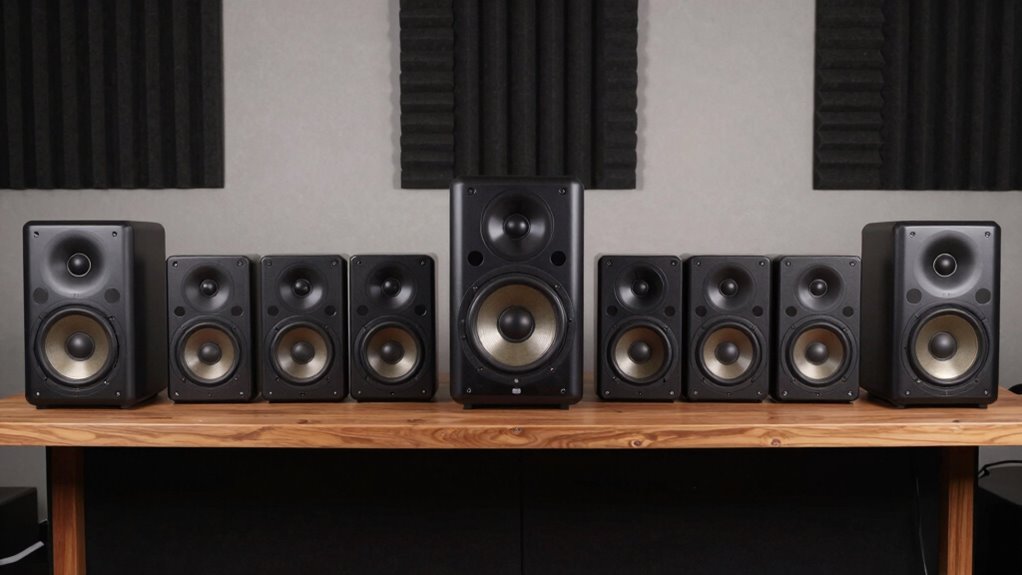
For powered bookshelf speakers under $1,000, I’d start with the Fluance Ai61 as the best overall choice for its larger drivers, useful connections, and subwoofer output. The Edifier R2750DB MKII is a stronger fit for listeners who want a larger three-way speaker, while the Edifier R1280DBs offers a more accessible feature set with Bluetooth and a subwoofer connection. The main tradeoffs are speaker size, input flexibility, low-bass capability, and how much power your room needs. A compact desktop pair can be easier to place, but a larger model may fill a living room more confidently. Read on for the full breakdown and help matching each option to your setup.

Get audio and creator gear delivered free with Prime
- Fast, free delivery on millions of items
- Prime Video, Amazon Music and more included
- Member-only deals all year
Complete the kit


Key Takeaways
- The Fluance Ai61 leads on versatility: its 6.5-inch drivers, USB input, and subwoofer output make it a more adaptable hub than the smaller Ai41.
- The Edifier R2750DB MKII is the room-filling pick: its three-way design and higher stated output favor larger listening spaces, though its size is less desk-friendly.
- The Edifier R1280DBs adds a useful upgrade path: its subwoofer line out gives buyers a way to add bass later, setting it apart from the R1280DB.
- Small speakers suit near-field listening, not every room: the RIOWOIS, Saiyin, Electrohome Huntley, and Edifier R980T are easier to fit, but their compact format limits deep bass and scale.
- Input choice changes the best pick: optical and Bluetooth suit TV and wireless sources, while USB and multiple analog connections matter more for computer and record-player setups.


| powered bookshelf speakers under 1000 | Connectivity | Dimensions | Weight | Power output |
|---|---|---|---|---|
| Fluance AI41 Powered 2-Way Ste | RCA, optical, Bluetooth 5.0, subwoofer output | 7.6 × 13 × 10.9 inches (D × W × H) | 16 pounds | — |
| Fluance Ai61 Powered 2-Way Ste | Bluetooth 5, RCA, optical, USB, subwoofer output | — | — | — |
| ULTIMEA 3-Way Powered Bookshel | Bluetooth 6.0, HDMI ARC, optical, RCA, USB | — | — | 70W RMS |
| RIOWOIS Powered Bookshelf Spea | Bluetooth 5.3 and multiple wired inputs | 9.69 × 7.6 × 6.22 inches (D × W × H) | 2.37 kg | — |
| Edifier R980T 4" Active Booksh | Dual AUX (3.5 mm), RCA | 11.5 × 7.5 × 17 inches (D × W × H) | 7.8 pounds | 24W RMS |
| Electrohome Huntley Powered Bo | Bluetooth 5, RCA, Aux-In | 9.17 × 9.17 × 11.1 inches | 4.1 pounds | — |
| Edifier R1280DB Powered Blueto | Bluetooth, optical, coaxial, dual RCA | 6.1 × 8.4 × 10 inches | 4.9 kg | 42W RMS |
| Saiyin Powered Bluetooth Books | Bluetooth, optical, coaxial, RCA, auxiliary | 150 × 170 × 240 mm | — | 40W per channel |
| Klipsch Reference R-40PM Power | Bluetooth and multiple analog/digital inputs | 10.1 × 5.7 × 11.8 inches | 8.3 kg | — |
| Edifier R2750DB MKII 3-Way Pow | HDMI eARC, optical, coaxial, line-in, Bluetooth 6.0 | — | — | 144W RMS |
| Edifier R1280DBs Active Blueto | Bluetooth, coaxial, optical, RCA | — | 4,900 g | 42W RMS |
| Edifier R1280T Powered Bookshe | Auxiliary, wired | — | — | 42W RMS |
More Details on Our Top Picks
Fluance AI41 Powered 2-Way Stereo Bookshelf Speakers with 5″ Drivers, 90W Amplifier, Bluetooth 5, RCA & Optical Inputs (Natural Walnut)
The Fluance AI41 is a strong middle ground for buyers who want substantial stereo sound without jumping to larger cabinets. Its 90W built-in amplifier and 5-inch glass-fiber drivers give it more scale than compact options such as the Edifier R980T, while the optical input makes it an easy match for a TV. Bluetooth 5.0 and RCA add flexibility for casual listening and wired sources, and the subwoofer output leaves room to build out the low end later.
Compared with the larger Fluance Ai61, the AI41 takes up less space and asks less of a small room, but its smaller drivers are less suited to listeners chasing stronger bass and higher output. The tradeoffs are its 16-pound weight and lack of water resistance; its remote also needs AAA batteries. I’d choose it for balanced everyday use, not humid rooms or outdoor setups.
Pros:- Built-in 90W amplifier avoids the need for a separate receiver.
- Optical, RCA, Bluetooth 5.0, and subwoofer output support varied home setups.
- Five-inch glass-fiber drivers provide more scale than the Edifier R980T’s 4-inch woofers.
- MDF cabinets and neodymium tweeters suit a dedicated living-room or desk setup.
Cons:- Smaller drivers than the Fluance Ai61 limit low-frequency output and headroom.
- The pair weighs 16 pounds, making it less convenient to move or reposition.
- No water resistance, and the remote requires two AAA batteries.
Best for: TV and music listeners who want a compact, powered stereo pair with optical connectivity and the option to add a subwoofer later.
Not ideal for: Buyers who need deep bass and stronger output from the speakers alone, or anyone placing speakers in a humid or outdoor area.
- Amplifier power:90W
- Driver size:5 inches
- Tweeter type:Neodymium
- Connectivity:RCA, optical, Bluetooth 5.0, subwoofer output
- Cabinet material:MDF wood
- Finish:Natural walnut
- Dimensions:7.6 × 13 × 10.9 inches (D × W × H)
- Weight:16 pounds
Our verdict“Choose the AI41 for versatile TV-and-music listening in a modest room; choose the Ai61 if fuller bass and greater output matter more than cabinet size.”
Fluance Ai61 Powered 2-Way Stereo Bookshelf Speakers with 6.5″ Drivers, 120W Amplifier, Bluetooth 5, RCA, Optical, USB, Sub Out (Natural Walnut)
For listeners who want a powered pair to fill a larger room, the Fluance Ai61 brings the most substantial amplifier and woofer combination among these two Fluance models: 120W power and 6.5-inch drivers, compared with the AI41’s 90W and 5-inch drivers. That larger driver can give music and TV sound more weight before a subwoofer enters the setup. USB, optical, RCA, and Bluetooth 5 also make it adaptable across a computer, television, and wireless sources.
The added scale has a cost in space. The Ai61 is a less natural fit for a crowded desk or small room than the AI41, and its larger drivers do not make it water-resistant or eliminate the need for an outlet. Buyers who mainly listen near-field may get better value from a smaller option such as the Edifier R980T. I’d pick the Ai61 when room-filling sound and a broad connection set matter more than compactness.
Pros:- A 120W amplifier and 6.5-inch drivers offer more headroom and bass potential than the Fluance AI41.
- USB, optical, RCA, and Bluetooth 5 cover common digital and analog sources.
- Subwoofer output allows a future low-frequency upgrade.
- MDF cabinets with a natural walnut finish suit a permanent home setup.
Cons:- Larger cabinets can overwhelm a small desk or compact listening room.
- No water-resistance rating; intended for indoor use.
- Requires mains power and batteries for the remote.
Best for: Listeners furnishing a medium or larger indoor room who want a powerful powered pair for music, TV, and computer audio, with USB and subwoofer connectivity.
Not ideal for: Desk users with limited space, or buyers who need portable, battery-powered, or weather-resistant speakers.
- Amplifier power:120W
- Driver size:6.5 inches
- Tweeter diameter:1 inch
- Connectivity:Bluetooth 5, RCA, optical, USB, subwoofer output
- Enclosure material:MDF wood
- Finish:Natural walnut
- Water resistance:Not water-resistant
- Warranty:2 years
Our verdict“Choose the Ai61 if you want the stronger, fuller-sounding Fluance option for a larger room; choose the AI41 or R980T when space is tighter.”
ULTIMEA 3-Way Powered Bookshelf Speakers, Pro-Level Audio, BS-3
The ULTIMEA BS-3 is the feature-led pick for buyers building a mixed TV, gaming, and music setup. Its HDMI ARC connection can simplify TV integration compared with the RCA-and-optical options on the Fluance AI41, while Bluetooth, USB, and optical inputs broaden the ways to connect other sources. A three-way design separates woofer, midrange, and treble duties, and app-controlled EQ lets listeners adjust the presentation instead of relying on fixed tuning.
That flexibility comes with more setup decisions: using several sources can mean managing extra cables and settings. The BS-3’s stated 70W RMS output is also below the Ai61’s 120W, so buyers prioritizing greater headroom should look to the larger Fluance. The listed frequency-response information gives only a 50 Hz figure, so it does not fully describe the speaker’s range. I’d favor the BS-3 for convenient TV control and EQ options, not for the simplest plug-in setup.
Pros:- HDMI ARC supports straightforward connection to compatible TVs.
- Three-way driver arrangement assigns separate drivers to low, mid, and high frequencies.
- App-controlled EQ and bass boost provide sound-adjustment options.
- Bluetooth, optical, RCA, USB, and subwoofer output support varied sources and system expansion.
Cons:- The 70W RMS output is lower than the Fluance Ai61’s stated 120W.
- Taking advantage of multiple inputs may require additional cable and setup management.
- No water resistance, and the supplied frequency-response figure does not describe the full range.
Best for: TV, gaming, and computer users who want HDMI ARC, app-based EQ, and several wired input choices in one powered speaker pair.
Not ideal for: Listeners seeking the highest stated amplifier output, a minimal-cable setup, or speakers for outdoor use.
- Power output:70W RMS
- Woofer size:5.25 inches
- Tweeter diameter:1 inch
- Frequency response:50 Hz (listed)
- Connectivity:Bluetooth 6.0, HDMI ARC, optical, RCA, USB
- Additional features:App-controlled EQ, bass boost, subwoofer output
- Materials:Engineered wood, ABS, fabric
- Mounting type:Shelf
Our verdict“Choose the BS-3 if HDMI ARC and adjustable EQ are priorities; choose the Ai61 if greater stated amplifier power and larger drivers matter more.”
RIOWOIS Powered Bookshelf Speakers, Desktop Speakers for Record Player
The RIOWOIS DS6701NP suits buyers who need powered speakers for a small tabletop setup rather than room-filling output. Its compact listed dimensions and 2.75-inch woofer make it a more desk-friendly choice than the Fluance AI41 or Ai61, and its built-in amplification means no separate receiver is needed. Bluetooth 5.3, a remote, and multiple wired inputs make it practical for a computer, phone, or compatible turntable arrangement.
The size advantage also marks its limit: it is less suited to listeners who want strong bass or broad-room coverage from the speakers alone. Unlike the ULTIMEA BS-3, the supplied details do not list HDMI ARC or app-based EQ, so it offers fewer described options for TV integration and sound tuning. The product information also cautions that turntable use depends on the turntable’s connection capability. I’d choose it for a compact, straightforward setup, not as the centerpiece of a larger room.
Pros:- Small listed dimensions make the pair easier to fit on a tabletop than the larger Fluance speakers.
- Built-in amplification lets compatible sources connect without a separate amplifier.
- Bluetooth 5.3 and remote control add convenient wireless playback and operation.
- Multiple wired inputs support computers and other audio sources.
Cons:- The 2.75-inch woofer is a poor match for buyers expecting substantial bass or room-filling output.
- Turntable compatibility depends on the turntable’s available connection method.
- The listed details do not specify HDMI ARC or Dolby/DTS compatibility.
Best for: Desk listeners and owners of compatible turntables who need compact powered speakers with Bluetooth and a remote.
Not ideal for: Buyers seeking deep bass, high output for a large room, or clearly documented HDMI ARC and Dolby/DTS support.
- Woofer diameter:2.75 inches
- Tweeter diameter:2 inches
- Connectivity:Bluetooth 5.3 and multiple wired inputs
- Enclosure materials:ABS, metal, and MDF
- Dimensions:9.69 × 7.6 × 6.22 inches (D × W × H)
- Weight:2.37 kg
- Power source:Corded electric
- Control method:Remote and buttons
Our verdict“Pick the RIOWOIS for a compact desktop or compatible turntable setup; choose a Fluance model for larger-room sound and bigger drivers.”
Edifier R980T 4″ Active Bookshelf Speakers – 2.0 Powered Studio Monitors (Pair)
The Edifier R980T is the straightforward choice for listeners who want an active pair for a computer or television and do not need wireless features. Its 24W RMS amplifier is modest beside the Fluance AI41’s 90W or Ai61’s 120W, but it keeps the setup simple: dual AUX inputs allow two wired sources to stay connected, and included RCA and 3.5 mm cables help get a basic system running. That makes it a practical alternative to feature-heavy speakers when the goal is uncomplicated desktop or near-field listening.
The compromises are clear. Its 4-inch woofer has less capacity for deep bass than either Fluance model, and there is no Bluetooth for cable-free playback. The cabinet uses plastic with a wood finish rather than the MDF construction listed for the Fluance speakers, so it is the more basic-feeling option. I’d shortlist it for wired listening in a small space, not for loud playback or wireless convenience.
Pros:- Built-in amplifier avoids the need for a separate receiver.
- Dual AUX inputs allow two wired sources to remain connected.
- Included RCA and 3.5 mm cables simplify basic setup.
- Compact 4-inch woofers suit near-field listening better than a large-room role.
Cons:- No Bluetooth or other wireless connectivity.
- The 4-inch woofers offer less bass potential than the Fluance AI41 and Ai61 drivers.
- Plastic cabinets with a wood finish feel less substantial than the MDF cabinets listed for the Fluance models.
Best for: Budget-conscious computer or TV listeners who want a simple wired pair with two AUX inputs and included connection cables.
Not ideal for: Buyers who need Bluetooth, strong low bass, or higher output for a larger listening room.
- Power output:24W RMS
- Woofer diameter:4 inches
- Connectivity:Dual AUX (3.5 mm), RCA
- Frequency response:20 kHz (listed)
- Signal-to-noise ratio:85 dB
- Enclosure material:Plastic with wood finish
- Dimensions:11.5 × 7.5 × 17 inches (D × W × H)
- Weight:7.8 pounds
Our verdict“Choose the R980T for simple, wired desktop audio; step up to a Fluance pair if you need stronger output, deeper bass, or Bluetooth.”
Electrohome Huntley Powered Bookshelf Speakers with Built-in Amplifier and 3-inch Drivers
The Huntley makes the most sense when small size and a wood-cabinet look matter more than room-filling output. Its 3-inch drivers and 20-watt maximum output suit a desk, bedroom, or modest TV setup, while Bluetooth 5, RCA, and Aux-In cover everyday sources without a separate amplifier. Compared with the Edifier R1280DB, the Huntley is the more compact, lower-output choice; the Edifier offers larger drivers, more power, and optical and coaxial inputs for a broader TV setup. The Huntley’s tradeoff is limited headroom: it is a poor match for loud listening or a large room, and its supplied power cord and speaker wire still tie placement to a powered connection. Choose it for straightforward near-field listening, not for upgrade-ready home theater sound.
Pros:- Bluetooth 5, RCA, and Aux-In support several common audio sources.
- Compact 3-inch-driver design suits desks and smaller rooms.
- Wood cabinets offer a distinctive retro appearance.
- Built-in amplification avoids the need for a separate receiver.
Cons:- 20-watt maximum output leaves limited headroom for loud or distant listening.
- No optical or coaxial input for direct digital TV connections.
- A powered connection is required, so placement is not fully flexible.
Best for: Desk and bedroom listeners who want compact powered speakers with Bluetooth and analog inputs in a retro wood-cabinet style.
Not ideal for: Buyers filling a large room, seeking high playback levels, or needing optical TV connectivity and stronger bass output.
- Speaker type:Powered bookshelf
- Driver size:3 inches
- Maximum output power:20 watts
- Audio output mode:Stereo
- Connectivity:Bluetooth 5, RCA, Aux-In
- Enclosure material:Wood
- Dimensions:9.17 × 9.17 × 11.1 inches
- Weight:4.1 pounds
Our verdict“Choose the Huntley for compact, casual listening with a warm wood-cabinet look, but pick the Edifier R1280DB if you need more output and digital TV inputs.”
Edifier R1280DB Powered Bluetooth Bookshelf Speakers with Optical Input
The R1280DB earns its place through useful input variety rather than sheer scale. Bluetooth handles casual streaming, while optical and coaxial inputs make it easier to connect a TV or other digital source without adding a receiver. Its 42W RMS output and 4-inch woofer give it more room to breathe than the Electrohome Huntley, particularly for everyday living-room or desk listening. The included remote and adjustable EQ also make source changes and basic tuning less fiddly. The tradeoff is that this remains a modest-sized speaker system: it is not the right fit for large rooms or listeners who want forceful bass without a subwoofer. Compared with the Saiyin Powered Bluetooth Bookshelf Speakers, it lacks a listed sub-out connection, so adding a dedicated subwoofer is less straightforward.
Pros:- Optical and coaxial inputs support direct connections to compatible digital sources.
- Bluetooth adds convenient wireless streaming.
- Remote control and adjustable EQ simplify everyday operation.
- 42W RMS output and 4-inch woofers offer more headroom than the compact Huntley.
Cons:- Output and bass capacity may fall short in large rooms.
- No listed subwoofer output for a simple wired bass upgrade.
- Requires mains power and is not suited to outdoor or wet locations.
Best for: TV and desktop listeners who want Bluetooth plus direct optical or coaxial connections and convenient remote control.
Not ideal for: Buyers who need strong bass in a large room or plan to add a subwoofer using a dedicated sub-out connection.
- Power output:42W RMS
- Woofer size:4 inches
- Tweeter:13 mm silk dome
- Connectivity:Bluetooth, optical, coaxial, dual RCA
- Frequency response:55 Hz (listed specification)
- Dimensions:6.1 × 8.4 × 10 inches
- Weight:4.9 kg
- Bluetooth range:10 meters
Our verdict“Pick the R1280DB for a flexible TV, desktop, or streaming setup with digital inputs; choose the Saiyin instead if a listed sub-out matters more.”
Saiyin Powered Bluetooth Bookshelf Speakers
The Saiyin stands apart for buyers who want a self-contained stereo system with a clear bass-upgrade path. Its 40W-per-channel output, 4-inch woofer, and range of Bluetooth, optical, coaxial, RCA, and auxiliary inputs cover more sources than the simpler Electrohome Huntley. The remote and dedicated sub-out also make it easier to control playback and add an external subwoofer later, without buying a separate amplifier. That flexibility is useful for a TV or desktop system that may grow over time. The main caveat is turntable compatibility: a deck with only a PHONO output needs a preamp, and the listed Bluetooth support does not replace that requirement. Compared with the Edifier R1280DB, Saiyin is the more expansion-oriented choice, but buyers should check their source connections before purchasing.
Pros:- Bluetooth, optical, coaxial, RCA, and auxiliary inputs support varied sources.
- Dedicated sub-out provides a direct route to deeper bass.
- Remote control supports source switching and volume adjustment.
- 40W per channel and built-in amplification avoid a separate receiver.
Cons:- A PHONO-only turntable requires a separate preamp.
- Not water-resistant, limiting placement in damp areas or outdoors.
- The provided data does not specify speaker dimensions or total system output.
Best for: Desktop and small-room listeners who want broad source compatibility now and the option to add a powered subwoofer later.
Not ideal for: Vinyl listeners with a PHONO-only turntable and no preamp, or anyone needing water-resistant speakers for humid or outdoor placement.
- Power output:40W per channel
- Woofer size:4 inches
- Tweeter size:12.7 mm
- Connectivity:Bluetooth, optical, coaxial, RCA, auxiliary
- Subwoofer output:Yes
- Bluetooth range:10 meters
- Dimensions:150 × 170 × 240 mm
- Cabinet materials:ABS, MDF, metal
Our verdict“Choose Saiyin if you want varied inputs and a straightforward subwoofer upgrade path, but sort out any PHONO-only turntable connection first.”
Klipsch Reference R-40PM Powered Bookshelf Speakers
The R-40PM is the pick for buyers drawn to direct, detailed presentation and a powered setup that avoids a separate receiver. Klipsch pairs a 1-inch Linear Travel Suspension tweeter with a 90° × 90° Tractrix horn, a design intended to control how high frequencies spread through the room. Bluetooth and multiple analog and digital inputs add source flexibility. Compared with the Edifier R1280DB, this model puts more emphasis on its horn-and-tweeter design than on remote convenience and a broad list of specified inputs; the supplied product data does not detail each input. Its 4-inch woofer keeps the cabinet relatively compact, but does not make it a substitute for a larger speaker when deep bass or powerful output is the priority. It also needs corded power, so it cannot be placed like a portable speaker.
Pros:- Tractrix horn design is intended to control high-frequency dispersion.
- Linear Travel Suspension tweeter is designed to reduce distortion.
- Built-in Bluetooth and multiple analog and digital inputs avoid a separate receiver.
- Compact tabletop footprint fits smaller listening setups.
Cons:- The listed specs do not identify the individual analog and digital input types.
- A 4-inch woofer may not satisfy listeners seeking deep bass or large-room output.
- Corded power limits placement flexibility, and the speakers are not waterproof.
Best for: Listeners seeking compact powered speakers for focused music or desktop use who value Klipsch’s horn-loaded tweeter design and built-in Bluetooth.
Not ideal for: Buyers who need detailed input specifications before connecting multiple devices, strong low bass, or speakers for outdoor use.
- Speaker type:Powered bookshelf
- Woofer size:4 inches
- Tweeter size:1 inch
- Tweeter design:Linear Travel Suspension with 90° × 90° Tractrix horn
- Connectivity:Bluetooth and multiple analog/digital inputs
- Dimensions:10.1 × 5.7 × 11.8 inches
- Weight:8.3 kg
- Power source:Corded electric
Our verdict“Choose the R-40PM for a compact, powered system centered on Klipsch’s horn-loaded presentation, but compare its input needs carefully against the more fully specified Edifier R1280DB.”
Edifier R2750DB MKII 3-Way Powered Bookshelf Speakers
The R2750DB MKII is the clear choice here for listeners who want substantial output and a three-way design rather than a small desktop pair. Its 7-inch woofer, 4.5-inch mid-range driver, and 1-inch silk-dome tweeter split the audio range across dedicated drivers, while the listed 144W RMS output gives it more headroom than the Edifier R1280DB or Saiyin. Connectivity is unusually broad for this group: HDMI eARC, optical, coaxial, line-in, and Bluetooth 6.0 cover TV and music sources, with app and remote controls for sound presets. That capability comes with a real space cost; its larger drivers make it a poor fit for cramped desks or shallow shelves. Buyers wanting a simple compact setup may find the R1280DB easier to place and operate.
Pros:- 144W RMS output provides substantially more listed power than the other speakers in this batch.
- Three-way driver layout includes a 7-inch woofer and dedicated 4.5-inch mid-range driver.
- HDMI eARC, optical, coaxial, line-in, and Bluetooth 6.0 support a wide range of sources.
- App, remote, and four sound presets offer playback and profile controls.
Cons:- Larger drivers and cabinet size make it a poor match for tight desk or shelf spaces.
- The feature set may require more setup than simpler options such as the Edifier R1280DB.
- A higher-cost positioning than basic powered speakers may not suit buyers seeking only simple desktop audio.
Best for: Listeners building a more capable living-room music and TV system who have space for larger speakers and want HDMI eARC, app controls, and high output.
Not ideal for: Small-desk users or buyers who prefer a compact, simple system and do not need the larger drivers, expanded connectivity, or sound-profile controls.
- Power output:144W RMS
- Speaker configuration:3-way
- Woofer:7 inches
- Mid-range driver:4.5 inches
- Tweeter:1-inch silk dome
- Connectivity:HDMI eARC, optical, coaxial, line-in, Bluetooth 6.0
- Supported audio:Hi-Res Audio, 24-bit/96kHz DSP, LDAC
- Controls and expansion:App, remote, four sound presets, sub-out
Our verdict“Pick the R2750DB MKII if you have room for larger speakers and want strong output plus HDMI eARC; choose the R1280DB for a simpler, more compact setup.”
Edifier R1280DBs Active Bluetooth Bookshelf Speakers with Optical Input, 42W RMS, and Subwoofer Line Out
The R1280DBs suit listeners who want straightforward wireless playback without giving up connections for a TV or other digital source. Bluetooth 5.0 handles casual streaming, while optical and coaxial inputs give it an advantage over the wired-only R1280T. Its 42W RMS output and remote make it a practical living-room or desktop choice, and the subwoofer line out leaves room to add more low-end support later. That flexibility matters because the 4-inch driver keeps the speakers compact but may not satisfy listeners seeking substantial bass on its own. Compared with larger-driver options such as the Fluance Ai41, the R1280DBs prioritizes convenient connections and a smaller footprint over greater driver area. Choose it for a versatile everyday setup; skip it if you need water resistance or room-filling bass without a subwoofer.
Pros:- Bluetooth 5.0 supports convenient wireless streaming.
- Optical and coaxial inputs accommodate digital audio sources such as TVs.
- Subwoofer line out allows a bass upgrade without replacing the speakers.
- Remote control and side-panel EQ provide accessible listening adjustments.
Cons:- The 4-inch driver may not provide enough bass for listeners who want weighty low frequencies without a subwoofer.
- No water resistance limits placement near moisture.
- The speakers need shelf or desk space and access to power.
Best for: Desktop and small living-room listeners who want Bluetooth, digital TV inputs, a remote, and the option to connect a separate subwoofer.
Not ideal for: Listeners seeking strong standalone bass for a large room, or anyone needing speakers that can tolerate moisture.
- Power output:42W RMS
- Connectivity:Bluetooth, coaxial, optical, RCA
- Bluetooth range:30 feet
- Subwoofer diameter:4 inches
- Tweeter diameter:0.75 inches
- Control:Remote
- Weight:4,900 g
- Warranty:2 years
Our verdict“Choose the R1280DBs for compact, flexible TV and desktop listening with Bluetooth and a subwoofer upgrade path.”
Edifier R1280T Powered Bookshelf Speakers – 2.0 Near Field Studio Monitor
The R1280T is the simpler pick for a desk or near-field setup where wired sources are enough. Its dual AUX inputs let a listener connect two devices without relying on Bluetooth, and bass and treble controls offer a practical way to tailor playback from the speaker itself. Like the R1280DBs, it has 42W RMS power, a 4-inch woofer, and a remote; unlike that sibling, it lacks wireless, optical, and coaxial connections. That makes the R1280T a better fit for laptop, tablet, or other analog-source listening than for a TV setup needing digital input. Compared with the larger-driver Fluance Ai41, it is the more modest desktop-oriented option, not the choice for listeners seeking stronger low-end output. Its wood enclosure and finish suit home spaces, but the listed dimensions suggest checking available room before buying.
Pros:- Dual AUX inputs make it easy to keep two wired sources connected.
- Bass and treble controls allow direct tonal adjustment.
- Remote control adds convenience for desk or room listening.
- Wood enclosure and classic finish suit a home-office setup.
Cons:- Wired-only connectivity excludes Bluetooth streaming and digital optical sources.
- The 4-inch woofer offers less bass scale than larger-driver alternatives.
- Requires an AC power source and adequate space for the listed dimensions.
Best for: Desktop listeners connecting a laptop and a second analog source who want separate bass and treble adjustment without wireless features.
Not ideal for: TV owners who need optical input, Bluetooth streamers, or listeners who want larger drivers and stronger bass output.
- Power output:42W RMS
- Connectivity:Auxiliary, wired
- Woofer diameter:4 inches
- Tweeter diameter:13 mm
- Impedance:4 ohms
- Signal-to-noise ratio:85 dB
- Remote control:Yes
- Enclosure material:Wood
Our verdict“Pick the R1280T for a wired desktop with multiple analog sources and hands-on tone controls, but choose the R1280DBs for wireless or digital inputs.”
How We Picked
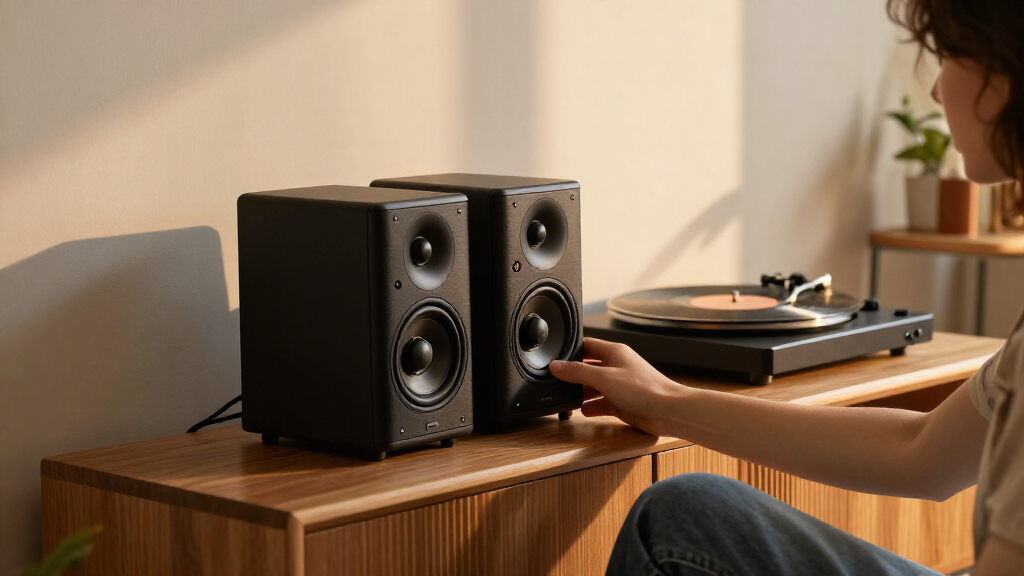
I compared these speakers by how well their features match common setups: desktop listening, TV audio, vinyl playback, and music in a shared living space. I gave weight to driver size and stated amplifier output as indicators of scale, but also looked at connections, Bluetooth availability, subwoofer support, and the practical impact of cabinet size. A feature only helped a ranking when it solved a clear buyer need; a broad input list matters less to someone who only wants a simple desktop pair.
The order favors speakers that combine useful performance potential with flexibility and fewer setup compromises. The Fluance Ai61 ranks first for balancing larger drivers and varied connections, while the Edifier R2750DB MKII stands out for buyers prioritizing a bigger three-way presentation. More compact or simpler models rank lower not because they lack a place, but because their smaller scale or narrower feature set suits a more specific buyer. Product names and specifications are based on the listed models; I do not treat stated wattage alone as a guarantee of sound quality.
Factors to Consider When Choosing Powered Bookshelf Speakers Under 1000
Before choosing a pair, I’d match the speakers to the room, source devices, and listening distance rather than focus on a single specification. These broader checks can prevent the common mismatch of buying a capable speaker that cannot connect cleanly—or a compact model expected to fill a much larger space.
Match Speaker Size to Listening Distance
Bookshelf speakers can serve a desk, a shelf, or a living room, but the same pair will not behave identically in each place. Near-field listening puts you close to the drivers, so smaller models may be entirely adequate for a computer setup. Across a wider room, larger drivers and a more substantial cabinet can help the sound feel less strained, though placement and room acoustics still matter. A common mistake is choosing by the word “bookshelf” and overlooking the actual cabinet dimensions. Measure both the available space and the distance to your listening position before deciding. If you want room-filling playback, do not assume that a compact pair can substitute for a larger system.
Choose Inputs Around Your Actual Sources
List every device you expect to connect before comparing connection panels: a TV, computer, turntable, phone, or game console may each call for a different input. Optical can simplify a TV connection, USB can be useful for a computer, and Bluetooth offers convenient wireless playback. Analog RCA is common, but a turntable may need a built-in phono preamp or a separate one; RCA sockets alone do not provide that function. Avoid paying extra for connections you are unlikely to use while missing the one your main source requires. Also check whether switching between devices is straightforward if several sources will stay connected. A little planning here can save adapters and extra boxes later.
Treat Bass Extension and Subwoofer Support as Separate Questions
A larger woofer can support stronger bass, but it does not make every speaker a replacement for a subwoofer. If you listen to bass-heavy music, watch action films, or want low frequencies at higher levels, check whether the speaker offers a subwoofer output and whether that connection suits your intended subwoofer. That output is an upgrade path, not proof that a subwoofer is included. Buyers who mostly listen to speech, acoustic music, or background playlists may prefer a simpler pair and save space. A frequent misstep is expecting small cabinets to produce deep bass simply because the product is marketed for a living room. Decide how much low-end impact matters before paying for larger speakers.
Read Power Ratings in Context
Amplifier wattage is one piece of the picture, not a direct ranking of loudness, clarity, or sound quality. Room size, listening distance, speaker sensitivity, and how loudly you listen all affect the result. Higher stated output can be useful when a speaker needs to play across a larger space, but it may add little for someone listening quietly at a desk. Compare the overall design and intended placement instead of selecting the largest number on a product page. If specifications are reported differently between models, avoid treating them as directly equivalent. The best choice is the one with enough headroom for your use, not automatically the model with the biggest rating.
Plan for Placement, Controls, and Daily Use
Powered speakers need access to power, a connection between the speaker pair, and enough clearance for their cabinets and controls. Check which speaker houses the amplifier and whether its position works with your outlets and source devices. Rear-facing ports can be affected by placing a speaker hard against a wall, while front-facing controls may be easier to reach on a desk. Think about whether you want a remote, convenient source switching, or controls within arm’s reach. A pair that fits on paper can still be awkward if cables cross a walkway or controls are blocked by a monitor. Consider cable routing and access before settling on a shelf or desk location.
Pay More for the Upgrade You Will Actually Use
Spending more makes sense when it buys a concrete benefit: greater room-filling potential, a connection your current system needs, or a subwoofer path you plan to use. It is less compelling when the upgrade is simply a bigger cabinet that will not fit your space or extra inputs that will sit unused. Buyers who expect to add a subwoofer later should prioritize compatible output over a small difference in stated power. Someone moving from a basic desktop setup may get more day-to-day value from Bluetooth or optical than from a more elaborate driver layout. Compare the total setup cost too, including stands, cables, and any preamp your sources require. Choose for the system you intend to build, not a hypothetical setup.
Frequently Asked Questions
Can powered bookshelf speakers connect directly to a TV?
Yes, if the speaker has an input that matches your TV, such as optical or analog audio. Optical can be a tidy option for compatible televisions, while RCA may work with an analog output or a suitable adapter. Check your TV’s audio output settings as well; some require selecting an external audio format or adjusting digital output settings. Bluetooth may connect wirelessly, but it can introduce delay that is distracting with video. Confirm the connection type before buying rather than assuming every powered speaker supports every TV.
Do I need a subwoofer with these speakers?
No, a subwoofer is optional and depends on how much deep bass you want and what you listen to. For dialogue, podcasts, and many everyday music sessions, a stereo pair may be enough. A subwoofer can add low-frequency impact for films and bass-heavy tracks, but it also takes up space and may need level and placement adjustments. Models with a subwoofer output offer a clearer route to adding one later, but that output does not mean a subwoofer comes in the box. Decide based on your listening priorities and room, not just the presence of a connector.
Will a turntable work with powered bookshelf speakers?
It can, but the turntable’s output stage matters. A turntable with a built-in phono preamp can usually connect to an available analog input, while a turntable without one needs an external phono preamp between the turntable and speakers. Do not assume that an RCA input on a speaker includes phono equalization. Check the turntable manual and the speaker’s input details before choosing cables. This compatibility check matters more than Bluetooth or wattage if vinyl is your main source.
Are compact powered speakers enough for a living room?
They can work in a smaller room or for moderate listening levels, especially when the listening position is not far away. In a larger or open-plan space, compact cabinets may sound less full and have less low-bass presence than larger options. Room layout, speaker placement, and how loudly you listen all affect the result, so cabinet size alone cannot settle the question. If you want stronger bass, a model with a subwoofer output can provide an expansion route. Measure your room and think about normal listening distance before choosing a compact pair for shared-space use.
Should I choose the Fluance Ai61 or the Edifier R2750DB MKII?
Choose the Fluance Ai61 if you want a versatile stereo pair with larger drivers, USB connectivity, and a subwoofer output in a comparatively straightforward setup. The Edifier R2750DB MKII is the better fit if you have room for a larger cabinet and value its three-way design and higher stated output. Neither is automatically the right choice for every room: desk placement may favor a smaller model, while a larger listening area can make the bigger option more appealing. Compare the inputs you need and the space you can give each speaker. Your sources and placement should break the tie.
Conclusion
For the best overall balance of driver size, connections, and future flexibility, I’d choose the Fluance Ai61. The best value-oriented fit for a simple setup is the Edifier R1280DB, while the R1280DBs makes more sense if adding a subwoofer later is part of the plan. For a larger-room or premium-feature focus, consider the Edifier R2750DB MKII; for a more energetic alternative, the Klipsch Reference R-40PM gives buyers a distinct option in the lineup. Beginners who want a familiar, flexible set of connections can start with the Fluance AI41 or Edifier R1280DB. For compact desktop use, compare the Edifier R980T, R1280T, RIOWOIS, Saiyin, and Electrohome Huntley by fit and required inputs; choose the ULTIMEA BS-3 if its three-way design and stated pro-level positioning match your needs. The right pick is the one that fits your room and sources—not simply the one with the largest output figure.
Halloween Picks
halloween
As an affiliate, we earn on qualifying purchases.