

For most festival setups, I’d start with the Champion 4500-Watt Electric Start Dual Fuel Portable Inverter Generator: its midrange capacity and dual-fuel flexibility make it a strong all-around fit. The Pulsar PG2200BiS is a more portable choice for modest loads, while the Westinghouse 5000 Peak Watt Dual Fuel offers more headroom for larger setups. The main tradeoffs are power versus carrying weight, runtime planning versus tank capacity, and convenience versus the extra care any fuel-burning generator requires. Festival rules, sound limits, and safe placement can narrow the field before wattage does. Read on for how these ten options compare and which one suits your setup.

Get audio and creator gear delivered free with Prime
- Fast, free delivery on millions of items
- Prime Video, Amazon Music and more included
- Member-only deals all year
Complete the kit


Key Takeaways
- The Champion 4500-Watt is the roundup’s balanced pick: it sits between compact models and heavier, higher-output choices, making it a practical starting point for varied festival loads.
- The Pulsar PG2200BiS favors portability over headroom: its smaller output suits essentials, but buyers with several simultaneous loads should look at larger models.
- The Westinghouse 5000 Peak Watt adds capacity and remote-start convenience: that appeal comes with a bulkier package than the compact picks.
- The Westinghouse 12000 Peak Watt Tri-Fuel is a specialist, not the default festival choice: its much higher peak output and three-fuel flexibility may be excessive for a small campsite.
- Dual-fuel labeling does not settle festival suitability: all ten options need checking for sound limits, propane runtime, transport practicality, and venue rules before purchase.
| Champion 4500-Watt Electric Start Dual Fuel Portable Inverter Generator |  | Best Overall for Long Festival Weekends | Fuel: Gasoline and propane | Listed wattage: 4500 watts | Voltage: 120 volts | VIEW ON AMAZON | See Our Full Breakdown |
| WEN 3600-Watt Dual Fuel Portable Inverter Generator with CO Watchdog |  | Best Compact Pick | Fuel: Gasoline and propane | Starting wattage: 3600 watts | Running wattage: 2600 watts | VIEW ON AMAZON | See Our Full Breakdown |
| ERAYAK 4500W Dual-Fuel Portable Inverter Generator for Home and Outdoor Use |  | Best Quiet-Operation Pick | Fuel: Gasoline and propane | Peak output: 4500 watts | Noise: 58 dBA | VIEW ON AMAZON | See Our Full Breakdown |
| PowerSmart 3800 Watt Dual Fuel Inverter Generator for Camping or Home Use | 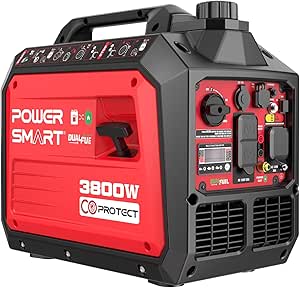 | Best for Extended Propane Runtime | Fuel: Gasoline and propane | Gasoline starting/running output: 3800 watts / 3300 watts | Propane starting/running output: 3500 watts / 3100 watts | VIEW ON AMAZON | See Our Full Breakdown |
| Westinghouse 12000 Peak Watt Tri-Fuel Portable Inverter Generator with Remote Start and CO Sensor |  | Best for Large Group Power | Fuel: Gasoline, propane, and natural gas | Starting wattage: 12000 watts | Running wattage: 9000 watts | VIEW ON AMAZON | See Our Full Breakdown |
| WEN 4800-Watt Dual Fuel Inverter Generator with Electric Start and CO Watchdog |  | Best for Safety-Conscious Festival Camps | Surge output: 4,800 watts | Fuel types: Gasoline and LPG | Engine displacement: 224 cc | VIEW ON AMAZON | See Our Full Breakdown |
| PowerSmart 4400 Watt Dual Fuel Portable Generator with Inverter Technology |  | Best for Extended Propane Runtime | Starting output: 4,000 watts on LPG; 4,400 watts on gasoline | Fuel types: LPG and gasoline | Stated runtime: Up to 24 hours on propane; up to 8 hours on gasoline | VIEW ON AMAZON | See Our Full Breakdown |
| Pulsar 2,200W Portable Dual Fuel Quiet Inverter Generator with USB Outlet & Parallel Capability, CARB Compliant, PG2200BiS |  | Best Compact Pick for Small Camps | Peak output: 2,000 watts on LPG; 2,200 watts on gasoline | Fuel types: LPG and gasoline | Noise level: 60 dB | VIEW ON AMAZON | See Our Full Breakdown |
| Westinghouse 5000 Peak Watt Super Quiet Dual Fuel Portable Inverter Generator, Remote Electric Start, Gas & Propane Powered, RV Ready 30A Outlet, Parallel Capable, Blue/Black |  | Best for High-Demand Group Camps | Peak output: 5,000 watts | Fuel types: Gasoline and LPG | Fuel tank: 3.4 gallons | VIEW ON AMAZON | See Our Full Breakdown |
| Champion 4000-Watt Dual Fuel Portable Inverter Generator |  | Best for Straightforward Safety Features | Output: 4,000 watts | Fuel types: Gasoline and propane | Noise level: 64 dBA at 23 feet | VIEW ON AMAZON | See Our Full Breakdown |
| propane inverter generator for festival | Fuel tank | Outlets | Engine displacement | Fuel |
|---|---|---|---|---|
| Champion 4500-Watt Electric St | 2.25 gallons | — | 212 cc | Gasoline and propane |
| WEN 3600-Watt Dual Fuel Portab | 1.5 gallons | 7 | — | Gasoline and propane |
| ERAYAK 4500W Dual-Fuel Portabl | — | 5 | — | Gasoline and propane |
| PowerSmart 3800 Watt Dual Fuel | 1.3 gallons | 6 | — | Gasoline and propane |
| Westinghouse 12000 Peak Watt T | 30 liters | 3 | 457 cc | Gasoline, propane, and natural gas |
| WEN 4800-Watt Dual Fuel Invert | 1.9 gallons | 4 | 224 cc | — |
| PowerSmart 4400 Watt Dual Fuel | 1.6 gallons | 4 | 223 cc | — |
| Pulsar 2,200W Portable Dual Fu | 1.18 gallons | 3 | 80 cc | — |
| Westinghouse 5000 Peak Watt Su | 3.4 gallons | 5 | — | — |
| Champion 4000-Watt Dual Fuel P | 1.54 gallons | 2 | 149 cc | — |
More Details on Our Top Picks
Champion 4500-Watt Electric Start Dual Fuel Portable Inverter Generator
For a festival camp that needs to run longer between fuel stops, I’d put the Champion near the top of this group. Its listed 21-hour propane runtime outlasts the WEN 3600’s stated five hours, while its 4500-watt output gives more headroom for several modest loads at once. The 61 dBA noise figure is useful context for a shared campsite, though it is not silent; placement and distance from neighbors still matter. Dual-fuel operation lets me plan around propane availability or use gasoline when that better suits the trip, and CO Shield auto shutoff adds a safety feature for outdoor operation. The tradeoff is size: at this power level it is less convenient to move than the WEN’s 49-pound unit. It also needs a separately purchased parallel kit to link another generator.
Pros:- Listed runtime reaches 21 hours on propane.
- Dual-fuel operation offers a choice between gasoline and propane.
- 4500-watt output provides more listed capacity than the WEN 3600.
- CO Shield auto shutoff adds a safety layer during outdoor operation.
Cons:- Bulky and relatively heavy compared with the 49-pound WEN 3600.
- Parallel kit is sold separately.
- Fuel-powered operation produces exhaust and is only suitable outdoors.
Best for: Festival campers staying several days who want extended propane runtime and enough output for multiple moderate electrical loads.
Not ideal for: Solo attendees prioritizing easy lifting and a small footprint, or anyone planning to use a generator inside a tent, vehicle, or enclosed area.
- Fuel:Gasoline and propane
- Listed wattage:4500 watts
- Voltage:120 volts
- Engine displacement:212 cc
- Fuel tank:2.25 gallons
- Runtime:Up to 14 hours on gasoline; up to 21 hours on propane
- Noise:61 dBA
- Warranty:3-year limited warranty
Our verdict“Choose the Champion if long propane stretches and higher output matter more than carrying a lighter generator to camp.”
WEN 3600-Watt Dual Fuel Portable Inverter Generator with CO Watchdog
I’d choose the WEN when getting the generator to a festival matters more than powering a large camp setup. At 49 pounds, it is the easiest listed option here to manage by hand, a clear portability advantage over the 50.7-pound PowerSmart and the heavier Champion. Its 2600-watt running output suits smaller loads, such as charging devices and running selected camp equipment, but leaves less room for simultaneous demand than the ERAYAK’s 3500-watt rated output. The dual-fuel setup and CO Watchdog add flexibility and a safety feature, while fuel shutoff helps with maintenance. The main compromise is endurance: the listed five-hour runtime is far shorter than the Champion’s and the PowerSmart’s propane figures. I’d skip it for a multi-day camp that needs sustained power without frequent fuel attention.
Pros:- At 49 pounds, it is lighter than the listed PowerSmart and Champion options.
- Runs on either gasoline or propane.
- CO shutdown sensor and overload protection are included.
- Fuel shutoff supports maintenance.
Cons:- Listed five-hour runtime is short beside the Champion and PowerSmart runtime claims.
- 2600-watt running output gives less load headroom than the ERAYAK.
- Parallel connection kit must be purchased separately.
Best for: Festivalgoers traveling light who need portable power for a modest electronics and camp-equipment setup.
Not ideal for: Groups planning to run several higher-draw devices for long stretches; its listed running output and five-hour runtime limit that use.
- Fuel:Gasoline and propane
- Starting wattage:3600 watts
- Running wattage:2600 watts
- Voltage:120 volts
- Weight:49 pounds
- Fuel tank:1.5 gallons
- Runtime:5 hours
- Outlets:7
Our verdict“Pick the WEN for a small festival setup where easier transport matters more than long runtime or higher output.”
ERAYAK 4500W Dual-Fuel Portable Inverter Generator for Home and Outdoor Use
Among these five, the ERAYAK has the lowest stated noise figure, 58 dBA, which makes it the most appealing choice when campsite noise is a priority. It pairs that with 3500 watts rated output and a claimed propane runtime of over 20 hours, giving it a stronger balance of sustained capacity and duration than the lighter WEN 3600. The Champion is another close alternative for extended propane use, but the ERAYAK is listed at 54 pounds and includes five outlets, including RV and USB options per the product details. Those numbers make it a flexible camp-power choice, not a silent one: I’d still follow event rules and keep it well away from people and enclosed spaces. Recoil starting is less convenient than electric or remote start, and its weight makes frequent solo repositioning a chore.
Pros:- Lowest stated noise figure in this group at 58 dBA.
- 3500 watts rated output exceeds the WEN 3600’s stated running output.
- Claimed propane runtime exceeds 20 hours.
- Five outlets and parallel-ready design offer connection flexibility.
Cons:- At 54 pounds, it is heavier than the WEN 3600.
- Recoil start is less convenient than electric or remote starting.
- Propane runtime is stated as over 20 hours without a more specific figure.
Best for: Festival campers who value a lower stated noise level, need midrange output, and can transport a 54-pound generator.
Not ideal for: Buyers who need push-button starting or a very light unit; the WEN is lighter, and this model uses recoil start.
- Fuel:Gasoline and propane
- Peak output:4500 watts
- Noise:58 dBA
- Propane runtime:Over 20 hours
- Gasoline runtime:Up to 16 hours
- Weight:54 pounds
- Outlets:5
- Starting system:Recoil start
Our verdict“Choose the ERAYAK if quieter stated operation and substantial propane endurance outweigh recoil starting and a heavier carry.”
PowerSmart 3800 Watt Dual Fuel Inverter Generator for Camping or Home Use
The PowerSmart’s headline advantage for a festival is its claimed up to 24-hour propane runtime, the longest stated propane figure among these five. That makes it a compelling fit for a camp that wants fewer fuel interruptions, especially compared with the WEN 3600’s listed five hours. Its less-than-59 dBA noise claim is also favorable, and six outlets give a group several connection points. The tradeoff is that the runtime figure should not be treated as a guarantee at every load, and the product lists only 3100 running watts on propane, below the ERAYAK’s 3500-watt rated output. At 50.7 pounds, it is not a lightweight carry, either. I’d rank it for propane endurance rather than sheer power or easiest transport, and would check the event’s generator rules before bringing it.
Pros:- Claims up to 24 hours of runtime on propane.
- Stated noise level is less than 59 dBA.
- Dual-fuel operation provides gasoline as an alternative.
- Six outlets give a group multiple connection points.
Cons:- Propane running output is listed at 3100 watts, below the ERAYAK’s 3500-watt rated output.
- At 50.7 pounds, it is not an easy choice for frequent solo carrying.
- Gasoline runtime is listed at up to eight hours, shorter than its propane claim.
Best for: Festival groups with access to propane who prioritize long intervals between refueling and moderate, steady power needs.
Not ideal for: Campers who need the highest running output in this group or a generator that is easy to lift and carry repeatedly.
- Fuel:Gasoline and propane
- Gasoline starting/running output:3800 watts / 3300 watts
- Propane starting/running output:3500 watts / 3100 watts
- Noise:Less than 59 dBA
- Runtime:Up to 8 hours on gasoline; up to 24 hours on propane
- Fuel tank:1.3 gallons
- Weight:50.7 pounds
- Outlets:6
Our verdict“Pick the PowerSmart for a propane-supplied camp that values fewer fuel stops over maximum output or minimal weight.”
Westinghouse 12000 Peak Watt Tri-Fuel Portable Inverter Generator with Remote Start and CO Sensor
The Westinghouse is in a different capacity class from the other picks: its 9000-watt running output is far beyond the Champion’s 4500-watt listing and the ERAYAK’s 3500-watt rated output. That makes it relevant only for a festival site with unusually heavy power needs, such as a large organized camp—not a typical tent setup. Its tri-fuel capability includes propane, gasoline, and natural gas, while remote start and a digital data center add convenience. The cost of that capacity is size and complexity: a 457 cc engine and 30-liter tank make this a poor match for attendees who need to carry or reposition a generator. Its listed 19-hour runtime does not specify a fuel or load in the provided details, so I would not compare it directly with the other propane runtime claims. Check event rules before choosing a unit this large.
Pros:- 9000-watt running output greatly exceeds the other listed generators.
- Runs on gasoline, propane, or natural gas.
- Remote start and digital data center add operating convenience.
- CO sensor and parallel capability are included.
Cons:- Large and heavy compared with the four smaller festival-oriented options.
- Listed 19-hour runtime does not specify the fuel or load.
- High capacity is unnecessary for many personal campsite setups.
Best for: Large festival camps or organized sites with high electrical demand, vehicle access, and room for a full-size generator.
Not ideal for: Solo festivalgoers, small tent camps, or anyone needing a compact unit; its high output, large engine, and substantial fuel tank are excessive for basic charging.
- Fuel:Gasoline, propane, and natural gas
- Starting wattage:12000 watts
- Running wattage:9000 watts
- Voltage:240 volts
- Engine displacement:457 cc
- Fuel tank:30 liters
- Runtime:19 hours; fuel and load not specified
- Outlets:3
- Warranty:3 years
Our verdict“Choose the Westinghouse only if your festival site needs far more power than a typical camp and can accommodate a large generator.”
WEN 4800-Watt Dual Fuel Inverter Generator with Electric Start and CO Watchdog
The WEN pairs 4,000 rated watts with propane flexibility, giving a festival camp more room for lights, charging, and other gear than the smaller Pulsar PG2200BiS. Its CO Watchdog shutdown sensor adds a useful safety layer, though it does not make indoor or enclosed operation safe; I would keep any generator outdoors and away from occupied areas. Keyless electric start, wheels, and a telescoping handle make setup less of a chore, while inverter output suits sensitive electronics. The tradeoff is endurance: the 1.9-gallon gasoline tank is listed for about seven hours at half load, so long festival days call for fuel planning. Compared with the Westinghouse iGen5000DF, it gives up output and tank capacity but offers a more manageable power level for many camps.
Pros:- Dual-fuel operation lets buyers use propane or gasoline.
- CO shutdown sensor and overload protection add safety features.
- Electric start, wheels, and telescoping handle ease setup and transport.
- Inverter output is suitable for sensitive electronics.
Cons:- About seven hours at half load on gasoline means refueling may interrupt extended use.
- Parallel operation requires a separately purchased connection kit.
- Fuel switching and initial setup may take extra attention.
Best for: Festival campers who want a safety sensor, electric starting, and enough output for several devices without stepping up to a larger generator.
Not ideal for: Groups running high-draw equipment for long stretches or wanting to avoid frequent fuel planning; its listed gasoline runtime and tank are limited.
- Surge output:4,800 watts
- Fuel types:Gasoline and LPG
- Engine displacement:224 cc
- Fuel tank:1.9 gallons
- Voltage:120 volts
- Outlets:4
- Starting:Keyless electric start
Our verdict“Choose the WEN if safety features and convenient starting matter more than long runtime or the Westinghouse iGen5000DF’s greater capacity.”
PowerSmart 4400 Watt Dual Fuel Portable Generator with Inverter Technology
The PowerSmart’s standout festival advantage is its stated up-to-24-hour propane runtime, which can reduce fuel changes during a long campout. That figure is distinct from its gasoline runtime and depends on load, so I would not treat it as a guarantee; still, the propane claim makes it more appealing for endurance than the Champion 4000-Watt model, whose listed gasoline runtime is shorter. It supplies 3,300 rated watts on LPG, enough for a modest shared setup, and its digital display helps track operation. The compromise is portability: at 68 pounds, it is a heavier carry than its compact dimensions suggest, and its 1.6-gallon tank limits gasoline use between refills. It suits buyers who can roll or stage it near camp, not anyone expecting an easy one-person carry across a field.
Pros:- Dual-fuel operation supports propane and gasoline.
- Up to 24 hours of stated runtime on propane.
- Inverter output is suitable for sensitive electronics.
- Digital display, low-oil shutdown, and overload protection add practical controls.
Cons:- At 68 pounds, it is difficult to carry over festival grounds.
- The 1.6-gallon gasoline tank can mean more frequent refueling.
- Its LPG rated output is lower than the WEN 4800 and Westinghouse iGen5000DF.
Best for: Festival campers with a planned, stationary setup who prioritize longer stated propane operation and want a display for checking generator status.
Not ideal for: Anyone carrying gear a long distance on foot or needing high LPG output for several demanding appliances; it is heavy and rated at 3,300 watts on propane.
- Starting output:4,000 watts on LPG; 4,400 watts on gasoline
- Fuel types:LPG and gasoline
- Stated runtime:Up to 24 hours on propane; up to 8 hours on gasoline
- Fuel tank:1.6 gallons
- Weight:68 pounds
- Engine displacement:223 cc
- Outlets:4
Our verdict“Pick the PowerSmart if propane endurance matters more than easy carrying or maximum output.”
Pulsar 2,200W Portable Dual Fuel Quiet Inverter Generator with USB Outlet & Parallel Capability, CARB Compliant, PG2200BiS
The Pulsar is the lineup’s small-load specialist: its 1,600 rated watts on LPG are a better fit for phones, lighting, and a few modest devices than for powering a whole group’s camp. At a stated 60 dB, it is quieter than the Champion’s listed 64 dBA, a useful difference when neighboring tents are close. The compact format and USB outlet keep everyday charging straightforward, while parallel capability offers a route to more output if you add a compatible unit. That flexibility does not change its main limitation: even the WEN 4800 delivers far more rated power, and the Pulsar’s 80 cc engine leaves less headroom for demanding equipment. Its 44-pound weight is also not featherlight for a small generator. Choose it for a deliberately lean setup, not a shared festival kitchen.
Pros:- Compact, lower-output format suits a small festival camp.
- Rated noise level of 60 dB is quiet relative to the Champion’s listed 64 dBA.
- Dual-fuel operation gives propane and gasoline flexibility.
- USB outlet and parallel capability offer useful charging and expansion options.
Cons:- Limited LPG output rules out many high-draw appliances.
- At 44 pounds, it is still a substantial carry for a compact unit.
- Basic controls offer less operating information than the PowerSmart’s digital display.
Best for: Solo campers or pairs who need propane-capable power for charging, LED lights, and a few low-draw devices.
Not ideal for: Groups running cooking appliances, larger audio equipment, or several devices at once; its LPG rated output is only 1,600 watts.
- Peak output:2,000 watts on LPG; 2,200 watts on gasoline
- Fuel types:LPG and gasoline
- Noise level:60 dB
- Fuel tank:1.18 gallons
- Engine displacement:80 cc
- Outlets:3
- Runtime:Up to 8 hours on gasoline, as stated
Our verdict“Choose the Pulsar for a quiet, modest-power camp, but step up to the WEN or Westinghouse if several people need more capacity.”
Westinghouse 5000 Peak Watt Super Quiet Dual Fuel Portable Inverter Generator, Remote Electric Start, Gas & Propane Powered, RV Ready 30A Outlet, Parallel Capable, Blue/Black
With 3,900 rated watts, the Westinghouse is the strongest fit here for a larger festival camp running several loads at once; it gives more stated rated output than the WEN 4800 while also bringing a 3.4-gallon tank and a stated runtime of up to 18 hours. Remote electric start and a fuel gauge can make operation more convenient when the generator is staged away from the main gathering area. Its RV-ready 30A outlet also suits compatible equipment, though buyers should check their plugs and power needs before packing. The tradeoff is bulk: this is less appealing for a walk-in festival or a site far from vehicle access. Compared with the compact Pulsar, it offers a great deal more capacity but is a much larger commitment in transport and fuel planning.
Pros:- Highest rated output among these five products at 3,900 watts.
- Dual-fuel operation supports gasoline and propane.
- Remote electric start reduces effort when the unit is staged nearby.
- 3.4-gallon tank and stated runtime up to 18 hours support longer sessions.
Cons:- Larger capacity and tank make it a poor match for walk-in festival sites.
- Runtime depends on load and fuel; long sessions can still require refueling.
- Its output is unnecessary bulk for buyers powering only phones and lights.
Best for: Vehicle-access festival groups that need to run multiple devices or compatible RV equipment and value remote starting and a larger tank.
Not ideal for: Walk-in campers, solo users with only charging and lighting needs, or anyone prioritizing a small, easy-to-carry generator.
- Peak output:5,000 watts
- Fuel types:Gasoline and LPG
- Fuel tank:3.4 gallons
- Stated runtime:Up to 18 hours
- Outlets:5
- Starting:Remote electric start
- Additional outlet:RV-ready 30A outlet
Our verdict“Choose the Westinghouse for a vehicle-access group camp that needs the most capacity here, not for a lightweight or minimal setup.”
Champion 4000-Watt Dual Fuel Portable Inverter Generator
The Champion is a practical middle-ground choice for campers who want dual-fuel flexibility and a CO safety feature without the Westinghouse iGen5000DF’s larger size and higher output. Its 149 cc engine and lightweight design are appealing for a festival setup where moving equipment matters, while CO Shield and low-oil shutoff add useful safeguards. The listed noise level is 64 dBA from 23 feet, a little louder than the Pulsar PG2200BiS at 60 dB, so it is less suited to camps where minimizing generator noise is the priority. The data lists two outlets and a 1.54-gallon tank, which makes outlet capacity and refueling worth planning around. Its gasoline runtime is stated as up to 10 hours at 25% load; that is a light-load figure, not a promise for heavier use.
Pros:- Dual-fuel operation allows use with gasoline or propane.
- CO Shield and low-oil shutoff provide useful safety features.
- Lightweight design is more appealing for transport than the 68-pound PowerSmart.
- Cold Start Technology is included for starting in cooler conditions.
Cons:- Two listed outlets offer fewer direct connections than the WEN or PowerSmart.
- At 64 dBA from 23 feet, it is louder than the Pulsar’s stated 60 dB.
- Parallel kit is sold separately, and gasoline runtime is listed at only 25% load.
Best for: Campers who want a portable, dual-fuel generator with CO protection and enough output for a moderate set of festival essentials.
Not ideal for: Groups needing many simultaneous outlet connections, very quiet operation, or extended use without stopping to manage fuel.
- Output:4,000 watts
- Fuel types:Gasoline and propane
- Noise level:64 dBA at 23 feet
- Engine displacement:149 cc
- Fuel tank:1.54 gallons
- Outlets:2
- Starting:Recoil start
- Safety features:CO Shield and low-oil shutoff
Our verdict“Choose the Champion for portable, safety-minded moderate power, but favor the Pulsar for lower stated noise or the Westinghouse for larger group loads.”

How We Picked
I ranked these models around festival realities rather than peak wattage alone: whether output can cover a plausible campsite load, whether propane operation is available, and how manageable the generator appears to transport and start. I also weighed practical features named for these products, including electric or remote start, CO monitoring, parallel capability, RV-ready connections, and tri-fuel flexibility. These features matter only when they match a buyer’s setup; a larger outlet or higher peak figure is not automatically an advantage at a crowded site.
The order favors a balanced fit for common festival use, then separates compact, value-oriented, and higher-capacity options by their likely role. The Champion 4500-Watt leads as a midrange dual-fuel choice, while the Pulsar is better for lighter loads and the Westinghouse 5000 Peak Watt suits buyers seeking more capacity and remote start. The Westinghouse 12000 Peak Watt ranks as a specialized high-output option because its scale may work against portability. Product names alone do not establish operating noise, propane runtime, weight, or venue approval, so I treat those as details buyers must confirm in the manufacturer specifications and festival rules.
| propane inverter generator for festival | Fuel | Fuel types |
|---|---|---|
| Champion 4500-Watt Electric St | Gasoline and propane | — |
| WEN 3600-Watt Dual Fuel Portab | Gasoline and propane | — |
| ERAYAK 4500W Dual-Fuel Portabl | Gasoline and propane | — |
| PowerSmart 3800 Watt Dual Fuel | Gasoline and propane | — |
| Westinghouse 12000 Peak Watt T | Gasoline, propane, and natural gas | — |
| WEN 4800-Watt Dual Fuel Invert | — | Gasoline and LPG |
| PowerSmart 4400 Watt Dual Fuel | — | LPG and gasoline |
| Pulsar 2,200W Portable Dual Fu | — | LPG and gasoline |
| Westinghouse 5000 Peak Watt Su | — | Gasoline and LPG |
| Champion 4000-Watt Dual Fuel P | — | Gasoline and propane |
Factors to Consider When Choosing Propane Inverter Generator For Festivals
Festival power planning starts with the site’s rules and your actual load, not the biggest wattage on a product label. I’d settle those two questions before comparing convenience features or fuel flexibility.
Check Festival Rules Before Choosing a Generator
Some festivals restrict fuel-powered generators entirely, while others set limits for sound, operating hours, fuel storage, or where equipment can sit. A model described as quiet is not automatically permitted; check the event’s written rules and ask the organizer about any unclear requirements. Confirm whether propane cylinders are allowed and whether the venue has rules about cylinder size or storage. A generator that fits your electrical plan is useless if it cannot enter the site. I’d treat approval as a purchase gate, not a detail to sort out after buying.
Size for Running Watts and Startup Surges
List the devices you expect to power at the same time, then check their running wattage and any startup surge, especially for appliances with motors or compressors. Peak watts and running watts are different figures, so choosing by the largest number on the box can leave too little steady capacity. Add a sensible margin for loads you might use together, but avoid hauling a much larger generator just in case. A smaller unit such as the Pulsar-style compact option may suit phone charging and a modest setup, while multiple demanding appliances point toward a larger class. Prioritize the load you truly need rather than hypothetical extras.
Plan Propane Runtime and Refills
Propane runtime depends on load, cylinder size, temperature, and the generator’s fuel consumption, so do not assume a dual-fuel model will run for a full event on one cylinder. Look for manufacturer runtime figures specifically for propane and compare them at a load close to your expected use. Work out how many cylinders you can safely transport and whether refills are available nearby. A larger generator may have more capacity without solving the logistics of keeping it fueled. If power needs are modest, reducing the load can be a simpler way to stretch fuel than moving up to a heavier machine.
Treat Sound, Placement, and Carbon Monoxide as One Plan
Inverter technology does not make a generator silent, and sound readings can vary with distance and load. Check published noise figures and how they were measured, then compare them with the festival’s limits and the proximity of neighboring camps. CO-monitoring features, such as those named on several WEN models, add a safety measure but do not make indoor, tent, vehicle, or enclosed-area operation safe. Follow the manual’s outdoor placement and clearance directions, and keep exhaust away from people and openings. Also plan how to protect the unit from weather without restricting airflow.
Account for Carrying, Starting, and Connections
A festival generator has to travel from your vehicle to its operating spot, so weight, handles, and the route across grass or uneven ground matter as much as the advertised output. Electric or remote start can make operation easier, but buyers should check the starting system’s requirements and keep the manual’s backup-start instructions in mind. Match outlets to your equipment and use suitable, properly rated cords; an RV-ready connection only helps if it matches your setup. Parallel capability is useful when a supported second unit is part of the plan, but it adds cost, gear, and setup steps. Choose convenience features that solve a real task rather than treating every feature as a must-have.
Pay More Only for Capacity You Can Use
Higher-output models make sense when the load list supports them, but extra capacity often brings more bulk and more demanding transport. The Westinghouse 12000 Peak Watt Tri-Fuel sits far above the compact end of this lineup, so its three-fuel flexibility and output are most relevant to buyers with substantial loads or uses beyond the festival. A smaller generator may be the better purchase for a simple campsite, even if it cannot cover every appliance at once. Compare the full package—fuel options, controls, outlets, service support, and handling—rather than paying for peak wattage alone. Leave room in the plan for cords, fuel cylinders, and safe storage.
Frequently Asked Questions
Can I use a propane inverter generator at any festival?
No. Festival policies vary, and some events prohibit fuel-powered generators or restrict propane cylinders, operating hours, and generator placement. Check the event’s current rules before buying or packing equipment, and contact organizers if the policy is unclear. Do not assume an inverter model or a product described as quiet will be accepted. Venue approval should come before comparing output or features.
How do I know whether a 2,200-watt model or a 4,500-watt model is enough?
Start by adding the running watts of the devices you expect to use together, then account for startup surges where applicable. Compare that total with the generator’s rated running output, not only its peak figure. A compact model like the Pulsar PG2200BiS can suit a small essentials-only load, while a 4,500-watt-class unit gives more room for multiple devices. Check the manufacturer’s output specifications for propane operation, since fuel type can affect available power.
How long will one propane cylinder run a dual-fuel generator?
There is no single runtime that applies across these models: cylinder capacity, electrical load, conditions, and the generator’s propane consumption all affect it. Use the manufacturer’s propane-specific runtime information and compare it at a load similar to yours. Then plan for the full event, including a reserve or a permitted refill option. Avoid relying on gasoline runtime figures to estimate propane use.
Is a CO sensor enough to make a generator safe near my tent?
No. A carbon monoxide sensor is an added protective feature, not permission to run a generator in a tent, vehicle, enclosed space, or close to people. Follow the manufacturer’s outdoor placement and clearance instructions, and direct exhaust away from people and openings. Check whether the festival also sets location rules. If there is no safe, approved place to operate it, do not run it at the site.
Should I choose a larger generator for extra peace of mind?
Only if your real load needs the added capacity. Moving up can help with several simultaneous appliances or startup surges, but a larger unit may be harder to transport and may not suit a small festival setup. A high-output model like the Westinghouse 12000 Peak Watt Tri-Fuel is a specialized option, not an automatic upgrade for every buyer. Build a load list first, then weigh the added output against handling, fuel planning, and event restrictions.
Conclusion
For the best overall balance among these options, I’d choose the Champion 4500-Watt Electric Start Dual Fuel model, subject to confirming its propane output, runtime, and the festival’s rules. For best value, compare the WEN 3600-Watt and PowerSmart 3800 Watt against your load and the manufacturer’s verified specifications rather than choosing by label alone. The best premium-style fit for extra capacity and remote-start convenience is the Westinghouse 5000 Peak Watt Dual Fuel; the 12000 Peak Watt Tri-Fuel makes more sense for buyers with unusually large loads or broader fuel needs. For beginners, the WEN 3600-Watt’s CO Watchdog feature may be a useful added safeguard, though safe outdoor placement remains mandatory. For specific needs, pick the Pulsar PG2200BiS for a compact, modest-load setup and reserve the largest Westinghouse for capacity-heavy use. Before deciding, confirm festival approval, propane runtime, operating noise, weight, and outlet compatibility.