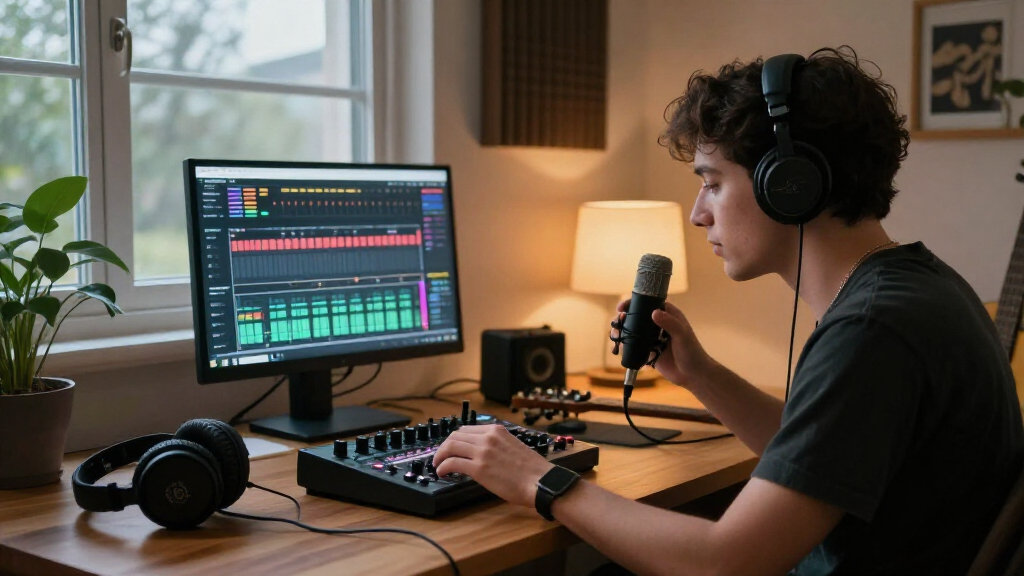
This checklist is for musicians, hosts, and creators putting together a live streaming setup for music. It covers six types of gear that can help shape a stream, from audio connections and microphones to video capture, lighting, controls, and headphones.

Get audio and creator gear delivered free with Prime
- Fast, free delivery on millions of items
- Prime Video, Amazon Music and more included
- Member-only deals all year
The sections are organized by gear type, with one named pick in each. Read the notes for the role each slot can play, then compare the product details with your own equipment and setup before deciding what belongs in your kit.
Use the checklist to check compatibility and fit first: confirm your computer and other devices can connect to the gear, consider where it will sit, and think through how you plan to use it on stream. You can prioritize the pieces that address your current setup needs and revisit the rest later.
USB Audio Interfaces
A USB audio interface is a key slot to consider when your stream includes instruments or multiple audio sources. The Focusrite Scarlett 16i16 4th Gen USB-C Audio Interface is the pick for this category. Before choosing it, map out the sources you plan to connect and how you want to route audio during a session. The product name identifies it as a USB-C interface; check your computer’s available connections and the interface’s current specifications to confirm that it fits your workflow.
A common buying mistake is selecting an interface before counting inputs and outputs or checking how each source will connect. Write down your microphones, instruments, and any other devices, then compare their connection types with the interface details. Also consider desk space and cable reach: a device that works on paper may be awkward if the ports are difficult to access or cables must cross your streaming area. Confirm operating-system support and any required software from the manufacturer. The 16i16 model name alone does not establish every feature or compatibility detail, so verify those against your particular setup.
For fit, plan where the interface will sit and leave room to reach its controls and connections. Think through whether you need to adjust levels while performing or hosting. A little advance planning can make the interface easier to use as part of a reliable audio workflow.
What to look for:
- Count the audio sources you need to connect.
- Match source connection types to the interface inputs.
- Confirm your computer has a compatible USB-C connection or adapter.
- Check operating-system support and required software.
- Measure desk space and plan cable reach.
Focusrite Scarlett 16i16 4th Gen USB-C Audio Interface

The Scarlett 16i16 is a 16-input, 16-output audio interface with two 4th-generation mic preamps, Hi-Z and line inputs, ADAT, S/PDIF, and MIDI connectivity. Its 24-bit/192kHz converters, Air modes, Auto Gain, and Clip Safe support detailed recording and level management, while Focusrite Control 2 enables hardware and DAW routing.
Pros:
- Broad analog and digital connectivity, including ADAT, S/PDIF, and MIDI
- 24-bit/192kHz converters with a stated 122 dB dynamic range
- Auto Gain and Clip Safe help manage recording levels
- Includes recording software, effects, and mastering tools
Cons:
- Requires an external power supply
- The stated frequency response of 125 kHz may be a data-entry error
Best for: Creators connecting several audio sources to a computer
Not ideal for: Setups that need only a simple, minimal connection
Bottom line: Choose this interface after confirming its connections, software support, and placement work with your streaming setup.
Broadcast Microphones
A broadcast microphone can be central to a stream built around spoken hosting, announcements, or vocals. The listed pick is the Electro-Voice RE20 Broadcast Announcer Microphone Bundle with Shockmou. Check the complete product listing to confirm exactly what the bundle includes; the provided name ends with “Shockmou,” so it does not establish the full accessory details. Confirm the microphone’s connection requirements and what additional equipment, if any, your setup needs.
A frequent mistake is treating a microphone as a complete recording chain. Before buying, check how it connects to your audio interface or other equipment, whether the required cable is included, and whether any additional components are needed for your use. Review the mounting and placement options too: make sure your stand or arm can support the microphone and position it comfortably without blocking your view or controls. Confirm bundle contents rather than assuming that a shock mount, cable, or other accessory is included.
Consider the distance between you and the microphone, your available desk area, and how you move while performing or speaking. Check the manufacturer’s documentation for handling and setup guidance, then plan a position that leaves room for your instruments and screen. A careful compatibility check helps this pick fit into a practical vocal setup rather than becoming an isolated piece of gear.
What to look for:
- Confirm the complete bundle contents from the product listing.
- Check the microphone’s connection requirements.
- Verify any additional equipment needed for your audio chain.
- Make sure your stand or arm supports the microphone.
- Plan placement around your screen, instruments, and controls.
Electro-Voice RE20 Broadcast Announcer Microphone Bundle with Shockmount and Bro

The Electro-Voice RE20 is a black, cardioid dynamic microphone designed for broadcast and vocal recording. Its Variable-D design, voice-tailored frequency response, and off-axis rejection help deliver clear sound with reduced proximity effect and handling noise.
Pros:
- Variable-D design helps minimize proximity effect
- Cardioid pattern rejects unwanted sound and reduces off-axis coloration
- Rugged steel construction with low handling noise
- Bundle includes a shockmount and broadcast arm with integrated XLR cable
Cons:
- The 16-ounce microphone may require a sturdy mounting setup
- No customer review details are provided beyond the overall rating
Best for: Hosts prioritizing a dedicated announcer microphone
Not ideal for: Buyers who need a fully specified bundle at a glance
Bottom line: Verify the listing’s full name, bundle contents, and connection needs before building around this microphone.
USB Capture Cards
A capture card may be a useful slot when your stream setup needs to bring an external video source into a computer. The named pick is the Elgato HD60 S+ External Capture Card. Before you buy, identify the source device and computer you plan to use, then check the manufacturer’s current specifications for supported connections, operating systems, and software. The product name alone does not confirm compatibility with every camera, console, or streaming application.
A common mistake is checking only that a capture card has a connection that looks familiar. Compare the source’s video output with the card’s input requirements, and check how the card connects to your computer. Confirm that your computer and chosen software support the intended workflow. Also consider whether you need to pass video onward to another display; check the product documentation for the exact supported arrangement rather than assuming it from the category name. These checks can prevent a signal-chain mismatch.
For practical fit, plan cable paths between the source, card, computer, and any display you use. Leave enough space to reach connections and avoid placing the card where cables will be tugged during a stream. If video and music equipment share a desk, map out the layout first. Confirming compatibility and placement helps the card serve a clear role in your streaming workflow.
What to look for:
- Match the video source output to the card’s input requirements.
- Check the card-to-computer connection and operating-system support.
- Confirm compatibility with your streaming software.
- Verify whether your intended display pass-through setup is supported.
- Plan cable paths and a stable place for the card.
Elgato HD60 S+ External Capture Card

Capture gameplay in 1080p60 HDR10 while playing through 4K60 HDR10 zero-lag passthrough. It supports streaming software on Windows and macOS, with ultra-low-latency Instant Gameview, continuous recording to a hard drive, and Flashback Recording to save recent gameplay.
Pros:
- Captures gameplay in 1080p60 HDR10
- Provides 4K60 HDR10 passthrough with zero lag
- Instant Gameview is designed for ultra-low-latency streaming
- Supports continuous and retroactive gameplay recording
Cons:
- Requires a computer meeting the listed processor, memory, graphics, and storage requirements
- Capture resolution is limited to 1080p60 HDR10
Best for: Creators adding an external video source to a computer
Not ideal for: Setups whose source or software compatibility is unconfirmed
Bottom line: Check the source, computer, software, and display arrangement against current specifications before choosing this capture card.
Ring Lights
Lighting affects how your face and performance appear on camera, so it is worth planning as part of the streaming setup. The pick here is the Neewer 18-inch Ring Light Kit with Stand and Phone Holder. Its name identifies an 18-inch ring light, a stand, and a phone holder; check the listing to confirm the specific components and their dimensions. Consider whether the light’s footprint and phone placement suit your camera angle and room.
A common buying mistake is focusing on the light while overlooking where the stand and phone holder will go. Measure the available floor or desk area, check the stand’s height range, and consider whether its placement could obstruct a keyboard, instrument, or walking path. Confirm that the phone holder fits your device and can position it where you need it. Review the product details for adjustment options and power requirements so you can determine whether they match your recording space and routine.
Think about how you frame yourself and whether the ring light can sit near the camera without crowding your view. If you stream at a desk, check that the stand and phone can coexist with your screen and audio equipment. The right choice depends on your actual room layout, camera position, and phone use. Taking those measurements in advance can make this kit easier to place as part of a comfortable on-camera setup.
What to look for:
- Measure floor or desk space for the stand.
- Check the stand’s height range and placement options.
- Confirm the phone holder fits your phone.
- Review adjustment options and power requirements.
- Plan the light position around your camera and workspace.
Neewer 18-inch Ring Light Kit with Stand and Phone Holder

This professional 18-inch LED ring light kit includes a 55W 5600K light, adjustable stand, soft tube, filters, and smartphone holder, ideal for photography, videography, and studio work. The kit offers adjustable brightness, stable support, and compatibility with cameras and smartphones for various content creation needs.
Pros:
- Adjustable brightness with wide dimming range
- Includes comprehensive accessories for versatile use
- Stable and durable aluminum stand
- Compatible with various smartphones and cameras
Cons:
- Light stand may be unstable if raised too high
- Requires assembly and proper unfolding of stand
- Some users may find the setup instructions unclear
Best for: Creators who want a ring light and phone holder in one kit
Not ideal for: Small spaces without room for a stand
Bottom line: Confirm the stand dimensions, phone fit, and light placement before adding this kit to your setup.
Stream Deck Controllers
A stream controller can help you organize actions you use repeatedly while hosting or performing. The listed pick is the Elgato Stream Deck + XL Control Platform. Check the product listing and current specifications to understand its controls, connections, software requirements, and supported integrations. The name alone does not confirm which applications or workflows it supports, so compare those details with the tools you already use.
A common mistake is buying a controller before deciding what you want it to do. List your recurring actions, such as changing scenes or controlling compatible software, then confirm that the device and its software support them. Check how it connects to your computer and whether its requirements fit your operating system. Also consider whether you will operate it during a performance: reachable placement matters if you need to trigger controls without turning away from your instruments or screen.
Because the product is described as an XL control platform, measure the desk area you can dedicate to it and compare that with its listed dimensions. Leave room for your keyboard, interface, and other frequently used equipment. Review setup guidance before assuming that a particular control arrangement is available. When the supported actions match your routine and the device fits your desk, it can become a useful part of stream operation.
What to look for:
- List the repeated actions you want to control.
- Confirm supported software and integrations from current documentation.
- Check computer connection and operating-system requirements.
- Compare listed dimensions with available desk space.
- Place controls within comfortable reach during a stream.
Elgato Stream Deck + XL Control Platform

The Stream Deck + XL is a customizable control platform with 36 macro keys, six multifunction dials, and a touch strip display for monitoring information and navigating actions. It connects to PC and Mac via USB-C and supports integrations with audio, video, and creative apps.
Pros:
- 36 customizable macro keys for one-touch commands and sequences
- Six multifunction dials provide precise adjustments
- Touch strip displays information and supports swipe navigation
- Integrates with a wide range of apps and equipment
Cons:
- Some optional accessories, such as the Network Dock, are sold separately
Best for: Creators who want hands-on control of supported stream actions
Not ideal for: Minimal setups with few repeated controls
Bottom line: Match the controller’s supported software and desk footprint to the actions you actually use.
Studio Headphones
Headphones are useful for listening to your stream mix and monitoring audio without relying only on speakers. The pick is the Neumann NDH 30 Open-Back Studio Headphones. The product name identifies these as open-back studio headphones; consider where and how you will use them before deciding whether that design suits your room. Check the manufacturer’s specifications for connection details and compatibility with your audio equipment.
A common mistake is choosing headphones without considering the listening environment. Open-back headphones can allow sound to travel between the headphones and the room, so check the manufacturer’s guidance and consider whether nearby microphones or other listeners affect your use. Confirm that the connection works with your interface or computer, including whether you need an adapter. Also check fit and comfort information where available: headband adjustment, earcup fit, and listening-session comfort matter when you wear them for extended rehearsals or streams.
Plan where you will store the headphones and whether the cable can reach your listening position without crossing a busy area. If you monitor while speaking or singing into a microphone, consider how the headphones fit into that setup and verify the intended use with the product documentation. Matching the open-back design, connection, and wearing comfort to your space makes it easier to choose headphones that support your monitoring routine.
What to look for:
- Consider whether open-back headphones suit your room and microphone setup.
- Check connection compatibility with your interface or computer.
- Verify whether an adapter is needed.
- Review fit and comfort information for extended use.
- Plan cable reach and headphone storage.
Neumann NDH 30 Open-Back Studio Headphones

The Neumann NDH 30 is a circumaural, open-back headphone designed for professional mixing and mastering. It features 38 mm transducers and a spring steel and aluminum build, offering outstanding detail resolution and high-precision stereo imaging.
Pros:
- Outstanding detail resolution and razor-sharp localization
- High-precision stereo imaging with a linear soundstage
- Durable construction using spring steel and aluminum
- Detachable cable for easy replacement and portability
Cons:
- Open-back design offers no noise isolation
- Not water-resistant
- Requires compatible devices with 3.5mm or 6.35mm jacks
Best for: Creators monitoring in a suitable listening environment
Not ideal for: Rooms where headphone sound leakage would be a concern
Bottom line: Confirm the connection, fit, and suitability of an open-back design for your monitoring space.
Build your setup in a budget-first order by identifying the biggest gap in your current workflow, then prioritizing the gear that addresses it. Check compatibility and included components before each purchase, and leave optional additions for a later step if your current equipment already covers that role.
You do not need to assemble every category at once. Start with a clear plan for your audio, video, lighting, and controls, then adjust as you learn what your streams need. A few careful checks can make each choice feel more purposeful and manageable.