

Choosing between mono and stereo for live music depends on your venue size, audience experience, and sound clarity needs. Mono is ideal for small, focused spaces or outdoor settings where clarity and directness matter most. Stereo works better in large venues or multi-instrument acts, creating a wide, immersive soundstage. Each setup offers unique benefits and challenges. Keep exploring to discover how to choose and optimize the best sound for your next performance.
Key Takeaways
- Mono ensures clear, consistent sound ideal for small venues, outdoor events, or speech-focused performances.
- Stereo provides a wide, immersive soundstage, enhancing large, multi-instrument, or expansive venues.
- Mono simplifies setup with fewer speakers, suitable for venues with limited technical resources.
- Stereo offers spatial cues for instrument placement, improving depth and realism when properly configured.
- Venue size, audience scale, and desired intimacy determine whether mono or stereo delivers the best live experience.
As an affiliate, we earn on qualifying purchases.
Mono vs Stereo in Live Music: The Basics Explained

When it comes to live music, understanding the difference between mono and stereo sound is essential. Mono recording captures all audio signals in a single channel, making the sound centralized. It’s straightforward and guarantees consistency across different listening environments. Stereo imaging, on the other hand, creates a sense of space by splitting sound into two channels, providing a wider and more immersive experience. In live settings, mono often delivers a focused, clear mix, especially when sound systems are limited. Stereo enhances the sense of depth and directionality, making you feel as if you’re part of the performance. Knowing when to prioritize mono or stereo depends on the venue, audience size, and the desired listening experience. Both formats serve specific purposes in live music environments. Understanding audio formats helps clarify how different setups influence the overall sound quality and audience experience.
As an affiliate, we earn on qualifying purchases.
When Does Mono Sound Better Than Stereo?

Mono sound often outperforms stereo in live music situations where clarity, consistency, and focus are priorities. When mono compatibility guarantees that all speakers produce a unified sound, it prevents phase issues that can distort stereo imaging. This is especially true in venues where sound sources need to be clear and direct, such as speech-focused events or outdoor festivals. Mono can help maintain a solid, centered audio image, reducing confusion caused by uneven stereo spread. Here’s a quick comparison:
| Aspect | When Mono Wins | When Stereo Wins |
|---|---|---|
| Clarity | Clearer, more focused sound | Rich, immersive experience |
| Consistency | Less phase issues | Better spatial cues |
| Venue Type | Large, outdoor, speech-focused | Intimate, immersive concerts |
Additionally, in situations where the sound system is not perfectly aligned, mono can help ensure that the audience experiences a consistent sound regardless of their position.
As an affiliate, we earn on qualifying purchases.
Creating Immersive Live Concerts With Stereo Sound

Stereo sound plays a vital role in creating an immersive live concert experience by surrounding audiences with a rich, spatial audio environment. With proper stereo mixing, you enhance audience engagement by making them feel like they’re part of the performance, as sounds move naturally across the soundstage. This spatial placement improves sound clarity, allowing each instrument and vocal to stand out distinctly. When the stereo image is well-managed, listeners can pinpoint the origin of different sounds, creating a sense of depth and realism. This immersive effect keeps the audience captivated and emotionally connected to the music. To achieve this, focus on balanced panning, appropriate speaker placement, and maintaining consistent levels, ensuring that every sonic detail contributes to the overall experience. Proper stereo mixing plays a crucial role in optimizing the listener’s spatial perception and overall audio quality.
stage speaker setup for live music
As an affiliate, we earn on qualifying purchases.
As an affiliate, we earn on qualifying purchases.
Best Live Venues for Mono Sound: Small and Focused Settings
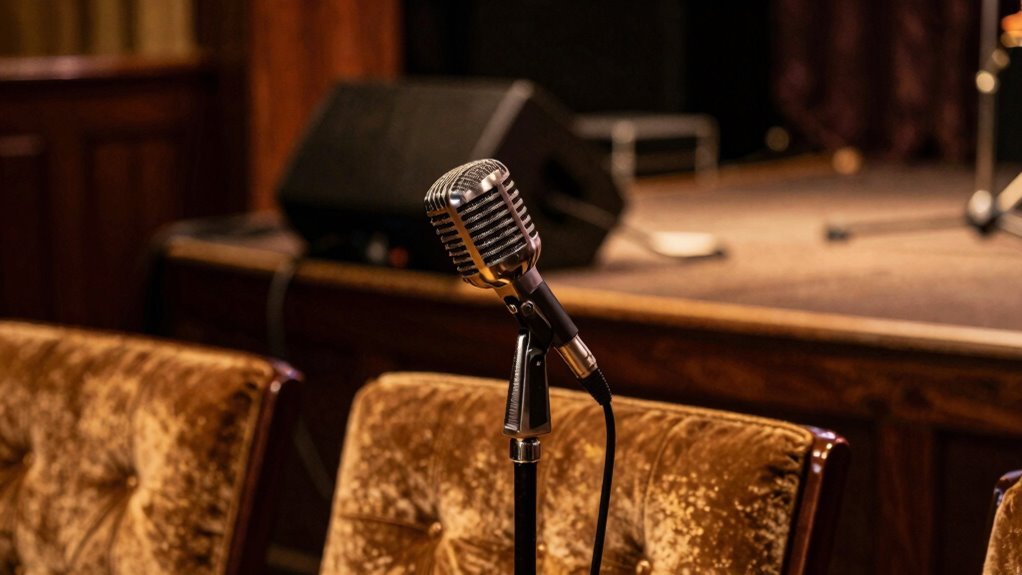
Small, focused venues are ideal for mono sound, offering an intimate audience experience that keeps everyone close to the performers. You’ll notice precise sound localization, making it easier to pick out individual instruments and vocals. Plus, with minimal acoustic interference, the sound stays clear and focused throughout the space. Exploring herbal traditions can also inspire a deeper appreciation for natural remedies that promote relaxation and focus, enhancing your concert experience.
Intimate Audience Experience
When you’re in a venue that’s designed for intimacy, the sound quality can feel more personal and immersive, especially when achieved through mono sound systems. Mono sound emphasizes the overall blend, creating a unified auditory experience that enhances audience intimacy. This setup allows every listener to feel closer to the performers, fostering a stronger emotional connection. In small, focused settings, mono sound reduces distractions caused by stereo imaging, making it easier to engage with the music’s core essence. The simplicity of mono also guarantees that subtle nuances aren’t lost, allowing you to connect more deeply with the performance. Overall, in intimate venues, mono systems help create a warm, inclusive atmosphere where every listener feels personally involved in the live experience. Additionally, European cloud innovation supports the deployment of reliable and secure audio streaming solutions that can enhance live music experiences.
Precise Sound Localization
In venues designed for focused listening, mono sound excels at delivering precise sound localization, allowing each instrument and vocal to be clearly identified and positioned within the space. This clarity enhances audience engagement, as listeners can easily follow individual elements without confusion. Mono sound provides sound transparency, meaning you experience a more natural and seamless blend of sources, making it easier to distinguish what’s happening on stage. In small, intimate settings, this focused approach ensures that every note and nuance reaches the audience accurately. When sound localization is sharp, your attention stays on the performance, and you feel more connected to the music. Overall, mono’s ability to deliver pinpoint accuracy makes it ideal for venues where clarity and engagement are top priorities.
Minimal Acoustic Interference
Minimal acoustic interference is vital in venues where mono sound truly shines. To achieve this, focus on strategic speaker placement, positioning speakers to minimize sound spill into unwanted areas. Proper speaker placement ensures the audience receives a clear, cohesive sound image without interference from echoes or background noise. Sound isolation plays a critical role; using barriers or curtains can reduce external noise and prevent sound from bouncing between surfaces. Small, focused venues benefit most from this setup, as it keeps the sound tight and controlled. When you limit acoustic interference, you create an environment where every listener experiences the performance as intended, with consistent audio quality throughout the space. This approach ensures clarity and intimacy, making mono sound ideal for these settings.
When to Use Stereo in Large Venues and Multi-Instrument Acts

Stereo is often the best choice for large venues and multi-instrument acts because it creates a wider, more immersive soundstage that can fill a sizable space effectively. This setup enhances audience perception by providing clearer separation between different instruments and vocals, making it easier for listeners to distinguish individual elements. When using stereo, stage monitoring becomes more effective, allowing performers to hear their cues and surroundings more naturally. In large venues, this helps maintain tight coordination among musicians. Additionally, stereo sound helps prevent the muddiness that can occur with mono setups, ensuring the audience experiences a rich, full mix. Proper sound system setup is crucial to maximize stereo benefits and ensure optimal audio quality throughout the venue. Overall, stereo boosts both performer awareness and audience engagement, making it ideal for complex, multi-instrument performances in expansive environments.
Limitations and Challenges of Mono and Stereo Setups
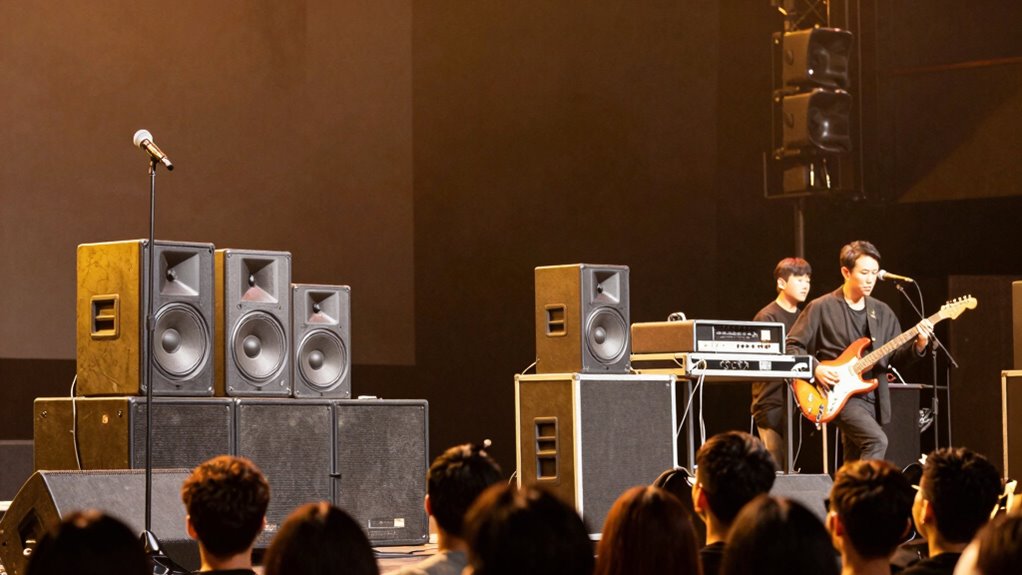
Both mono and stereo setups have their limitations that can impact your sound quality. Spatial constraints may make stereo less effective in certain spaces, while mono can lack depth and immersion. Additionally, stereo systems often require more complex equipment and calibration, which can be challenging to manage during live performances. Moreover, environmental factors such as ambient noise and acoustics can influence the effectiveness of each setup.
Spatial Limitations
While mono setups can be simpler to implement, they often struggle with spatial limitations that affect how you perceive the live music experience. With only one channel, sound spreads evenly but lacks depth, making it harder to create an immersive environment. This can diminish audience engagement, as you miss out on the sense of space and directionality of instruments. Sound clarity may also suffer, especially in larger venues where sound waves don’t reach all areas equally. Stereo setups, by contrast, offer a wider soundstage, allowing you to perceive the position and movement of performers more naturally. However, this advantage comes with the challenge of ensuring proper speaker placement to avoid phase issues and uneven sound distribution. Additionally, contrast ratio plays a significant role in how well the nuances of live music are conveyed, with higher ratios providing clearer distinction between different sounds. Ultimately, spatial limitations in mono can reduce the realism and emotional impact of live music.
Equipment Complexity
Implementing a mono setup tends to be straightforward, often requiring fewer speakers and simpler wiring, which can save time and reduce costs. With less equipment to connect and calibrate, the setup process becomes quicker, and troubleshooting is simpler. Mono systems generally involve less equipment complexity, making them ideal for venues with limited technical resources or those seeking a quick setup. However, stereo setups are more complex, requiring multiple channels, careful speaker placement, and more extensive wiring. This increased equipment complexity can extend setup time and introduce potential points of failure. While stereo provides a richer sound experience, it demands more planning and technical skill. Balancing the benefits of sound quality against the challenges of setup time and equipment complexity is vital when choosing between mono and stereo configurations. Proper installation practices ensure safety and optimal performance, especially in more intricate stereo systems.
How to Decide Between Mono and Stereo for Your Next Show

Deciding whether to use mono or stereo sound for your next live show depends on several key factors. Audience size and speaker placement are essential. For small venues, mono can guarantee everyone hears the same mix clearly, avoiding phase issues. Larger venues benefit from stereo, offering a more immersive experience. Consider this table to guide your choice:
| Audience Size | Best Sound Type | Reason |
|---|---|---|
| Small | Mono | Clear, focused sound |
| Large | Stereo | Wide, immersive experience |
| Narrow space | Mono | Consistent coverage |
| Wide space | Stereo | Better stereo imaging |
| Mobile setup | Mono | Simplicity and reliability |
Match your speaker placement and audience size to the appropriate sound setup for ideal results. Additionally, understanding audio quality can help you make more informed decisions about your sound setup.
Top Tips to Optimize Your Live Sound Setup With Mono and Stereo
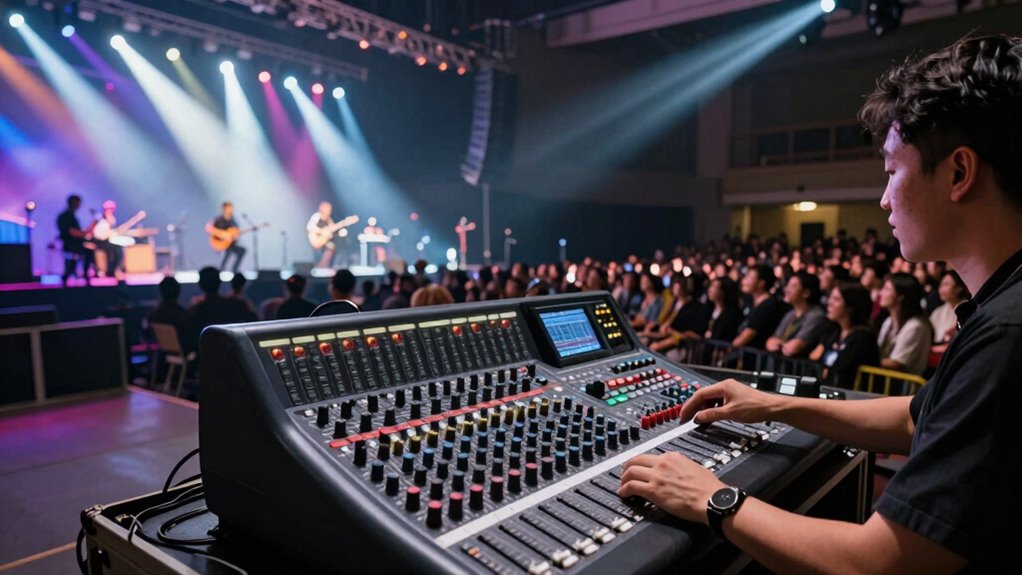
To get the most out of your live sound setup, focus on proper speaker placement and gain staging, whether you’re using mono or stereo. Good speaker placement ensures balanced sound and minimizes feedback, so position speakers to cover the audience evenly. In stereo setups, use panning techniques to create a sense of space and width, placing instruments and vocals thoughtfully across the stereo field. For mono arrangements, prioritize direct sound and clarity by aligning speakers directly in front of the audience. Always double-check gain levels to prevent distortion. Remember, adjusting panning and speaker placement based on your venue’s acoustics can considerably improve sound quality. These tips help you achieve a clear, immersive experience for your audience, no matter the setup.
Frequently Asked Questions
How Does Speaker Placement Influence Mono Versus Stereo Sound Quality?
Speaker placement greatly impacts mono versus stereo sound quality by affecting speaker alignment and phase coherence. Properly aligned speakers ensure sound waves reach your ears simultaneously, maintaining phase coherence. In stereo setups, positioning speakers with the right distance and angles prevents phase issues that can cause sound cancellation or muddiness. For mono, placement is less critical, but consistent alignment still ensures a clear, balanced sound, avoiding phase discrepancies that reduce clarity.
Can Mono and Stereo Setups Be Combined in a Single Live Performance?
Sure, you can combine mono and stereo setups in a live performance—just don’t expect perfect speaker synchronization without a little audio mixing magic. You’ll need to carefully blend the two, adjusting levels so they complement rather than clash. Think of it as audio juggling—keeping everything balanced and clear. Mixing these setups lets you capture the full stereo richness while maintaining a solid mono foundation for clarity, making your sound both dynamic and cohesive.
What Are the Cost Differences Between Mono and Stereo Sound Systems?
You’re likely to find that stereo sound systems cost more than mono setups because they require additional equipment like extra speakers, amplifiers, and cabling. The cost comparison shows higher equipment expenses for stereo, which can add up quickly, especially for larger venues. Mono systems are more budget-friendly, making them ideal if you’re aiming to minimize equipment expenses. However, consider your sound quality needs when choosing between the two.
How Do Audience Size and Venue Acoustics Affect Mono Vs Stereo Choices?
You should choose mono for smaller venues or spaces with challenging acoustics, as it guarantees consistent sound and audience engagement. Stereo works better in larger venues with good acoustics, where audience members experience richer soundscapes. Keep in mind that venue lighting can highlight the differences, so consider how visuals complement your sound setup. Ultimately, your choice impacts how effectively you connect with the audience and enhance their live music experience.
Are There Specific Genres That Benefit More From Mono or Stereo Sound?
Think of genres as musical landscapes where instrument separation paints vivid scenes. For genres like rock or jazz, stereo sound lets you enjoy lush layers and dynamic instrument separation, creating an immersive experience. Conversely, genres like classical or folk often benefit from mono, which offers clarity and focus, ensuring every note resonates with authenticity. Your choice hinges on genre preferences, guiding your soundscape to match the emotional depth and complexity of each style.
Conclusion
Choosing between mono and stereo depends on your venue, your sound goals, and your audience experience. Whether you aim for intimacy or immersion, simplicity or depth, your decision shapes the live music experience. Consider your space, your act, and your sound vision. With the right setup, you enhance clarity, create atmosphere, and connect with your audience. Make informed choices, optimize your sound, and let your music truly resonate.