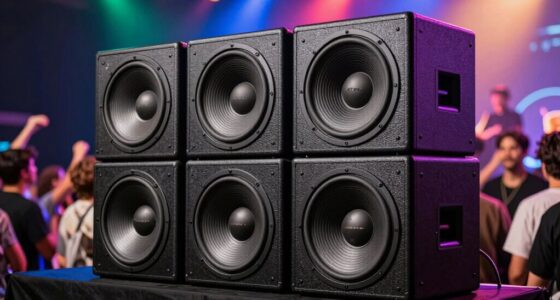


Choosing the right stage monitor wedge powered speaker determines whether you hear yourself clearly or fight feedback all night. My top overall pick is the Samson RSXM12A because it balances 12-inch low-end punch with precise midrange clarity, making it versatile for both vocals and instruments. For those prioritizing budget without sacrificing reliability, the Seismic Audio SA-10MT-PW offers solid performance for smaller venues, while the Behringer EUROLIVE F1220D stands out for its built-in feedback suppression, a critical feature for noisy stages. The main tradeoff here lies between portability (10-inch models) and low-frequency response (12-inch models). Continue reading to see which model fits your specific gigging needs.

Get audio and creator gear delivered free with Prime
- Fast, free delivery on millions of items
- Prime Video, Amazon Music and more included
- Member-only deals all year
Complete the kit


Key Takeaways
- The Samson RSXM12A dominates the mid-range market by offering a 12-inch woofer in a relatively compact wedge, bridging the gap between portable 10-inch monitors and bulky floor wedges.
- Built-in feedback suppression, found in the Behringer F1220D, is not a luxury but a necessity for vocalists on small, reflective stages, reducing the need for external processors.
- Buying a pair of 10-inch monitors (like the Seismic Audio SA-10MT-PW) often provides better stereo imaging and redundancy than a single larger monitor, though it doubles the weight and setup time.
- Power ratings (Watts) are less indicative of real-world volume than driver size and sensitivity; a 350W 10-inch monitor can easily outperform a poorly tuned 1000W unit in clarity.
- Titanium horn drivers, featured in several Seismic Audio models, offer brighter high-frequency projection but can sound harsh at close range compared to the smoother silk-dome tweeters in premium brands.


| stage monitor wedge powered speaker | Woofer Size | Weight |
|---|---|---|
| Seismic Audio SA-10MT-PW Power | 10 inches | 33.1 lbs |
| Seismic Audio SA-10MT-PW Pair | 10 inches | 35 lbs per unit |
| Seismic Audio SA-10MT | 10 inches | — |
| Samson RSXM12A 2-Way Active St | 12 inches | — |
| ALTO TX410 350W 10" Powered PA | 10 inches | — |
| Behringer EUROLIVE F1220D Bi-A | 12 inches | — |
| Sound Town METIS-10MPW Powered | 10 inches | Lightweight |
| Rockville RSM12A V2 12" 1000W | 12 inches | 52 pounds |
| Seismic Audio SA-10M 10" Floor | 10 inches | 22 pounds |
More Details on Our Top Picks
Seismic Audio SA-10MT-PW Powered 2-Way 10″ Floor/Stage Monitor Wedge
This unit stands out for high value per dollar, offering a robust 250W RMS Class D amplifier in a single cabinet. Unlike the Samson RSXM12A, which prioritizes high-wattage output in a larger 12-inch package, this 10-inch wedge is more compact for smaller stages. The full metal grill and MDF construction provide necessary durability for gigging musicians who transport gear frequently. However, the 33.1 lb weight is substantial for a 10-inch monitor, making it less ideal for musicians with back issues or those who need ultra-portable solutions. It lacks the digital features found in the ALTO TX410, such as Bluetooth, but compensates with reliable analog connectivity via XLR and 3.5mm inputs.
Pros:- Strong 250W RMS power for its size
- Rugged construction with metal grill and corners
- Versatile analog inputs for various sources
Cons:- Heavy for a 10-inch monitor
- No digital connectivity options
- Basic EQ controls lack fine-tuning
Best for: Solo performers and small bands needing a single, durable monitor for small-to-medium venues without breaking the bank.
Not ideal for: Musicians requiring wireless streaming or ultra-lightweight gear for frequent travel.
- Power Output:250 Watts RMS
- Woofer Size:10 inches
- Amplifier Class:Class D
- Max SPL:121 dB
- Weight:33.1 lbs
- Inputs:2x XLR Combo, 1x 3.5mm
Our verdict“A solid, no-frills choice for musicians who prioritize durability and raw power over modern wireless features.”
Seismic Audio SA-10MT-PW Pair of Powered 2-Way 10-Inch Floor/Stage Monitors with Titanium Horns
Buying this pair makes sense for duos or small bands needing synchronized monitoring without buying units separately. While the specs mirror the single Seismic Audio SA-10MT-PW, the bundle offers a cohesive setup for stereo or dual-stage coverage. The 250W RMS per cabinet ensures adequate headroom for vocal clarity in mid-sized rooms. Compared to the Sound Town METIS-10MPW, these units offer a more traditional analog interface with straightforward gain and EQ controls, avoiding the potential complexity of digital presets. The main tradeoff is the combined weight of 70 lbs, which demands a sturdy vehicle and strong arms for loading. It is a straightforward workhorse for those who know exactly what they need and dislike feature bloat.
Pros:- Cost-effective way to get two monitors
- Consistent sound signature across both units
- Durable build with metal corners
Cons:- Very heavy when moving the pair
- No wireless input options
- Basic feature set
Best for: Small bands or duo acts needing two identical monitors for balanced stage coverage on a budget.
Not ideal for: Single musicians or those with limited car trunk space due to the heavy combined weight.
- Quantity:Pair (2 units)
- Power Output:250 Watts RMS each
- Woofer Size:10 inches
- Frequency Response:48 Hz – 20 kHz
- Weight:35 lbs per unit
- Connectors:XLR Combo, 3.5 mm
Our verdict“The most logical entry point for bands needing two reliable monitors without paying for premium digital features.”
Seismic Audio SA-10MT – Pair of 10-Inch Floor/Stage Monitors with Titanium Horn
This pair serves as a budget-friendly passive option for those who already own an amplifier. Unlike the powered Seismic Audio SA-10MT-PW, these require external amplification, which adds complexity but allows for system scaling with existing gear. The 150W RMS rating is lower than the powered counterparts, meaning they will not get as loud in large venues. The titanium horn provides clear high-frequency projection, crucial for vocal intelligibility, but the lack of onboard EQ means all tone shaping must happen at the mixer. This is strictly for users who understand impedance matching and have compatible amps; it is not a plug-and-play solution for beginners.
Pros:- Lower cost if you already have an amp
- Lighter than powered equivalents
- Clear high-frequency projection
Cons:- Requires external amplifier
- Lower power handling than active models
- No onboard controls
Best for: Experienced sound engineers or venues with existing amplification racks looking to add passive monitors.
Not ideal for: Beginners or musicians who want a simple plug-and-play setup without extra amps.
- Quantity:Pair (2 units)
- Power Handling:150 Watts RMS
- Woofer Size:10 inches
- Voice Coil:2 inches
- Magnet:40 oz
- Type:Passive Monitor
Our verdict“A smart choice for tech-savvy users with existing amps, but a hassle for anyone seeking simplicity.”
Samson RSXM12A 2-Way Active Stage Monitor
The Samson RSXM12A punches well above its weight with 800 watts of Class D power in a surprisingly compact chassis. This makes it a strong competitor to the Rockville RSM12A for musicians needing high headroom without the bulk of traditional 12-inch monitors. The coaxial design improves phase coherence, resulting in clearer vocals compared to the separate woofer/tweeter layout of the Seismic Audio SA-10MT-PW. However, the lack of onboard EQ or mixing controls is a significant drawback; you must rely entirely on your mixer or interface for tone shaping. It is a pure output tool, ideal for users with a controlled signal chain who prioritize volume and clarity over onboard flexibility.
Pros:- Extremely high power-to-weight ratio
- Coaxial driver for better clarity
- Compact and easy to position
Cons:- No onboard EQ or mixing controls
- Single input channel limits flexibility
- Can be too bright at high volumes
Best for: Gigging musicians in mid-sized venues who have a reliable mixer and need maximum volume in a small footprint.
Not ideal for: Users who need onboard EQ, effects, or mixing capabilities directly on the monitor.
- Power Output:800 Watts
- Woofer Size:12 inches
- Design:Coaxial 2-Way
- Modes:FOH and Monitor
- Input:XLR-1/4-inch Combo
- Construction:All-wood
Our verdict“A powerhouse for those with a solid front-of-house mixer who want raw volume without the extra weight.”
ALTO TX410 350W 10″ Powered PA Speaker with Bluetooth and Mixer
This model excels in versatility and connectivity, offering Bluetooth streaming and a built-in 2-channel mixer that the Seismic Audio SA-10MT-PW completely lacks. It allows a solo performer to plug in a mic, play backing tracks wirelessly, and adjust levels directly on the speaker. The 350W output is sufficient for small-to-medium events, though it lacks the raw headroom of the Samson RSXM12A. The 10-inch driver keeps it portable, but the integrated electronics add slight bulk compared to simpler wedges. This is the go-to choice for modern performers who value ease of use and wireless freedom over pure analog simplicity or maximum decibel output.
Pros:- Built-in Bluetooth and 2-channel mixer
- User-friendly controls for quick setup
- Good balance of power and portability
Cons:- Mixer channels are limited to two
- Less power headroom than 12-inch rivals
- Bluetooth latency can affect live monitoring
Best for: Solo entertainers, DJs, and presenters who need wireless playback and basic mixing in one unit.
Not ideal for: Bands needing multiple input channels or maximum SPL for large rock venues.
- Power Output:350 Watts
- Woofer Size:10 inches
- Connectivity:Bluetooth, Mic, Line
- Mixer:2-Channel Built-in
- HF Driver:1″ Titanium Compression
- Dispersion:90° x 60°
Our verdict“The most modern and convenient option for solo acts who want to cut cables and simplify their rig.”
Behringer EUROLIVE F1220D Bi-Amped 250 Watt Monitor Speaker System
This monitor stands out for its dedicated feedback filter, a feature often missing in budget wedges. If you struggle with ring-outs on loud stages, this unit offers more control than the Seismic Audio SA-10M, which lacks such active processing. The Class-D amplifier keeps the weight manageable despite the 12-inch woofer, making it easier to lug than heavier alternatives. However, the stainless steel enclosure adds significant bulk compared to the plastic-bodied Sound Town METIS-10MPW. While the sound quality is robust for its price, the lack of Bluetooth connectivity means you cannot stream directly from a phone, a convenience the ALTO TX410 offers. This is a workhorse for players who prioritize stability over modern connectivity.
Pros:- Integrated feedback filter reduces ringing without external pedals
- Bi-amped design offers precise control over highs and lows
- Lightweight for its size due to Class-D amplification
- Robust construction withstands stage abuse
Cons:- No Bluetooth or digital connectivity options
- Heavier than plastic-housed competitors like the Sound Town
- Basic EQ controls lack fine-tuning precision
Best for: Musicians playing in reverberant venues who need active feedback suppression without external gear.
Not ideal for: Mobile DJs who need Bluetooth streaming or lightweight setups for frequent transport.
- Amplifier Power:250 Watts
- Woofer Size:12 inches
- Tweeter Size:3 inches
- Connectivity:XLR, 1/4 inch TRS/TS, RCA, Speakon
- Impedance:8 ohm
- Mounting Type:Tabletop/Floor
Sound Town METIS-10MPW Powered 10″ 300W DJ PA Stage Monitor Speaker
The Sound Town METIS-10MPW strikes a balance between portability and power, making it more manageable than the bulky Rockville RSM12A V2. Its 10-inch woofer delivers tight lows without the boominess often found in larger wedges at close range. I find the onboard 3-band EQ more practical than the fixed tuning on the Seismic Audio SA-10M, allowing quick adjustments for different stage acoustics. However, the 10-inch driver may lack the sheer projection of the 12-inch models, requiring higher volume settings in large rooms. The carpeted finish is less durable than the metal grilles on premium units, showing wear faster. It is an excellent choice for small venues where space and ease of setup matter most.
Pros:- Compact footprint fits easily on cramped stages
- Versatile inputs accommodate mixers and phones
- Adjustable EQ allows for room-specific tuning
- Lightweight design reduces load-in fatigue
Cons:- Smaller driver limits low-end impact compared to 12-inch models
- Carpeted exterior is prone to scuffing and wear
- Peak power ratings can be misleading for sustained volume
Best for: Solo performers and small bands needing a lightweight monitor for cafes and small clubs.
Not ideal for: Large stage productions requiring high SPL and deep bass extension.
- Amplifier Power:300 Watts
- Woofer Size:10 inches
- Tweeter Size:1 inch Titanium Compression Driver
- Inputs:XLR, 1/4″, 1/8″
- EQ Controls:3-Band (Bass, Mid, Treble)
- Dimensions:12.6″ D x 19.1″ W x 10.8″ H
- Weight:Lightweight
Our verdict“Ideal for gigging musicians who value portability and quick setup over raw power.”
Rockville RSM12A V2 12″ 1000W 2-Way Powered Active Monitor Speaker
This unit delivers 1000W peak power, significantly outpacing the Behringer F1220D in raw headroom. If you need to cut through a noisy drum kit, the 12-inch woofer combined with the titanium compression driver provides the projection needed for larger audiences. The MDF enclosure offers better resonance control than the plastic bodies of the Seismic Audio SA-10M, resulting in cleaner mids. However, the 52-pound weight makes it a two-person lift, unlike the manageable Sound Town. The Class AB amplifier also generates more heat and draws more power than the Class-D units found in competitors. This is for players who need volume and durability, accepting the physical burden as a tradeoff.
Pros:- High wattage provides ample headroom for loud instruments
- Rugged MDF construction reduces cabinet resonance
- Wide frequency response handles vocals and bass well
- Durable steel grille protects drivers from impact
Cons:- Heavy at 52 pounds, making solo transport difficult
- Class AB amplification is less efficient and heavier
- Larger footprint requires more stage space
Best for: Drummers and loud rock bands needing high-volume monitoring in large venues.
Not ideal for: Solo acts or mobile DJs who prioritize ease of transport and light weight.
- Peak Power:1000 Watts
- RMS Power:250 Watts
- Woofer Size:12 inches
- Tweeter Size:1 inch Titanium Diaphragm
- Weight:52 pounds
- Dimensions:24″ D x 18″ W x 16″ H
- Enclosure Material:MDF and Metal
Our verdict“Buy this if you need maximum volume and durability and don’t mind the weight.”
Seismic Audio SA-10M 10″ Floor / Stage Monitor Wedge with Titanium Horn
Unlike the powered options in this list, the Seismic Audio SA-10M is a passive monitor, requiring an external amplifier. This makes it a viable upgrade path for those who already own a power amp but need a dedicated wedge. Compared to the Sound Town METIS-10MPW, it lacks onboard processing and EQ, placing the tonal burden on your mixer. The titanium horn driver ensures crisp highs, but the 65Hz low-frequency limit means it cannot reproduce deep bass, unlike the 45Hz capable Rockville RSM12A V2. It is a simple, no-frills solution for basic stage monitoring where budget and simplicity are paramount. Do not expect modern features like Bluetooth or digital tuning.
Pros:- Lower cost due to lack of internal amplifier
- Lightweight construction eases transport
- Titanium horn provides clear high-frequency response
- Simple design reduces potential failure points
Cons:- Requires external power amplifier to operate
- No onboard EQ or processing controls
- Limited low-frequency response compared to powered 12-inch models
Best for: Home studio owners or venues with existing amplified systems needing basic passive wedges.
Not ideal for: Musicians without an external amplifier or those needing portable, all-in-one solutions.
- Power RMS:150 Watts
- Power Peak:300 Watts
- Woofer Size:10 inches
- Frequency Response:65Hz to 16kHz
- Sensitivity:94dB
- Weight:22 pounds
- Inputs:Two 1/4″ and two Speakon
Our verdict“Choose this only if you already have a power amp and need a simple, low-cost wedge.”

How We Picked
I evaluated these nine options by prioritizing acoustic accuracy and stage-friendly ergonomics over raw spec-sheet numbers. A monitor’s primary job is to deliver a truthful representation of your signal, so I focused on frequency response consistency and how well each unit handles high-gain inputs without distorting. I also assessed the physical design, specifically the tilt angles and handle placement, because a monitor that is difficult to position or carry is a monitor that will be left at home.
Connectivity and control simplicity were the next filters. I favored units with straightforward EQ controls and balanced XLR inputs, which are standard in professional environments, over those relying solely on unbalanced jacks. Finally, I considered value relative to intended use; a beginner playing coffee shops has different needs than a touring musician requiring road-ready durability. This ranking reflects which speakers offer the best balance of performance, reliability, and price for their specific target user.
Factors to Consider When Choosing Stage Monitor Wedge Powered Speaker
Selecting a powered monitor involves more than just picking the loudest box. You must balance acoustic performance with physical constraints and control features. Here is what you need to weigh before making your purchase.
Driver Size: 10-Inch vs. 12-Inch Tradeoffs
The choice between a 10-inch and a 12-inch woofer is the single biggest decision affecting your stage experience. 10-inch monitors are lighter, more compact, and easier to angle sharply toward your ears, making them ideal for tight spaces and vocalists who need clarity without excessive bass bleed. However, they often lack the low-end foundation needed for bass-heavy genres or drum monitoring. 12-inch monitors provide deeper bass extension and higher headroom, allowing you to hear your kick and bass guitar clearly. The tradeoff is weight and size; 12-inch wedges are heavier and may require a steeper stand or specific stage positioning to avoid muddying the mix. If you play in cramped clubs, stick to 10-inch. If you perform on larger stages or need full-range monitoring, invest in a 12-inch.
Feedback Suppression and Control
Feedback is the enemy of any live performance, and a powered monitor with built-in feedback suppression can save your show. This feature uses digital filters to identify and notch out ringing frequencies automatically, reducing the need for complex EQ adjustments on the fly. While high-end external processors offer more precision, integrated solutions like those in the Behringer F1220D provide a pragmatic solution for solo acts and small bands. Without this feature, you rely entirely on your mixing console’s EQ or your own ear for notch filtering, which can be difficult when you are also performing. For beginners or those without a dedicated sound engineer, prioritizing a monitor with active feedback management is a smart move to reduce stress and improve consistency.
Portability and Ergonomic Design
Do not underestimate the physical burden of your gear. A powered wedge contains amplification and speakers, making it heavier than passive equivalents. Look for models with well-placed handles and a weight profile you can lift into a car trunk repeatedly. Some units, like the Samson RSXM12A, are designed with ergonomic grips that make transport manageable, while others feel like awkward boxes. Additionally, consider the tilt angles. A monitor that only offers two or three fixed angles may not align with your ear position, forcing you to stack it on chairs or use makeshift risers. A monitor with adjustable tilt or a wide range of fixed angles ensures you hear the mix exactly where you need it, reducing fatigue during long sets.
Input Flexibility and Connectivity
Check the input configuration carefully. Professional stages rely on XLR inputs for balanced signals, which reduce noise over long cable runs. If a monitor only offers 1/4-inch TRS or RCA inputs, you may encounter hum or interference, especially in venues with poor electrical grounding. Furthermore, consider how many channels you need. Some monitors allow you to mix multiple sources directly on the wedge, which is handy if you are running a small setup without a large mixer. However, if you are feeding a single line-level signal from a console, basic input simplicity is better than complex onboard mixers that add points of failure. Ensure the monitor supports the output format of your mixer or interface to avoid unnecessary adapters.
Durability and Build Quality
Stage gear takes a beating from cables, beer spills, and accidental kicks. Build quality determines whether your monitor survives a year of gigs or a decade. Look for cabinets made of durable plywood or high-density polyethylene (HDPE) rather than thin plastic. Metal grilles are preferable to plastic ones for protecting the drivers from impact. The corners should be reinforced with metal or rubber to prevent cracking when dropped. Cheaper models often use plastic corners and thinner cabinets that resonate sympathetically, adding unwanted coloration to the sound. While a rugged build adds weight and cost, it protects your investment and ensures the sound remains consistent despite physical abuse on the road.
Frequently Asked Questions
Can I use a powered monitor as a main PA speaker?
While a stage monitor wedge can technically project sound to an audience, it is not designed for main PA duty. Monitors are angled upward to target a specific listener’s ears, resulting in uneven coverage for the rest of the room. The frequency response is often tuned to be mid-forward for clarity, which can sound harsh or thin to the audience. Additionally, the dispersion pattern is usually narrower than a proper PA speaker. For small, intimate settings, it might work in a pinch, but for any standard venue, use a dedicated PA system for the audience and a monitor for yourself to ensure everyone hears a balanced mix.Do I need a pair of monitors or just one?
This depends on your stage layout and whether you need stereo imaging. A single monitor is sufficient for most vocalists and guitarists who stand in one spot, as it provides a focused, mono reference mix. However, if you are a keyboardist or DJ who moves across a wider stage, or if you are monitoring a stereo mix, a pair allows for better spatial awareness and redundancy. If one fails, you have a backup. The downside is the increased weight and setup complexity. For solo performers, one high-quality 12-inch wedge is often better than two lower-quality 10-inch wedges.How does the tilt angle affect sound quality?
The tilt angle dictates where the sound waves hit your ears. If the angle is too shallow, the sound projects over your head, leaving you with a muddy, bass-heavy mix because you are hearing more floor reflections. If it is too steep, the treble frequencies can be piercing. The ideal angle places the tweeter directly at your ear level when you are standing or sitting in your performance position. Many powered wedges offer multiple fixed angles to accommodate different heights. If your chosen monitor does not have the right angle, you may need to use a monitor stand or riser to correct the elevation, which adds to the overall setup time.Is Bluetooth connectivity useful in a stage monitor?
Bluetooth is primarily useful for pre-show soundchecks and backing tracks, not for live performance audio. Relying on Bluetooth for live instruments is risky due to potential latency (delay) and connection dropouts. However, having it allows you to play reference tracks through the monitor to dial in your EQ settings before the audience arrives. It also lets you play ambient music during breaks without running cables. For the actual performance, always use a wired connection to guarantee signal integrity and zero latency. Do not let Bluetooth availability drive your primary purchase decision unless you are a DJ who needs it for specific workflows.Why do some monitors sound ‘boxy’ even when powered on?
A boxy sound is often caused by the cabinet resonating or the monitor being placed too close to a wall or corner. The low-frequency waves build up in these boundaries, creating a muddy, indistinct tone. Try moving the monitor away from walls and using isolation pads to decouple it from the floor. If the issue persists, check the EQ settings; many monitors have a ‘low cut’ or ‘flat’ setting that should be engaged. If the cabinet itself is thin plastic, it may naturally resonate, coloring the sound. In this case, upgrading to a model with a denser cabinet material like plywood will resolve the resonance issue and provide a cleaner, more accurate listening experience.Conclusion
Choosing the right stage monitor wedge powered speaker comes down to matching the tool to your specific performance environment. For most musicians seeking a balance of power, clarity, and portability, the Samson RSXM12A is the best overall choice, offering 12-inch depth without the bulk of traditional wedges. If you are on a tight budget but need reliable sound for small venues, the Seismic Audio SA-10MT-PW is the best value pick, delivering solid performance for its price point. For those who struggle with feedback on small stages, the Behringer EUROLIVE F1220D is the best premium feature pick due to its integrated feedback suppression. Beginners should start with a single 10-inch monitor like the Seismic Audio SA-10M to learn their mix without overwhelming the stage, while touring professionals should look at the robust build of the Samson or Behringer options to withstand the rigors of the road.