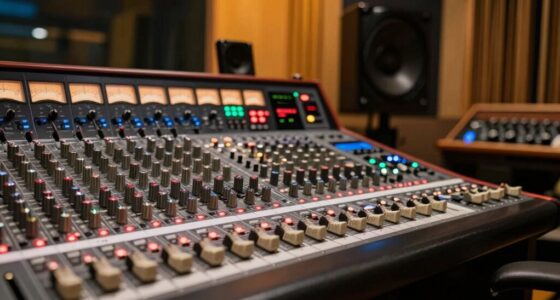

Soundstage is about creating a sense of space in your audio, making sounds seem to come from different directions and distances. It’s like an invisible 3D map that your brain fills in, giving depth and realism to music or movies. Proper speaker placement and room setup improve this effect, so sounds feel like they’re happening around you. Keep exploring, and you’ll discover simple ways to make your sound experience even richer.

Get audio and creator gear delivered free with Prime
- Fast, free delivery on millions of items
- Prime Video, Amazon Music and more included
- Member-only deals all year
Key Takeaways
- Imagine sound as coming from different directions, creating a 3D space around you.
- Proper speaker placement and room setup make sounds appear from specific locations.
- Clear sound cues help your brain perceive depth and distance easily.
- Minimizing room reflections and reflections improves how sounds are positioned.
- Even simple stereo setups can produce a convincing soundstage with thoughtful positioning.

Creating a convincing soundstage doesn’t have to be complicated. When you’re listening to music or watching a movie, what you’re really after is that sense of space—the feeling that sounds are coming from different directions and distances, not just from your speakers. That’s where surround sound and spatial imaging come into play. These elements work together to create an immersive experience that makes you feel like you’re inside the action or right in the middle of the musical performance.
Creating a convincing soundstage enhances your listening experience by immersing you in a three-dimensional world of sound.
To understand soundstage without getting overwhelmed, think of it as a three-dimensional map of sound. Surround sound systems are designed to place audio cues around you, filling the space with different sounds that seem to come from various directions. It’s not just about loudness; it’s about placement. When done right, surround sound creates a broad, enveloping environment that tricks your brain into perceiving depth and distance. Spatial imaging is what makes this possible—it’s the ability of your audio setup to precisely position sounds in that space. If you close your eyes and hear a guitar on the left and a voice in the center, that’s spatial imaging at work.
You don’t need fancy equipment to grasp the basics. Start by paying attention to how sounds are positioned in your listening environment. When you listen to a track or watch a film, notice where the vocals are coming from, where the background instruments sit, and how sounds move from side to side or front to back. Good surround sound systems enhance this perception, but even stereo setups can produce a convincing soundstage if your speakers are well placed and your room acoustics are decent. Think of your speakers as the eyes of your auditory scene—they paint a picture that your brain interprets as a three-dimensional space. room acoustics also play a crucial role in how well your soundstage comes across. Additionally, understanding spatial cues can help you optimize your setup for better sound placement. Paying attention to how your room’s acoustic environment influences sound can significantly improve your listening experience. Improving your speaker placement and reducing reflective surfaces can make a substantial difference in how immersive your sound feels.
Achieving a good soundstage is really about clarity and placement. When your speakers are correctly positioned and your room isn’t overly reflective or cluttered, you’ll notice that sounds seem to come from specific locations rather than just from the speakers themselves. It’s about the subtle cues that help your brain interpret spatial imaging accurately. So, don’t get caught up in complex jargon or expensive gear. Focus on how sounds are arranged and how they make you feel immersed. With a little attention, you’ll master the basics of soundstage and enjoy a richer, more realistic listening experience.
Popular right now

KitchenAid Artisan 5-Quart Tilt-Head Stand Mixer, Milkshake

Ninja Foodi 10-Qt DualZone XL Air Fryer, 6-in-1, Grey (DZ401)

Samsung 55-Inch M70H Series 4K HDR Mini-LED Smart TV with HDMI Cable and 12-Month CPS Warranty
As an affiliate, we earn on qualifying purchases.
Frequently Asked Questions
How Does Room Acoustics Affect Soundstage Perception?
Room acoustics profoundly influence your soundstage perception by affecting how sound waves travel and reflect. Room dimensions can cause standing waves or echo, distorting spatial cues. Acoustic treatment helps control reflections, making the soundstage clearer and more precise. When you optimize your room with proper dimensions and treatment, you’ll notice a more accurate sense of space and depth, enhancing your overall listening experience and making the soundstage feel more immersive and natural.
Can Speaker Placement Improve Soundstage Clarity?
Yes, adjusting your speaker placement can improve soundstage clarity. Keep speaker symmetry by positioning them at equal distances from your listening position and maintaining consistent angles. Also, match the speaker height to your ear level for ideal imaging. These tweaks help create a balanced, immersive soundstage, allowing you to better perceive instrument placement and depth, making your listening experience more precise and engaging.
What Equipment Most Influences Soundstage Depth?
You can substantially influence soundstage depth through headphone calibration, which adjusts psychoacoustic illusions to create a more immersive experience. For example, in a case study, proper calibration made listeners perceive layered instrument placement as deeper and more defined. This illustrates how equipment like calibrated headphones enhances depth perception, making the soundstage feel more expansive without changing the physical setup. Focus on calibration to maximize your soundstage’s depth.
Is Soundstage More Noticeable With Certain Music Genres?
Yes, soundstage tends to be more noticeable with certain music genres, especially those emphasizing spatial elements like classical, jazz, or live recordings. Your listener preference also plays a role; if you enjoy immersive, detailed sound, you’ll likely notice soundstage differences more. Genres with layered instruments and spacious recordings help reveal the depth and width of your soundstage, making it more engaging and easier to perceive.
How Does Headphones Soundstage Differ From Speakers?
Headphone soundstage feels like a private concert, with precise headphone imaging wrapping you in a 3D bubble, unlike speakers that spread sound across a room through speaker dispersion. While speakers fill a space, headphones put you center stage, creating intimacy and clarity. Your headphones’ soundstage is tightly controlled, making every instrument stand out vividly, whereas speakers offer a more natural, immersive experience as sound disperses outward.
Conclusion
So there you have it—soundstage isn’t some mystical art reserved for audiophile wizards. It’s just a clever way your gear tricks your brain into imagining a concert hall right in your living room. No need to memorize fancy terms or spend a fortune. Just relax, enjoy your music, and remember: if your sound feels as flat as a pancake, maybe it’s time to give your gear a little “stage” boost. Happy listening!