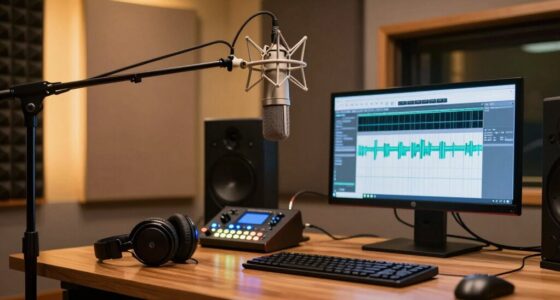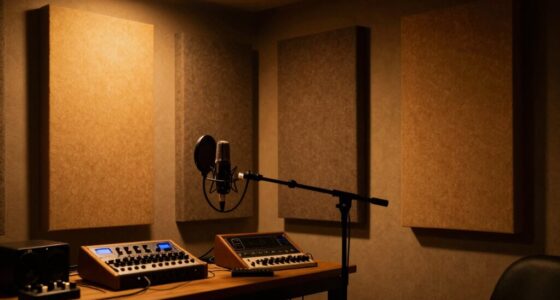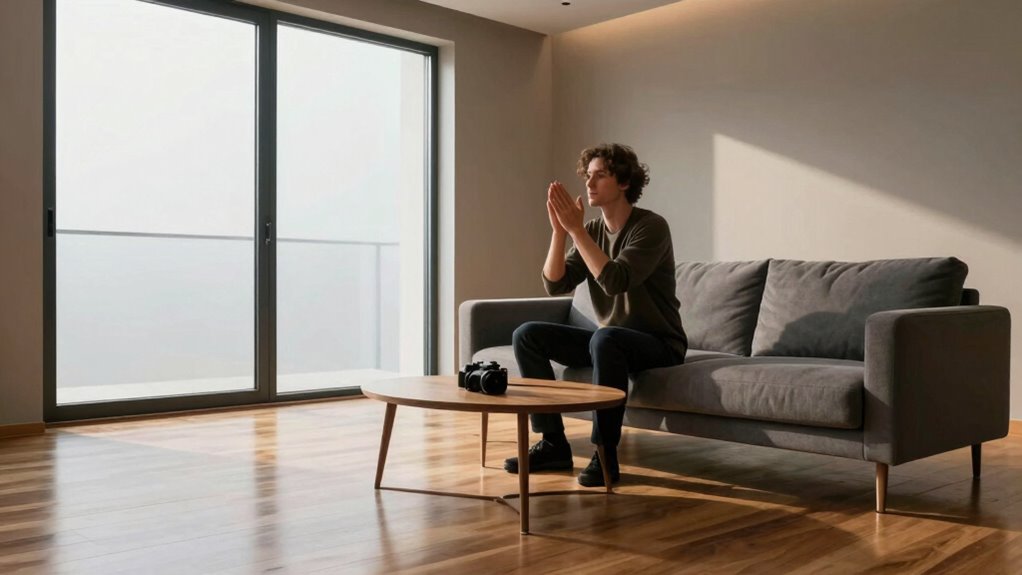

The clap test gives you a quick snapshot of your room’s acoustics, but it doesn’t reveal issues like echoes, dead spots, or resonances that impact sound quality. To better hear these problems, listen carefully as you move around—note muffling or ringing sounds—and consider using a smartphone app to analyze frequency response. Small adjustments in speaker placement and simple acoustic treatments can make a big difference. Keep exploring, and you’ll discover how to optimize your space further.

Get audio and creator gear delivered free with Prime
- Fast, free delivery on millions of items
- Prime Video, Amazon Music and more included
- Member-only deals all year
Key Takeaways
- The clap test offers only a quick impression; use additional methods like listening and movement to assess room acoustics.
- Identify issues such as echoes, dead spots, or uneven sound by moving around and listening carefully.
- Adjust speaker placement and add acoustic treatments like bass traps and panels for better sound quality.
- Use smartphone apps to analyze room frequency response and detect resonances or problematic reflections.
- Seek professional help if acoustic problems persist despite DIY adjustments or if the room has complex features.
acoustic panels for room soundproofing
As an affiliate, we earn on qualifying purchases.
As an affiliate, we earn on qualifying purchases.
Why the Clap Test Isn’t Enough to Judge Your Room’s Sound Quality
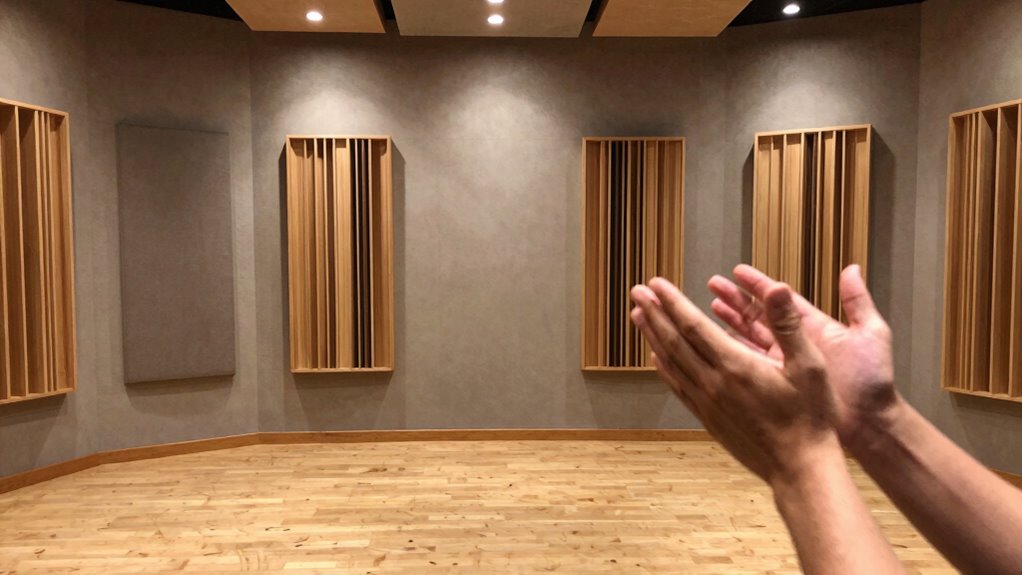
While the clap test can give you a quick sense of a room’s acoustics, it doesn’t provide a complete picture of sound quality. Sound absorption from walls, furniture, and curtains greatly affects how sound behaves, which the clap test doesn’t reveal. Proper speaker placement plays a crucial role in achieving balanced sound, but it’s not something you can gauge by clapping alone. Relying solely on this test might overlook issues like echo, dead zones, or uneven sound distribution. To truly understand your room’s acoustics, consider how sound waves are absorbed and reflected, and experiment with speaker placement to optimize clarity. Additionally, understanding the contrast ratio of your room can help you assess how well it supports different sound levels and details. This deeper insight ensures your listening experience is clear, balanced, and free of unwanted echoes.
As an affiliate, we earn on qualifying purchases.
Identify Common Acoustic Problems in Your Room

Understanding the common acoustic problems in your room is essential for improving sound quality. Common issues include excessive echoes, dead spots, and uneven sound distribution. These problems often stem from poor sound absorption and suboptimal speaker placement. To identify them, listen carefully for lingering reverberations or areas where sound seems muffled or overly bright. Pay attention to how sound behaves in different parts of the room. Utilizing soundproofing techniques can also help in managing these issues effectively.
smartphone room frequency analyzer app
As an affiliate, we earn on qualifying purchases.
As an affiliate, we earn on qualifying purchases.
How to Spot Echoes and Dead Spots Using Your Ears
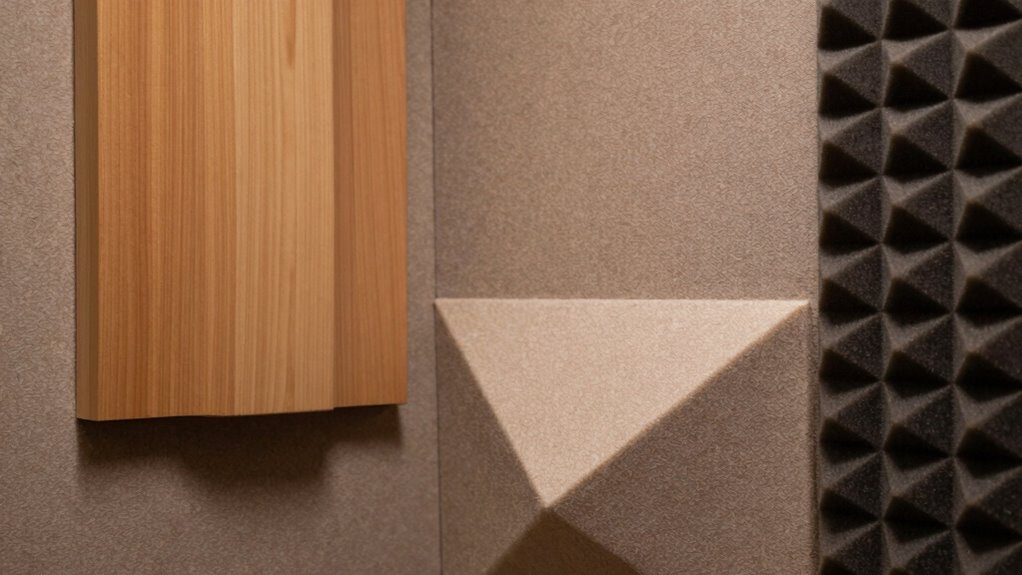
To identify echoes and dead spots in your room, start by actively listening from different positions. Pay attention to how sounds reflect or fade, indicating issues like frequency imbalance or poor speaker placement. Use these steps:
- Move around your space, clapping at ear level to hear how sound behaves.
- Note areas where echoes seem pronounced—these are echo hotspots.
- Identify dead spots where sound feels muffled or distant.
- Listen for uneven sound distribution, which suggests frequency imbalance.
- Incorporate knowledge of acoustic treatment principles to improve your listening environment and reduce problematic reflections.
As an affiliate, we earn on qualifying purchases.
Check Room Frequencies With a Smartphone App
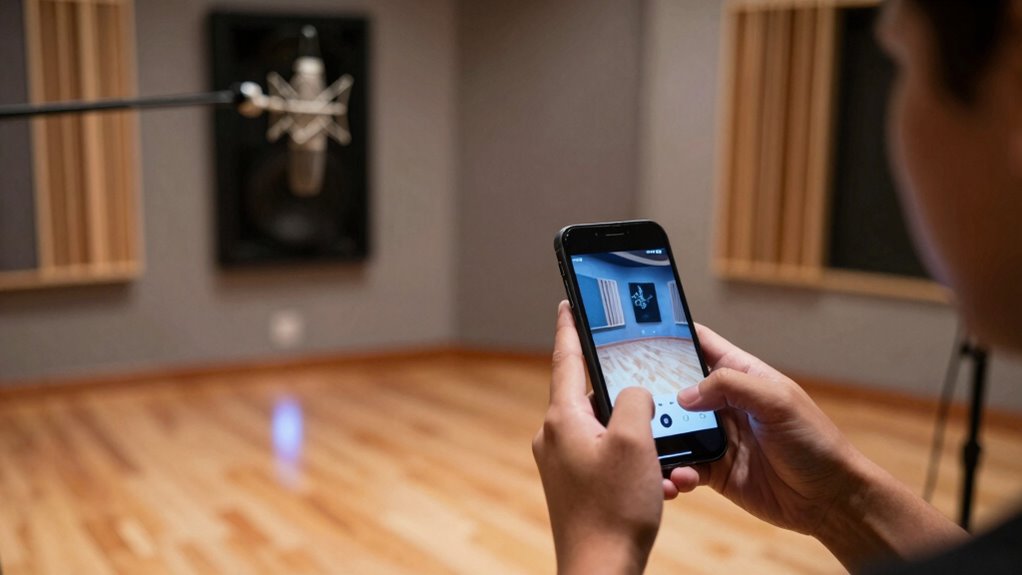
Using a smartphone app to check your room’s frequencies is a quick and effective way to identify problem areas. With a simple room measurement process, you can analyze how sound behaves in different spots. These apps perform sound analysis by capturing frequency response data, revealing peaks and dips that indicate resonances or dead zones. By moving around your space and recording with the app, you’ll gain insight into specific frequencies that need treatment. This real-time feedback helps you understand how your room influences sound quality. Many apps also provide visual graphs, making it easy to interpret the sound analysis results. Overall, this approach allows you to target acoustic treatments more precisely, improving your listening environment without expensive equipment. Room acoustics considerations are essential for achieving optimal sound performance.
Listen for Clarity and Detect Room-Induced Sound Distortions
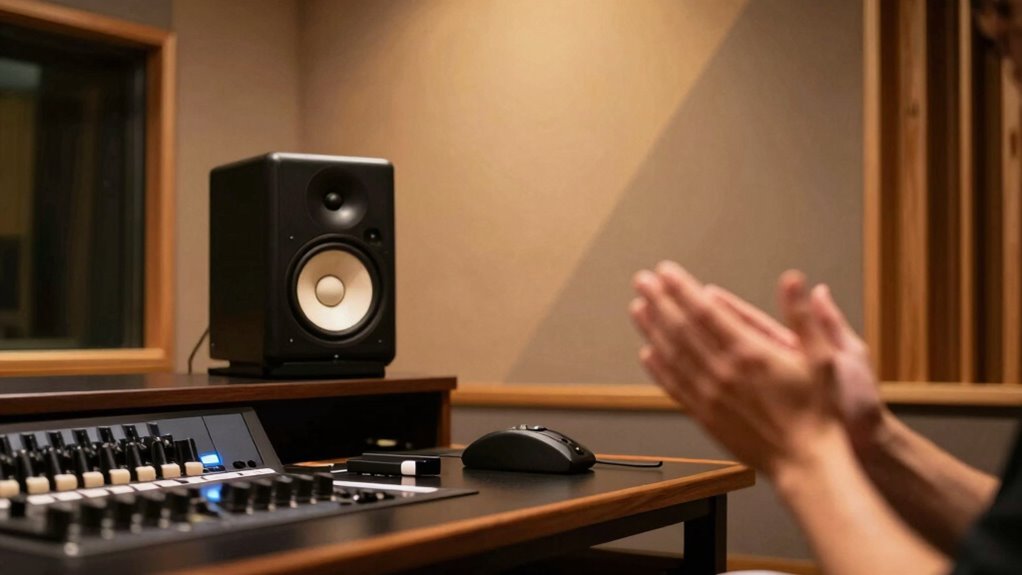
As you listen, pay attention to echoes and reverb that can muddy the sound. Notice any spots where clarity dips or sounds become distorted. Identifying these issues helps you understand how your room affects audio quality. Additionally, considering factors like air quality can influence acoustic perception and overall sound clarity.
Detect Echoes and Reverb
Ever wonder if your room’s acoustics are affecting sound quality? Detecting echoes and reverb is key to identifying room-induced distortions. First, listen carefully after clapping—notice if sounds linger or bounce around. Second, identify if certain frequencies seem muffled or overly bright. Third, check for a sense of spaciousness that feels unnatural. Fourth, consider if sound masking techniques could help reduce disruptive reflections. Echoes and reverb often result from insufficient acoustic treatment, which allows sound waves to bounce freely. To improve clarity, add acoustic panels or diffusers that absorb or scatter reflections. By paying attention to these cues, you can better understand your room’s acoustics and optimize it for cleaner, more precise sound.
Identify Clarity Variations
When you clap and notice lingering echoes or uneven sound quality, you’re observing how room acoustics influence clarity. These variations can reveal frequency anomalies caused by reflective surfaces that emphasize certain pitches, leading to sound coloration. Such distortions make some notes sound muffled or exaggerated, affecting overall clarity. Pay attention to how the sound shifts across different parts of the room; inconsistencies may indicate areas with poor acoustic treatment or problematic surfaces. Identifying these clarity variations helps you pinpoint where the room distorts sound, so you can address issues—whether through repositioning speakers, adding diffusers, or adjusting furnishings. Recognizing how room-induced sound distortions impact clarity is essential for creating an ideal listening environment. Understanding room acoustics provides the foundation for effectively diagnosing and improving sound quality in your space.
Move Around to See How Position Changes Affect Sound

Moving around the room can reveal how your position affects sound quality. By changing your location, you notice how speaker placement and furniture arrangement influence clarity and resonance. To maximize your listening experience, consider these key points:
Shifting positions reveals how speaker placement and furniture affect sound quality and clarity.
- Test different distances from speakers to find the sweet spot.
- Move laterally to identify areas with echo or dead spots.
- Notice how furniture positioning impacts sound reflection.
- Experiment with angles to see how sound disperses differently.
- Adjusting room layout can significantly improve sound performance and create a calmer, more organized space.
As you shift, pay attention to where sound is most balanced and clear. This helps you decide where to position speakers and arrange furniture for superior acoustics. Moving around isn’t just about hearing differences—it’s about actively shaping your room’s sound environment.
Compare Different Seating or Listening Positions
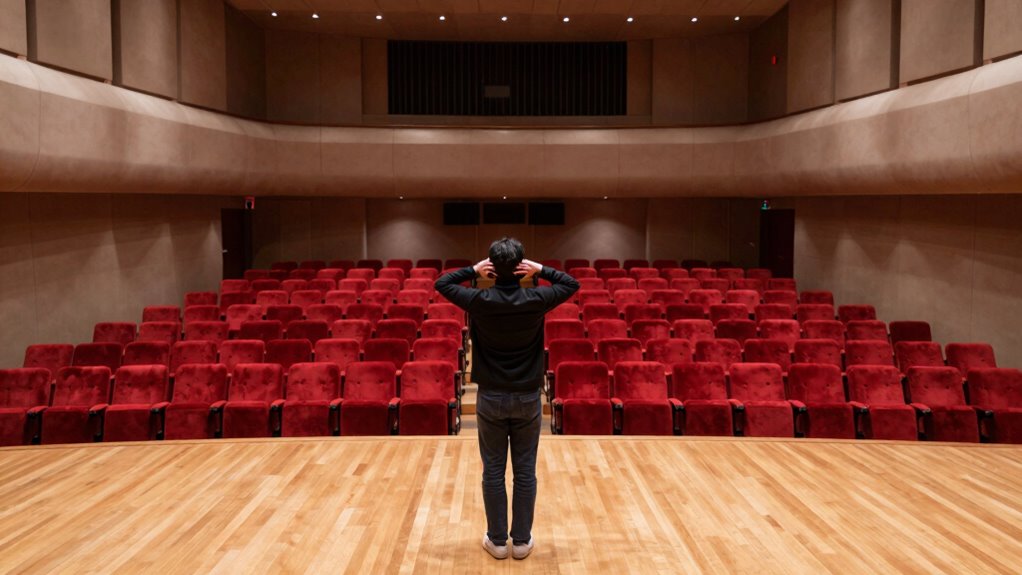
Your seating choice can greatly alter how you hear your room. By trying different spots, you’ll discover where the sound is clearest and most balanced. Finding the ideal listening position guarantees you get the best audio experience possible. Adjusting your placement can also help you optimize ventilation considerations and improve overall comfort.
Seating Impact on Sound
Seating position has a significant impact on how you perceive sound in a room. Your location relative to the speakers influences clarity and balance. To optimize your listening experience:
- Avoid sitting directly in line with speaker reflections to prevent echo or muddiness.
- Choose seats where speaker placement creates even sound distribution.
- Consider acoustic treatment, like panels or diffusers, around your seating area to reduce unwanted reflections.
- Test different positions to find spots with the best stereo image and minimal sound distortion.
Your seat’s placement affects how sound waves interact with the room, so experiment with different spots. Proper speaker placement and acoustic treatment enhance your listening experience, making your room sound clearer and more immersive.
Optimal Listening Positions
Choosing the right listening position can dramatically improve your audio experience, as different spots in the room influence how sound reaches your ears. To find the best spot, start by adjusting your speaker placement to minimize reflections and maximize direct sound. Your furniture arrangement also matters; avoid blocking speakers or creating acoustic dead zones with large furniture pieces. Sit at a position where sound waves combine smoothly, often around the room’s center or slightly off to the side of the main speaker. Experiment with different seating locations to identify where sound feels balanced and clear. Small shifts in your position can make a big difference, enhancing clarity, bass response, and overall sound quality. Proper positioning guarantees you hear your room’s acoustics at their best.
How to Recognize Room Modes and Resonances by Ear

Recognizing room modes and resonances by ear involves paying close attention to specific sound characteristics that reveal their presence. You’ll notice certain frequency anomalies that stand out, like boomy or muffled spots. To identify resonance, listen for these clues:
Notice boomy spots and lingering sounds to identify room resonances by ear.
- Sudden increases in volume at specific pitches
- Lingering or ringing sounds after notes stop
- Uneven sound distribution across the frequency spectrum
- Sharp dips or peaks when listening to sustained tones
- Developing an understanding of room acoustics can help you better interpret these sonic cues.
Focusing on these signs helps with resonance identification, revealing where your room’s acoustics distort sound. These anomalies often indicate problematic room modes. By tuning into these cues, you can better understand how your space affects sound quality and begin planning for effective room treatments.
Simple Fixes to Improve Your Room’s Acoustics
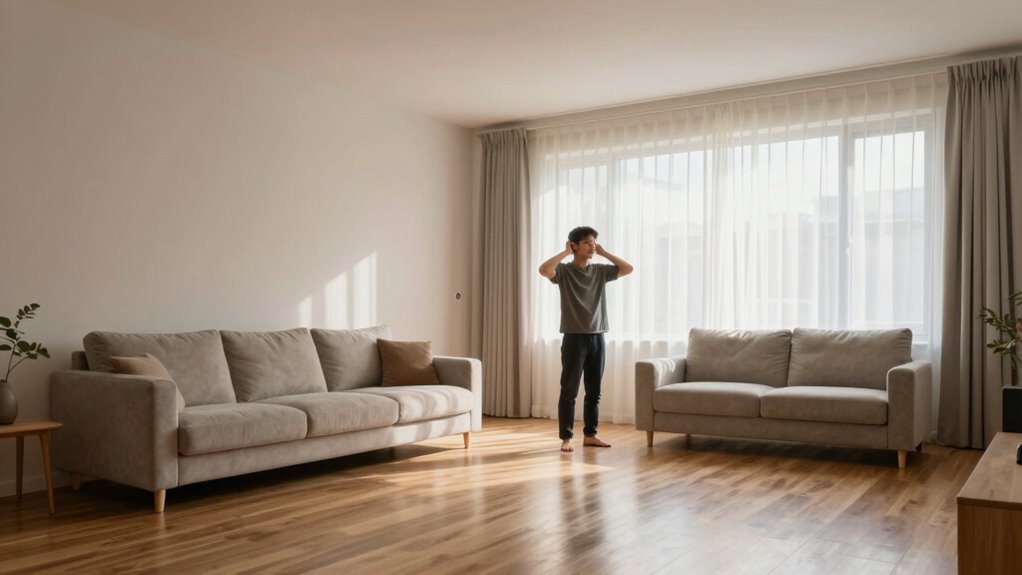
Improving your room’s acoustics doesn’t have to be complicated or expensive. Start with simple fixes like adjusting your speaker placement to reduce unwanted reflections and dead spots. Position your speakers so they form an equilateral triangle with your listening position, and avoid placing them too close to walls. Adding bass traps in corners helps absorb low-frequency resonances that cause muddiness and boominess. These traps minimize bass build-up, creating a clearer, more balanced sound. You don’t need professional equipment—just strategic placement and affordable acoustic treatments can make a big difference. Small adjustments like moving speakers or adding bass traps can dramatically improve your room’s sound quality, making your listening experience more accurate and enjoyable without breaking the bank. Proper speaker placement is essential for achieving optimal sound quality and reducing acoustic issues.
When to Seek Professional Help for Fine-Tuning Your Room

If you notice persistent acoustic problems despite your efforts, it might be time to get professional help. Complex room layouts or unique architectural features can make DIY fixes ineffective. When your high-end audio goals demand precise tuning, consulting an expert can make all the difference.
Persistent Acoustic Issues
Even after trying various adjustments, some acoustic issues persist and can’t be resolved with simple DIY fixes. If you notice persistent echo, uneven sound, or excessive noise leakage, it’s time to contemplate professional help. A soundproofing expert can evaluate your space and recommend effective solutions, such as advanced soundproofing techniques. Additionally, they can suggest decorative acoustic treatments that blend seamlessly with your decor while improving sound quality.
You should seek professional assistance if you observe:
- Unmanageable sound leakage despite basic fixes
- Persistent echo or resonance
- Inconsistent sound distribution
- Challenges in achieving desired acoustics despite adjustments
These issues often require specialized knowledge to resolve effectively.
Complex Room Architectures
When your room features complex architectural elements like irregular walls, high ceilings, or unusual shapes, achieving ideal acoustics becomes more challenging. The room shape can cause uneven sound distribution, making it harder to identify and correct issues. Furniture placement becomes critical in these spaces; strategic positioning can help break up sound reflections and reduce echoes. However, the intricate interplay of angles, surfaces, and heights often requires expert assessment to optimize. If you notice persistent dead spots or excessive reverberation despite adjustments, it’s time to seek professional help. An acoustician or room tuning specialist can analyze your unique space, recommend tailored solutions, and implement treatments that improve sound clarity and balance. Complex room architectures often demand expert intervention for the best listening experience.
High-End Audio Goals
Are your high-end audio goals being hindered by less-than-ideal room acoustics? If so, it’s time to contemplate professional help for fine-tuning. When to seek assistance? Look for signs like inconsistent soundstage, excessive bass resonance, or difficulty achieving clarity. Here are key areas to focus on:
- Optimizing speaker placement for even sound distribution.
- Installing bass trapping to control low-frequency buildup.
- Addressing reflective surfaces that cause echo or muddiness.
- Fine-tuning room dimensions and furniture placement for balance.
Professionals can evaluate these factors precisely, ensuring your room complements your high-end equipment. Proper speaker placement and bass trapping are essential steps toward achieving your audio goals and creating an immersive listening environment.
Frequently Asked Questions
How Can I Tell if My Room’s Sound Quality Is Truly Balanced?
You can tell if your room’s sound quality is balanced by listening carefully to how different sounds blend together. Consider the room size and wall materials—larger rooms or those with hard surfaces like concrete reflect sound, causing echoes. Soft materials like carpets and curtains absorb sound, creating a warmer tone. Use your ears to detect uneven echoes or dead spots, and adjust with acoustic treatments accordingly.
What Tools Besides My Ears Can Help Analyze Room Acoustics?
You can use tools like sound level meters and acoustic measurement software to analyze your room’s acoustics. Sound level meters measure decibel levels and identify problematic spots, while acoustic software provides detailed frequency response and reverberation time analysis. These tools give you objective data, helping you pinpoint issues and optimize your space for better sound quality. Combining your ears with these tools guarantees a more balanced and accurate assessment.
How Do Furniture and Decor Affect Room Sound?
Sure, your sofa and fancy curtains aren’t just for style—they’re secretly sound engineers. Wall treatments and decor can absorb, diffuse, or reflect sound, drastically changing your room’s acoustics. Heavy drapes tame echo, while plush furniture softens harsh reflections. Watch out for ceiling effects, too—high ceilings bounce sound wildly, making your audio sound like an opera in a cave. So, choose your furniture wisely; your ears will thank you.
Can DIY Fixes Significantly Improve My Room’s Acoustics?
Yes, DIY solutions can substantially improve your room’s acoustics. You can create acoustic furniture like soft, fabric-covered panels or even repurpose household items to absorb sound. Adding DIY diffusers or bass traps helps reduce echo and improve clarity. These affordable, creative fixes are easy to implement and make a noticeable difference in sound quality, creating a more balanced and pleasant listening or speaking environment.
What Signs Indicate I Need Professional Acoustic Treatment?
When your room feels more like a cave than a space for sound, it’s time to contemplate professional acoustic treatment. If visual inspection reveals persistent issues like uneven surfaces or materials that reflect sound, and you notice sound distortion or echoing that simple fixes can’t fix, those are strong signs. These clues tell you that expert intervention can restore clarity and balance, transforming your space into a true acoustic haven.
Conclusion
Think of your room like a musical instrument—if it’s out of tune, no matter how good your gear, the sound suffers. The clap test is just the first note; to truly hear your room’s personality, trust your ears and investigate further. By identifying issues and making simple tweaks, you can turn your space into a harmony of clear, balanced sound—like fine-tuning that instrument for perfect pitch.
Fall Picks
fall essentials
As an affiliate, we earn on qualifying purchases.