
Understanding where kick drums, bass, vocals, and guitars sit in the frequency spectrum helps you craft clearer mixes. Kick drums usually dwell around 60 to 100 Hz, providing punch, while bass instruments cover 40 to 250 Hz, ensuring they don’t clash. Vocals sit mainly between 300 Hz and 3 kHz for clarity, and guitars spread from 80 Hz up to 5 kHz. Learning these ranges lets you shape each element properly; exploring further reveals how to optimize your mix precisely.
Key Takeaways
- Kick drums primarily occupy 60-100 Hz, providing punch and weight, and should be EQ’d to avoid muddiness with bass.
- Bass instruments mainly sit between 40-250 Hz, requiring careful separation from kick and other low-end elements.
- Vocals typically range from 300 Hz to 3 kHz, where clarity and presence are achieved through EQ and effects.
- Guitars span 80 Hz to 5 kHz, with midrange (1-3 kHz) crucial for clarity, while higher harmonics add brightness.
- Balancing these ranges with proper EQ and filtering ensures a clear, cohesive, and professional mix.
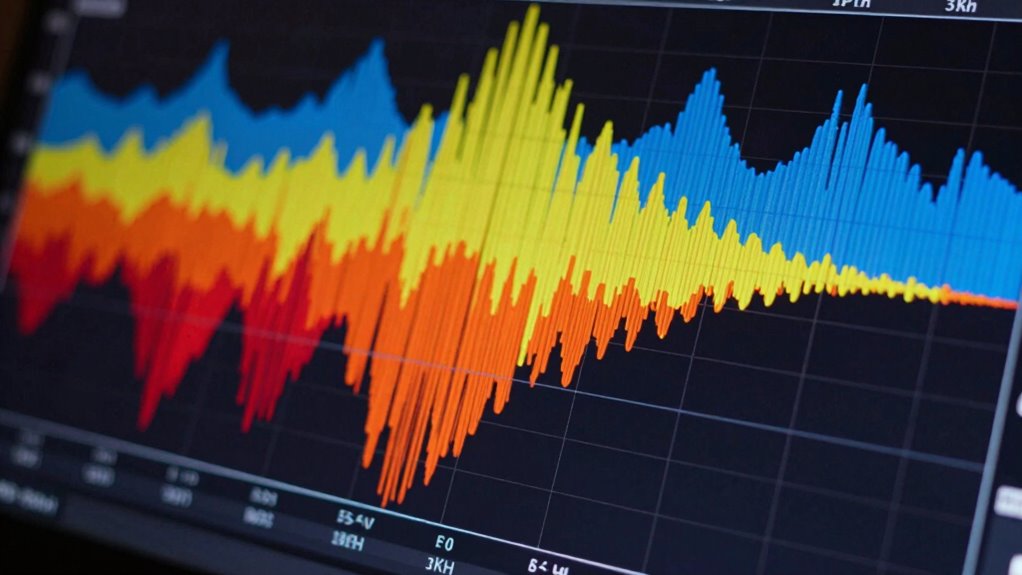
Have you ever wondered what distinguishes one sound from another? It all comes down to their frequency ranges. When you’re mixing music, understanding where each instrument and vocal sits in the frequency spectrum helps you carve out space and create a balanced, clear mix. Effects processing plays a big role here, allowing you to enhance or tame specific frequency bands, but knowing where those bands live is essential. Mixing techniques rely heavily on this knowledge to prevent muddiness and guarantee each element shines through.
Kick drums, for example, usually occupy the lower end of the spectrum, typically between 60 and 100 Hz. This range gives the kick its punch and weight. When mixing, you might focus on boosting or cutting frequencies within this range to add more thump or reduce boominess. Bass instruments, like electric bass or synth bass, also sit in the low frequencies but often extend slightly higher, around 40 to 250 Hz. Separating the kick from the bass in this range is vital; otherwise, they can clash and create a muddy sound. Careful EQing and filtering help define each element, making the rhythm section tight and controlled.
Vocal ranges tend to be more mid-focused, generally spanning from about 300 Hz to 3 kHz. This is where the clarity and presence of vocals are most prominent. When mixing vocals, effects processing—such as EQ, compression, and reverbs—are key tools. EQ can cut unnecessary low-end rumble or harsh high frequencies, while compression smooths out dynamics to keep vocals consistent. Reverb and delay add space, but only when applied thoughtfully, so the vocals sit well without overwhelming other elements. Proper mixing techniques guarantee vocals cut through the mix without overpowering instruments.
Guitars have a broader range depending on the type—electric, acoustic, or bass guitar—but typically sit between 80 Hz and 5 kHz. Clean electric guitars often occupy the midrange, around 1 to 3 kHz, giving them clarity and presence. Distorted guitars spread across a wide spectrum, with their fundamental frequencies around 80 to 200 Hz and harmonics reaching higher. Effects processing like distortion, modulation, or delay can shape guitar sounds dramatically, but understanding their frequency placement helps you avoid masking other instruments. EQ and filtering help carve out space for guitars, making sure they sound full but not overpowering. Additionally, understanding the frequency ranges of different instruments can help you achieve a more cohesive mix.
In the end, knowing where each sound lives in the frequency spectrum empowers you to apply mixing techniques effectively. It’s about balancing the elements, using effects processing wisely, and creating space that allows every instrument and vocal to shine. When you master these concepts, your mixes become clearer, more dynamic, and more professional.
Frequently Asked Questions
How Do Different Genres Utilize Frequency Ranges Uniquely?
Different genres utilize frequency ranges uniquely through genre-specific sound design and cultural frequency preferences. For instance, EDM emphasizes deep bass frequencies to create a danceable groove, while jazz highlights mid-range vocals and instruments for warmth. Hip-hop may focus on punchy kicks and bass, reflecting cultural tastes. You’ll notice these choices shape each genre’s signature sound, making the emotional and cultural connection clear through distinct frequency use.
Can EQ Adjustments Alter Perceived Frequency Ranges?
Yes, EQ adjustments can change how you perceive frequency ranges. By using EQ tricks like boosting or cutting specific bands, you can emphasize or de-emphasize certain sounds. However, be cautious of frequency masking, where overlapping sounds compete in the same range, making them less clear. Properly applying EQ helps you carve out space for each instrument, enhancing clarity and making your mix sound more balanced.
What Equipment Best Identifies Specific Frequency Ranges?
You can identify specific frequency ranges best with accurate equipment like a high-quality spectrum analyzer or a professional EQ. Some might think cheaper gear suffices, but the audio spectrum’s nuances demand equipment accuracy to pinpoint sounds precisely. Invest in a reliable analyzer, and you’ll gain clear insights into where kick, bass, vocals, and guitars sit, making your mixing decisions much more effective and precise.
How Do Room Acoustics Affect Frequency Perception?
Room acoustics greatly influence your perception of frequencies. If your room has excessive resonance, it can boost certain frequencies, making sounds seem harsh or boomy. Acoustic treatment helps control this by absorbing or diffusing problematic resonances, giving you a clearer, more accurate sound. By managing room resonance effectively, you guarantee your monitoring reflects true frequency ranges, making mixing and editing more precise and reliable.
Are There Any Health Risks Associated With Specific Frequencies?
Yes, certain frequencies can pose health risks if you’re exposed to them at high volumes. Hearing damage and tinnitus risk increase with prolonged exposure to loud sounds, especially in the high-frequency range. To protect yourself, avoid listening at maximum volume for extended periods and use ear protection in noisy environments. Regular breaks and maintaining safe volume levels help reduce the chances of long-term hearing issues.
Conclusion
Now that you understand where kick drums, bass, vocals, and guitars sit in the frequency spectrum, you can shape your mixes more effectively. Imagine you’re mixing a song where the bass and kick clash in the low end; by knowing their ranges, you can carve out space for both to shine. With this knowledge, you’ll craft clearer, punchier mixes—like a chef perfectly balancing flavors—making your music resonate exactly as you envision.