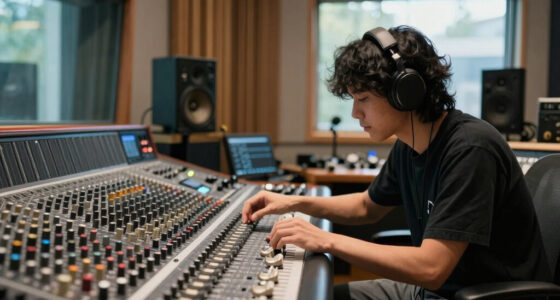
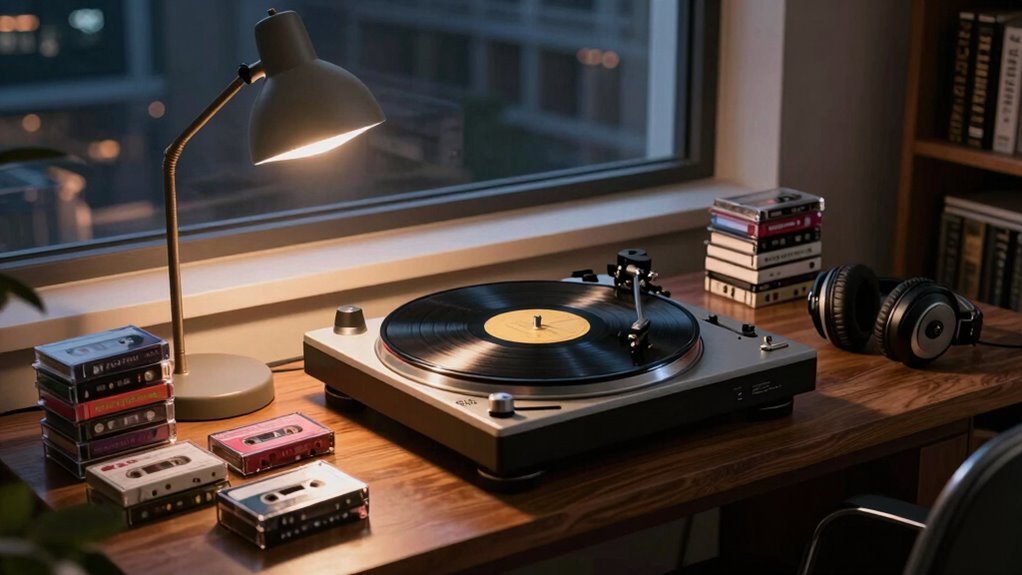

To build a better music test playlist for serious listening, select high-fidelity recordings from different genres that highlight clarity, dynamic range, and textures. Mix complex and simple tracks to evaluate your equipment’s performance across various sound signatures. Prioritize well-produced, uncompressed tracks from reputable sources and include high-resolution files for added detail. Vary track order, length, and style to keep your listening engaging and thorough. Keep exploring, and you’ll discover how to fine-tune your setup even further.

Get audio and creator gear delivered free — and shop member deals
- Fast, free delivery on millions of items
- Access to Prime Big Deal Days deals on October 6–7
- Prime Video, Amazon Music and more included
Key Takeaways
- Select high-fidelity, well-produced tracks across various genres to reveal different aspects of your audio equipment.
- Incorporate high-resolution files and diverse sonic textures to challenge playback capabilities and preserve detail.
- Balance complex arrangements with simple recordings to evaluate system handling and clarity across sound signatures.
- Arrange tracks to maintain engagement, mixing tempos and styles to prevent fatigue during critical listening.
- Prioritize reputable sources and avoid overly processed recordings for accurate, transparent sound evaluation.

Creating a music test playlist that truly enhances your serious listening sessions requires more than just selecting your favorite tracks. To get the most out of your experience, you need to focus on building a curated collection that challenges your equipment and sharpens your auditory perception. The foundation of a good playlist is audio fidelity—choosing recordings that are clean, detailed, and true to the original sound. High-quality recordings reveal the nuances in music, from subtle instrument textures to delicate vocal inflections. When you prioritize audio fidelity, you’re better equipped to identify issues like distortion, compression, or background noise, which are vital when testing audio gear or optimizing your listening setup.
Prioritize high-quality recordings to uncover subtle details and accurately assess your audio system’s performance.
But audio fidelity shouldn’t be the only consideration. Incorporating genre diversity ensures your playlist covers a broad spectrum of sonic characteristics. Different genres emphasize different elements—classical music often highlights clarity and dynamic range, jazz may focus on instrument separation and improvisation, while electronic music can push bass response and spatial effects. By mixing genres, you expose your system to a variety of sound profiles, helping you detect weaknesses or strengths across different types of music. This diversity not only prevents your listening sessions from becoming monotonous but also guarantees your equipment can handle a wide array of audio signals, making your testing more thorough.
When selecting tracks, aim for recordings that are well-produced and mastered, preferably from reputable labels or sources known for high standards. Avoid overly compressed or heavily processed tracks, as they can mask what your gear truly sounds like. Instead, choose recordings with transparent sound quality—these will reveal how well your system reproduces the subtle details and dynamic range of each track. Don’t shy away from exploring different eras and styles; older recordings often have a richness and depth that modern digital files sometimes lack, while contemporary tracks can showcase the latest in recording technology. Paying attention to audio fidelity in your playlist ensures you are testing your system with the most revealing material possible, making your evaluations more accurate and meaningful. Additionally, selecting tracks with varying sonic textures can further challenge your gear and provide a more comprehensive assessment.
Furthermore, paying attention to the resolution of digital files can significantly impact how well your system performs during testing, as higher-resolution formats preserve more detail and nuance. Lastly, consider the length and flow of your playlist. Mix up the order to prevent fatigue and to test how your system handles transitions between different sound signatures. Include some tracks with complex arrangements and others that are simple and intimate. This variety will help you develop a more nuanced understanding of your gear’s performance. With a well-balanced playlist emphasizing audio fidelity and genre diversity, you’ll be better prepared to fine-tune your audio setup and truly enjoy the depth and detail of your music.
As an affiliate, we earn on qualifying purchases.
Frequently Asked Questions
What Genres Are Best for a Test Playlist?
For a test playlist, you should include diverse genres like classical, jazz, rock, and electronic to guarantee genre diversity. This variety helps you evaluate sound quality across different styles, revealing how well your equipment handles various textures and frequencies. By mixing genres, you challenge your listening skills and get an all-encompassing sense of your gear’s performance, making your playlist more effective for serious listening tests.
How Long Should a Test Playlist Be?
Your test playlist should be about 1 to 2 hours long—long enough to truly gauge your audio calibration but short enough to keep your focus sharp. Think of it as a curated journey through sound. Too short, and you miss details; too long, and fatigue kicks in. This ideal length ensures you accurately assess your system’s capabilities while maintaining an engaging flow, perfect for precise playlist curation.
Should I Include New or Familiar Songs?
You should include a mix of both new and familiar songs in your playlist. Familiar songs help you assess volume consistency and overall sound quality because you already know how they should sound. Adding new tracks challenges your ears and improves your listening skills. Balance these two types to get an accurate sense of your audio setup’s performance, ensuring you’re not biased by song familiarity or inconsistent volume levels.
How Often Should I Update My Playlist?
You should update your playlist every 4 to 6 weeks to keep your listening environment fresh and engaging. Research shows that our brains adapt to familiar music, reducing listening pleasure over time. Incorporate music theory principles to select tracks that challenge your ears and deepen your appreciation. Regular updates guarantee your playlist remains a dynamic tool for serious listening, preventing stagnation and helping you discover new nuances in your favorite songs.
What Equipment Is Ideal for Critical Listening?
For critical listening, you need well-calibrated audio equipment. Use speakers that you can position accurately, ensuring ideal speaker positioning for balanced sound. Invest in audio calibration tools to fine-tune your setup, eliminating distortions and inaccuracies. A good pair of studio monitors or high-quality headphones also helps. Keep your environment acoustically treated, so your equipment performs at its best, providing a true representation of the music for serious listening.
As an affiliate, we earn on qualifying purchases.
Conclusion
Creating a refined music test playlist enhances your listening experience and sound evaluation skills. Keep experimenting with diverse genres and high-quality recordings to truly understand your audio setup. Did you know that a study found audiophiles who test their systems regularly report 30% more satisfaction with their sound? So, stay curious, keep refining your playlist, and enjoy discovering new details in your favorite tracks—your ears will thank you for it.
As an affiliate, we earn on qualifying purchases.
As an affiliate, we earn on qualifying purchases.
Halloween Picks
halloween
As an affiliate, we earn on qualifying purchases.