
To choose the right amplifier for your speakers and room, match the speaker’s impedance, usually 8 ohms, with the amp’s compatibility to prevent damage. Make certain the amplifier’s power output fits your speakers’ recommended wattage, and consider your room size—larger spaces need more power for clear sound. Pay attention to listening habits and environment, adjusting power and volume accordingly. If you want to learn how to make the best match, keep exploring these important factors.

Get audio and creator gear delivered free with Prime
- Fast, free delivery on millions of items
- Prime Video, Amazon Music and more included
- Member-only deals all year
Key Takeaways
- Match the amplifier’s power output to your speaker’s recommended wattage range to avoid under or overpowering.
- Ensure the amplifier’s impedance rating (ohms) is compatible with your speaker’s impedance.
- Consider room size and acoustics to determine necessary power and volume capacity.
- Evaluate your listening habits—higher volumes require amplifiers with sufficient headroom.
- Verify manufacturer specifications for safe and optimal matching of amplifier and speakers.
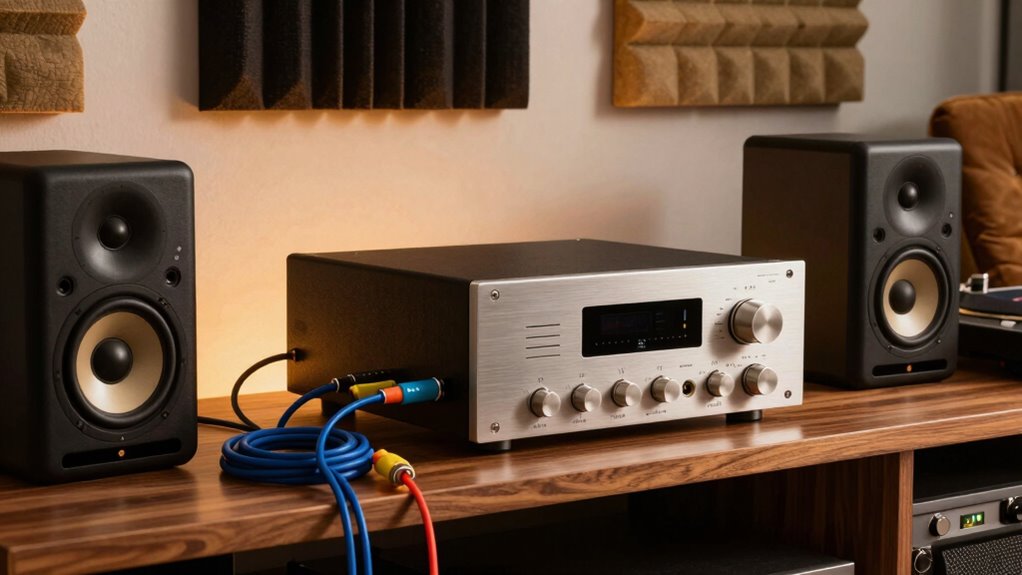
Are you unsure how to pick the right amplifier for your audio setup? The key lies in understanding a few essential concepts, especially speaker impedance and amplifier power ratings. When selecting an amplifier, you want to ensure it matches well with your speakers’ impedance, which is usually measured in ohms. Most home speakers are rated at 8 ohms, but some may be 4 ohms or even 6 ohms. If you choose an amplifier that’s not compatible with your speaker impedance, you risk either underpowering your speakers or damaging them. An amplifier designed for 8-ohm speakers can often handle 6-ohm loads, but it’s safer to verify the manufacturer’s specifications. You also need to consider amplifier compatibility**** to prevent potential issues. You don’t want an amplifier that’s too powerful or too weak; instead, look for one that can comfortably handle your speakers’ impedance without strain.
Next, consider amplifier power ratings, which tell you how much power the amplifier can deliver to your speakers. Power ratings are usually expressed in watts per channel, and it’s important to match these ratings to your speakers’ recommended power range. If your speakers are rated for 50 to 100 watts, you’ll want an amplifier that can deliver within that range, so you get enough volume without risking damage or distortion. An underpowered amplifier will struggle to reach higher volumes and may produce distortion, while an overly powerful one can push your speakers beyond their limits, potentially causing damage. The goal is to find a balance where the amplifier provides enough clean power to fill your room without overwhelming your speakers.
Additionally, room acoustics can influence how much power you need, as different environments affect sound distribution and clarity. Room size also plays a significant role in choosing the right amplifier. A small room might not require as much power, so a less powerful amplifier can do the job well. Conversely, larger rooms need more headroom, meaning you should pick an amplifier with higher power ratings to ensure sound fills the space evenly. Additionally, consider your listening habits—if you enjoy listening at high volumes often, lean toward an amplifier with higher power ratings to accommodate that without distortion. Always check the specifications for both speaker impedance and power ratings to ensure compatibility. An ideal match ensures you get clear, dynamic sound without risking damage to your equipment.
As an affiliate, we earn on qualifying purchases.
Frequently Asked Questions
Can I Connect Multiple Speakers to One Amplifier?
Yes, you can connect multiple speakers to one amplifier, but you need to ensure speaker placement and power distribution. Make sure the total impedance matches your amplifier’s output to avoid overloads. Proper speaker placement ensures even sound distribution, while balanced power distribution prevents damage. Use appropriate wiring configurations, like daisy chaining or using a speaker selector, to safely connect multiple speakers and optimize your listening experience.
How Do I Match Impedance Between Amplifier and Speakers?
Matching impedance between your amplifier and speakers is like tuning a perfect duet, ensuring harmony and clarity. You check your speakers’ impedance, usually marked in ohms, and confirm your amplifier’s compatible impedance range. Adjust amplifier gain if needed to match speaker sensitivity, avoiding distortion or damage. Think of it as balancing volume and tone—when impedance aligns, your sound stays smooth, powerful, and true to your music.
Is a Higher Wattage Amplifier Always Better?
A higher wattage amplifier isn’t always better; it depends on your speakers’ power handling and room size. If your speakers can’t handle the extra power, you risk distortion levels and potential damage. For smaller rooms or less efficient speakers, a lower wattage amp may perform better, providing clean sound without distortion. Always match the amplifier’s wattage with your speakers’ capacity to guarantee ideal sound quality and avoid damage.
What Features Should I Look for in a Home Theater Amplifier?
Did you know that 80% of sound quality depends on speaker placement and acoustic treatment? When choosing a home theater amplifier, look for features like multiple HDMI inputs, a good power output, and room calibration tools. These help optimize sound. Also, consider options for speaker calibration and room EQ, which guarantee your setup sounds balanced, even if your speaker placement isn’t perfect.
How Does Room Acoustics Affect Amplifier Selection?
Room acoustics profoundly influence your amplifier choice. In a larger space, you need an amplifier with more power to fill the room without distortion. If your room has poor acoustics, consider investing in acoustic treatment like panels or diffusers to improve sound quality. Proper acoustic treatment enhances the amplifier’s effectiveness, ensuring clear, balanced audio. Matching your amplifier’s power with your room size and acoustics creates a more immersive listening experience.
As an affiliate, we earn on qualifying purchases.
Conclusion
Remember, a chain is only as strong as its weakest link. When choosing an amplifier, make sure it matches your speakers’ power and your room’s acoustics to get the best sound. Don’t rush the process—take your time to research and test. With the right amplifier in place, you’ll enjoy rich, clear audio that transforms your space. After all, good things come to those who wait—and listen carefully.
As an affiliate, we earn on qualifying purchases.
As an affiliate, we earn on qualifying purchases.
Halloween Picks
halloween
As an affiliate, we earn on qualifying purchases.