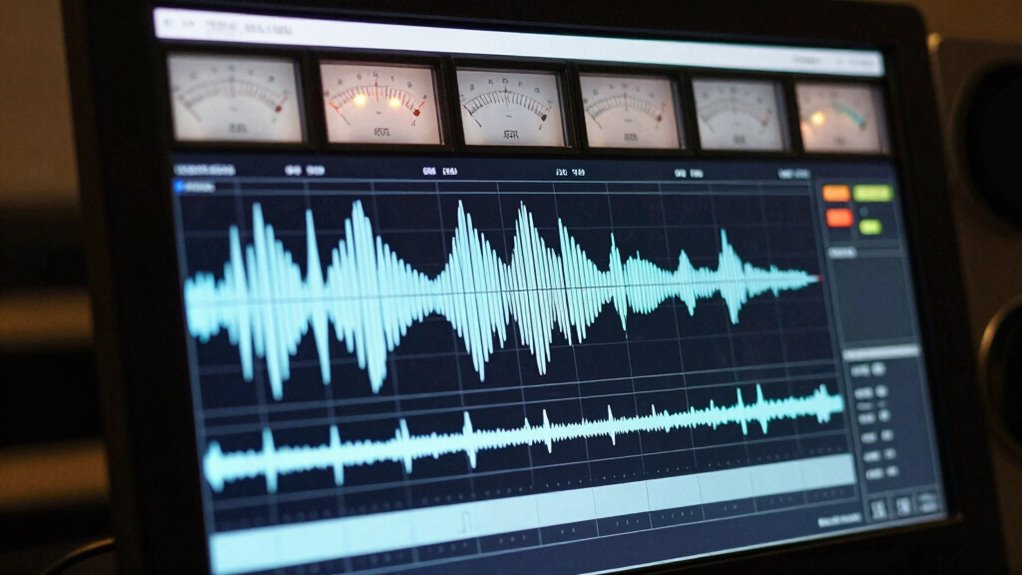
To spot compression problems without sounding overly critical, listen for sounds that feel dull, flat, and lifeless. Pay attention to unnatural uniformity and a lack of contrast between quiet and loud parts. If the audio feels overly squashed or makes everything sound the same, the compressor might be working too hard. Recognizing artifacts like metallic or hollow sounds is a good indicator too. Keep exploring, and you’ll find even more subtle signs of compression issues.

Get audio and creator gear delivered free with Prime
- Fast, free delivery on millions of items
- Prime Video, Amazon Music and more included
- Member-only deals all year
Key Takeaways
- Listen for a dull, lifeless sound lacking variation and punch in the audio.
- Notice if the music or vocals feel overly uniform and lack natural dynamics.
- Be alert to metallic, hollow, or distorted sounds indicating over-compression.
- Check for muffled or dull sections, especially during loud or transitional parts.
- Develop an understanding of basic compression effects to recognize when it’s used excessively.

Have you ever noticed your engine running rough or losing power? When it comes to audio, a similar thing can happen if compression isn’t handled properly. One of the key signs of compression problems is a reduced dynamic range. Think of dynamic range as the distance between the quietest and loudest parts of your audio. When compression is overdone, this range shrinks, making everything sound overly uniform and flat. Instead of feeling lively and natural, your audio becomes dull and lifeless, lacking the punch that makes music and vocals engaging.
Over-compression shrinks the dynamic range, making audio sound dull, flat, and lifeless instead of lively and natural.
You might also start to notice strange audio artifacts—those unpleasant, sometimes metallic or hollow sounds that pop up when compression gets out of control. These artifacts can manifest as a kind of distortion or muddiness, often lurking in the background but becoming painfully obvious when you listen closely. They’re a clear sign that the compressor is working too hard or that it’s set incorrectly. If your audio sounds “squashed” or overly compressed, it’s probably because the compressor has reduced the dynamic range too much, causing these unwanted artifacts to emerge. Paying attention to how compression impacts the overall sound can help you develop an intuitive sense for when it’s being used effectively versus excessively.
To spot these issues without sounding like an audio snob, pay attention to how your audio feels and sounds. Does it sound consistently loud and lacking variation? Are there moments where the music or vocals seem unnaturally uniform? These are clues that the compressor might be overdoing it. Listening critically but without obsessing over technical jargon can help you develop an ear for imbalance.
Another quick check is to listen for audio artifacts—distortions or strange noises—especially during louder sections or transitions. These are often signs that the compressor is pushing the audio too far, causing unwanted side effects. If you notice a loss of clarity or a “muffled” quality, it might be due to compression issues. Additionally, understanding audio compression fundamentals can help you better identify when it’s being used effectively versus excessively.
audio compressor for music production
As an affiliate, we earn on qualifying purchases.
As an affiliate, we earn on qualifying purchases.
Frequently Asked Questions
Can Compression Issues Affect All Music Genres Equally?
Compression issues don’t affect all music genres equally. Genre-specific dynamics influence how compression impacts a track, making some genres more sensitive to over-compression. For example, pop music may rely heavily on compression for a polished sound, while jazz emphasizes natural dynamics. Don’t fall for compression myths that suggest universal settings; instead, tailor your approach to suit each genre’s unique nuances and maintain the musical integrity.
What Are Common Signs of Over-Compressed Vocals?
Over-compressed vocals often lose their natural dynamic range, making them sound flat and lifeless. Common signs include a lack of audio clarity, where the vocals feel squashed and dull, and an overly consistent volume level that eliminates natural variations. Did you know that studies show listeners find over-compressed tracks less engaging? To avoid this, make sure your vocals retain some dynamic range, preserving clarity and emotional impact without sounding overly processed.
How Does Room Acoustics Influence Perceived Compression Problems?
Room acoustics greatly influence how you perceive compression issues. Poor room treatment can exaggerate or mask compression artifacts, making vocals sound overly dull or harsh. When your space lacks proper acoustic treatment, reflections and standing waves distort the sound, leading you to mistake natural room resonances for compression problems. To accurately judge compression, improve your room acoustics with appropriate treatment, creating a more honest listening environment and reducing false perceptions.
Are Some Audio Players Better at Revealing Compression Issues?
Some audio players are like eagle-eyed detectives, better at revealing compression issues. They accurately showcase dynamic range and highlight compression artifacts, making flaws obvious. Higher-end or specialized players tend to preserve nuances and expose subtle problems that cheaper ones might hide. If you want to detect compression problems without missing a beat, choose a player known for transparency and detailed sound reproduction. This way, you catch every compression artifact hiding in your tracks.
Can Early Detection Prevent Long-Term Audio Quality Degradation?
Yes, early detection can prevent long-term audio quality degradation. By noticing issues with dynamic range and listening fatigue early on, you can adjust your settings or source material before they worsen. This proactive approach helps maintain clarity and prevents your ears from becoming strained over time. Regularly listening critically guarantees you catch compression problems early, preserving both sound quality and your listening comfort.
As an affiliate, we earn on qualifying purchases.
Conclusion
Now that you know what to listen for, you can spot compression issues like a detective in a crowded room. Imagine your ears as a finely tuned instrument, catching subtle nuances and faint whispers of distortion or squashed dynamics. With practice, you’ll navigate the audio landscape confidently, avoiding the trap of becoming an audio snob. Instead, you’ll enjoy clear, balanced sound that feels natural—like a gentle breeze rather than a gust that overwhelms everything in its path.
As an affiliate, we earn on qualifying purchases.
As an affiliate, we earn on qualifying purchases.
Halloween Picks
halloween
As an affiliate, we earn on qualifying purchases.