
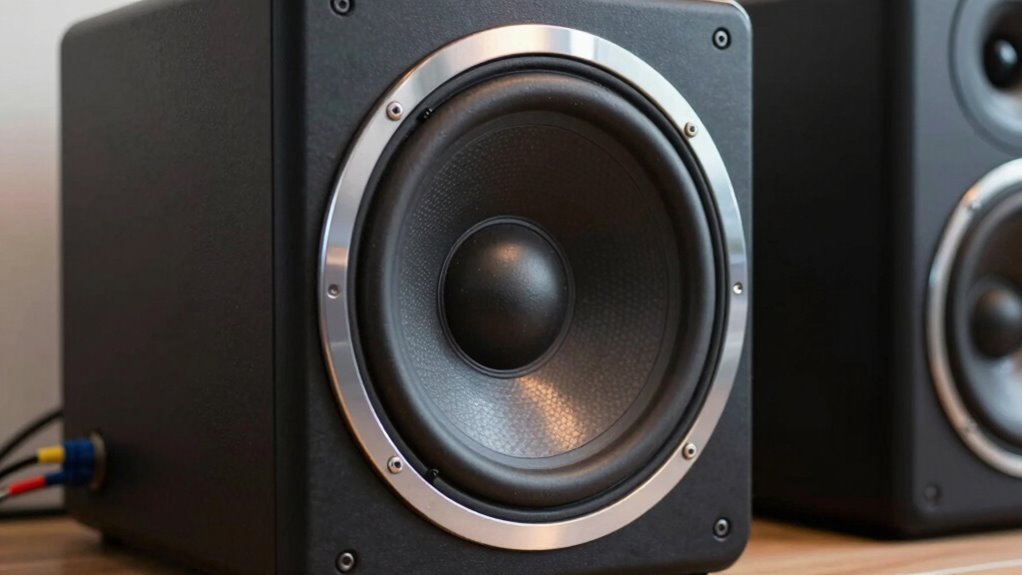

To get the best bass from your stereo setup, start by placing your subwoofer near a wall or corner for more impactful low frequencies. Experiment with different spots to find the tightest, most balanced sound. Adjust the crossover settings so it blends smoothly with your main speakers—around 80-120Hz is usually good. Fine-tuning room acoustics and calibration helps achieve clear, powerful bass. Keep exploring to discover how to optimize your system even further.

Get audio and creator gear delivered free with Prime
- Fast, free delivery on millions of items
- Prime Video, Amazon Music and more included
- Member-only deals all year
Key Takeaways
- Place the subwoofer near walls or corners to enhance bass without causing muddiness.
- Adjust crossover settings (typically 80-120Hz) for seamless integration with main stereo speakers.
- Experiment with subwoofer placement to find the tightest, most balanced bass response.
- Use calibration tools to fine-tune the subwoofer for a clear, immersive sound experience.
- Consider room acoustics and furniture placement to optimize sound reflection and reduce resonance.
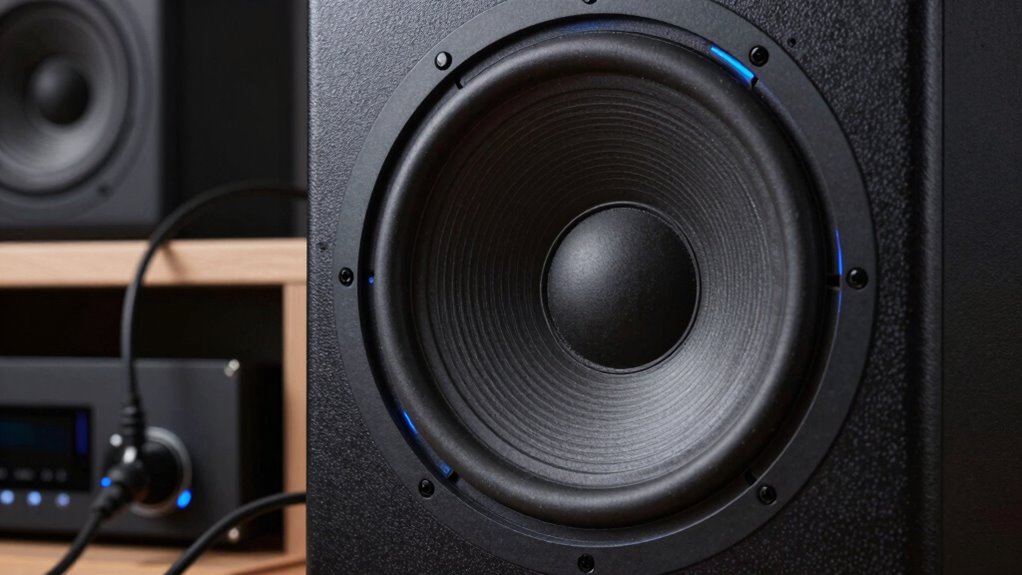
Have you ever wondered how to get deeper, richer sound from your music system? The secret often lies in understanding how your subwoofer works and how to set it up properly. One of the most critical aspects is woofer placement. Where you position your subwoofer can dramatically influence the bass quality. Ideally, you want to place your woofer near a wall or corner, as this can amplify low frequencies and create a fuller sound. But avoid placing it directly in a corner if it causes boomy or boisterous bass, which can muddy your overall audio. Experimentation is key—try different spots within your room to find the position that delivers the tightest, most balanced bass response. Keep in mind that your room’s shape and furniture placement also affect how sound waves bounce and resonate, so minor adjustments can make a big difference. Proper woofer placement is essential for achieving optimal sound quality and ensuring your bass is both powerful and precise. Additionally, understanding the room acoustics can help you make more informed placement choices to enhance sound clarity and acoustic treatment. Recognizing how sound waves interact with your space can lead to even better audio performance. Another essential factor in achieving best bass is setting your crossover properly. Your crossover settings determine how your subwoofer blends with your main speakers. You want the changeover to sound seamless, with no gaps or overlapping frequencies. If your crossover is set too high, your subwoofer might be handling frequencies better suited for your main speakers, leading to muddiness. Set it too low, and you’ll miss out on the deep bass that gives music its impact. Typically, a crossover point between 80Hz and 120Hz works well for most stereo setups, but you’ll want to adjust based on your specific speakers and listening preferences. Use your receiver or amplifier’s settings to fine-tune this crossover, and listen carefully to how the bass integrates with the rest of your sound. Keep in mind that subwoofer calibration plays a crucial role in achieving a balanced and immersive listening experience, especially when combined with proper placement and crossover adjustments.
As an affiliate, we earn on qualifying purchases.
Frequently Asked Questions
How Do I Choose the Right Subwoofer Size for My Room?
To pick the right subwoofer size for your room, consider its dimensions and your listening preferences. Larger rooms benefit from bigger subwoofers, which deliver deeper bass. Look for subwoofers with quality materials like sturdy woofers and durable enclosures. Subwoofer customization options, such as adjustable crossover and volume controls, help tailor the sound. Matching the subwoofer size to your room guarantees balanced bass, enhancing your overall listening experience.
Can I Connect Multiple Subwoofers to My Stereo System?
Yes, you can connect multiple subwoofers to your stereo system. For example, if you have two subwoofers, you’ll need to wire them properly using subwoofer wiring methods like parallel or series, ensuring impedance stays within your amplifier’s limits. Adjust each subwoofer’s crossover to blend smoothly with your main speakers. Proper setup guarantees balanced bass and prevents distortion, delivering a richer, more immersive listening experience.
What Is the Ideal Placement for a Subwoofer in a Room?
Place your subwoofer near a wall or corner to enhance bass response, but avoid placing it directly against the wall for better room acoustics. Experiment with different spots to find the smoothest, most balanced sound. Also, consider its subwoofer aesthetics; select a position that complements your room’s decor. Keep in mind that slight adjustments can make a big difference in overall sound quality and visual harmony.
How Do I Calibrate My Subwoofer for Optimal Sound?
To calibrate your subwoofer for ideal sound, start by adjusting the subwoofer frequency response to match your room and listening preferences. Set the crossover so it smoothly blends with your main speakers; typically, around 80 Hz works well. Use a calibration microphone or your receiver’s auto-calibration feature if available, and fine-tune the volume until the bass feels balanced and clear without overpowering the rest of your music.
Do I Need a Separate Amplifier for My Subwoofer?
Think of your subwoofer as a muscle needing a power boost. Generally, you don’t need a separate amplifier if your receiver’s built-in power can handle it. Proper subwoofer wiring is essential for clear sound, and regular subwoofer maintenance guarantees it stays in top shape. If your subwoofer demands more power, an external amplifier can give it the extra strength it needs to shake the room effectively.
best subwoofer placement for stereo system
As an affiliate, we earn on qualifying purchases.
As an affiliate, we earn on qualifying purchases.
Conclusion
In the world of stereo setups, a subwoofer can be your subtle secret to richer, fuller sound. While it might seem like just a boost in bass, it’s really about creating an environment where every note feels alive. When you choose to embrace this addition, you’re not just upgrading your system—you’re opening a door to a deeper connection with your music. Sometimes, the smallest change can lead to the most profound listening experience.
subwoofer crossover settings for music
As an affiliate, we earn on qualifying purchases.
As an affiliate, we earn on qualifying purchases.
room acoustics treatment for better bass
As an affiliate, we earn on qualifying purchases.
As an affiliate, we earn on qualifying purchases.
Halloween Picks
halloween
As an affiliate, we earn on qualifying purchases.