When you experience live music, you feel its bigger, more powerful sound because of the natural acoustics, crowd energy, and spontaneous interactions. The venue’s design enhances sound with reverberations and reflections, making everything seem larger and more immersive. Audience reactions and physical vibrations add a raw, visceral quality that studio recordings lack. If you want to understand how these elements combine to create that larger-than-life feeling, keep exploring the details behind live music’s unique impact.

Get audio and creator gear delivered free with Prime
- Fast, free delivery on millions of items
- Prime Video, Amazon Music and more included
- Member-only deals all year
Key Takeaways
- Live performances leverage natural acoustics and venue design to create a sense of grandeur and spatial depth.
- Audience reactions and collective energy amplify the emotional impact and perceived loudness.
- Spontaneity, physicality, and instrument vibrations add raw, visceral intensity absent in polished studio recordings.
- Reverberations and reflections in live venues enhance sound size and richness.
- The immersive environment and shared experience make live music feel larger and more dynamic than studio recordings.
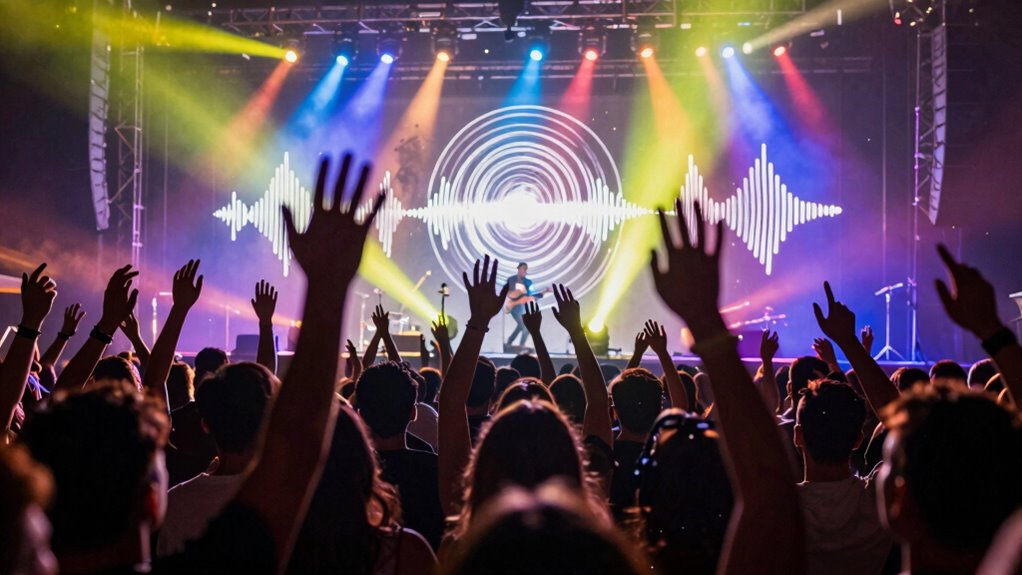
Whether you prefer the raw energy of a live performance or the polished perfection of studio recordings, both forms of music offer unique experiences. When you attend a concert, you’re immersed in an environment where audience engagement transforms the soundscape. The collective energy of the crowd, the ambient noise, and the spontaneous interactions between performers and listeners all contribute to a sense that the music is bigger and more alive. This communal atmosphere amplifies your emotional connection, making the sound feel larger than life. In contrast, studio recordings are crafted meticulously, with every detail controlled and refined. While they may have a pristine clarity, they often lack the palpable energy that live environments generate.
Live music captures raw energy and spontaneity, creating an immersive, emotionally powerful experience that recordings can’t fully replicate.
The acoustic environment plays an essential role in why live music sounds so expansive. Venues are designed to fill spaces with sound, leveraging natural reverberations and reflections that enrich the overall experience. The walls, ceilings, and even the audience themselves act as acoustic enhancers, creating a fuller, more immersive sound. When you’re in a concert hall or open-air arena, the natural acoustics work with the live performance to produce a sense of grandeur that’s difficult to replicate in a studio. Studio recordings, on the other hand, are captured in controlled environments where sound is carefully isolated and edited. While this allows for precision, it often results in a flatter, less dynamic sound compared to the vibrant chaos of a live setting.
Another reason live music feels bigger is the spontaneity and physicality of the performance. You can sense the vibrations of the instruments and the raw emotion in the performers’ movements. This physicality, coupled with audience reactions—cheers, claps, and sing-alongs—creates a feedback loop that magnifies the impact. It’s not just about hearing the music; it’s about feeling it pulsate through the space. Studio recordings tend to lack this immediacy, as they are polished and sometimes over-produced, which can diminish the visceral experience. Additionally, the acoustic environment of a live venue enhances the overall perception of sound size and energy, making the experience more impactful. The way sound interacts with the environment can amplify certain frequencies, adding to the perceived size of the sound, and this is often influenced by the acoustic characteristics of the venue.
In the end, what you’re really hearing in a live setting is a complex blend of sound, space, and collective energy. The acoustic environment and audience interaction make the music feel larger because they add layers of depth and emotion that recordings, no matter how technically perfect, can’t fully replicate. That’s why live music resonates so powerfully—it’s an experience rooted in the moment, in the environment, and in the shared energy of everyone present.
As an affiliate, we earn on qualifying purchases.
Frequently Asked Questions
How Do Acoustics Affect Live Music Sound Quality?
Acoustics greatly influence your live music experience by affecting sound quality through room resonances and sound diffusion. When room resonances are well-managed, they prevent muddiness, keeping sound clear and full. Sound diffusion evenly distributes sound waves, creating a richer, immersive experience. If these elements are poorly controlled, the music can sound distorted or dull. Good acoustics enhance clarity, warmth, and the overall size of the sound, making live performances feel more alive and dynamic.
Can Live Music Recordings Be Accurately Recreated in Studios?
You can’t perfectly recreate live music recordings in studios due to recording limitations and the challenge of capturing the true energy. Studio precision is high, but it often lacks the ambient acoustics and dynamic feel of a live performance. While technology helps bridge the gap, some elements of spontaneity and space are hard to replicate, making live recordings uniquely vibrant and authentic compared to studio versions.
What Role Does Audience Noise Play in Live Sound Perception?
Audience noise and crowd energy considerably influence your perception of live sound. When you hear ambient noise, it creates a sense of presence and excitement, making the music feel bigger and more immersive. Crowd energy amplifies this effect, as your brain interprets the lively sounds around the performance as part of the overall experience. This combination heightens your emotional connection, making live music seem more powerful and dynamic than studio recordings.
How Does Speaker Setup Influence Live Music Sound Size?
Your speaker setup acts like the artist’s brushstrokes shaping the sound landscape. Proper speaker placement guarantees sound waves fill the room, creating a sprawling sonic canvas. Room acoustics, with their reflective surfaces and dimensions, amplify this effect, making live music feel larger-than-life. When you position speakers thoughtfully and understand the room’s acoustic personality, you craft an immersive experience where every note resonates with boldness and depth, just like being at a concert.
Why Do Some Genres Sound Better Live Than in the Studio?
Some genres sound better live than in the studio because of venue ambiance and performer energy. When you attend a live show, the lively atmosphere, acoustics, and audience interaction enhance the experience, making the music feel more powerful. Performer energy adds passion and spontaneity that recordings can’t fully capture. This dynamic environment elevates genres like rock or jazz, giving you a richer, more immersive sound that studio recordings often lack.
home theater surround sound system
As an affiliate, we earn on qualifying purchases.
As an affiliate, we earn on qualifying purchases.
Conclusion
Next time you catch a live show, remember that the energy and spatial effects make the music feel bigger and more immersive than studio recordings. Did you know that live performances can have sound levels reaching up to 120 decibels, compared to around 100 decibels in a typical studio? That extra volume and the crowd’s reactions create a sense of scale and presence that studio recordings often can’t replicate. So, embrace the raw power of live music—you’re truly experiencing it at its fullest.
As an affiliate, we earn on qualifying purchases.
As an affiliate, we earn on qualifying purchases.
Fall Picks
fall essentials
As an affiliate, we earn on qualifying purchases.