
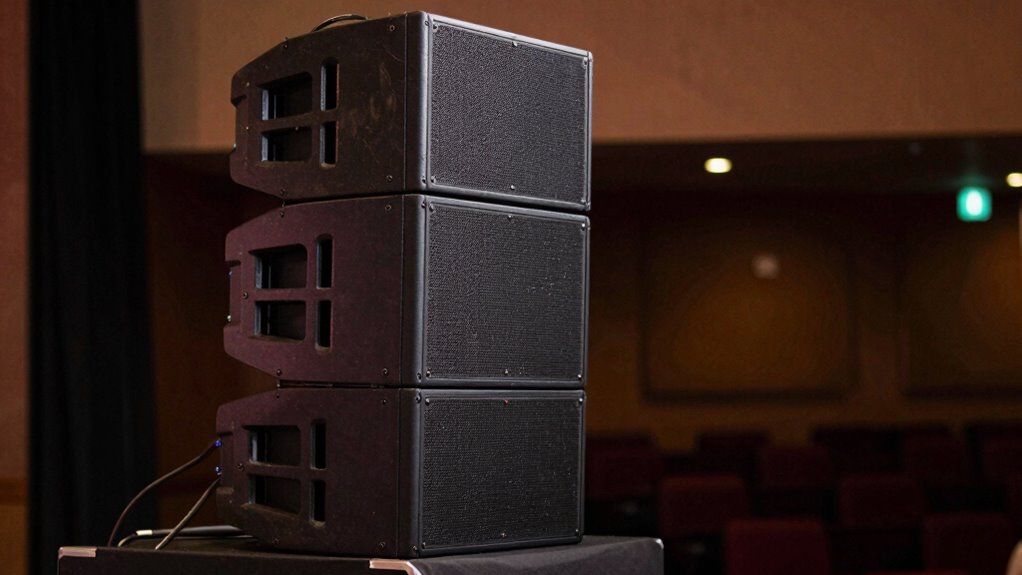

When using line arrays in small to mid-sized spaces, you focus on positioning and angles to guarantee even sound coverage. Place the speakers at a height above the audience, angling them downward to reduce reflections and dead zones. Adjust the dispersion and size of the array to suit your venue’s dimensions. Proper setup prevents feedback and uneven sound, helping your band sound clear from front to back. Keep exploring these techniques to master professional sound in any space.

Get audio and creator gear delivered free with Prime
- Fast, free delivery on millions of items
- Prime Video, Amazon Music and more included
- Member-only deals all year
Key Takeaways
- Line arrays provide even sound coverage, reducing dead spots and ensuring clarity across small to mid-sized venues.
- Proper speaker placement at a height and angled downward minimizes reflections and enhances sound uniformity.
- Use vertical curving and angle adjustments to tailor dispersion for venue dimensions and audience size.
- Conduct sound checks to fine-tune angles and distances, preventing overlaps and feedback issues.
- Mastering dispersion and placement techniques ensures professional, consistent sound quality for band performances.
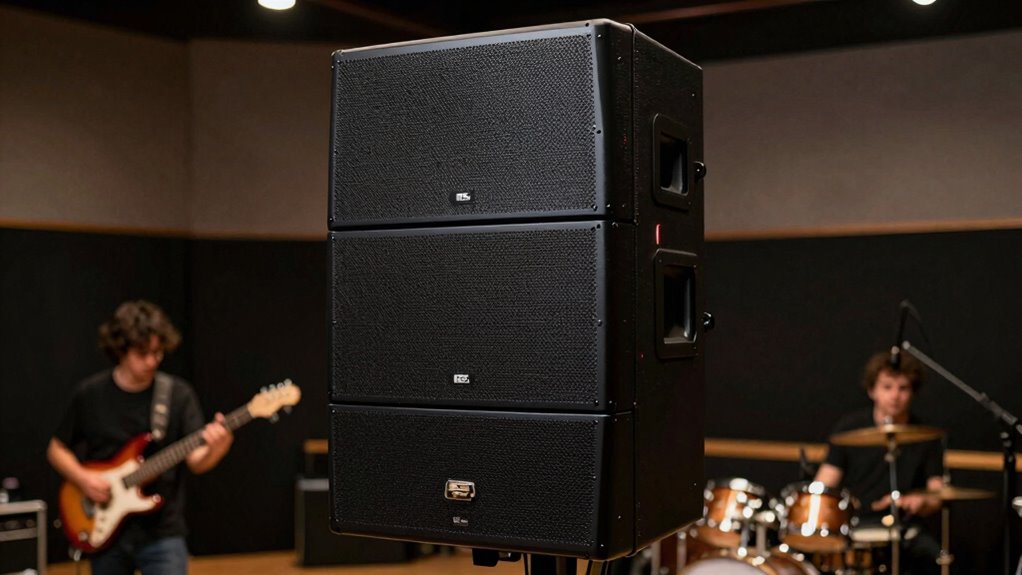
Have you ever wondered how large concerts and events achieve clear, even sound coverage across vast spaces? The secret often lies in the strategic use of line arrays. These specialized speaker systems are designed to project sound efficiently over long distances, ensuring every seat in the house gets a clear audio experience. When you’re working with small to mid-sized venues, understanding sound dispersion and speaker placement becomes critical to making the most of a line array setup.
Sound dispersion refers to how sound waves spread out from your speakers. With traditional speakers, sound can become uneven—some areas get overwhelmed while others are barely audible. Line arrays address this by focusing sound dispersion vertically and horizontally, allowing you to control how sound covers the space. Proper sound dispersion means that you can prevent echoes, minimize dead zones, and maintain a balanced sound throughout the venue. The key is to select a line array that matches the venue’s dimensions and to adjust the angles of individual speakers to guarantee sound reaches every corner evenly.
Speaker placement plays an essential role in achieving ideal sound coverage. As you set up a line array, you want the speakers to be positioned at a height and angle that maximize sound projection without causing feedback or excessive overlap. For small to mid-sized spaces, a common approach is to hang the line array slightly above the audience, angling it downward toward the crowd. This setup reduces sound reflections from the floor and walls, which can muddy the audio. You also need to consider the height and width of the venue; a well-placed line array will create a uniform sound field, eliminating hot spots and dead zones. Additionally, understanding sound dispersion is fundamental to optimizing your setup and ensuring balanced coverage. Properly assessing venue acoustics can further enhance how sound travels within a space.
Adjustments are often necessary to tailor sound dispersion and speaker placement to your specific space. You might start with a vertical curving of the array for broader coverage or a more straight configuration for narrower spaces. The goal is to achieve even sound distribution without overwhelming certain areas or leaving others in silence. Experimenting with angles and distances helps fine-tune the sound, making sure that your audience experiences consistent audio quality from front to back. Developing a sound check routine can help identify and correct coverage issues before the event begins. A thorough understanding of speaker placement techniques can significantly enhance the clarity and reach of your sound system.
In essence, mastering sound dispersion and speaker placement when working with line arrays empowers you to deliver professional-quality sound, no matter the venue size. It’s about precision—carefully positioning your speakers and adjusting their angles to fill the space evenly. When done right, your line array system becomes a powerful tool to guarantee your performance sounds as good in the back row as it does up front.
As an affiliate, we earn on qualifying purchases.
Frequently Asked Questions
How Do Line Arrays Compare to Traditional Speaker Setups?
Line arrays deliver better sound dispersion and more consistent frequency response across a venue compared to traditional speakers. They focus sound more precisely, reducing unwanted reflections and feedback, which improves clarity. With their vertical stacking, you get even coverage from front to back, making them ideal for small to mid-sized spaces. Traditional setups might struggle with uneven sound distribution, but line arrays guarantee your audience hears clear, balanced sound everywhere.
What Are the Cost Considerations for Small Venues?
For small venues, cost considerations focus on matching your venue acoustics and audience size. Line arrays can be more expensive upfront but offer better sound coverage, reducing the need for multiple speakers. If your space has challenging acoustics or a larger audience, investing in a line array might save money long-term by providing clearer sound without extra equipment. For smaller, simpler settings, traditional speakers could be more budget-friendly and sufficient.
How to Choose the Right Line Array for My Band?
Choosing the right line array is like finding a musical soulmate. Focus on subwoofer placement to guarantee deep, even bass coverage, and match your amplifier to the array’s power requirements for ideal sound. Consider your venue size and audience capacity, and select a system that offers clarity and projection without overwhelming. Research brands, ask for demos, and trust your ears—your perfect sound setup is within reach.
What Maintenance Is Required for Line Array Systems?
You should regularly inspect your line array system for physical damage and clean the components to prevent dust buildup. Calibrate the speakers periodically to guarantee ideal sound, adjusting for any changes in environment or setup. Proper array positioning is essential to avoid phase issues and feedback. Keep a maintenance schedule, and if you notice any irregularities, consult a professional to fine-tune the system and keep it performing at its best.
Can Line Arrays Be Easily Transported and Set Up?
Transporting and setting up line arrays can be challenging, but with the right storage solutions, it becomes easier. Portability challenges often stem from their size and weight, but modular designs help. Using dedicated cases and carts streamlines the process, reducing setup time. While they aren’t as portable as smaller speakers, proper planning and equipment make moving and installing line arrays manageable, ensuring you can focus on your performance instead of logistics.
As an affiliate, we earn on qualifying purchases.
Conclusion
Now that you understand the basics of line arrays, you’re better equipped to optimize your band’s sound for small to mid-sized venues. Imagine you’re setting up for a local gig and want even coverage without feedback or dead spots. By applying these principles—like proper speaker placement and aiming—you guarantee every note reaches your audience clearly. With a little practice, your sound will be as tight and professional as a seasoned pro, making every performance memorable.
professional PA system for bands
As an affiliate, we earn on qualifying purchases.
As an affiliate, we earn on qualifying purchases.
As an affiliate, we earn on qualifying purchases.
Halloween Picks
halloween
As an affiliate, we earn on qualifying purchases.







![Iron Maiden Legend Nicko McBrain Turned Down Trump Golf Invite: “[He] Should Be Put In Jail”](https://deadsetlive.com/wp-content/uploads/2026/10/iron-maiden-legend-nicko-mcbrain-turned-down-trump-golf-invite-he-should-be-put-featured-260x140.jpg)