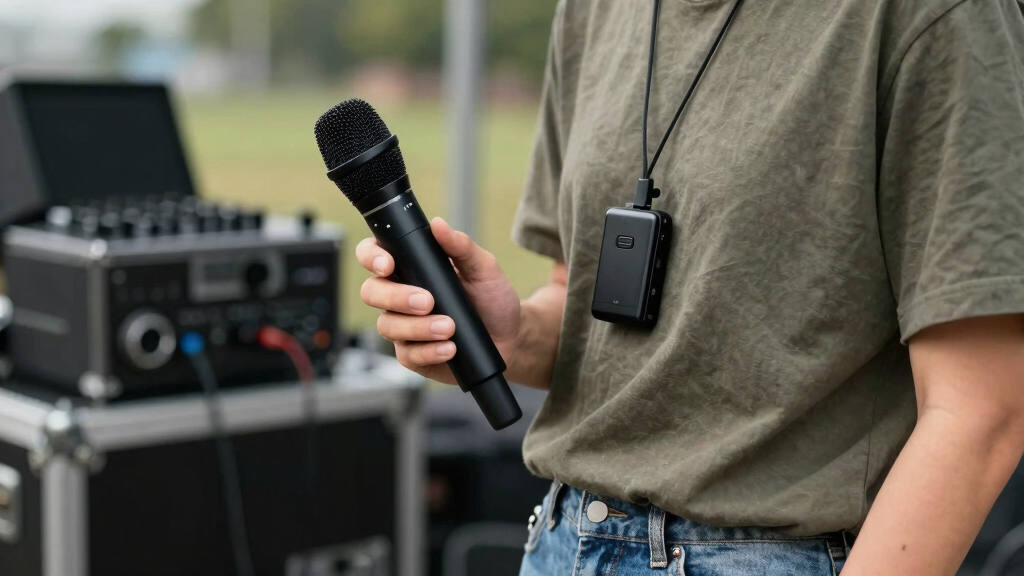
If you’re searching for high-quality wireless microphone systems, you’re likely weighing reliability against price and channel count. The Shure GLXD24+/SM58 takes the best overall spot for its dual-band digital transmission and dependable 12-hour battery. For budget-conscious buyers, the Phenyx Pro PTU-71-2H delivers solid UHF performance without the premium price. And if you need four channels for a panel or church service, the Phenyx Pro PTU-5000-4H is the obvious choice. The main tradeoffs in this category are digital versus analog transmission, battery life, and how many microphones you can run simultaneously. Keep reading for the full breakdown of all 14 systems and which one fits your specific use case.

Get audio and creator gear delivered free with Prime
- Fast, free delivery on millions of items
- Prime Video, Amazon Music and more included
- Member-only deals all year
Complete the kit


Key Takeaways
- Digital transmission, as seen in the Shure GLXD24+, separates itself from analog UHF by resisting interference and extending battery life through efficient power management.
- Multi-channel systems like the Phenyx Pro PTU-5000-4H are the only practical option for panel discussions or church services, but they demand more frequency coordination and a higher budget.
- Battery life varies wildly—Sony ULT and Aveek claim 20 to 40 hours, while many budget systems fall below 10 hours; consider your longest event before buying.
- Metal chassis construction, common on Phenyx Pro models, survives touring and frequent setup, while plastic bodies are fine for stationary installations but not road-worthy.
- Range specs are often marketing numbers; real-world performance depends on line-of-sight and RF congestion, so prioritize systems with auto-scan and true diversity receivers.
| Phenyx Pro PTU-71-2H Dual UHF Wireless Handheld Microphone System |  | Best Entry-Level Dual Channel System | Channels: 2 | Frequency Range: 536.57–587.12 MHz | Selectable Frequencies: 100 per channel | VIEW LATEST PRICE | See Our Full Breakdown |
| Shure GLXD24+/SM58 Dual Band Pro Digital Wireless Microphone System |  | Best Professional Reliability | Battery Life: 12 hours | Frequency Range: 2.4 and 5.8GHz dual band | Wireless Range: 100 ft | VIEW LATEST PRICE | See Our Full Breakdown |
| Phenyx Pro PTU-5000-4H 4-Channel UHF Wireless Microphone System |  | Best for Small Group Vocals | Channels: 4 | Microphones: 4 handheld dynamic cardioid | Wireless Range: Up to 260 ft | VIEW LATEST PRICE | See Our Full Breakdown |
| Phenyx Pro 4‑Channel UHF Auto Scan Wireless Microphone System (PTU‑7000‑4H) |  | Best High-Capacity Value | Channels: 4 | Frequency Range: 530‑580 MHz | Total Frequency Options: 160 | VIEW LATEST PRICE | See Our Full Breakdown |
| Sony ULT MIC Wireless Microphone for Karaoke |  | Best for Portable Karaoke | Battery Life: 20 hours | Connectivity: Bluetooth | Channels: 1 | VIEW LATEST PRICE | See Our Full Breakdown |
| Aveek Wireless Microphone System with 4-Pack Dynamic Handheld Mics |  | Best for Large Group Events | Channels: 4 | Range: 262 feet | Battery Life: 40 hours | VIEW LATEST PRICE | See Our Full Breakdown |
| Wireless Microphone System, Dual Metal Cordless Mic Set |  | Best Durability and Range | Range: 500 feet | Channels: 200 (2×100 adjustable) | Construction: All-metal | VIEW LATEST PRICE | See Our Full Breakdown |
| Sennheiser Pro Audio Profile Wireless 2-Channel Microphone System |  | Best for Content Creators | Frequency: 2.4 GHz | Channels: 2 | Recording: 32-bit float internal | VIEW LATEST PRICE | See Our Full Breakdown |
| Shure BLX24/PG58 Handheld Wireless Audio System |  | Best for Solo Stage Performance | Frequency Band: H9 (512–542 MHz) | Range: 300 feet | Battery Life: 14 hours | VIEW LATEST PRICE | See Our Full Breakdown |
| Phenyx Pro Wireless Microphone System, Dual Channel UHF |  | Best Versatility for Hybrid Events | Range: 328 feet | Channels: 2 | Frequencies: 200 selectable | VIEW LATEST PRICE | See Our Full Breakdown |
| JBL Wireless Two-Microphone System with Dual-Channel Receiver |  | Best for JBL PartyBox Owners | Connectivity: USB-C / Wireless | Compatibility: JBL PartyBox Series Only | Channels: 2 | VIEW LATEST PRICE | See Our Full Breakdown |
| Sennheiser XSW 1-835 Dual Channel Wireless Microphone System |  | Best for Vocal Performance | Microphone Capsule: Sennheiser e835 Dynamic | Polar Pattern: Cardioid (Unidirectional) | Channels: 2 | VIEW LATEST PRICE | See Our Full Breakdown |
| Phenyx Pro 4-Channel Wireless Microphone System with Auto Scan |  | Best for Multi-Format Versatility | Channels: 4 | Included Mics: 2 Handheld, 2 Bodypack (with Headset/Lapel) | Frequency Range: 530 – 580 MHz | VIEW LATEST PRICE | See Our Full Breakdown |
| Phenyx Pro Wireless Microphone System, 2 Handheld UHF Microphones |  | Best Budget Dual-Channel | Channels: 2 | Build Material: Metal | Frequency Range: 500 MHz Band | VIEW LATEST PRICE | See Our Full Breakdown |
| high-quality wireless microphone system | Channels | Frequency Range |
|---|---|---|
| Phenyx Pro PTU-71-2H Dual UHF | 2 | 536.57–587.12 MHz |
| Shure GLXD24+/SM58 Dual Band P | — | 2.4 and 5.8GHz dual band |
| Phenyx Pro PTU-5000-4H 4-Chann | 4 | — |
| Phenyx Pro 4‑Channel UHF Auto | 4 | 530‑580 MHz |
| Sony ULT MIC Wireless Micropho | 1 | — |
| Aveek Wireless Microphone Syst | 4 | — |
| Wireless Microphone System | 200 (2×100 adjustable) | — |
| Sennheiser Pro Audio Profile W | 2 | — |
| Shure BLX24/PG58 Handheld Wire | 1 | — |
| Phenyx Pro Wireless Microphone | 2 | 536.57 – 587.12 MHz |
| JBL Wireless Two-Microphone Sy | 2 | — |
| Sennheiser XSW 1-835 Dual Chan | 2 | 548 – 572 MHz (Band A) |
| Phenyx Pro 4-Channel Wireless | 4 | 530 – 580 MHz |
| Phenyx Pro Wireless Microphone | 2 | 500 MHz Band |
More Details on Our Top Picks
Phenyx Pro PTU-71-2H Dual UHF Wireless Handheld Microphone System
This system stands out for its auto-scan frequency selection, which simplifies the often frustrating process of finding a clear channel. Compared to the Phenyx Pro PTU-5000-4H, which uses fixed frequencies, this dual-channel unit offers more flexibility by allowing users to choose from 100 frequencies per channel. The 328-foot line-of-sight range is impressive for its class, though real-world performance may vary in cluttered environments. It serves as a solid step up from basic Bluetooth options but lacks the robust interference handling of professional-grade systems like the Shure GLXD24+. The metal construction adds durability, making it suitable for regular transport, though the reliance on AA batteries requires ongoing maintenance.Pros:- Auto-scan feature quickly identifies clear frequencies to reduce interference.
- Includes two handheld microphones and all necessary cabling for immediate use.
- Metal chassis provides better durability than plastic competitors in this price bracket.
Cons:- Limited to two channels, restricting use for larger vocal groups.
- Line-of-sight range specification may not hold in RF-heavy urban environments.
- Dependence on AA batteries adds recurring cost and setup time.
Best for: Home karaoke enthusiasts and small church groups needing a reliable, easy-to-setup dual mic system without professional mixing requirements.
Not ideal for: Professional live sound engineers who need frequency coordination tools and digital transmission reliability.
- Channels:2
- Frequency Range:536.57–587.12 MHz
- Selectable Frequencies:100 per channel
- Line-of-Sight Range:290–328 ft
- Microphone Type:Handheld Dynamic
- Polar Pattern:Cardioid
- Signal-to-Noise Ratio:98 dB
- Battery Type:AA (Included)
Our verdict“A practical, affordable choice for beginners who want dual-mic flexibility without the complexity of pro-level frequency coordination.”
Shure GLXD24+/SM58 Dual Band Pro Digital Wireless Microphone System
The Shure GLXD24+ represents the upper tier of wireless performance, leveraging dual-band digital technology to minimize dropouts that plague analog UHF systems like the Phenyx Pro PTU-71-2H. Its automatic frequency management is a significant advantage for live events where RF interference is unpredictable. The inclusion of the iconic SM58 microphone ensures vocal clarity and feedback resistance, a standard in professional audio. However, the 100-foot range is modest compared to the 328-foot claims of budget UHF competitors, reflecting the trade-off between digital stability and raw distance. It requires a learning curve for battery management but offers unparalleled consistency for critical applications.Pros:- Dual-band digital transmission virtually eliminates RF interference and dropouts.
- 12-hour rechargeable battery life reduces downtime compared to AA-powered rivals.
- Automatic frequency management simplifies setup in crowded RF environments.
Cons:- Shorter 100-foot range compared to long-range UHF alternatives.
- Not backward compatible with older GLX-D receivers, limiting system expansion.
- Higher entry cost due to proprietary battery and digital technology.
Best for: Professional performers and venues requiring rock-solid, interference-free audio with industry-standard mic capsules.
Not ideal for: Budget-conscious hobbyists or users in large open venues who prioritize maximum distance over signal integrity.
- Battery Life:12 hours
- Frequency Range:2.4 and 5.8GHz dual band
- Wireless Range:100 ft
- Included Microphone:SM58
- Rechargeable Battery:SB904 lithium-ion
- Setup Options:Tabletop, rack-mount
- Connectivity:Wireless, license-free
Our verdict“The definitive choice for professionals who value consistent, interference-free performance over maximum wireless range.”
Phenyx Pro PTU-5000-4H 4-Channel UHF Wireless Microphone System
This system addresses a specific need: four simultaneous inputs for small choirs or panel discussions. Unlike the dual-channel Phenyx Pro PTU-71-2H, the PTU-5000-4H provides individual XLR outputs, allowing precise mixing of each voice. The 260-foot range is adequate for indoor events, though it falls short of the 328-foot reach found in the newer PTU-7000-4H. A major limitation is the use of fixed frequencies, which means users cannot scan for clear channels if interference occurs. This makes it less robust than auto-scan models but sufficient for controlled environments like small halls or classrooms where RF noise is minimal.Pros:- Four independent channels allow for mixed vocals and individual volume control.
- Metal receiver and mic bodies offer sturdy build quality for the price.
- Individual XLR outputs facilitate easy integration into existing mixer setups.
Cons:- Fixed frequencies prevent users from switching channels to avoid interference.
- Requires an external amplifier or powered speakers, as it has no built-in output.
- Shorter 260-foot range compared to auto-scan UHF competitors.
Best for: School choirs, small worship teams, or conference panels needing four dedicated mic inputs without complex frequency coordination.
Not ideal for: Events in urban areas with high RF traffic, as the fixed frequencies cannot be changed if interference arises.
- Channels:4
- Microphones:4 handheld dynamic cardioid
- Wireless Range:Up to 260 ft
- Receiver Outputs:4 XLR outputs
- Signal-to-Noise Ratio:105 dB
- Battery Life:Up to 8 hours
- Construction:Metal receiver and microphones
Our verdict“A straightforward solution for small groups needing four mic inputs in RF-quiet environments, lacking the flexibility of scan-capable systems.”
Phenyx Pro 4‑Channel UHF Auto Scan Wireless Microphone System (PTU‑7000‑4H)
This model refines the formula of the PTU-5000-4H by adding Smart Auto Scan and IR sync, directly addressing the fixed-frequency limitation of its predecessor. With 160 total selectable frequencies, it offers far greater flexibility for avoiding interference in crowded venues. The 328-foot range matches the best in its class, providing significant stage freedom. However, the 4 kg weight makes it less portable than lighter dual-channel units, and the need for eight AA batteries adds logistical overhead. It bridges the gap between basic consumer kits and professional racks, offering pro-like features such as individual XLR and mixed outputs at an accessible price point.Pros:- Auto Scan and IR Sync drastically reduce setup time and interference issues.
- 160 selectable frequencies provide robust options for crowded RF environments.
- Mixed 1/4″ output alongside individual XLRs offers versatile connection flexibility.
Cons:- Heavy receiver weight (~4 kg) limits portability for mobile setups.
- Requires eight AA batteries, increasing operational costs and setup time.
- No rechargeable battery option included, unlike some premium digital systems.
Best for: Event organizers and DJs who need four flexible channels with interference-avoidance tools for varied venues.
Not ideal for: Traveling performers who need lightweight gear, as the receiver is heavy and battery management is cumbersome.
- Channels:4
- Frequency Range:530‑580 MHz
- Total Frequency Options:160
- Working Range:328 ft line‑of‑sight
- Battery Life:16 hrs
- Outputs:4 XLR, 1/4″ mixed
- Signal‑to‑Noise Ratio:98 dB
Our verdict“The strongest value proposition for users needing four channels with professional-grade interference management features.”
Sony ULT MIC Wireless Microphone for Karaoke
Designed specifically for convenience, the Sony ULT MIC prioritizes ease of use over technical flexibility. Its 20-hour battery life is exceptional, outlasting the AA-dependent Phenyx Pro PTU-71-2H and the 12-hour Shure GLXD24+. The noise reduction technology helps isolate vocals, a useful feature for amateur singers in noisy homes. However, it operates on a single channel via Bluetooth, which introduces latency and potential interference issues that analog UHF systems avoid. The 65 dB signal-to-noise ratio is lower than the 98 dB found in UHF competitors, resulting in less clean audio. This is a lifestyle product, not a professional audio tool.Pros:- Up to 20 hours of battery life minimizes charging frequency.
- Integrated noise reduction improves vocal clarity in casual settings.
- Simple Bluetooth connectivity pairs easily with modern speakers and TVs.
Cons:- Single-channel Bluetooth transmission is susceptible to interference and latency.
- Lower signal-to-noise ratio compared to UHF and digital wireless systems.
- Limited compatibility with non-Bluetooth audio equipment.
Best for: Casual users seeking a hassle-free, long-lasting karaoke kit for home parties with compatible Bluetooth speakers.
Not ideal for: Audio purists or large event hosts who require low-latency, interference-free, multi-channel performance.
- Battery Life:20 hours
- Connectivity:Bluetooth
- Channels:1
- Frequency Response:2.4 GHz
- Signal-to-Noise Ratio:65 dB
- Special Feature:Noise Reduction
- Connector Type:6.35 mm Jack
Our verdict“An excellent choice for casual home karaoke where battery life and simplicity matter more than professional audio fidelity.”
Aveek Wireless Microphone System with 4-Pack Dynamic Handheld Mics
This system stands out for its capacity, offering four handheld mics in a single kit, which makes it ideal for choirs or panel discussions where the Shure BLX24/PG58 falls short by providing only one channel. The 262-foot range is sufficient for most indoor venues, though it lacks the sheer distance of the Phenyx Pro’s 328-foot capability. I appreciate the 40-hour battery life claim, which reduces the need for mid-event swaps, but note that it relies on AA batteries rather than proprietary rechargeable packs. The unidirectional pickup pattern helps isolate voices, minimizing feedback in loud rooms. However, the lack of compatibility with laptops or mobile devices limits its utility for hybrid events. It is a robust, analog-style solution for traditional PA setups.Pros:- Includes four handheld microphones in one box
- Extended battery life reduces frequent replacements
- Long 262-foot range covers large indoor spaces
- Simple plug-and-play operation for analog mixers
Cons:- No compatibility with laptops, tablets, or phones
- Requires AA batteries instead of built-in rechargeables
- Bulky receiver unit compared to compact digital systems
Best for: Choir directors, church leaders, or event coordinators needing multiple simultaneous vocal inputs for large groups.
Not ideal for: Content creators or solo performers who need only one or two channels and want digital device compatibility.
- Channels:4
- Range:262 feet
- Battery Life:40 hours
- Polar Pattern:Unidirectional
- Signal-to-Noise Ratio:85 dB
- Connectivity:6.35 mm Jack, XLR
Our verdict“Choose this if you need four reliable vocal channels for a live event and have a standard analog audio mixer.”
Wireless Microphone System, Dual Metal Cordless Mic Set
If you value physical resilience, this system’s all-metal construction offers a tangible sense of quality that plastic-bodied competitors like the Aveek lack. The 500-foot range is exceptional, surpassing the Shure BLX24/PG58’s 300-foot limit, making it suitable for outdoor weddings or large conference halls. With 200 selectable channels, the auto-scan feature effectively mitigates interference in crowded RF environments, a common pain point with lower-end UHF systems. However, it demands external audio equipment like mixers or PA systems, as it does not connect directly to cameras or phones. This is a workhorse tool for venues that demand reliability and distance over digital convenience.Pros:- 500-foot transmission range for expansive venues
- Durable all-metal chassis withstands rough handling
- 200 adjustable frequencies reduce interference risks
- Simple setup with standard XLR and 1/4-inch outputs
Cons:- Requires an external mixer or PA system to function
- No direct connectivity to cameras or computers
- Heavier than plastic-bodied alternatives
Best for: Venue operators and DJs who need rugged hardware and long-range transmission for large outdoor or indoor events.
Not ideal for: Podcasters or videographers who require direct USB-C or 3.5mm connections to digital recording devices.
- Range:500 feet
- Channels:200 (2×100 adjustable)
- Construction:All-metal
- Outputs:XLR, 1/4-inch mixed
- Compatibility:Mixers, PA systems, Amps
- Frequency Type:UHF
Our verdict“This is the go-to choice for professionals who need maximum range and durable hardware for large-scale events.”
Sennheiser Pro Audio Profile Wireless 2-Channel Microphone System
Unlike the traditional UHF systems like the Shure BLX24/PG58, this Sennheiser unit operates on 2.4 GHz digital transmission, offering seamless compatibility with cameras, phones, and laptops without complex RF coordination. The inclusion of internal backup recording and 32-bit float audio is a game-changer for videographers, preventing audio clipping even during sudden loud noises. While the portable charging bar simplifies power management, the system is limited to two channels, making it less suitable for the multi-person setups handled by the Aveek 4-pack. The learning curve for setting up the digital ecosystem is steeper than plug-and-play analog units, but the audio fidelity and modern connectivity justify the effort for digital-first workflows.Pros:- Direct connectivity to cameras, phones, and laptops
- 32-bit float recording prevents audio distortion
- Internal backup recording adds a layer of safety
- Compact and portable with integrated charging
Cons:- Limited to only two channels
- Requires firmware updates for full feature access
- Higher complexity than basic analog systems
Best for: Videographers, streamers, and podcasters who need direct digital integration and high-fidelity audio with backup safety.
Not ideal for: Stage performers or large event coordinators who need multiple simultaneous handheld mics for a PA system.
- Frequency:2.4 GHz
- Channels:2
- Recording:32-bit float internal
- Included Mics:2 Clip-on, 1 Handheld
- Power:Rechargeable with bar
- Mode:Safety Channel Mode
Our verdict“Ideal for modern content creators who prioritize digital integration and audio safety over traditional stage performance features.”
Shure BLX24/PG58 Handheld Wireless Audio System
This system remains a benchmark for reliability in live sound, featuring the iconic PG58 dynamic microphone known for its vocal clarity and durability. Compared to the multi-mic Aveek system, the Shure BLX24/PG58 offers superior brand consistency and a streamlined setup process, though it provides only a single channel. The 300-foot range is adequate for most clubs and mid-sized halls, and the 14-hour battery life ensures a full night of performances without interruption. While it lacks the digital conveniences of the Sennheiser Profile, its analog simplicity and robust build make it a trusted choice for musicians and speakers who value proven performance over modern features.Pros:- Industry-standard PG58 microphone capsule
- Reliable UHF transmission with easy frequency scanning
- Long 14-hour battery life on AA batteries
- Compact receiver design fits easily in racks
Cons:- Only provides one channel of audio
- Fixed H9 frequency band may face local interference
- No digital features like internal recording
Best for: Solo musicians, speakers, and performers who need a single, high-quality vocal channel for live venues.
Not ideal for: Groups needing multiple simultaneous mics or users who need direct digital device connectivity.
- Frequency Band:H9 (512–542 MHz)
- Range:300 feet
- Battery Life:14 hours
- Microphone Type:PG58 Dynamic
- Channels:1
- Included Items:Receiver, Transmitter, Clip, PSU
Our verdict“The reliable choice for solo performers who want classic Shure vocal quality without unnecessary digital complexity.”
Phenyx Pro Wireless Microphone System, Dual Channel UHF
This system bridges the gap between vocal performance and presentation needs by including handheld, bodypack, and lapel microphones in one kit. Unlike the Shure BLX24/PG58, which is strictly handheld, the Phenyx Pro’s multiple transmitter options allow users to switch between singing, speaking, and moving around freely. The 328-foot range exceeds the Aveek system, and the auto-scan function helps avoid interference in busy RF environments. While it requires AA batteries and lacks the digital polish of the Sennheiser Profile, its flexibility makes it a strong contender for churches, schools, and corporate events where both hands-free and handheld use are required.Pros:- Includes handheld, bodypack, and lapel mics
- Auto-scan finds clear frequencies automatically
- 328-foot range handles large rooms effectively
- Dual-channel receiver allows two simultaneous users
Cons:- Setup can be complex for beginners
- Relies on AA batteries for all transmitters
- UHF band may face interference in dense urban areas
Best for: Event planners and church leaders who need both handheld and hands-free options for varied speaking and singing scenarios.
Not ideal for: Professional singers who prefer dedicated high-end capsules or users needing only a single channel.
- Range:328 feet
- Channels:2
- Frequencies:200 selectable
- Transmitters:Handheld, Bodypack, Lapel
- Frequency Range:536.57 – 587.12 MHz
- Power:4 x AA batteries
Our verdict“A flexible all-in-one solution for mixed-use events requiring both handheld and hands-free microphone capabilities.”
JBL Wireless Two-Microphone System with Dual-Channel Receiver
This system is designed exclusively for JBL PartyBox speakers, making it the obvious choice for owners of compatible models like the Encore or 100 series. Unlike the Sennheiser XSW 1-835, which requires separate audio interfaces or mixers, the JBL unit plugs directly into the speaker’s USB-C port for instant setup. The receiver mixes both microphone channels into a single output, simplifying the signal chain for casual users. However, this convenience comes with a significant limitation: if you do not own a compatible JBL speaker, this system is essentially useless. The microphones also rely on replaceable AA batteries, adding ongoing maintenance costs compared to rechargeable alternatives found in premium kits. Sound quality is tuned for party environments, prioritizing volume and clarity over studio fidelity. It is a closed-loop ecosystem solution that trades flexibility for ease of use.
Pros:- Seamless integration with a wide range of JBL PartyBox speakers via USB-C
- Plug-and-play setup requires no technical audio knowledge or external mixers
- Dual-channel receiver mixes two microphones into one stream for easy management
Cons:- Strictly compatible only with specific JBL PartyBox models, limiting versatility
- Microphones require frequent replacement of AA batteries rather than offering rechargeable cells
Best for: JBL PartyBox owners who want a simple, plug-and-play karaoke or speech solution without managing complex audio cabling.
Not ideal for: Users with non-JBL audio equipment or those who need to connect to mixers, PA systems, or computers via XLR.
- Connectivity:USB-C / Wireless
- Compatibility:JBL PartyBox Series Only
- Channels:2
- Battery Type:AA (Microphones), Rechargeable (Receiver)
- Playback Time:Up to 6 hours
- Polar Pattern:Unidirectional
- Frequency Response:15 kHz
Our verdict“Buy this if you own a compatible JBL PartyBox and prioritize simplicity over professional audio flexibility.”
Sennheiser XSW 1-835 Dual Channel Wireless Microphone System
The Sennheiser XSW 1-835 stands out for its professional-grade audio quality, leveraging the renowned e835 cardioid capsule known for its warm tone and feedback rejection. Compared to the budget-friendly Phenyx Pro 4-Channel System, the Sennheiser offers superior sound fidelity and build quality, making it suitable for serious singers and presenters. The receiver features one-button scanning and synchronization, which streamlines frequency coordination in environments with RF interference. Its metal construction feels durable and premium, contrasting with the plastic housings of many consumer-grade alternatives. While it lacks the multi-format versatility of systems that include headsets or lapel mics, its focus on handheld vocal performance is unmatched in this tier. The tradeoff is the lack of included rechargeable batteries and a higher entry point for casual users who may not need professional audio precision.
Pros:- Industry-standard e835 capsule provides warm, clear vocals with excellent feedback rejection
- Robust metal construction ensures durability for touring and frequent setup
- One-button scanning and IR sync simplify frequency management in busy RF environments
Cons:- No rechargeable battery pack included, requiring additional purchase for sustainability
- Limited to handheld microphones, offering no option for headset or lapel connectivity
Best for: Vocalists, presenters, and churches requiring reliable, high-fidelity sound with minimal feedback risk.
Not ideal for: Users needing multiple mic types (headsets/lapels) in one kit or those on a strict budget who prioritize features over audio nuance.
- Microphone Capsule:Sennheiser e835 Dynamic
- Polar Pattern:Cardioid (Unidirectional)
- Channels:2
- Frequency Range:548 – 572 MHz (Band A)
- Connectivity:XLR Outputs
- Simultaneous Systems:Up to 10
- Build Material:Metal
- Power Source:2x AA Batteries (Included)
Our verdict“Choose this system if you prioritize professional vocal sound quality and reliability over multi-format versatility.”
Phenyx Pro 4-Channel Wireless Microphone System with Auto Scan
This system offers unmatched flexibility by including two handhelds, two bodypacks, and headset/lapel options in a single kit. For event coordinators or churches that need to switch between speakers, singers, and lecturers, this is more practical than the dual-handheld-only Sennheiser XSW 1-835. The auto-scan feature helps mitigate interference across its four channels, a significant advantage in crowded RF environments like conferences. However, the sheer number of components requires 8 AA batteries, increasing operational overhead. While the sound quality is competent for speech and casual singing, it does not match the audio refinement of dedicated vocal systems like the Sennheiser. The setup process is also more complex due to the variety of input types, making it less ideal for beginners who just want to plug in and go.
Pros:- Includes four distinct microphone types (handheld, bodypack, lapel, headset) for diverse use cases
- Auto-scan function quickly finds clear frequencies to reduce interference
- Supports up to four simultaneous users, ideal for panel discussions or choir sections
Cons:- Requires 8 AA batteries, leading to higher ongoing costs and maintenance
- Complex setup with multiple inputs and channels can be daunting for non-technical users
Best for: Churches, corporate event planners, and DJs who need to switch between handheld, headset, and lapel microphones frequently.
Not ideal for: Audiophiles seeking top-tier vocal fidelity or beginners who find managing four channels and multiple battery packs overwhelming.
- Channels:4
- Included Mics:2 Handheld, 2 Bodypack (with Headset/Lapel)
- Frequency Range:530 – 580 MHz
- Battery Requirement:8x AA Batteries
- Range:Up to 328 feet
- Signal-to-Noise Ratio:98 dB
- Key Feature:Auto Frequency Scan
Our verdict“This is the right choice if you need one system to handle every type of speaker and performer at an event.”
Phenyx Pro Wireless Microphone System, 2 Handheld UHF Microphones
For those who need a reliable dual-channel system without the premium price tag, this Phenyx Pro model delivers solid performance. It features a durable metal build, which offers better physical resilience than the plastic receivers found in many entry-level competitors. Compared to the JBL PartyBox system, this unit connects via standard XLR and 1/4-inch outputs, making it compatible with any mixer, PA, or computer interface. The 30 tunable frequency groups provide reasonable interference protection for small venues, though it lacks the advanced auto-scan efficiency of the 4-channel Phenyx Pro. The primary tradeoff is the reliance on AA batteries and a more basic feature set, but for karaoke nights or small church services, it provides excellent value and straightforward operation.
Pros:- Sturdy metal construction withstands frequent handling and transport
- Standard XLR and 1/4-inch outputs ensure broad compatibility with audio gear
- 30 tunable frequencies help avoid interference in local RF environments
Cons:- No rechargeable batteries included, requiring ongoing AA battery purchases
- Limited to two channels, which may be insufficient for larger events
Best for: Home karaoke enthusiasts, small church groups, or budget-conscious users needing standard XLR connectivity.
Not ideal for: Large professional venues requiring complex RF management or users who need headset/lapel options included.
- Channels:2
- Build Material:Metal
- Frequency Range:500 MHz Band
- Tunable Frequencies:30 Groups
- Operating Range:200 ft
- Outputs:2x XLR, 1x 1/4-inch
- Power Source:AA Batteries
Our verdict“A dependable, affordable workhorse for users who need standard connectivity and durable build quality.”

How We Picked
To rank these 14 systems, I evaluated each on transmission type (digital versus analog UHF), frequency agility, battery life, build quality, channel count, and ease of setup. The most important criterion was RF reliability—how well a system holds its signal in crowded environments. Systems with auto-scan and true diversity receivers scored higher because they reduce dropouts without manual frequency hunting.
I also weighed real-world usability: how quickly can you set it up, how intuitive is the receiver interface, and does the battery life match the demands of a full event? Value mattered, but not at the expense of audio quality or durability. The ranking reflects a balance of performance, versatility, and price, with the best overall pick offering the fewest compromises for the widest range of users.
Factors to Consider When Choosing High-quality Wireless Microphone Systems
Choosing a wireless microphone system goes beyond picking the most expensive option. You need to match the technology to your venue, your number of speakers, and your tolerance for interference. Here are the factors that separate a good system from a frustrating one.
Analog UHF vs. Digital Transmission
The biggest fork in the road is whether to go analog UHF or digital. Analog systems like the Shure BLX24/PG58 are simpler and often cheaper, but they’re more susceptible to interference and offer no battery efficiency gains. Digital systems, such as the Shure GLXD24+, use a digital signal that rejects noise and allows the transmitter to sip power, which is why they can run 12 hours on two AA batteries. If you’re in an urban area with heavy RF traffic, digital is the safer bet. For a rural church or a home setup, analog UHF is perfectly adequate and easier to troubleshoot.
Frequency Range and Auto-Scan
Most UHF systems operate in the 500–600 MHz band, but the exact frequencies vary by model. Auto-scan is a lifesaver—it finds a clear channel at the push of a button. Without it, you’re manually scanning a spectrum analyzer or hoping your chosen channel doesn’t collide with a TV station or another wireless system. The Phenyx Pro models and the Sennheiser XSW 1-835 all include auto-scan, which I consider non-negotiable for anyone who moves between venues. Also check the tuning bandwidth: a wider range (like 40 MHz on some Phenyx units) gives you more room to find a clean frequency.
Battery Life and Power Options
Battery life is often the difference between a smooth event and an embarrassing cutoff. The Sony ULT and Aveek systems claim 20 and 40 hours respectively, which is great for all-day conferences or wedding marathons. But beware: those numbers usually assume low-power mode or intermittent use. The Shure GLXD24+ offers a more realistic 12 hours with its digital power management. If you’re doing weekly gigs, rechargeable AA batteries or systems with USB-C charging ports (like the Sony ULT) will save you money over time. Always carry spares—no system has infinite battery.
Channel Count and Multi-Mic Scenarios
How many microphones do you need to run at once? A dual-channel system (like the Sennheiser XSW 1-835) handles two speakers, but a four-channel unit (Phenyx Pro PTU-5000-4H) is required for panels, roundtables, or multi-presenter church services. Running multiple mics increases the risk of intermodulation distortion, so a system with true diversity receivers and a wide frequency range becomes more valuable. Don’t buy a 4-channel system if you only need two—you’ll pay for unused complexity. Conversely, don’t buy two separate dual-channel systems because they may interfere with each other; a single multi-channel unit is designed to coordinate its frequencies internally.
Build Quality and Portability
If your microphones will live on a podium or in a fixed rack, plastic bodies are fine. But if you’re packing and unpacking weekly, look for metal construction. The Phenyx Pro PTU-71-2H and the Shure GLXD24+ both feature sturdy metal transmitters and receivers that survive drops and cable yanks. The Aveek system, while feature-packed, uses a lighter plastic that’s acceptable for stationary use but may not last on the road. Also consider the receiver’s form factor: half-rack units are easier to mount, while compact tabletop receivers (like the JBL) are convenient for small venues but lack rack-mount options.
Range and RF Reliability
Manufacturers love to quote ranges like 500 feet, but that’s only in ideal line-of-sight conditions. In a real room with walls, bodies, and other electronics, expect 100–150 feet from a good UHF system. The Shure GLXD24+ claims 100 feet and holds it reliably thanks to its dual-band diversity. The Aveek’s 262-foot claim is optimistic; you’ll likely get half that indoors. The best way to judge reliability is to look for a receiver with two antennas and a diversity circuit—it picks the stronger signal and reduces dropouts. If you’re covering a large stage or outdoor event, prioritize range over price.
Frequently Asked Questions
Should I choose a digital or analog wireless mic system?
Choose digital if you’re in a city or any environment with heavy Wi-Fi, TV, or other RF sources. Digital systems like the Shure GLXD24+ use a digital modulation that rejects interference and offers better battery life. Analog UHF is cheaper and perfectly fine for rural or isolated venues where the RF spectrum is clean. If you’re a beginner and just need a reliable mic for a small church or classroom, analog will save you money. But if you’re a professional who can’t afford dropouts, digital is worth the premium.
How many channels do I actually need?
Count the maximum number of microphones you’ll need simultaneously. For a solo singer or a single presenter, a one-channel system is enough, but dual-channel systems are more versatile and barely cost more. If you host panels, roundtables, or multi-speaker church services, you need four channels—the Phenyx Pro PTU-5000-4H is a solid choice. Buying two separate dual-channel systems is a mistake because they can interfere with each other unless you coordinate frequencies manually. A single multi-channel unit manages frequencies internally to avoid intermodulation.
What’s the real-world range I can expect?
Real-world range is usually 100–150 feet indoors with line-of-sight, even if the box claims 500 feet. Walls, metal structures, and crowds absorb RF signals. The Shure GLXD24+ delivers a reliable 100 feet thanks to its dual-band diversity. The Aveek’s 262-foot claim is achievable only outdoors with no obstacles. To maximize range, place the receiver high and in clear view of the transmitter, and avoid placing it near metal racks or other electronics. If you need to cover a large auditorium, consider a system with a remote antenna or a longer range spec.
Do I need a bodypack or a handheld mic?
That depends on your use case. Handheld mics are best for singers, presenters who want to hold something, or anyone who wants to pass the mic around. Bodypacks with lapel or headset mics are ideal for hands-free speaking, teaching, or presentations where you’re moving around or using your hands. Many systems, like the Phenyx Pro PTU-7000-4H, come with a mix of both. If you’re buying for a church, a combination of handhelds for the pastor and bodypacks for the worship team is a flexible setup. For a karaoke system, stick with handhelds.
How do I avoid interference in crowded RF environments?
Use a system with auto-scan and true diversity reception. Auto-scan finds a clear channel in seconds, while diversity uses two antennas to pick the stronger signal. Before your event, scan and set frequencies at least 30 minutes ahead, and check for nearby wireless systems that might be on the same band. The Sennheiser XSW 1-835 and the Phenyx Pro models both have excellent auto-scan. Also, keep the receiver at least 10 feet away from Wi-Fi routers and other transmitters. If you’re in a dense urban area, consider a digital system like the Shure GLXD24+ because it’s less prone to interference than analog.
Conclusion
After comparing all 14 systems, the Shure GLXD24+/SM58 is my best overall pick for its digital reliability, 12-hour battery, and true diversity reception—it’s the system I’d trust for any professional gig. For the best value, the Phenyx Pro PTU-71-2H gives you dual-channel UHF with metal build and auto-scan at a price that won’t hurt. If money is no object and you want premium audio quality, the Sennheiser XSW 1-835 offers a polished, dual-channel experience with excellent sound. Beginners should start with the Shure BLX24/PG58—it’s simple, reliable, and forgiving. And if you need four channels for a panel or church, the Phenyx Pro PTU-5000-4H is the only way to go. Match your choice to your venue, your channel count, and your tolerance for setup hassle, and you’ll find the right system.