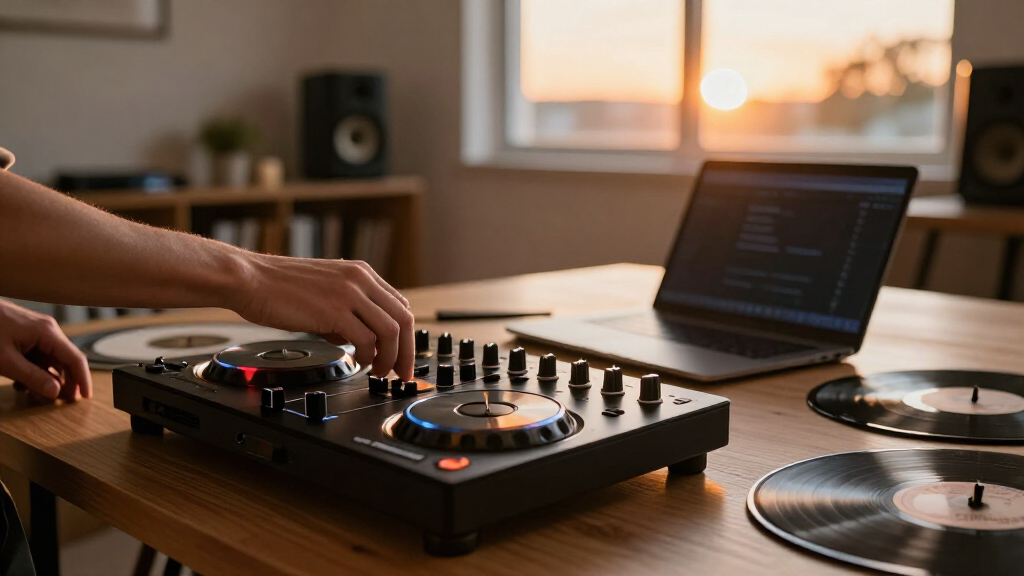
For most home DJs, I’d start with the Pioneer DJ DDJ-FLX4: its approachable two-channel layout and flexible software support make it a strong all-round choice. The Numark Mixstream Pro+ stands apart for mixing without a laptop, while the Hercules DJControl Inpulse 300 MK2 puts extra emphasis on learning the basics. The main tradeoffs are portability versus hands-on control, bundled extras versus core controller quality, and laptop-based mixing versus standalone operation. Smaller models can be easier to store but may feel limiting as skills grow. Read on for all 15 picks and guidance on choosing the right home setup.

Get audio and creator gear delivered free with Prime
- Fast, free delivery on millions of items
- Prime Video, Amazon Music and more included
- Member-only deals all year
Complete the kit


Key Takeaways
- The DDJ-FLX4 is the most balanced home pick. It appears in three listings, including a bundle, but the controller itself is the same model; compare the included extras rather than treating those listings as different decks.
- The Mixstream Pro+ is the standout for laptop-free mixing. Its standalone format serves a different need from the laptop-dependent controllers, but it is a larger commitment in both setup style and footprint.
- Beginner support is not one-size-fits-all. The Inpulse 300 MK2 focuses on guided learning, while the DJLearning Kit MK II adds speakers and headphones for buyers building a first complete setup.
- Portability comes with control compromises. The Starlight, MixTrack Go, and DJControl Mix suit tight spaces or mobile use, but their compact formats are less suited to developing a full-size two-deck workflow.
- Choose by mixing style, not light effects or bundle count. The DDJ-REV5 and DDJ-REV1 target scratch-oriented control, while Party Mix models emphasize casual, light-led sessions rather than the broadest path for skill growth.
| Pioneer DJ AlphaTheta DDJ-FLX2 Compact 2-Channel DJ Controller Bundle |  | Best Overall for Flexible Home Setups | Channels: 2 | Software compatibility: rekordbox, djay, Serato | Connections: USB Type-C; Bluetooth Low Energy | VIEW LATEST PRICE | See Our Full Breakdown |
| Numark Party Mix III Bluetooth DJ Controller with Built-In Lights |  | Best for Casual, Party-Ready Beginners | Decks: 2 | Connectivity: Bluetooth MIDI, USB-C | Lighting: Beat-synchronized built-in LED light show | VIEW LATEST PRICE | See Our Full Breakdown |
| Pioneer DJ DDJ-FLX4 2-Channel DJ Controller, 16 Pads, White |  | Best for Beginners Ready to Grow | Channels and decks: 2 channels; 2 decks | Performance pads: 16 | Connectivity: USB, Bluetooth | VIEW LATEST PRICE | See Our Full Breakdown |
| Pioneer DJ DDJ-REV5 2-Channel Scratch DJ Controller with On-Jog Display | 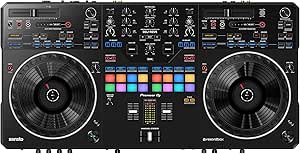 | Best Premium Pick for Scratch and Open-Format Practice | Channels: 2 | Jog wheels: Full-size, with on-jog displays | Layout: Scratch-style, battle layout | VIEW LATEST PRICE | See Our Full Breakdown |
| Numark MixTrack Go Compact Bluetooth DJ Controller |  | Best Ultra-Portable Pick | Decks: 2 | Connectivity: Bluetooth MIDI, USB-C | Power source: USB | VIEW LATEST PRICE | See Our Full Breakdown |
| Hercules DJControl Inpulse 300 MK2 2-Deck DJ Controller |  | Best for Learning Manual Beatmatching | Decks: 2 | Channels: 2 | Compatible software: Serato, DJUCED | VIEW LATEST PRICE | See Our Full Breakdown |
| Numark Mixstream Pro+ Standalone DJ Controller |  | Best for Computer-Free Home Mixing | Display: 7-inch touchscreen | Jog wheels: 6 inches | Connectivity: Wi-Fi, Bluetooth audio input, USB, SD card | VIEW LATEST PRICE | See Our Full Breakdown |
| Numark Party Mix II 2-Deck DJ Controller with Built-In Lights |  | Best Compact Starter for Casual Mixing | Decks: 2 | Software: Serato DJ Lite | Outputs: 1/8-inch main output and headphone output | VIEW LATEST PRICE | See Our Full Breakdown |
| Pioneer DJ DDJ-FLX4 2-Channel DJ Controller Bundle with Carrying Case and Polishing Cloth |  | Best All-Rounder for Growing Home DJs | Channels: 2 | Compatible software: rekordbox, Serato DJ Lite, Serato DJ Pro, djay | Inputs: 1 x MIC | VIEW LATEST PRICE | See Our Full Breakdown |
| Pioneer DJ DDJ-REV1 2-Deck Serato DJ Controller, Black |  | Best for Scratch and Open-Format Practice | Channels: 2 | Compatible platforms: Mac OS X, Windows | Included software: Serato DJ Lite | VIEW LATEST PRICE | See Our Full Breakdown |
| Hercules DJControl Starlight Compact 2-Channel DJ Controller |  | Best for Ultra-Compact Home Setups | Channels: 2 | Connectivity: USB | Power source: Battery powered | VIEW LATEST PRICE | See Our Full Breakdown |
| Pioneer DJ DDJ-FLX4 2-Channel DJ Controller |  | Best Overall for Home Mixing | Channels: 2 | Performance pads: 16 | Connectivity: USB | VIEW LATEST PRICE | See Our Full Breakdown |
| Hercules DJLearning Kit MK II Beginner DJ Set with Controller, Speakers, and Headphones |  | Best Complete Starter Set | Controller: DJControl Inpulse 200 MK2, 2-channel | Included audio equipment: DJMonitor 32 speakers and HDP DJ45 headphones | Included software: Serato DJ Lite and DJUCED | VIEW LATEST PRICE | See Our Full Breakdown |
| Hercules DJControl Mix Bluetooth Wireless DJ Controller for Smartphones |  | Best for Smartphone-Only Mixing | Decks: 2 | Connectivity: Bluetooth | Compatible devices: Android and iOS smartphones and tablets | VIEW LATEST PRICE | See Our Full Breakdown |
| Hercules DJControl Inpulse 500 2-Deck DJ Controller for Serato and DJUCED |  | Best for Hands-On Practice | Channels: 2 | Connectivity: USB | Power source: Corded electric | VIEW LATEST PRICE | See Our Full Breakdown |
| DJ controllers for home mixing | Weight | Connectivity | Dimensions | Channels |
|---|---|---|---|---|
| Pioneer DJ AlphaTheta DDJ-FLX2 | 2.6 pounds | — | 15.09 × 8.19 × 1.9 inches | 2 |
| Numark Party Mix III Bluetooth | — | Bluetooth MIDI, USB-C | — | — |
| Pioneer DJ DDJ-FLX4 2-Channel | 2.8 kg | USB, Bluetooth | — | — |
| Pioneer DJ DDJ-REV5 2-Channel | 14 pounds | USB Type-C | — | 2 |
| Numark MixTrack Go Compact Blu | 1.1 pounds | Bluetooth MIDI, USB-C | 3.67 × 12.76 × 1.57 inches | — |
| Hercules DJControl Inpulse 300 | 5.6 pounds | USB | 3.78 x 20.16 x 12.68 inches | 2 |
| Numark Mixstream Pro+ Standalo | 8.16 pounds | Wi-Fi, Bluetooth audio input, USB, SD card | 11.7 x 22.2 x 2.95 inches | — |
| Numark Party Mix II 2-Deck DJ | 1.76 pounds | USB Type B | 7.83 x 12.82 x 2.04 inches | — |
| Pioneer DJ DDJ-FLX4 2-Channel | 4.63 pounds | — | — | 2 |
| Pioneer DJ DDJ-REV1 2-Deck Ser | 5 pounds | USB, auxiliary | 10.6 x 20.7 x 2.33 inches (D x W x H) | 2 |
| Hercules DJControl Starlight C | 1.1 pounds | USB | — | 2 |
| Pioneer DJ DDJ-FLX4 2-Channel | 2.8 kg | USB | 21.3 × 13.3 × 5.1 in | 2 |
| Hercules DJLearning Kit MK II | 14.3 pounds | USB | 20.87 × 14.44 × 10.83 inches | — |
| Hercules DJControl Mix Bluetoo | 2.1 pounds | Bluetooth | — | — |
| Hercules DJControl Inpulse 500 | 11.6 lb | USB | 10.54 × 20.26 × 5.12 in | 2 |
More Details on Our Top Picks
Pioneer DJ AlphaTheta DDJ-FLX2 Compact 2-Channel DJ Controller Bundle
The DDJ-FLX2 is my pick for home mixers who want one compact controller that can work with a phone, tablet, or computer. Its support for rekordbox, djay, and Serato gives it broader software flexibility than the Numark Party Mix III, while Smart Fader and Smart CFX can help newer DJs make smoother transitions without replacing hands-on practice. At just 2.6 pounds, it is easy to move between a desk and a living-room setup, and the included case adds useful protection.
The tradeoff is its modest connection panel: both master and headphone outputs use 3.5 mm jacks, which may call for adapters in a more permanent speaker setup. Serato DJ Pro also requires a separate license. Choose the DDJ-FLX2 for flexible, space-conscious mixing; pick the larger DDJ-FLX4 if you want 16 pads and microphone mixing.
Pros:- Works with rekordbox, djay, and Serato software
- USB bus power and a 2.6-pound body make it easy to reposition
- Smart Fader and Smart CFX offer guided help with transitions and effects
- Bundle includes a carrying case and TRS cable
Cons:- Master and headphone outputs are both 3.5 mm stereo mini jacks
- Serato DJ Pro requires a separate license
Best for: Home beginners who want a lightweight controller that can move between mobile devices and a computer, with a case for storage.
Not ideal for: DJs building a fixed home setup around larger audio connections or those who specifically want included Serato DJ Pro access.
- Channels:2
- Software compatibility:rekordbox, djay, Serato
- Connections:USB Type-C; Bluetooth Low Energy
- Power:USB bus power
- Audio outputs:1 master and 1 headphone output, both 3.5 mm stereo mini jack
- Dimensions:15.09 × 8.19 × 1.9 inches
- Weight:2.6 pounds
- Bundle:Carrying case, TRS cable, polishing cloth
Our verdict“Choose the DDJ-FLX2 if you want a portable, software-flexible home controller and can work with its mini-jack outputs.”
Numark Party Mix III Bluetooth DJ Controller with Built-In Lights
The Numark Party Mix III puts entertainment and beginner-friendly controls ahead of a more traditional home-studio feel. Its beat-synchronized LED lights add a visual party effect, while the eight pads per deck and live-remix controls give new DJs ways to experiment beyond basic fades. Compared with the DDJ-FLX2, it has an RCA main output, a useful fit for connecting common home speakers without relying on a mini-jack adapter.
That party focus comes with limits. The lights suit casual mixing but may matter little at a desk, and its beginner-oriented tools are less compelling for someone intent on developing a more advanced performance setup. The controller also needs USB power, and Bluetooth MIDI is not the same as a wireless audio connection. I’d choose it over the MixTrack Go for built-in visual flair, but not for the lightest or most understated home setup.
Pros:- Beat-synchronized LED lights add a party effect without extra equipment
- RCA main output connects readily to many home speaker setups
- Eight backlit performance pads per deck support live remixing
- Works with Serato DJ Lite and the djay app
Cons:- USB-powered design needs a connected power source
- Built-in light show and beginner-focused feature set may be unnecessary for serious home practice
- Bluetooth MIDI support depends on compatible devices and software
Best for: New DJs who want a compact controller for casual home sessions, beginner-friendly mixing, and small gatherings with compatible speakers.
Not ideal for: Developing DJs who prioritize a restrained desk setup or want a controller built around more advanced performance needs.
- Decks:2
- Connectivity:Bluetooth MIDI, USB-C
- Lighting:Beat-synchronized built-in LED light show
- Performance pads:8 backlit pads per deck
- Mixer controls:3-band EQ, channel filters, crossfader
- Audio outputs:RCA main output, 1/8-inch headphone output
- Dimensions and weight:8.07 × 13.31 × 1.85 inches; 2.42 pounds
- Included accessories:USB-C cable, software download card, smartphone/tablet stand, 1/8-inch to stereo RCA adapter
Our verdict“Pick the Party Mix III for casual, light-filled home sessions, not for a low-key setup focused on developing advanced technique.”
Pioneer DJ DDJ-FLX4 2-Channel DJ Controller, 16 Pads, White
The DDJ-FLX4 is the stronger learning platform for someone who expects home mixing to become a regular hobby. Its 16 performance pads provide more room for hot cues and other performance modes than the DDJ-FLX2, while Smart Fader and Smart CFX can ease early mixing practice. Support for computers and mobile devices gives it room to adapt as a setup changes, and the built-in sound card and microphone mixing add flexibility for home sessions.
It is less travel-friendly than the DDJ-FLX2: at 2.8 kg, it is heavier, and its white finish may not suit every desk or studio style. The two-channel, two-deck layout also sets a clear ceiling for expansion. I’d favor it over the Party Mix III for skill-building and performance controls, while casual users who mainly want a playful party controller may prefer the Numark’s built-in lights.
Pros:- Sixteen performance pads support a range of performance modes
- Smart Fader and Smart CFX can make early transitions more approachable
- Works with PC, Mac, and mobile devices
- Built-in sound card and microphone mixing support flexible home sessions
Cons:- Two-channel, two-deck control limits room to expand
- At 2.8 kg, it is heavier than the compact DDJ-FLX2
Best for: New and developing home DJs who want extra performance pads, mobile and computer compatibility, and microphone mixing in a two-deck layout.
Not ideal for: Buyers who need a very lightweight controller for frequent travel or who want more than two channels and decks.
- Channels and decks:2 channels; 2 decks
- Performance pads:16
- Connectivity:USB, Bluetooth
- Compatible devices:PC, Mac, iPhone, iPad, Android
- Supported software:rekordbox, Serato DJ Pro
- Audio and mixing features:Built-in sound card; microphone mixing
- Weight:2.8 kg
- Included component:USB cable
Our verdict“Choose the DDJ-FLX4 if you want beginner-friendly guidance with more performance controls than the compact DDJ-FLX2.”
Pioneer DJ DDJ-REV5 2-Channel Scratch DJ Controller with On-Jog Display
For a home DJ focused on scratch technique, the DDJ-REV5 offers a more specialized control layout than the DDJ-FLX4 or DDJ-FLX2. Its full-size jog wheels with on-jog displays make playback position easier to follow during precise cueing and scratching, while the battle-style arrangement and DJM-style mixer controls suit open-format performance practice. Support for both Serato DJ Pro and rekordbox, with licenses included, also avoids the separate-license issue noted for the DDJ-FLX2.
This focus makes it a poor fit for buyers seeking a simple, easy-to-store home controller. At 14 pounds, it is substantially less portable than the lightweight Numark MixTrack Go, and its scratch-centered layout may feel less natural for a newcomer seeking basic mixing controls. I’d choose it when technique and a club-style workflow matter more than compactness or simplicity.
Pros:- Full-size jog wheels with on-jog displays support precise scratching and playback awareness
- Battle-style controls suit scratch and open-format practice
- Serato DJ Pro and rekordbox licenses are included
- Performance pads and DJM-style mixer controls support a more performance-oriented workflow
Cons:- At 14 pounds, it is much less portable than compact options such as the MixTrack Go
- Scratch-focused layout may be less approachable for basic beginner mixing
Best for: Scratch and open-format DJs who want full-size jog wheels, detailed playback feedback, and a battle-style home practice layout.
Not ideal for: Casual beginners or space-constrained buyers who want a lightweight controller for occasional mixing and easy storage.
- Channels:2
- Jog wheels:Full-size, with on-jog displays
- Layout:Scratch-style, battle layout
- Supported software:Serato DJ Pro, rekordbox
- Connectivity:USB Type-C
- Performance controls:Performance pads for hot cues, loops, and samples
- Weight:14 pounds
- Compatible systems:PC and Mac
Our verdict“Choose the DDJ-REV5 if scratch technique and a battle-style workflow matter more than portability or beginner simplicity.”
Numark MixTrack Go Compact Bluetooth DJ Controller
The Numark MixTrack Go is the easiest option here to pack away or move between rooms: it weighs just 1.1 pounds and supports Bluetooth MIDI with compatible phones and tablets. That makes it a more travel-minded choice than the DDJ-FLX4, while its capacitive jog wheels, eight pads per deck, and dedicated Stems controls provide more hands-on performance tools than its slim profile might suggest. A built-in audio interface supplies separate speaker and headphone outputs for cueing at home.
The compact connections are also its main compromise: both outputs are 1/8-inch, so larger home audio systems may need an adapter. Bluetooth MIDI depends on compatible devices and software, and USB power is still required. Compared with the Party Mix III, it skips the built-in light show in favor of a lighter, more minimal controller. Choose it for portability, not for a permanent, connection-rich home rig.
Pros:- At 1.1 pounds, it is especially easy to carry and store
- Bluetooth MIDI supports compatible phone and tablet setups
- Dedicated Stems controls and eight pads per deck add performance options
- Built-in audio interface provides separate speaker and headphone outputs
Cons:- Main and headphone outputs are both 1/8-inch
- Bluetooth MIDI works only with compatible devices and software
- USB power is required
Best for: Mobile-minded beginners and casual DJs who want to practice at home and carry a controller between rooms or locations.
Not ideal for: DJs setting up a permanent home system with larger audio connections or those who need broad compatibility from Bluetooth MIDI.
- Decks:2
- Connectivity:Bluetooth MIDI, USB-C
- Power source:USB
- Audio outputs:1/8-inch main output and 1/8-inch headphone output
- Controls:Capacitive jog wheels, performance pads, Stems controls, Fade FX
- Included software:Serato DJ Lite, Algoriddim djay
- Dimensions:3.67 × 12.76 × 1.57 inches
- Weight:1.1 pounds
Our verdict“Pick the MixTrack Go if low weight and mobile practice matter more than full-size home audio connections.”
Hercules DJControl Inpulse 300 MK2 2-Deck DJ Controller
I’d choose the Inpulse 300 MK2 for home learners who want help building a skill, not just getting a blend started. Its built-in light guides offer visual cues for practicing manual beatmatching, while 16 pads and pre-mapped Stems controls give you room to experiment beyond basic transitions. It works with both Serato and DJUCED, a useful choice if you want to compare software rather than commit to one workflow. Compared with the Numark Party Mix II, it offers more learning-oriented guidance and control options; the Party Mix II is smaller and adds a light show instead. The tradeoff is that this Hercules controller needs a computer, and its plastic body is less reassuring for frequent transport. I’d skip it if you want a standalone setup or a controller that works without a laptop.
Pros:- Light guides support practice with manual beatmatching
- Compatible with both Serato and DJUCED
- 16 performance pads and pre-mapped Stems controls broaden performance options
- Supports computer-stored tracks and select streaming services
Cons:- Requires a computer to operate
- Plastic construction may be less suited to heavy transport
- Larger than ultra-compact beginner controllers such as the Numark Party Mix II
Best for: Home learners with a Mac or PC who want visual practice aids for manual beatmatching and the flexibility to try Serato or DJUCED.
Not ideal for: DJs who want computer-free mixing, a metal-bodied controller, or an especially compact unit for frequent travel.
- Decks:2
- Channels:2
- Compatible software:Serato, DJUCED
- Beatmatching guide:Built-in light guides
- Performance pads:16
- Connectivity:USB
- Weight:5.6 pounds
- Dimensions:3.78 x 20.16 x 12.68 inches
Our verdict“Choose the Inpulse 300 MK2 if you want computer-based home mixing with visual beatmatching guidance and room to grow into Stems.”
Numark Mixstream Pro+ Standalone DJ Controller
The Mixstream Pro+ is the clearest choice here for someone who wants to mix at home without keeping a laptop in the setup. Its standalone operation, 7-inch touchscreen, Wi-Fi, and support for USB and SD media make it a more self-contained option than the computer-dependent Hercules DJControl Inpulse 300 MK2. Built-in speakers are handy for practice or casual playback, while balanced XLR and RCA main outputs give you more connection flexibility when you add a PA system. The touchscreen and Engine DJ Stems also make track browsing and vocal or instrument isolation part of the hardware workflow. The tradeoffs are its larger footprint and corded power; standalone Stems require a one-time software license purchase, and streaming may require subscriptions. I’d skip it if your main goal is a small, inexpensive-to-set-up laptop controller.
Pros:- Operates without a computer
- Built-in speakers support practice and casual playback
- Wi-Fi, USB, and SD support give several ways to access music
- Balanced XLR and RCA main outputs suit different speaker setups
Cons:- Standalone Stems require a one-time software license purchase
- Streaming services may require subscriptions
- Larger and less portable than the Pioneer DJ DDJ-FLX4
Best for: Home DJs who want a self-contained setup for practice, streaming-supported track access, and occasional connection to a PA without relying on a computer.
Not ideal for: Laptop-focused beginners seeking a compact controller, or buyers who want to avoid potential software-license and streaming-subscription costs.
- Display:7-inch touchscreen
- Jog wheels:6 inches
- Connectivity:Wi-Fi, Bluetooth audio input, USB, SD card
- Audio outputs:Balanced XLR main, RCA main, 1/4-inch and 1/8-inch headphone outputs
- Microphone input:1/4 inch
- Power source:Corded electric
- Weight:8.16 pounds
- Dimensions:11.7 x 22.2 x 2.95 inches
Our verdict“Pick the Mixstream Pro+ if you want home mixing to run from a standalone unit rather than a laptop.”
Numark Party Mix II 2-Deck DJ Controller with Built-In Lights
For a first home setup that should stay simple and easy to put away, I’d shortlist the Numark Party Mix II. Its two-deck layout, touch-sensitive jog wheels, filter controls, and Serato DJ Lite compatibility cover the basics, while headphone monitoring lets a beginner cue the next track before bringing it into the mix. The beat-synced lights add a party touch without requiring separate lighting equipment. At just 1.76 pounds, it’s far easier to move or store than the Hercules DJControl Inpulse 300 MK2, which offers more pads and beatmatching guidance for someone focused on learning technique. That compactness comes with real limits: the main output is only 1/8 inch, and the plastic construction is better suited to casual home use than frequent heavy handling. I’d move up if you need more connection options or deeper controls.
Pros:- Lightweight body is easy to store and move
- Two-deck layout and Serato DJ Lite provide a straightforward starting point
- Headphone output supports cueing and monitoring
- Beat-synced RGB lights add visual effects without separate lighting gear
Cons:- Main output uses a 1/8-inch connector
- Plastic construction is less suited to heavy handling
- Fewer learning aids and performance controls than the Hercules DJControl Inpulse 300 MK2
Best for: First-time DJs who want a lightweight controller for casual laptop mixing, headphone practice, and small home gatherings.
Not ideal for: DJs connecting to larger sound systems, practicing more advanced techniques, or seeking a sturdier controller with broader controls.
- Decks:2
- Software:Serato DJ Lite
- Outputs:1/8-inch main output and headphone output
- Connectivity:USB Type B
- Lighting:Built-in beat-synced RGB LED lights
- Weight:1.76 pounds
- Dimensions:7.83 x 12.82 x 2.04 inches
- Material:Plastic
Our verdict“Choose the Party Mix II for simple, portable laptop mixing at home, but look elsewhere if speaker connections or learning tools are a priority.”
Pioneer DJ DDJ-FLX4 2-Channel DJ Controller Bundle with Carrying Case and Polishing Cloth
I’d rank the DDJ-FLX4 bundle as the most balanced computer-based pick for a home DJ who expects to try different software or take the controller outside the house. Its compatibility with rekordbox, Serato DJ Lite, and djay gives it more room for software preference changes than the Serato-focused DDJ-REV1. Smart Fader and Smart CFX can simplify transitions and effects while you learn, and the included carrying case makes storage and transport easier. A microphone input also suits home livestreams or a small hosting setup. The two-channel design keeps the layout approachable, but it is not a standalone controller like the Numark Mixstream Pro+. Serato DJ Pro requires a license, and the listed RCA master output may call for an external DAC or audio interface in larger PA setups. The cloth is an accessory, not a reason to choose the bundle.
Pros:- Compatible with rekordbox, Serato DJ Lite, and djay
- Smart Fader and Smart CFX support accessible mixing and effects
- Microphone input accommodates MCing and livestreams
- Carrying case helps with storage and transport
Cons:- Serato DJ Pro requires a license
- An external DAC or audio interface is recommended for larger professional PA systems
- Requires a computer or supported mobile device, unlike the standalone Numark Mixstream Pro+
Best for: Aspiring home DJs who want a portable two-channel controller, software flexibility, and a microphone input for livestreaming or hosting.
Not ideal for: DJs seeking standalone operation, more than two channels, or a ready-made connection path for a large professional PA.
- Channels:2
- Compatible software:rekordbox, Serato DJ Lite, Serato DJ Pro, djay
- Inputs:1 x MIC
- Outputs:MASTER (RCA x1), PHONES (3.5 mm stereo mini jack)
- USB ports:2 x USB Type-C
- Soundcard:16-bit/24-bit, 44.1 kHz/48 kHz
- Weight:4.63 pounds
- Included accessories:Carrying case, polishing cloth, USB Type-C cable, quick start guide
Our verdict“Choose this DDJ-FLX4 bundle if you want a portable, software-flexible controller for home practice, livestreaming, and occasional travel.”
Pioneer DJ DDJ-REV1 2-Deck Serato DJ Controller, Black
The DDJ-REV1 suits a home DJ whose practice leans toward scratching and open-format mixing rather than general-purpose transitions. Its battle-style layout takes cues from turntables and a mixer, while tall pitch faders and quick effect controls give those techniques a more natural place in the workflow. Serato DJ Lite and one-motion scratch routines make it approachable for beginners without disguising its specific focus. Compared with the more broadly software-flexible Pioneer DJ DDJ-FLX4, the REV1 puts its emphasis on a scratch-oriented layout instead of Smart Fader, Smart CFX, and compatibility across several software options. That specialization is also the limitation: it has only two channels, one USB port, and an entry-level feature set. I’d pass if you mainly want a flexible controller for varied home mixing rather than a battle-style practice setup.
Pros:- Battle-style layout reflects a turntable-and-mixer workflow
- Tall pitch faders and quick effect controls support scratch practice
- Serato DJ Lite provides an entry point for computer-based mixing
- Compact design is manageable for a home setup
Cons:- Limited to two channels
- Focused layout is less versatile for general-purpose mixing than the Pioneer DJ DDJ-FLX4
- Includes Serato DJ Lite rather than a broader choice of software
Best for: Beginning scratch and open-format DJs who want a compact, battle-style controller for Serato DJ Lite practice at home.
Not ideal for: Home DJs seeking broader software choice, standalone use, more than two channels, or a general-purpose layout for varied mixing styles.
- Channels:2
- Compatible platforms:Mac OS X, Windows
- Included software:Serato DJ Lite
- Connectivity:USB, auxiliary
- USB ports:1
- Dimensions:10.6 x 20.7 x 2.33 inches (D x W x H)
- Weight:5 pounds
- Warranty:1 year manufacturer
Our verdict“Pick the DDJ-REV1 if scratch techniques and open-format practice matter more to you than software flexibility or all-purpose mixing.”
Hercules DJControl Starlight Compact 2-Channel DJ Controller
The DJControl Starlight is the smallest, most grab-and-go choice in this group, making sense for a bedroom setup that needs to pack away easily or for practice away from a desk. Its built-in audio supports headphone cueing as well as speaker output, so the compact size does not remove a basic part of learning to mix. It also includes Serato DJ Lite and mix-synced lighting. Compared with the fuller-sized Pioneer DJ DDJ-FLX4, though, it offers fewer hands-on controls and only two channels, so it is less comfortable for longer practice sessions or expanding beyond basic two-deck mixing. Its battery-powered design adds portability, but means power planning is part of the setup. I’d choose it for portability over room to grow.
Pros:- Compact 1.1-pound design is easy to carry and store
- Built-in audio supports headphone cueing and speaker output
- Serato DJ Lite is included
- RGB and strobe lighting sync with the mix
Cons:- Limited to two channels
- Small format offers less control space than the DDJ-FLX4
- Battery-powered operation adds a power-management requirement
Best for: Bedroom DJs who want a lightweight controller for basic Serato practice and need to store or carry their setup between sessions.
Not ideal for: DJs who want a roomy, full-size control layout, more than two channels, or a home setup that can stay connected to mains power.
- Channels:2
- Connectivity:USB
- Power source:Battery powered
- Output connector:RCA
- Software:Serato DJ Lite
- Weight:1.1 pounds
- Lighting:RGB and strobe effects
Our verdict“Choose the DJControl Starlight if compact storage and portability matter more than a larger, more expandable home-mixing layout.”
Pioneer DJ DDJ-FLX4 2-Channel DJ Controller
The DDJ-FLX4 earns my best-overall spot because it pairs a beginner-friendly layout with enough performance controls to keep home practice engaging. Its Smart Fader helps simplify basic transitions, while 16 pads give users more ways to trigger performance functions than the stripped-down DJControl Starlight. Broad compatibility with computers and mobile devices, plus support for several DJ apps, also gives a new DJ room to choose a workflow rather than commit to one device type. The tradeoff is a two-channel limit: it suits learning and standard two-deck mixing, not setups built around extra decks. At 2.8 kg and over 21 inches wide, it is portable but not as easy to tuck away as the Starlight. For a primary home controller, that balance is compelling.
Pros:- Smart Fader supports easier basic track transitions
- 16 performance pads provide hands-on access to performance functions
- Compatible with Android, Windows, iOS, PC, and Mac
- Supports several DJ apps, including rekordbox and Serato DJ Pro
Cons:- Two-channel layout limits expansion to additional decks
- Larger and heavier than the compact DJControl Starlight
- Requires an external computer or compatible mobile device for mixing
Best for: New and developing home DJs who want a versatile two-deck controller that works with a computer or supported mobile device and offers room to practice performance techniques.
Not ideal for: DJs who need more than two channels, or those seeking a very small controller that can be packed away after every session.
- Channels:2
- Performance pads:16
- Connectivity:USB
- Compatible platforms:Android, Windows, iOS, PC, Mac
- Compatible software:djay, rekordbox, Serato DJ Pro
- Dimensions:21.3 × 13.3 × 5.1 in
- Weight:2.8 kg
Our verdict“Pick the DDJ-FLX4 as a flexible main home controller if you want beginner-friendly mixing controls without giving up performance pads or device choice.”
Hercules DJLearning Kit MK II Beginner DJ Set with Controller, Speakers, and Headphones
The DJLearning Kit MK II is the most complete route into home mixing here: it bundles a two-channel controller with speakers and headphones, so a beginner does not have to assemble the listening setup separately. Its Beatmatch Guide LEDs provide visual cues during practice, while both DJUCED and Serato DJ Lite offer a choice of included software. Compared with buying the DDJ-FLX4 on its own, this kit prioritizes a ready-to-start package over a wider selection of device connections and controller features. That convenience comes with a larger, heavier box, and the supplied equipment is aimed at learning rather than an experienced DJ upgrading a mature setup. The listed compatibility is for laptop and PC use, with no mobile-device support specified. I’d choose it when one coordinated beginner package matters most.
Pros:- Includes the controller, DJMonitor 32 speakers, and HDP DJ45 headphones
- Beatmatch Guide LEDs support learning beatmatching
- Includes DJUCED and Serato DJ Lite
- Supports PC and Mac
Cons:- The beginner-focused controller may not suit advanced mixing needs
- The full 14.3-pound kit takes more storage space than a controller alone
- Compatible-device information specifies computers, not phones or tablets
Best for: First-time DJs with a PC or Mac who need a controller, speakers, headphones, and beginner-oriented beatmatching guidance in one package.
Not ideal for: Experienced DJs who already own monitoring gear, want a more advanced controller, or need specified smartphone and tablet compatibility.
- Controller:DJControl Inpulse 200 MK2, 2-channel
- Included audio equipment:DJMonitor 32 speakers and HDP DJ45 headphones
- Included software:Serato DJ Lite and DJUCED
- Connectivity:USB
- Compatible devices:Laptop, PC
- Hardware platform:PC/Mac
- Weight:14.3 pounds
- Dimensions:20.87 × 14.44 × 10.83 inches
Our verdict“Choose this kit if you are starting from scratch on a computer and want the core controller and listening gear together.”
Hercules DJControl Mix Bluetooth Wireless DJ Controller for Smartphones
The DJControl Mix is the clearest fit for someone who wants a home-mixing setup centered on a phone or tablet rather than a laptop. Bluetooth connectivity and the foldable smartphone stand keep the arrangement compact, while jog wheels, faders, knobs, and pads provide familiar physical controls through the djay app. Compared with the DJControl Starlight, it leans more heavily on a mobile device and wireless connection instead of its own built-in audio setup for cueing and speaker output. That makes device compatibility and app reliance central buying factors: you need a supported iOS or Android device and compatible software. Its two-deck design is suited to straightforward mixes, not expanding into a larger multi-deck home rig. I’d pick it for mobile convenience, not as the most self-contained controller here.
Pros:- Works with compatible iOS and Android smartphones and tablets
- Bluetooth connection supports a mobile-centered setup
- Includes jog wheels, faders, knobs, and pads
- Foldable smartphone stand is included
Cons:- Requires a compatible smartphone or tablet and DJ app
- Two-deck layout does not provide extra-channel expansion
- Unlike the DJControl Starlight, the supplied product details do not list built-in audio for cueing and speaker output
Best for: Phone- or tablet-first beginners who want physical two-deck controls for casual practice without building a laptop-based setup.
Not ideal for: DJs who do not own a compatible iOS or Android device, prefer a computer-based workflow, or need a controller with its own listed audio outputs.
- Decks:2
- Connectivity:Bluetooth
- Compatible devices:Android and iOS smartphones and tablets
- Supported software:djay by Algoriddim, DJUCED
- Weight:2.1 pounds
- Materials:Plastic and metal
- Included components:DJ deck, USB cable, user manual
Our verdict“Choose the DJControl Mix if you want to practice two-deck mixing from a compatible phone or tablet and value a compact wireless setup.”
Hercules DJControl Inpulse 500 2-Deck DJ Controller for Serato and DJUCED
The DJControl Inpulse 500 suits a home DJ who wants physical controls for deliberate practice, including touch-detection jog wheels, 16 backlit RGB pads, and dedicated filter and FX controls. Its built-in audio interface and hardware input mixer make it a more self-contained practice tool than the smartphone-focused DJControl Mix, while light guides can help reinforce mixing skills. Retractable feet raise the controller above the surface, a practical touch for a busy home desk. Compared with the DDJ-FLX4, it shares a two-deck focus but puts more emphasis on hands-on learning features and a hardware input mixer. The tradeoffs are its 11.6-pound weight, corded power, and limited expansion beyond two channels. I’d favor it for a stationary practice setup, not a controller that needs to travel often.
Pros:- Built-in audio interface and hardware input mixer
- 16 backlit RGB pads and touch-detection jog wheels
- Light guides support learning to mix
- Retractable feet lift the controller above the desk surface
Cons:- Corded electric power limits untethered use
- At 11.6 pounds, it is heavier than the DDJ-FLX4
- Two-channel design offers limited room for a multi-deck setup
Best for: Home DJs who want a substantial two-deck controller with dedicated jog, pad, filter, and FX controls for regular practice on Serato or DJUCED.
Not ideal for: Mobile DJs who need a lightweight, battery-powered controller or users who want more than two channels for a growing setup.
- Channels:2
- Connectivity:USB
- Power source:Corded electric
- Compatible software:Serato and DJUCED
- Dimensions:10.54 × 20.26 × 5.12 in
- Weight:11.6 lb
- Included components:Cables, DJ deck, owner’s manual
Our verdict“Choose the Inpulse 500 for a stationary home rig where hands-on practice controls matter more than portability or extra channels.”
How We Picked
I ranked these controllers for home mixing, where desk space, setup simplicity, headphone monitoring, software compatibility, and room to develop matter more than stage-ready extras. I also weighed how much hands-on control each unit provides, whether it needs a computer or phone, and whether a bundle meaningfully fills a home setup gap. Build and portability matter, but a smaller footprint does not automatically make a controller the better long-term choice.
The DDJ-FLX4 leads because it balances accessible controls and useful flexibility for a wide range of home DJs. After that, the order favors distinct needs: guided learning, standalone use, scratch workflows, and low-cost or space-saving setups. Similar listings are treated as the same controller when their core hardware matches; bundle contents affect convenience, not the controller’s underlying performance. Product placement reflects the fit of each model for home mixing, not a claim that every buyer needs the highest-ranked option.
Factors to Consider When Choosing DJ Controllers For Home Mixing
Before choosing a controller, I’d match the hardware to how and where you plan to mix. Room layout, learning style, and software habits can matter more than a long feature list, especially for a home setup that may stay in one place.
Decide Whether You Want a Laptop, Phone, or Standalone Setup
Start with the device you want beside the controller, because that decision affects both setup and routine. Laptop-based models offer a familiar screen for browsing and managing a music library, but they occupy desk space and depend on compatible software. Phone-focused controllers can be appealing in a small room, though a phone’s screen and connection options may constrain browsing or extended sessions. Standalone equipment removes the computer from the mixing process, but its workflow and controls may differ from software-based decks. A common mistake is buying for portability without checking how you will actually organize and access music. I’d choose the source workflow first, then compare controllers built around it.
Measure Your Space and Think About How You’ll Practice
A compact controller is easier to store, but smaller jog wheels, closely spaced controls, or fewer dedicated adjustments can make regular practice less comfortable. Measure the surface you can dedicate to mixing, including room for a laptop, headphones, and any speakers. Also consider whether you will leave the controller set up or pack it away after each session. Buyers who practice several times a week may benefit more from a comfortable layout than the smallest possible footprint. By contrast, occasional mixing in a shared room can favor a portable design. Avoid assuming that a compact unit will feel like a full-size deck simply because it has two channels.
Choose a Learning Path That Matches Your Patience
Beginner guidance can help with timing, phrasing, and basic transitions, but it should support practice rather than replace it. Some controllers lean on software-led instruction, while a complete starter kit can reduce the effort of sourcing separate speakers and headphones. That convenience may come with less freedom to choose every component yourself. If you already understand beatmatching or have a preferred software workflow, guided prompts may matter less than familiar controls and compatibility. Check whether the tutorial features work with the software you intend to use. I would prioritize clear, repeatable practice habits over decorative features that make a first session exciting but do little to build technique.
Match the Layout to Your Mixing Style
For smooth two-deck mixing, look for clear channel controls, practical monitoring, and enough performance controls for the way you plan to play. Scratch-focused layouts place more emphasis on jog-wheel handling and transport controls, so they can suit turntablist practice better than a general-purpose arrangement. Extra pads are useful only if your software and routines make use of them; they are not a substitute for comfortable channel controls. Think about what you will practice at home: transitions, cue points, scratching, or casual party sets. A frequent mismatch is choosing a scratch-oriented model for ordinary mixing or a basic party unit when you want room to develop more involved techniques. The right layout is the one that makes your regular practice feel direct.
Check the Full Setup, Not Just the Controller
A controller is only one part of a home rig. Confirm what you need for headphones, speakers, cables, a computer stand, and a stable surface, then check which items are included in any bundle. A carrying case can be useful if the controller will travel, but it adds little for a unit that stays on a desk. Bundled speakers and headphones may help a beginner start sooner, while experienced buyers may prefer to select components suited to their room. Check the controller’s connection types and the software’s supported operating systems before ordering. This avoids paying attention to accessory count while missing a cable, output, or compatibility issue that affects everyday use.
Think About Growth Before Paying for Extras
Paying more can make sense when it buys a workflow you will use, such as standalone mixing or a layout suited to scratch practice. It is less useful when the added value is mostly decorative lighting, a bundle accessory you already own, or controls tied to features you do not expect to use. At the same time, the least expensive compact option may become frustrating if you quickly want larger controls or more direct access to your software. Consider how often you will practice and which skill you plan to build over the next year. I’d favor a controller with the right core layout over one chosen for a long feature list. That approach keeps the purchase aligned with your actual home setup.
Frequently Asked Questions
Is the DDJ-FLX4 bundle a better choice than the standard DDJ-FLX4?
The controller in these listings is the same DDJ-FLX4, so the meaningful difference is the bundle contents. I’d choose the bundle only if its carrying case or other included items fill a real need in your setup. If you already own suitable accessories, the standard listing avoids duplicating them. Check the exact package contents, since bundles can vary. The controller’s core mixing workflow does not change just because a case is included.
Can I start mixing at home without buying separate speakers and headphones?
The DJLearning Kit MK II is the clearest option in this lineup for buyers seeking a controller packaged with speakers and headphones. That can simplify getting started, but it limits your choice of those components compared with selecting them separately. Check whether the included speakers suit your room and listening needs before treating the kit as a complete long-term solution. Some standalone controllers and compact models do not replace a full speaker setup. Headphone monitoring and room speakers serve different purposes, so plan for both if you want to practice cueing and listen back in the room.
Should I choose the Mixstream Pro+ if I want to avoid using a laptop?
The Mixstream Pro+ is the lineup’s clearest fit for laptop-free mixing because it is designed as a standalone controller. That makes it distinct from controllers built around software running on a computer. Before choosing it, check that its music-source workflow fits how you maintain your library and prepare tracks. Standalone use can simplify a desk, but it does not guarantee the same browsing habits or software features you may already know. If you prefer managing music on a laptop and value that screen, a laptop-based controller may suit you better.
Which controller makes the most sense if my main goal is learning to DJ?
The Hercules DJControl Inpulse 300 MK2 is a strong match if you want a controller oriented toward learning, while the DJLearning Kit MK II may appeal if you also need speakers and headphones. The best choice depends on whether guided practice or a ready-to-start equipment package matters more. A beginner does not need every advanced control at once, but a layout that feels comfortable can support longer practice sessions. Check that the teaching features work with the software and computer you plan to use. If you already have the basics down, the DDJ-FLX4 offers a broader all-round direction rather than focusing as heavily on instruction.
Are compact Bluetooth controllers suitable as my only home DJ controller?
They can be, if your priority is casual mixing in a small space or using a phone-based setup. The DJControl Mix and the compact MixTrack Go or Starlight offer a different balance from larger two-deck controllers: storage and portability take priority over a roomier control surface. Check the app or software requirements, connection method, and whether the available controls match the techniques you want to practice. Bluetooth convenience does not by itself mean every part of the audio path or setup is wireless. If you expect frequent practice and rapid skill growth, a more spacious controller may be a better long-term main deck.
Conclusion
For the best overall home controller, I’d choose the Pioneer DJ DDJ-FLX4 for its balance of accessible operation and flexibility; the standard model and bundle share the same core controller, so decide by the accessories you need. For best value in a beginner-focused setup, the Hercules DJControl Inpulse 300 MK2 is the clearest learning-oriented pick, while the DJLearning Kit MK II suits buyers who also need speakers and headphones. For best premium-style, laptop-free use, the Numark Mixstream Pro+ is the distinctive choice in this lineup. Scratch-focused buyers should look at the DDJ-REV5 or the more approachable DDJ-REV1, while space-conscious or phone-first mixers can consider the compact Hercules and Numark options. Match the controller to your practice habits and setup, not just its feature list.
Fall Picks
fall essentials
As an affiliate, we earn on qualifying purchases.