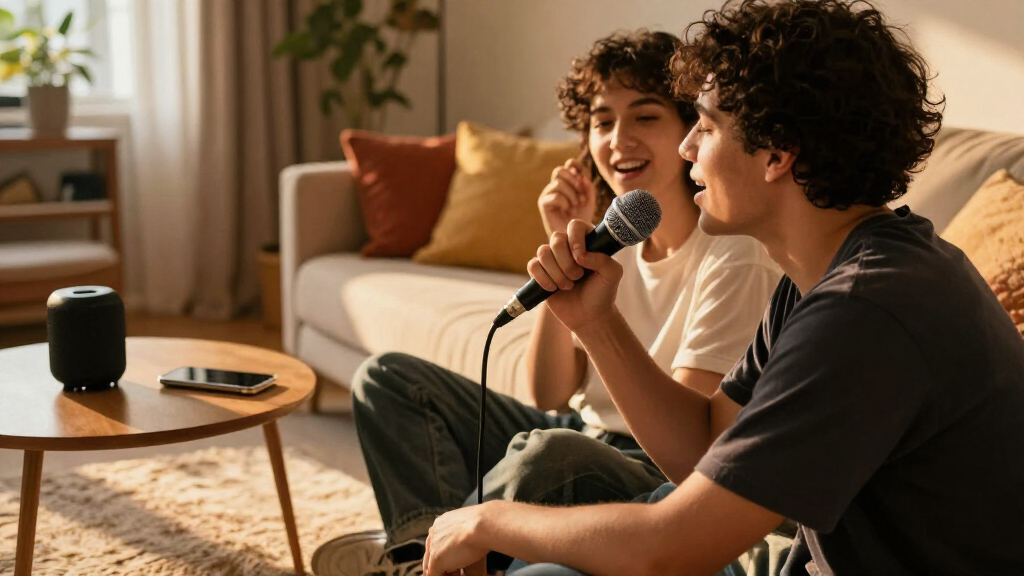

Wireless karaoke microphones range from portable Bluetooth singing mics to dual-handheld systems with a receiver for a speaker or mixer. My best overall pick is the JBL Wireless Two-Microphone System for buyers who want two mics and a dedicated receiver, while the BONAOK Q37 suits casual singing on the go and the Phenyx Pro PTU-71-2H is a stronger fit for more demanding group use. The main choice is between a self-contained mic that keeps setup simple and a receiver-based system that offers more flexibility but needs compatible audio equipment. Battery life, connection type, and the number of singers also change which setup makes sense. Read on for the full breakdown and help matching each option to your karaoke setup.

Get audio and creator gear delivered free with Prime
- Fast, free delivery on millions of items
- Prime Video, Amazon Music and more included
- Member-only deals all year
Complete the kit


Key Takeaways
- System type is the biggest dividing line: the BONAOK Q37 and Q78 are portable Bluetooth microphone options, while receiver-based models such as the JBL Wireless Two-Microphone System need a separate compatible speaker or audio setup.
- Two-mic bundles suit shared singing: options including the JBL PartyBox Wireless Microphones, Phenyx Pro PTU-71-2H, and TONOR TW360 bundle two handheld mics, so buyers can choose by compatibility and system features rather than mic count alone.
- UHF and 2.4 GHz serve different setups: several receiver systems use UHF, while the HUACAM W58 uses 2.4 GHz; buyers should check local wireless conditions and the included receiver before choosing.
- Portability brings different tradeoffs: standalone Bluetooth mics reduce the gear needed for casual singing, while dual handheld receiver systems are better suited to connecting with existing speakers or mixers.
- Feature claims matter only when they match the use: the ECHOMUSSY‘s stated 40-hour battery claim may appeal to extended sessions, while LED effects on the BONAOK Q78 favor a more playful setup; neither replaces checking how the mic connects to the intended speaker.
| Wireless Dual Handheld Dynamic Microphone System |  | Best for Simple Duets | Microphone type: Handheld dynamic | Microphone count: 2 | Connectivity: Wireless; receiver has 3.5 mm and 6.35 mm microphone connections | VIEW LATEST PRICE | See Our Full Breakdown |
| Kelgyua Dual UHF Metal Handheld Wireless Microphone System |  | Best for Large Rooms | Model: KM-822 | Microphone count: 2 | Frequency channels: 2 × 100 selectable UHF channels | VIEW LATEST PRICE | See Our Full Breakdown |
| WONATU G26-S Dual Wireless Karaoke Microphones |  | Best Rechargeable Duo | Model: G26-S | Microphone count: 2 | Wireless connection: 2.4 GHz | VIEW LATEST PRICE | See Our Full Breakdown |
| BONAOK Q37 Wireless Bluetooth Karaoke Microphone, Rose Gold |  | Best for Phone Karaoke | Model: Q37 | Color: Rose Gold | Connectivity: Bluetooth and cable | VIEW LATEST PRICE | See Our Full Breakdown |
| ECHOMUSSY Wireless Handheld Microphone with 40-Hour Battery |  | Best for Long Sessions | Wireless connection: 2.4 GHz | Microphone count: 1 | Connectors: 3.5 mm and 6.35 mm jacks | VIEW LATEST PRICE | See Our Full Breakdown |
| BONAOK Q78 Portable Bluetooth Karaoke Microphone with LED Lights |  | Best for Casual Sing-Along Fun | Model: Q78 | Connectivity: Bluetooth 5.0 | Functions: Wireless microphone, Bluetooth speaker, MP3 player | VIEW LATEST PRICE | See Our Full Breakdown |
| Dual Rechargeable All-Metal Wireless Karaoke Microphones |  | Best for Long Duet Sessions | Microphones: 2 handheld dynamic cardioid microphones | Wireless connectivity: 2.4 GHz | Wireless range: Up to 200 ft (60 m) in open, unobstructed environments | VIEW LATEST PRICE | See Our Full Breakdown |
| HUACAM W58-2.4G Dual Wireless Microphone System |  | Best for Lightweight Event Use | Model: W58-2.4G | Microphones: 2 handheld | Wireless frequency: 2.4 GHz | VIEW LATEST PRICE | See Our Full Breakdown |
| TONOR TW360 UHF Wireless Microphone System, Gray | 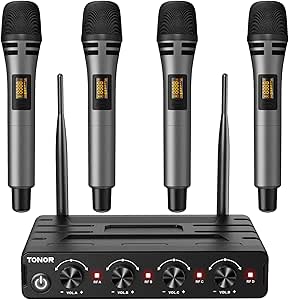 | Best for Channel Flexibility | Model: TW360 | Wireless connectivity: UHF | Selectable channels: 40 (4 × 10) | VIEW LATEST PRICE | See Our Full Breakdown |
| Phenyx Pro Dual UHF Auto Scan Handheld Wireless Microphone System PTU-71-2H |  | Best for Large Rooms and Events | Model: PTU-71-2H | Frequency range: 530–580 MHz | Channels: 2 | VIEW LATEST PRICE | See Our Full Breakdown |
| HUACAM Wireless Karaoke Microphone Set with Receiver, Gray |  | Best for Simple Two-Singer Setups | Microphones: 2 handheld wireless microphones | Wireless frequency: 2.4 GHz | Channels: 1 | VIEW LATEST PRICE | See Our Full Breakdown |
| ALPOWL Wireless Handheld Microphone System with Rechargeable Receiver |  | Best for Rechargeable Range | Channels: 2 | Wireless range: Up to 200 ft (60 m) | Microphone type: Handheld dynamic | VIEW LATEST PRICE | See Our Full Breakdown |
| Talomen K60-2 Dual Handheld Wireless Microphone System |  | Best for Rechargeable Flexibility | Microphones: 2 handheld microphones | Wireless transmission: 2.4 GHz | Wireless range: Up to 160 ft (50 m) | VIEW LATEST PRICE | See Our Full Breakdown |
| JBL Wireless Two-Microphone System with Dual-Channel Receiver |  | Best for JBL PartyBox Plug-and-Play | Channels: 2 | Microphone pattern: Unidirectional | Frequency range: 65–15,000 Hz | VIEW LATEST PRICE | See Our Full Breakdown |
| JBL PartyBox Wireless Microphones, 2-Pack |  | Best for Long PartyBox Sessions | Microphones: 2 handheld wireless microphones | Compatibility: JBL PartyBox speakers | Wireless connection: 2.4 GHz via digital dongle | VIEW LATEST PRICE | See Our Full Breakdown |
More Details on Our Top Picks
Wireless Dual Handheld Dynamic Microphone System
I’d choose this set for duets on a speaker or karaoke machine that already has a microphone input. It includes two handheld dynamic microphones and a receiver, so two singers can join in without adding a separate transmitter. Its 3.5 mm and 6.35 mm connections fit a range of compatible audio gear, and the stated line-of-sight range reaches 200 feet. Compared with the WONATU G26-S, it has a shorter stated range and no stated rechargeable microphone battery, but its straightforward jack-based setup may suit buyers who want a basic receiver system. The main limitation is compatibility: it won’t connect directly to a phone, computer, or tablet, and a headphone or AUX input alone may not work. I’d skip it if your karaoke setup is phone-only.
Pros:- Includes two handheld microphones for duet singing
- Receiver supports 3.5 mm and 6.35 mm microphone inputs
- Stated line-of-sight range reaches 200 feet
- Metal microphone enclosures and included anti-slip rings
Cons:- Does not connect directly to phones, computers, or tablets
- Requires an audio device with a compatible microphone input
- No rechargeable battery runtime is specified
Best for: Two singers using a karaoke machine, PA system, amplifier, or speaker with a 3.5 mm or 6.35 mm microphone input
Not ideal for: Phone-only karaoke users and buyers whose speakers have AUX inputs but no microphone input
- Microphone type:Handheld dynamic
- Microphone count:2
- Connectivity:Wireless; receiver has 3.5 mm and 6.35 mm microphone connections
- Stated range:Up to 200 feet line of sight
- Polar pattern:Unidirectional
- Impedance:600 ohm
- Signal-to-noise ratio:70 dB
- Enclosure material:Metal
Our verdict“Pick this for simple two-person karaoke with compatible audio gear; skip it if you need direct phone connectivity.”
Kelgyua Dual UHF Metal Handheld Wireless Microphone System
For karaoke in a large room or event space, the Kelgyua KM-822 stands out for its stated range of up to 500 feet, the longest specified here among these five products. Auto-scan and IR sync can make setup less fiddly when choosing a channel, while individual mute buttons give singers or hosts a quick way to silence a mic between turns. Compared with the Wireless Dual Handheld Dynamic Microphone System, Kelgyua adds UHF channel selection, LCD displays, and XLR output, which better suits a PA setup. That extra event flexibility comes with two practical catches: it uses AAA batteries with no rechargeable option stated, and the listed warranty is only one month. I’d favor it for a compatible PA system, not a compact phone-based karaoke setup.
Pros:- Stated wireless range reaches up to 500 feet
- Auto-scan and IR sync simplify channel setup
- Individual mute buttons and LCD displays on the microphones
- Receiver offers both 6.35 mm and XLR outputs
Cons:- Microphones require AAA batteries and have no stated rechargeable option
- Listed warranty is one month
- Requires compatible audio equipment with a microphone input
Best for: Hosts and singers using a PA system in a large room who want two mics, channel selection, and XLR output
Not ideal for: Buyers seeking rechargeable microphones, a longer stated warranty, or direct phone connectivity
- Model:KM-822
- Microphone count:2
- Frequency channels:2 × 100 selectable UHF channels
- Stated range:Up to 500 feet
- Pickup pattern:Cardioid
- Outputs:6.35 mm jack and XLR
- Power:2 AAA batteries per microphone, included
- Warranty:1 month
Our verdict“Choose Kelgyua for long-range karaoke through a PA system if you’re comfortable supplying AAA batteries.”
WONATU G26-S Dual Wireless Karaoke Microphones
The WONATU G26-S is the clearest fit here for duet singers who want to avoid frequent battery changes: its rechargeable microphones are stated to run for over 40 hours per charge. The receiver has both 3.5 mm and 6.35 mm plugs, giving it more connection flexibility than the ECHOMUSSY Wireless Handheld Microphone, which is explicitly not compatible with AUX jacks. WONATU also lists 99 channels and a stated range of up to 260 feet, plus DSP feedback and noise reduction intended to help keep vocals usable in a karaoke mix. It still needs compatible audio equipment; it is not a phone microphone. One detail deserves caution: warranty information conflicts, with 12 months stated in the description and 1 month in item details. I’d confirm coverage before relying on the longer term.
Pros:- Two rechargeable microphones support duet singing
- Battery life is stated as over 40 hours per charge
- Receiver has both 6.35 mm and 3.5 mm plugs
- DSP is described as reducing feedback and background noise
Cons:- Requires compatible audio equipment rather than connecting directly to a phone
- Warranty information conflicts between the description and item details
Best for: Duet singers with a karaoke machine or speaker input who want rechargeable mics and multiple receiver plug options
Not ideal for: Phone-only karaoke users and buyers who need a clearly consistent warranty term
- Model:G26-S
- Microphone count:2
- Wireless connection:2.4 GHz
- Channels:99
- Stated range:Up to 260 feet
- Battery life:Over 40 hours per charge
- Charging port:USB Type-C
- Receiver connectors:6.35 mm and 3.5 mm
- Body material:Metal
Our verdict“Choose the G26-S for rechargeable duets and flexible receiver plugs, after confirming the warranty and your audio input.”
BONAOK Q37 Wireless Bluetooth Karaoke Microphone, Rose Gold
If your karaoke library lives on a phone, the BONAOK Q37 is the most self-contained choice in this group: it connects by Bluetooth or cable and combines a microphone with a speaker, MP3 player, and recorder. Separate music, microphone, and echo controls let a singer adjust the mix on the handheld unit, without the receiver and separate audio system needed by the Kelgyua KM-822. That convenience changes the use case: it’s a personal karaoke gadget, not a two-mic PA system for a room full of singers. Bluetooth range is stated at 10 m, and a microSD card up to 32 GB can hold music, but the card is not included. I’d pick it for casual solo singing and skip it when you need duets, greater room coverage, or a dedicated PA connection.
Pros:- Connects to smartphones by Bluetooth or cable
- Combines microphone, speaker, MP3 player, and recorder functions
- Separate controls for microphone, echo, and music volume
- Supports microSD cards up to 32 GB
Cons:- MicroSD card is not included
- Bluetooth range is stated as 10 m
- Single handheld unit does not provide a two-microphone duet setup
Best for: Solo singers and families who want phone-based karaoke with built-in playback and simple on-device controls
Not ideal for: Duet singers, PA hosts, and buyers who need a separate receiver or longer-range room coverage
- Model:Q37
- Color:Rose Gold
- Connectivity:Bluetooth and cable
- Bluetooth range:10 m
- MicroSD support:Up to 32 GB
- Microphone type:Handheld, unidirectional
- Audio sensitivity:80 dB
- Signal-to-noise ratio:120 dB
- Dimensions:4.25 × 3.86 × 11.02 inches
Our verdict“Choose the Q37 for casual phone-based solo karaoke; choose a receiver system such as the WONATU G26-S for duets.”
ECHOMUSSY Wireless Handheld Microphone with 40-Hour Battery
For a karaoke host who wants one microphone ready through a long event, the ECHOMUSSY pairs a stated up to 40-hour battery life with a 2.4 GHz connection and plug-and-play setup. Its hypercardioid pattern and listed noise reduction are aimed at keeping the vocal pickup focused, while the metal enclosure adds a sturdier feel than a basic plastic handheld. Compared with the dual-mic WONATU G26-S, this is a single-microphone option, so it suits solo turns better than duets; its stated range is also shorter at up to 200 feet. Check the input carefully: despite the listed 3.5 mm and 6.35 mm connectors, the product specifically says it is not compatible with AUX jacks. I’d shortlist it for a compatible mixer or karaoke machine, not a generic AUX speaker.
Pros:- Battery life is stated as up to 40 hours
- Stated wireless range reaches up to 200 feet
- Hypercardioid pickup and noise reduction are aimed at focused vocals
- Metal enclosure and plug-and-play setup with compatible microphone jacks
Cons:- Not compatible with AUX jacks
- Single microphone does not support two-singer duets by itself
- Requires compatible audio equipment with a microphone input
Best for: Solo singers and karaoke hosts with a compatible microphone input who want long stated runtime between charges
Not ideal for: Duet setups and buyers whose speaker offers only an AUX input
- Wireless connection:2.4 GHz
- Microphone count:1
- Connectors:3.5 mm and 6.35 mm jacks
- Pickup pattern:Hypercardioid
- Battery capacity:1200 mAh
- Battery life:Up to 40 hours
- Stated range:Up to 200 feet
- Signal-to-noise ratio:105 dB
- Enclosure material:Metal
Our verdict“Pick the ECHOMUSSY for long solo karaoke sessions with compatible gear, but avoid it for AUX-only speakers or duets.”
BONAOK Q78 Portable Bluetooth Karaoke Microphone with LED Lights
The BONAOK Q78 puts the speaker, microphone, and music player in one handheld unit, so it suits casual singing without a separate karaoke receiver. Its Bluetooth 5.0 connection lets a phone supply songs, while TF card playback offers another option when a card is available. The echo effect and music-responsive lights add a playful feel that the more performance-focused Phenyx Pro PTU-71-2H does not prioritize. That simplicity comes with limits: the Q78 is a self-contained personal karaoke device, not a pair of microphones for duets or a system for connecting to a PA. Its TF card is not included, and the built-in battery cannot be replaced by the user. I’d choose it for easy home sing-alongs, but skip it when room coverage or multiple singers matter.
Pros:- Combines a microphone, Bluetooth speaker, and MP3 player in one handheld unit
- Bluetooth and TF card playback provide two ways to play songs
- Echo effect and music-responsive LED lights add karaoke-style effects
- Built-in rechargeable battery avoids disposable batteries during normal use
Cons:- Only one handheld microphone is included, limiting duet use
- TF card is not included
- Built-in battery is non-removable
Best for: Families or casual singers who want a single Bluetooth microphone and speaker for home sing-alongs.
Not ideal for: Duets, larger rooms, or buyers who need microphones to connect to a karaoke machine or PA system.
- Model:Q78
- Connectivity:Bluetooth 5.0
- Functions:Wireless microphone, Bluetooth speaker, MP3 player
- Playback:TF card support; card not included
- Effects:Echo effect and dynamic LED lights
- Microphone pattern:Unidirectional
- Battery:Built-in rechargeable, non-removable
- Dimensions:4.25 x 3.86 x 11.02 inches
Our verdict“Choose the Q78 for light, self-contained sing-alongs; choose a receiver-based system when you need duets or PA compatibility.”
Dual Rechargeable All-Metal Wireless Karaoke Microphones
For duet hosts who already own audio gear, this two-microphone set prioritizes endurance and control. The 2.4 GHz receiver connects to equipment with a dedicated 3.5 mm or 6.35 mm microphone input, and each handheld has its own volume control and LCD display. That makes it easier to balance two singers than with a single-unit option such as the BONAOK Q78. The listed range reaches 200 ft in open conditions, while battery life is rated up to 40 hours, a useful fit for repeated events between charges. Cardioid pickup and DSP noise reduction are intended to keep attention on vocals. The tradeoff is compatibility: this system does not connect directly to phones, laptops, TVs, or Bluetooth-only speakers. Its plug-and-play setup is simple only if the right input is already available.
Pros:- Includes two handheld microphones with independent volume controls
- Up to 40 hours of use is suited to extended or repeated sessions
- LCD displays show microphone information during use
- Cardioid capsules and DSP noise reduction focus on vocals
Cons:- Requires audio equipment with a dedicated 3.5 mm or 6.35 mm microphone input
- Not compatible with phones, laptops, TVs, or Bluetooth-only speakers
Best for: Duet hosts and event organizers with a karaoke machine, mixer, or powered speaker that has a dedicated microphone input.
Not ideal for: Phone-only karaoke users or anyone relying on Bluetooth-only speakers, since those devices are listed as incompatible.
- Microphones:2 handheld dynamic cardioid microphones
- Wireless connectivity:2.4 GHz
- Wireless range:Up to 200 ft (60 m) in open, unobstructed environments
- Battery life:Up to 40 hours
- Receiver:Rechargeable
- Connectors:3.5 mm and 6.35 mm
- Features:DSP noise reduction, LCD displays, independent volume controls
- Enclosure:Metal
Our verdict“Pick this set for long duet sessions with compatible audio gear, but choose the BONAOK Q78 for phone-based, all-in-one karaoke.”
HUACAM W58-2.4G Dual Wireless Microphone System
The HUACAM W58 is a compact-minded choice for buyers who need two microphones and a receiver for short karaoke sessions, speeches, or small events. Its 2.4 GHz link and plug-and-play setup keep the basic arrangement straightforward, while the receiver is rated for 5–6 hours of operation after a 2–3 hour charge. That is a much shorter stated run time than the 40-hour Dual Rechargeable All-Metal system, so I’d favor the latter for frequent, lengthy events. The W58’s included 3.5 mm adapter and anti-slip rings help with setup and handling, but its listed Lightning connector and auxiliary connection details call for care when checking compatibility with your equipment. The microphones also use included batteries, and only one channel is listed, a potential limitation for managing two simultaneous vocal signals.
Pros:- Two handheld microphones support duet and shared event use
- Plug-and-play setup helps reduce setup steps
- Rechargeable receiver is rated for 5–6 hours of operation
- Includes a 3.5 mm adapter, anti-slip rings, and charging cable
Cons:- Microphones require batteries, adding a separate power requirement
- Receiver operating time is shorter than the 40-hour Dual Rechargeable All-Metal system
- Only one channel is listed, leaving simultaneous microphone handling unclear
Best for: Traveling hosts or event speakers who want two lightweight handhelds for sessions lasting up to several hours.
Not ideal for: Frequent long events or buyers who need clearly specified independent microphone channels and broad equipment compatibility.
- Model:W58-2.4G
- Microphones:2 handheld
- Wireless frequency:2.4 GHz
- Receiver battery:1500 mAh
- Receiver charging time:2–3 hours
- Operating time:5–6 hours
- Connector:Lightning
- Included accessories:Receiver, 3.5 mm adapter, 2 anti-slip rings, 3 batteries, USB charging cable
Our verdict“Choose the W58 for lightweight, shorter events, and favor the Dual Rechargeable All-Metal set for longer sessions and clearer individual controls.”
TONOR TW360 UHF Wireless Microphone System, Gray
The TONOR TW360 suits karaoke setups where wireless interference is a concern and the host wants options for changing frequencies. Its receiver offers 40 selectable channels and automatically syncs with the transmitter, reducing manual setup when a channel needs to change. The listed 200 ft range gives more room to move than a short-range home setup, though performance is specified for the system generally rather than a particular room. Compared with the HUACAM W58, the TW360 has more clearly stated channel selection, but it is a single-microphone system rather than a two-mic duet set. It connects through a 6.35 mm jack, so the receiving equipment needs a matching microphone input. Power comes from two AA batteries per microphone, and those batteries are not included.
Pros:- 40 selectable channels provide options when a frequency needs changing
- Automatic transmitter syncing simplifies setup
- Listed wireless range reaches 200 ft (60 m)
- Unidirectional pickup is designed to reduce background noise
Cons:- Only one microphone is specified, so it does not support duets out of the box
- Requires a 6.35 mm microphone input
- Two AA batteries are required and not included
Best for: Karaoke hosts with a mixer, amplifier, or speaker that has a 6.35 mm microphone input and may need to change UHF channels.
Not ideal for: Duet users who need two microphones in the box or buyers without a compatible 6.35 mm input.
- Model:TW360
- Wireless connectivity:UHF
- Selectable channels:40 (4 × 10)
- Wireless range:Up to 200 ft (60 m)
- Connector:6.35 mm jack
- Pickup pattern:Unidirectional
- Power:2 AA batteries per microphone; not included
- Compatible equipment:Mixers, karaoke machines, amplifiers, and speakers
Our verdict“Choose the TW360 for a single singer who needs selectable UHF channels and has a compatible 6.35 mm input.”
Phenyx Pro Dual UHF Auto Scan Handheld Wireless Microphone System PTU-71-2H
With two handheld microphones, Auto Scan, and a stated line-of-sight range of up to 328 ft, the Phenyx Pro PTU-71-2H is aimed at event hosts who need room to move and a way to find a clearer frequency. It offers up to 100 selectable frequencies per channel across two channels, a more event-oriented setup than the TONOR TW360, which lists 40 selectable channels and one microphone. The metal construction and included cables and adapters also make this a fuller kit for connecting to compatible audio equipment. Its receiver weighs 2.7 kg, which makes it less convenient to carry than a lightweight system such as the HUACAM W58. The included eight AA batteries cover the full set, but ongoing use still depends on replacing batteries. The long range is specified for line of sight.
Pros:- Two-channel system includes two handheld dynamic microphones
- Auto Scan selects a frequency to reduce interference
- Up to 328 ft line-of-sight range supports movement across larger spaces
- Metal construction and included cables and adapters provide a substantial setup kit
Cons:- Receiver weighs 2.7 kg, making transport less convenient
- Requires eight AA batteries for operation
- Maximum range is specified for line-of-sight conditions
Best for: Event hosts and karaoke operators who need two microphones, selectable UHF frequencies, and long line-of-sight coverage.
Not ideal for: Travelers who prioritize a lightweight receiver or buyers seeking rechargeable microphones and receiver power.
- Model:PTU-71-2H
- Frequency range:530–580 MHz
- Channels:2
- Selectable frequencies:100 per channel
- Maximum range:Up to 328 ft (line of sight)
- Power:8 AA batteries included
- Connectors:6.35 mm jack and XLR
- Receiver weight:2.7 kg
Our verdict“Pick the PTU-71-2H for two-mic events that benefit from frequency scanning and long line-of-sight range, if receiver weight and AA power suit your setup.”
HUACAM Wireless Karaoke Microphone Set with Receiver, Gray
The HUACAM set gives two singers separate handheld microphones and a receiver, making it a straightforward fit for home karaoke with compatible audio gear. Its 2.4 GHz connection and included 3.5 mm adapter offer a few ways to connect, while noise reduction may help keep vocals clearer in a casual room. Compared with the ALPOWL system, HUACAM has fewer stated setup and battery details, so buyers get less guidance about runtime and range. Its receiver is single channel, which may limit how the two microphones are handled by compatible equipment. The microphones also use three included AA batteries rather than rechargeable power. Choose it for a basic two-mic kit; skip it if rechargeable microphones or independently specified channels matter to you.
Pros:- Includes two handheld wireless microphones and a receiver
- 2.4 GHz wireless operation
- Included 3.5 mm adapter expands connection options for compatible equipment
- Noise-reduction feature is listed
Cons:- Microphones require three AA batteries
- Single-channel specification may constrain use with some audio setups
- Range and battery runtime are not specified
Best for: Households that want two microphones for casual singing with an amplifier or mixer that accepts the included adapter
Not ideal for: Buyers who want rechargeable microphones, clearly specified range, or a multi-channel receiver
- Microphones:2 handheld wireless microphones
- Wireless frequency:2.4 GHz
- Channels:1
- Connectors:3.5 mm jack and 6.35 mm jack
- Included accessory:Receiver and 3.5 mm adapter
- Power:3 included AA batteries
- Special feature:Noise reduction
Our verdict“Pick HUACAM for a basic two-singer kit with an adapter; choose ALPOWL if rechargeable power and stated range are higher priorities.”
ALPOWL Wireless Handheld Microphone System with Rechargeable Receiver
The ALPOWL system suits buyers who want two wireless channels and rechargeable microphones for karaoke, speeches, or small events. Its listed range of up to 200 feet gives more room to move than the Talomen K60-2’s stated 160 feet, though real performance depends on the space and setup. USB-C charging and plug-and-play operation reduce battery swaps and setup steps, while DSP noise reduction adds a useful feature for spoken vocals as well as singing. There is a notable specification conflict: the details state up to 10 hours of microphone life, while the title claims 50 hours, so I would not plan around the longer figure. The receiver also needs a microphone jack, which rules out some speakers and devices.
Pros:- Two-channel handheld system
- USB-C charging for microphones and receiver
- Stated wireless range up to 200 feet
- Plug-and-play setup and DSP noise reduction
Cons:- Runtime claims conflict between 10 and 50 hours
- Receiver requires a microphone jack
- Initial pairing may take 1–3 minutes
Best for: Hosts and karaoke singers with compatible microphone-jack equipment who want rechargeable mics and a stated long wireless range
Not ideal for: Buyers who need a clearly documented runtime or want to connect through AUX, a phone, or a computer
- Channels:2
- Wireless range:Up to 200 ft (60 m)
- Microphone type:Handheld dynamic
- Polar pattern:Omnidirectional
- Microphone battery life:Up to 10 hours listed in details
- Charging:USB-C; 3–4 hours to fully charge
- Connector:6.35 mm jack
- Frequency range:0.05–18 kHz
Our verdict“Choose ALPOWL for rechargeable two-channel use and a longer stated range, provided its runtime ambiguity and microphone-jack connection work for you.”
Talomen K60-2 Dual Handheld Wireless Microphone System
The Talomen K60-2 is a practical choice for singers who need two microphones and want rechargeable batteries instead of the AA-powered setup in the HUACAM set. Its 2.4 GHz link has a stated range of up to 160 feet, and the package includes adapters for both 6.35 mm and 3.5 mm microphone inputs. That flexibility depends on having a microphone input: Talomen explicitly excludes AUX and line inputs, and it does not work with phones, computers, or tablets. The rechargeable AA cells and USB-C receiver charging can reduce disposable battery use, while the unidirectional dynamic mics focus pickup toward the singer. This makes it a better fit for compatible speakers, amplifiers, and mixers than for mobile karaoke or general-purpose audio connections.
Pros:- Two handheld microphones with rechargeable AA batteries
- USB-C charging and stated battery life over 10 hours
- Adapters support 6.35 mm and 3.5 mm microphone inputs
- Stated wireless range up to 160 feet
Cons:- Does not support AUX or line inputs
- Not compatible with phones, computers, or tablets
- Requires audio equipment with a microphone input
Best for: Two-person karaoke users with speaker or amplifier microphone inputs who want rechargeable batteries and both common mic-jack adapter sizes
Not ideal for: Phone, tablet, and computer karaoke users, or anyone whose speaker only has AUX or line input
- Microphones:2 handheld microphones
- Wireless transmission:2.4 GHz
- Wireless range:Up to 160 ft (50 m)
- Microphone type:Dynamic, unidirectional
- Frequency range:2402–2480 MHz
- Battery life:More than 10 hours
- Charging:USB-C; 2–3 hours
- Inputs supported:6.35 mm or 3.5 mm microphone input
Our verdict“Pick Talomen for rechargeable two-mic karaoke on compatible mic inputs; skip it if you need phone or AUX connectivity.”
JBL Wireless Two-Microphone System with Dual-Channel Receiver
For owners of a compatible JBL PartyBox speaker, this set keeps setup simple: connect the dual-channel receiver and use two microphones without a separate pairing process. The listed 65–15,000 Hz frequency range and unidirectional pattern give buyers concrete audio details, while JBL describes the vocals as clear with no noticeable distortion or delay. Compared with the JBL PartyBox Wireless Microphones, this system is the more direct receiver-based option, but it has a shorter listed playback time of up to six hours and replaceable AA microphone batteries. Compatibility is also the central constraint: the product is intended for a listed range of JBL PartyBox speakers, so owners of other karaoke equipment should check fit before choosing it. It is a focused speaker companion rather than a flexible universal system.
Pros:- Two microphones and a dual-channel receiver
- Simple plug-and-play setup with compatible speakers
- Unidirectional microphones
- Receiver playback listed up to six hours
Cons:- Compatibility is limited to a listed range of JBL PartyBox speakers
- Microphones use replaceable AA batteries
- Up to six hours of receiver playback may not cover longer events
Best for: JBL PartyBox owners who want a dual-mic kit with a simple receiver connection for karaoke and announcements
Not ideal for: Buyers with non-JBL equipment or singers who need longer sessions without changing microphone batteries
- Channels:2
- Microphone pattern:Unidirectional
- Frequency range:65–15,000 Hz
- Signal-to-noise ratio:60 dB
- Playback time:Up to 6 hours
- Microphone batteries:Replaceable AA batteries
- Receiver power:Lithium polymer battery
- Weight:1.2 lb
Our verdict“Choose this system if you own a compatible PartyBox and value a straightforward dual-mic connection over broader compatibility or longer runtime.”
JBL PartyBox Wireless Microphones, 2-Pack
The JBL PartyBox Wireless Microphones are built for singers who already use a compatible PartyBox and want a long-running pair of handheld mics. Their cardioid pickup, built-in pop filter, and shock mounts are aimed at reducing breath noise and handling bumps, which can help voices stay clearer in a lively room. JBL lists up to 20 hours of use, falling to up to 12 hours with the digital dongle; a quick 10-minute charge is listed for up to two hours of play. Compared with the JBL Wireless Two-Microphone System, this pair offers longer stated runtime but requires its digital dongle for wireless connection. The same PartyBox compatibility limit applies, so this is a specialized add-on rather than a general-purpose microphone set.
Pros:- Two handheld microphones with rechargeable batteries
- Up to 20 hours of use listed, or up to 12 hours with the dongle
- Cardioid pickup, pop filter, and shock mounts help limit unwanted noise
- Can be used while charging
Cons:- Designed for JBL PartyBox speakers
- Wireless connection requires the digital dongle
- Dongle use reduces stated runtime to up to 12 hours
Best for: PartyBox owners who sing through long gatherings and want rechargeable microphones with noise-reducing design features
Not ideal for: Buyers using non-PartyBox audio gear or those who want a wireless setup without a separate digital dongle
- Microphones:2 handheld wireless microphones
- Compatibility:JBL PartyBox speakers
- Wireless connection:2.4 GHz via digital dongle
- Wireless range:Up to 30 meters
- Polar pattern:Unidirectional (cardioid)
- Battery life:Up to 20 hours; up to 12 hours with digital dongle
- Recharge time:10 minutes provides up to 2 hours of playtime
- Frequency range:50–15,000 Hz
Our verdict“Choose this pair for extended karaoke sessions with a compatible PartyBox; the standard JBL system may suit buyers who prefer a simpler receiver connection.”

How We Picked
I compared these 15 options by how well their form and connection type match common karaoke setups: casual home singing, group sessions, portable use, and connection to a larger audio system. I weighed whether each listing describes one mic or a dual set, whether it includes a receiver, its stated wireless method, battery or recharge features, and practical extras such as lights or a metal build. These details shape setup effort and compatibility more than a feature count does.
The ranking favors versatile systems with a clear path to two-person singing and connection to suitable audio gear, then places portable Bluetooth mics where simplicity and self-contained use matter more. Premium positioning depends on the stated system design and brand-specific compatibility, not on unverified sound quality claims. Product names and descriptions alone do not establish measured range, latency, durability, or real-world battery performance, so I treat those as points buyers should verify before choosing.
Factors to Consider When Choosing Wireless Karaoke Microphones
Start with the audio equipment you already own, then decide how many people need to sing at once. Those two choices will narrow the field faster than choosing by color or effects. The following checks help avoid mismatched connections and features that add little to your setup.
Match the microphone to your speaker
A Bluetooth karaoke mic and a receiver-based wireless mic solve different connection problems. Before buying, check the speaker’s input types and whether it can accept a microphone signal, since a Bluetooth music connection alone may not support microphone audio. Receiver systems often connect by cable to a speaker, mixer, or amplifier, so confirm the included receiver’s output fits your equipment. Do not assume that any wireless mic will pair directly with any Bluetooth speaker. If you are buying a speaker too, check that both products support the same connection path. This simple compatibility check can matter more than extra effects or a claimed wireless range.
Choose for one singer or a group
For duets and parties, two included microphones can save the trouble of sourcing a matched second unit. Check whether the system supports both mics at the same time and whether its receiver has separate channels or controls; a two-mic bundle does not automatically mean independent volume adjustment. A single portable mic may be easier to pass around at a small gathering, but handoffs can interrupt a song. If children or occasional singers will use it, simple controls and a clear way to mute or adjust volume can matter more than advanced receiver features. Think about where the microphones will be stored between gatherings, since a two-mic kit takes more space. Buy for the usual number of simultaneous singers, not the largest party you might host once.
Understand wireless bands and your surroundings
Wireless systems can use different bands, and the environment affects how reliably they work. UHF systems and 2.4 GHz systems are not interchangeable, and nearby wireless devices or crowded venues can influence performance. For home use, the right choice is usually the system that connects cleanly with your audio gear and has a straightforward setup. For events, check the manufacturer’s frequency details and guidance for using multiple systems nearby. A scan feature, where included, can help find a clearer channel, but it cannot remove every source of interference. Treat stated range as a specification to verify against your room or venue rather than a guarantee through walls or across a busy space.
Read battery claims in context
Battery life affects whether a mic is ready for a long session, but a quoted runtime is usually tied to particular usage conditions. Check whether the microphone, receiver, or both need charging, and find out whether the receiver uses a separate power source. Rechargeable designs can reduce disposable battery use, while replaceable batteries may be easier to swap during an event. For a portable mic, consider how it charges and whether you can recharge it between sessions. Long sessions with lights or other active features may use power differently from basic operation. Keep a charging plan that fits the way the mic will be used, especially if the setup is meant for a party away from a wall outlet.
Pay for features that change how you sing
Effects and LED lights can add fun, but they do not make a mic compatible with a speaker or improve the basic setup by themselves. For a family karaoke night, playful effects may be part of the appeal; for a living-room system connected to a receiver, stable controls and suitable outputs may matter more. Metal construction can appeal to buyers looking for a sturdier handheld feel, though material alone does not establish long-term durability. Decide whether you need echo or volume controls on the mic, on the receiver, or in your speaker’s app. Extra controls are useful only when they are easy for the singer to reach and do not complicate setup. Prioritize the feature that solves a real problem in your routine.
Frequently Asked Questions
Can I connect a wireless karaoke microphone to any Bluetooth speaker?
No. Some portable karaoke microphones connect to a phone or speaker over Bluetooth for music, but microphone audio may use a separate built-in speaker or another output path. Receiver-based microphones typically need a speaker or amplifier with a compatible input. Check the mic’s connection diagram and the speaker’s available inputs before ordering. If your speaker has no microphone input, a separate receiver or mixer may be needed.
Should I choose UHF or 2.4 GHz for home karaoke?
Neither band is automatically best for every home. UHF receiver systems can suit a setup built around a speaker or mixer, while a 2.4 GHz option may fit buyers who prefer that wireless format. Nearby devices and the layout of the room can affect either system. Compare the included receiver, channel controls, and the manufacturer’s setup guidance against your existing equipment. For occasional singing in one room, compatibility and simple operation are often the more useful deciding points.
Do two-microphone systems let both singers control their own volume?
Not always. A two-mic package tells you how many microphones are included, but it does not by itself confirm separate volume controls or independent channel adjustment. Look for receiver controls or product documentation that explicitly describes separate levels. This matters when singers have different vocal volumes or are standing at different distances from the speaker. If independent adjustment is important, verify it before choosing a bundle.
Is a portable Bluetooth karaoke mic enough for a party?
It can be enough for a small, casual gathering if its connection works with the music source and the built-in or connected speaker suits the room. A standalone format usually reduces the number of pieces to set up, but it may offer fewer options for connecting to larger audio gear. For a group that wants duets or louder sound, a two-mic receiver system connected to a suitable speaker may be a better fit. Check whether the portable model supports the number of singers you expect and how music and mic audio are routed. Party size and speaker compatibility matter more than portability alone.
When is it worth choosing a premium receiver-based system?
It makes sense when you already have compatible sound equipment, expect regular group use, or need a two-mic setup designed to connect through a receiver. A premium label alone does not establish better range or sound, so compare the actual connection details, channel controls, included accessories, and operating requirements. For occasional home singing, a simpler portable mic may involve less setup. For a larger system, check that the receiver output matches your speaker or mixer and that the wireless band suits the environment. Pay for capabilities you will use in your setup rather than assuming a higher tier will solve compatibility issues.
Conclusion
For the broadest two-mic receiver setup, my best overall choice is the JBL Wireless Two-Microphone System, provided its receiver fits your audio gear. The best value for a simple portable setup is the BONAOK Q37 for casual singing, while buyers who want a more feature-rich receiver system can look at the Phenyx Pro PTU-71-2H as a premium-oriented option. For beginners, a portable mic such as the BONAOK Q78 keeps the experience playful and straightforward; for extended sessions, the ECHOMUSSY stands out for its stated battery claim, which buyers should verify against their usage. If you are choosing for a JBL PartyBox setup, consider the JBL PartyBox Wireless Microphones and confirm compatibility with your specific speaker. Match the connection and number of mics to your setup, and the shortlist becomes much easier.