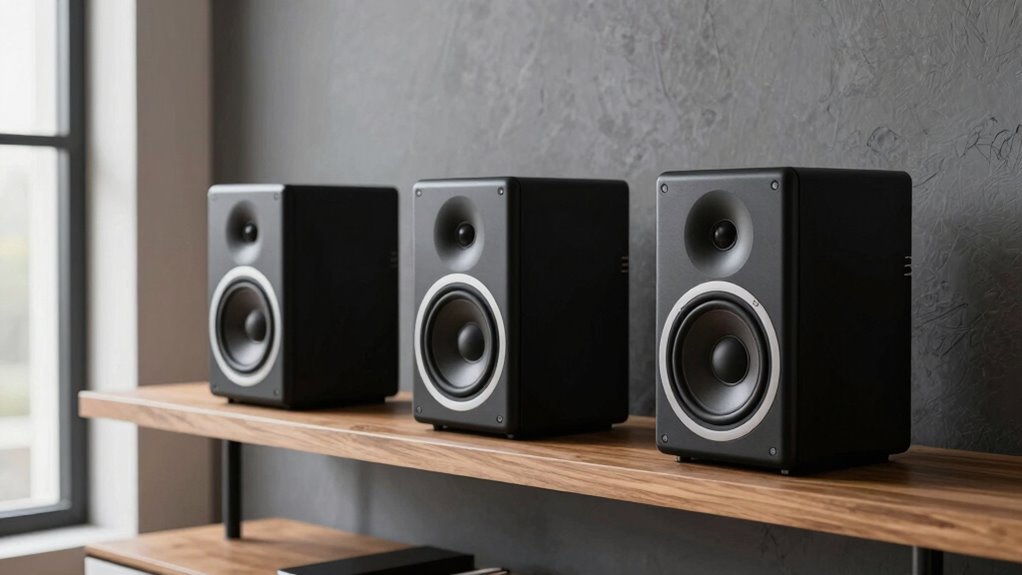

For passive bookshelf speakers under $1,000, my best overall pick is the KEF Q1 Meta for listeners prioritizing refined hi-fi sound, while the Dayton Audio Classic B65 stands out as a practical value choice and the Micca RB42 suits smaller spaces. The main tradeoffs are sound refinement versus amplifier demands, speaker size versus bass output, and premium design versus everyday value. Passive speakers also need a separate amplifier or receiver, so matching the whole system matters as much as choosing a pair. This lineup ranges from compact, wall-mountable options to larger models built for more substantial listening setups. Read on for my full breakdown of how the picks differ and which one fits your room and priorities.

Get audio and creator gear delivered free with Prime
- Fast, free delivery on millions of items
- Prime Video, Amazon Music and more included
- Member-only deals all year
Complete the kit


Key Takeaways
- The KEF Q1 Meta is the refinement-led pick: it takes the top spot for buyers who prioritize a hi-fi-focused choice over a basic system upgrade.
- Value does not mean choosing on wattage alone: the Dayton Audio Classic B65 and Edifier P12 are more useful comparisons when you want straightforward passive stereo options.
- Compact placement changes the shortlist: the Micca RB42 and wall-mountable RIOWOIS address space constraints that larger 6.5-inch models may not suit.
- Amplifier matching is a key filter: the Fosi Audio SP601 is specified at 4Ω, so buyers should check that their amplifier supports the speaker load.
- The lineup serves different priorities, not one universal winner: ribbon-tweeter, hybrid-cone, and conventional two-way designs call for different listening and system preferences.
| Audioengine P4 Passive Bookshelf Speakers |  | Best Compact Pick | Speaker type: Passive bookshelf | Woofer: 4-inch aramid fiber | Tweeter: 0.75-inch silk dome | VIEW ON AMAZON | See Our Full Breakdown |
| Audio Express Koe’ B102 – 100 Watt Home Theater Passive Bookshelf Speakers (Pair) |  | Best for Flexible Placement | Configuration: Passive bookshelf speaker pair, 2-way | Woofer: 5.25 inches | Tweeter: 0.75 inches | VIEW ON AMAZON | See Our Full Breakdown |
| Fosi Audio SP601 Passive Bookshelf Speakers, Pair, 4Ω, 160W, with 6.5-Inch HybridCone Woofers and 1.5-Inch Silk Dome Tweeters |  | Best for Powerful, Full-Range Stereo | Configuration: Passive bookshelf speaker pair | Woofer: 6.5-inch HybridCone composite | Tweeter: 1.5-inch silk dome | VIEW ON AMAZON | See Our Full Breakdown |
| HiVi-Swans D3.1 MKII Passive Bookshelf Speakers, 6.5-Inch 2-Way Pair |  | Best Cabinet-Build Pick | Configuration: 2-way passive stereo pair | Woofer: 6.5 inches | Tweeter: 28 mm natural-fiber dome | VIEW ON AMAZON | See Our Full Breakdown |
| Dayton Audio Classic B65 Passive Bookshelf Speaker Pair, 6.5-Inch Woofer, 1-Inch Silk Dome Tweeter |  | Best Value Pick | Configuration: 2-way passive stereo pair | Woofer: 6.5-inch poly | Tweeter: 1-inch silk dome | VIEW ON AMAZON | See Our Full Breakdown |
| RIOWOIS Passive Bookshelf Speakers, Wall-Mountable, Pair |  | Best Compact Wall-Mount Pick | Speaker type: Passive bookshelf pair | Woofer: 2.75 inches | Tweeter: 2 inches | VIEW ON AMAZON | See Our Full Breakdown |
| KEF Q1 Meta Passive Hi-Fi Bookshelf Speakers (Pair), Walnut Brown |  | Best Premium Compact Hi-Fi Pick | Speaker type: Passive bookshelf pair | Driver: 12th-generation 5.25-inch Uni-Q | Technology: Metamaterial Absorption Technology | VIEW ON AMAZON | See Our Full Breakdown |
| 200W Passive Bookshelf Speakers with Ribbon Tweeter |  | Best for High-Output Home Entertainment | Speaker type: Passive bookshelf pair | Woofer: 5.25 inches | Tweeter: 4-inch super ribbon | VIEW ON AMAZON | See Our Full Breakdown |
| HiVi-Swans Oasis 140 Passive Bookshelf Speakers, 2-Way HiFi Home Audio Speakers |  | Best Balanced Two-Way Pick | Configuration: 2-way passive bookshelf speakers | Tweeter: 20mm soft dome | Woofer: 4-inch metal dynamic | VIEW ON AMAZON | See Our Full Breakdown |
| Edifier P12 Passive Bookshelf Speakers, 2-Way, Pair, Wood Finish |  | Best Beginner-Friendly Passive Pair | Configuration: 2-way bookshelf speaker pair | Woofer: 4 inches (10 cm) | Tweeter: 19 mm silk dome | VIEW ON AMAZON | See Our Full Breakdown |
| Polk Audio T15 100-Watt Bookshelf Speakers, Black, Pair |  | Best for Flexible Home Theater Placement | Speaker type: Passive bookshelf | Power: 100 watts | Driver: 5.25-inch Dynamic Balance | VIEW ON AMAZON | See Our Full Breakdown |
| Micca RB42 Reference 2-Way Passive Bookshelf Speakers, Walnut |  | Best Compact Pick for Music | Speaker type: 2-way passive bookshelf | Woofer: 4 inches | Tweeter: 0.75-inch silk dome | VIEW ON AMAZON | See Our Full Breakdown |
| passive bookshelf speakers under 1000 | Tweeter | Woofer | Impedance | Mounting |
|---|---|---|---|---|
| Audioengine P4 Passive Bookshe | 0.75-inch silk dome | 4-inch aramid fiber | 10,000 ohms (listed) | Tabletop |
| Audio Express Koe’ B102 | 0.75 inches | 5.25 inches | 4 ohms | Tabletop or wall-mountable |
| Fosi Audio SP601 Passive Books | 1.5-inch silk dome | 6.5-inch HybridCone composite | 4 ohms | — |
| HiVi-Swans D3.1 MKII Passive B | 28 mm natural-fiber dome | 6.5 inches | 8 ohms | — |
| Dayton Audio Classic B65 Passi | 1-inch silk dome | 6.5-inch poly | 6 ohms | Shelf or wall mount |
| RIOWOIS Passive Bookshelf Spea | 2 inches | 2.75 inches | 6 ohms | Wall mount; mounting kit included |
| KEF Q1 Meta Passive Hi-Fi Book | — | — | — | — |
| 200W Passive Bookshelf Speaker | 4-inch super ribbon | 5.25 inches | 4 ohms | — |
| HiVi-Swans Oasis 140 Passive B | 20mm soft dome | 4-inch metal dynamic | — | — |
| Edifier P12 Passive Bookshelf | 19 mm silk dome | 4 inches (10 cm) | 6 ohms | Shelf, tabletop, or built-in wall-mount bracket |
| Polk Audio T15 100-Watt Booksh | 0.75 inches | — | 8 ohms | Wall mount with integrated keyhole slot |
| Micca RB42 Reference 2-Way Pas | 0.75-inch silk dome | 4 inches | — | Shelf mount or tabletop mount |
More Details on Our Top Picks
Audioengine P4 Passive Bookshelf Speakers
The Audioengine P4 is the most space-conscious choice in this group, with a 4-inch woofer and front-ported cabinet suited to desktops, shelves, and rooms where larger speakers would be awkward. Compared with the Dayton Audio Classic B65 and its 6.5-inch woofer, the P4 gives up low-frequency reach but takes up less room and is easier to place near a wall. Its silk-dome tweeter and aramid-fiber woofer are aimed at clear stereo listening, while the handcrafted finish makes it a more decor-friendly option than a basic utility speaker. The tradeoff is physical: its small driver limits bass, so listeners wanting weight for movie effects or bass-heavy music may prefer the Fosi Audio SP601. It also needs a separate amplifier, and the listed impedance specification is unusual enough that I would confirm amplifier compatibility before buying.
Pros:- Compact 4-inch woofer design fits desktop and smaller-room setups.
- Front port allows more flexible placement near a wall than a rear-ported design.
- Silk-dome tweeter and aramid-fiber woofer target clear, detailed stereo sound.
- Three-year warranty and included speaker bags add practical ownership support.
Cons:- Small woofer limits bass extension compared with the Fosi Audio SP601 and Dayton Audio Classic B65.
- Requires a separate amplifier or receiver.
- The listed 10,000-ohm impedance is unusual and should be checked against the intended amplifier.
Best for: Desktop listeners and apartment owners who want a compact passive pair for near-field stereo and have an amplifier with confirmed compatibility.
Not ideal for: Listeners who want strong deep bass, high output in a large room, or a speaker that works without a separate amplifier.
- Speaker type:Passive bookshelf
- Woofer:4-inch aramid fiber
- Tweeter:0.75-inch silk dome
- Frequency response:60 Hz (listed)
- Impedance:10,000 ohms (listed)
- Mounting:Tabletop
- Finish:Black
- Warranty:3 years
Our verdict“Choose the P4 for compact desktop or small-room listening, but choose a larger-woofer option if bass and room-filling output matter more.”
Audio Express Koe’ B102 – 100 Watt Home Theater Passive Bookshelf Speakers (Pair)
The Koe’ B102 earns its place for buyers who need placement options as much as stereo sound: these speakers can sit on a tabletop or be wall-mounted, making them useful in a compact TV room or a setup where stands are impractical. Their 5.25-inch woofers give them more driver area than the Audioengine P4, while the P4 is the more compact choice for desktop use. A listed 4-ohm impedance and 100-watt power figure point toward pairing with an appropriately capable amplifier; this is not an all-in-one speaker system. The included SPL/frequency-response charts offer more information for planning a setup than the product details provide for some rivals, including the Dayton Audio Classic B65. The compromise is that the B102 is larger than a small-room listener may want, and its lack of weather protection rules out outdoor use.
Pros:- Tabletop and wall-mount options suit rooms without space for speaker stands.
- 5.25-inch woofers provide more driver area than the compact Audioengine P4.
- Matched pair includes SPL and frequency-response charts for setup reference.
- Listed 100-watt power figure supports use in a home theater or stereo system with suitable amplification.
Cons:- Passive design requires a separate amplifier or AV receiver.
- Listed 4-ohm impedance calls for an amplifier rated to handle that load.
- Larger than compact desktop-oriented options and not waterproof.
Best for: TV-room and apartment listeners who need a passive pair that can be wall-mounted and have a compatible 4-ohm amplifier.
Not ideal for: Buyers seeking a small desktop speaker, an outdoor-capable pair, or a setup without a separate amplifier.
- Configuration:Passive bookshelf speaker pair, 2-way
- Woofer:5.25 inches
- Tweeter:0.75 inches
- Power output:100 watts (listed)
- Impedance:4 ohms
- Mounting:Tabletop or wall-mountable
- Enclosure:MDF with black vinyl veneer
- Waterproof:No
Our verdict“Pick the Koe’ B102 when wall-mounting flexibility matters and your amplifier can handle its 4-ohm load.”
Fosi Audio SP601 Passive Bookshelf Speakers, Pair, 4Ω, 160W, with 6.5-Inch HybridCone Woofers and 1.5-Inch Silk Dome Tweeters
With a 6.5-inch HybridCone woofer and a listed 160-watt power rating, the Fosi Audio SP601 is the high-output-minded option among these five. Its larger driver gives it more potential for substantial low-midrange presence than the Audioengine P4, while the P4 remains the easier fit for a crowded desktop. The SP601 also pairs a 1.5-inch silk-dome tweeter with an aluminum waveguide intended to spread sound broadly, which may suit listeners who do not sit directly in front of the speakers. A tuned bass-reflex port is designed to keep bass controlled even near a wall. The price of that scale is system matching: the 4-ohm load calls for a capable amplifier, and the larger cabinet will not suit every shelf. Unlike the sealed Dayton Audio Classic B65, this ported design puts greater emphasis on bass output and placement flexibility rather than a sealed enclosure.
Pros:- 6.5-inch HybridCone woofers offer more driver area than the Audioengine P4.
- 1.5-inch silk-dome tweeters and aluminum waveguides are designed for broad, smooth sound dispersion.
- Tuned bass-reflex port is designed to control bass, including near-wall placement.
- Binding posts accept banana plugs or bare wire.
Cons:- 4-ohm impedance requires an amplifier able to handle a relatively demanding load.
- Larger 6.5-inch bookshelf format is a poor fit for cramped desktops or shallow shelves.
- Passive speakers need separate amplification and are not waterproof.
Best for: Stereo listeners with a sturdy shelf and a 4-ohm-capable amplifier who want larger drivers and broad sound dispersion.
Not ideal for: Desktop users with limited space, owners of amplifiers not rated for 4-ohm speakers, or anyone needing weather-resistant speakers.
- Configuration:Passive bookshelf speaker pair
- Woofer:6.5-inch HybridCone composite
- Tweeter:1.5-inch silk dome
- Impedance:4 ohms
- Power:160 watts
- Maximum output power:180 watts
- Connectivity:Dual-mode binding posts for banana plugs or bare wire
- Warranty:24 months
Our verdict“Choose the SP601 for a larger, higher-output stereo setup with suitable amplification, not for a compact desktop system.”
HiVi-Swans D3.1 MKII Passive Bookshelf Speakers, 6.5-Inch 2-Way Pair
The HiVi-Swans D3.1 MKII is the most cabinet-focused choice here: its wood-veneer enclosure has internal bracing, and an angled, detachable front baffle is designed to direct sound toward the listener. Those details favor a more deliberate living-room setup over quick placement on a desk. Its 6.5-inch woofer gives it more scale than the Audioengine P4, while its 8-ohm impedance is a less demanding match on paper than the 4-ohm Fosi Audio SP601. The tradeoff is substantial size and weight: at 48.5 pounds per the supplied data, these are not easy speakers to move between shelves or rooms. They also require an external amplifier or AV receiver, and the listed 20 kHz frequency-response figure provides only an upper endpoint rather than a full response range. Buyers should check cabinet dimensions and available support before choosing them.
Pros:- Internally braced, genuine wood-veneer cabinet is designed to reduce resonance.
- Angled front baffle is intended to direct sound toward the listening position.
- 6.5-inch woofer provides more driver area than the Audioengine P4.
- 8-ohm impedance is less demanding on paper than the 4-ohm Fosi Audio SP601.
Cons:- Large dimensions and listed 48.5-pound weight make placement and moving difficult.
- Requires an external amplifier or AV receiver.
- The supplied frequency-response specification lists only 20 kHz, not a complete range.
Best for: Listeners building a permanent stereo or AV setup who value a braced, veneered cabinet and want 6.5-inch drivers with an 8-ohm load.
Not ideal for: Desktop users, renters who frequently move equipment, or buyers with shallow shelves and limited space for large, heavy speakers.
- Configuration:2-way passive stereo pair
- Woofer:6.5 inches
- Tweeter:28 mm natural-fiber dome
- Maximum output power:120 watts
- Impedance:8 ohms
- Frequency response:20 kHz (listed)
- Dimensions:14.17 × 8.58 × 14.88 inches
- Item weight:48.5 pounds
- Cabinet material:High-density wood with genuine wood veneer
Our verdict“Choose the D3.1 MKII for a permanent, space-conscious-of-quality setup with room for a heavy cabinet, but not for a desk or frequently rearranged system.”
Dayton Audio Classic B65 Passive Bookshelf Speaker Pair, 6.5-Inch Woofer, 1-Inch Silk Dome Tweeter
The Dayton Audio Classic B65 is the straightforward, adaptable pick: a 6.5-inch woofer, 1-inch silk-dome tweeter, and sealed cabinet make it a practical fit for listeners who want a conventional passive pair without the extra size and weight of the HiVi-Swans D3.1 MKII. Its sealed acoustic-suspension design avoids a bass port, which can make placement easier when speakers need to sit near a wall, though it does not promise the same port-assisted bass emphasis as the Fosi Audio SP601. Integrated keyhole brackets add a wall-mount option, and removable grilles make the look adjustable. The 40-watt RMS handling is more modest than the SP601’s listed power rating, so I would pair the B65 with an amplifier suited to moderate listening rather than choosing it for maximum output. It remains passive and wired, with no wireless playback built in.
Pros:- Sealed cabinet and dedicated crossover are designed for controlled, balanced playback.
- 6.5-inch poly woofer and 1-inch silk-dome tweeter cover a broad range of listening needs.
- Integrated keyhole brackets allow wall mounting as an alternative to shelf placement.
- Five-year warranty is longer than the listed warranties of the other products in this batch.
Cons:- 40-watt RMS power handling is more modest than the Fosi Audio SP601’s listed power rating.
- Passive design requires an amplifier or AV receiver.
- Wired-only connection provides no built-in wireless playback.
Best for: Budget-conscious stereo and TV listeners who want a 6.5-inch sealed pair, flexible shelf or wall placement, and a five-year warranty.
Not ideal for: Buyers seeking wireless convenience, maximum output, or the port-assisted bass design of the Fosi Audio SP601.
- Configuration:2-way passive stereo pair
- Woofer:6.5-inch poly
- Tweeter:1-inch silk dome
- Power handling:40W RMS / 75W maximum
- Impedance:6 ohms
- Enclosure:Sealed acoustic suspension
- Mounting:Shelf or wall mount
- Binding posts:Gold-plated
- Warranty:5 years
Our verdict“Choose the B65 for a flexible, sealed 6.5-inch pair and long warranty, but look elsewhere if wireless playback or high output is the priority.”
RIOWOIS Passive Bookshelf Speakers, Wall-Mountable, Pair
I’d choose the RIOWOIS pair when mounting flexibility matters more than room-filling output. Its compact 2.75-inch woofer and separate 2-inch tweeter suit a small TV area or a basic surround setup, while the included mounting kit saves a separate accessory purchase. Compared with the Edifier P12, which also supports wall mounting but has a larger 4-inch woofer, the RIOWOIS is the more space-conscious choice, not the stronger bet for fuller bass. Its stated 30-watt peak power points toward modest systems rather than loud playback. I’d also plan for a compatible amplifier or receiver and supply speaker wire yourself; there’s no built-in Bluetooth to simplify music playback. The wood-grain look adds a home-friendly finish, but these are best for practical placement, not a high-output stereo upgrade.
Pros:- Compact cabinet and included wall-mounting kit support flexible placement.
- Separate woofer and tweeter handle different parts of the sound range.
- Wood-grain finish offers a more home-friendly appearance than a plain utility speaker.
Cons:- The 2.75-inch woofer is less suited to substantial bass than the Edifier P12’s 4-inch driver.
- Requires an amplifier or receiver and speaker wires, which are not included.
- No Bluetooth for direct wireless music playback.
Best for: Apartment dwellers or TV owners who need a small passive pair with included wall-mounting hardware for a compact surround setup.
Not ideal for: Listeners seeking fuller bass, high output, or wireless playback; the small woofer, amplifier requirement, and lack of Bluetooth may call for a different system.
- Speaker type:Passive bookshelf pair
- Woofer:2.75 inches
- Tweeter:2 inches
- Peak power:30 W
- Impedance:6 ohms
- Mounting:Wall mount; mounting kit included
- Amplification:Separate amplifier or receiver required
- Dimensions:9.69 × 7.6 × 6.22 inches
Our verdict“Choose the RIOWOIS pair for compact wall-mounted TV or surround use, but pick a larger speaker if stronger bass is a priority.”
KEF Q1 Meta Passive Hi-Fi Bookshelf Speakers (Pair), Walnut Brown
The KEF Q1 Meta is the premium-focused choice here for buyers building a carefully matched stereo system in a smaller room. Its 5.25-inch 12th-generation Uni-Q array places the tweeter within the midrange driver, a design intended to spread sound more evenly around the listening area; KEF’s Metamaterial Absorption Technology is designed to reduce unwanted sound from the rear of the driver. That makes it a more ambitious hi-fi option than the compact RIOWOIS, which is better framed as a practical wall-mount or surround speaker. The tradeoff is that the Q1 Meta needs a separate stereo amplifier and asks for more deliberate system planning. Its 13.4-pound wood cabinets are still manageable for a desk or smaller living room, but there’s no water resistance or wireless operation. I’d favor it for stereo refinement, not all-in-one convenience.
Pros:- Uni-Q driver array is designed to distribute sound broadly across the room.
- Metamaterial Absorption Technology targets unwanted driver output for cleaner reproduction.
- Compact wood enclosure suits tabletop placement and smaller listening spaces.
- Passive design lets the owner select a compatible amplifier and other system components.
Cons:- A separate stereo amplifier is required, adding equipment and setup needs.
- No Bluetooth or built-in amplification for direct, simple playback.
- Not water resistant, so it is limited to dry indoor placements.
Best for: Stereo listeners furnishing a study, bedroom, or smaller living room who already own or plan to choose a quality amplifier.
Not ideal for: Buyers who want Bluetooth, built-in amplification, outdoor flexibility, or a low-commitment speaker for casual TV sound.
- Speaker type:Passive bookshelf pair
- Driver:12th-generation 5.25-inch Uni-Q
- Technology:Metamaterial Absorption Technology
- Maximum output power:150 W
- Enclosure:Wood
- Placement:Tabletop
- Amplification:Separate stereo amplifier required
- Dimensions:10.9 × 7.1 × 11.9 inches
- Weight:13.4 pounds
Our verdict“Pick the KEF Q1 Meta for a compact, amplifier-based stereo system where sound refinement matters more than convenience.”
200W Passive Bookshelf Speakers with Ribbon Tweeter
For buyers prioritizing stated power capacity and home-entertainment versatility, this pair stands apart with a 5.25-inch woofer, 4-inch super ribbon tweeter, and listed 200-watt peak power. That combination gives it a more output-oriented pitch than the HiVi-Swans Oasis 140, whose smaller 4-inch woofer and 2 × 50-watt peak rating suggest a more modest system. The cabinet remains reasonably compact for tabletop placement, and the MDF construction and wood-grain finish fit a living room or office. However, the 4-ohm impedance makes amplifier compatibility a detail I’d check before buying, and the speakers still require external amplification. The product data also mentions Bluetooth range, but lists these as passive speakers; I would not assume they connect wirelessly on their own. No waterproofing is specified, so they belong indoors.
Pros:- 5.25-inch woofer and 4-inch super ribbon tweeter provide distinct low- and high-frequency drivers.
- Listed 200-watt peak power suits buyers planning a higher-output system.
- MDF cabinets and wood-grain finish suit indoor home or office placement.
- Published frequency response spans 45 Hz to 20 kHz.
Cons:- Requires an external amplifier or receiver; no built-in amplification is listed.
- The 4-ohm load requires checking amplifier compatibility.
- Bluetooth is mentioned in the product data, but passive operation means wireless playback should not be assumed; no waterproofing is specified.
Best for: Home-theater, gaming, or TV listeners who want a compact passive pair with substantial stated peak power and already have a suitable amplifier.
Not ideal for: Buyers seeking a self-powered Bluetooth speaker or those whose amplifier is not rated for a 4-ohm load.
- Speaker type:Passive bookshelf pair
- Woofer:5.25 inches
- Tweeter:4-inch super ribbon
- Peak power:200 W
- Impedance:4 ohms
- Frequency response:45 Hz–20 kHz
- Sensitivity:89 ± 2 dB
- Enclosure:MDF
- Dimensions:9.38 × 7.48 × 12.2 inches
Our verdict“Choose this pair for a higher-output indoor entertainment system if your amplifier supports 4-ohm speakers and you do not need built-in wireless playback.”
HiVi-Swans Oasis 140 Passive Bookshelf Speakers, 2-Way HiFi Home Audio Speakers
The HiVi-Swans Oasis 140 takes a straightforward two-way approach: a 4-inch metal dynamic woofer handles the lower range, while a 20mm soft dome tweeter covers high frequencies. Its listed 2 × 50-watt peak power makes it a more moderate match for everyday music, gaming, or TV than the 200-watt ribbon-tweeter pair, which is pitched toward higher-output use. Compared with the Edifier P12, the Oasis 140 offers a clearly stated two-way driver configuration and a fabric-mesh finish, while Edifier adds wall brackets and included speaker wires. The Swans still needs an amplifier or receiver, and the available data omits impedance, dimensions, and sensitivity, so system matching and placement planning are less certain. I’d shortlist it for a simple high-fidelity setup, but buyers who need mounting details or easy setup may prefer the better-documented Edifier.
Pros:- Two-way design pairs a 4-inch woofer with a 20mm soft dome tweeter.
- Listed 2 × 50-watt peak power fits a moderate home listening system.
- Grey fabric mesh gives the speakers a softer visual finish.
- Designed for home theater, music, and gaming use.
Cons:- Requires a separate amplifier or receiver.
- Available product data does not state impedance, dimensions, or sensitivity, making system planning less certain.
- No included cables or mounting accessories are specified.
Best for: Music, gaming, and TV listeners seeking a conventional two-way passive pair for a modest home stereo or theater setup.
Not ideal for: Buyers who need complete amplifier-matching specifications, wall-mount hardware, or speaker wires included in the box.
- Configuration:2-way passive bookshelf speakers
- Tweeter:20mm soft dome
- Woofer:4-inch metal dynamic
- Peak power:2 × 50 W
- Frequency response:Up to 20 kHz
- Finish:Grey fabric mesh
- Amplification:Separate amplifier or receiver required
Our verdict“Choose the Oasis 140 for a conventional two-way home setup, but favor the Edifier P12 if included wires and wall mounting matter more.”
Edifier P12 Passive Bookshelf Speakers, 2-Way, Pair, Wood Finish
The Edifier P12 is the easiest pick here for someone assembling a basic passive system, because the pair includes speaker wires and built-in wall-mount brackets. Its 4-inch bass drivers and 19mm silk dome tweeters offer a familiar two-way layout, while the bass-reflex port is intended to support low-frequency response from the compact cabinets. Compared with the RIOWOIS, the P12 has a larger woofer and includes wires, so it asks for less accessory shopping, though it still needs an amplifier or receiver. The KEF Q1 Meta is the more ambitious hi-fi option, but it requires a separate amplifier and offers no comparable setup extras. Edifier’s stated maximum output is 40 watts, which makes this a sensible modest-system choice rather than a high-output centerpiece. It is also not water resistant, so keep it indoors.
Pros:- Speaker wires are included, reducing setup purchases.
- Built-in wall-mount brackets allow shelf, tabletop, or wall placement.
- 4-inch bass drivers and bass-reflex port support a compact two-way design.
- Silk dome tweeters are designed to reproduce detailed treble.
Cons:- A separate amplifier or receiver is still required.
- Maximum output is listed at 40 watts, limiting its appeal for high-output systems.
- Not water resistant.
Best for: First-time passive-speaker buyers who want a compact pair with included speaker wires and the option to mount near a TV.
Not ideal for: Listeners seeking high output, wireless playback, or speakers for damp or outdoor spaces.
- Configuration:2-way bookshelf speaker pair
- Woofer:4 inches (10 cm)
- Tweeter:19 mm silk dome
- Impedance:6 ohms
- Maximum output power:40 W
- Enclosure:Wood
- Mounting:Shelf, tabletop, or built-in wall-mount bracket
- Included:Speaker wires
- Dimensions:5.04 × 6.61 × 9.37 inches
Our verdict“Choose the Edifier P12 for a straightforward first passive setup with included wires and flexible placement, not for high-volume or outdoor listening.”
Polk Audio T15 100-Watt Bookshelf Speakers, Black, Pair
The Polk Audio T15 makes the most sense for buyers building a straightforward, receiver-based home theater. Its integrated keyhole slots make wall placement practical, and the speakers can serve as front, rear, or surround channels—more placement flexibility than the shelf- or tabletop-focused Micca RB42. The 5.25-inch Dynamic Balance driver and 0.75-inch tweeter are designed for balanced mids and clear highs, while the 8-ohm impedance gives buyers a clear specification to check against their receiver. The tradeoff is that these are wired, passive speakers, so an amplifier or AV receiver is required and placement depends on running speaker cable. Compared with the RB42’s smaller 4-inch woofer, the T15 is the more adaptable pick for a multi-speaker room, but it gives up the Micca’s walnut finish and compact footprint.
Pros:- Integrated keyhole slots support wall mounting and flexible home theater placement.
- Can be used as front, rear, or surround speakers.
- 5.25-inch Dynamic Balance driver and 0.75-inch tweeter are designed for balanced sound.
- 8-ohm impedance is specified for receiver compatibility checks.
Cons:- Requires a separate AV receiver or amplifier and speaker wire.
- Wired connections restrict placement compared with wireless speakers.
- The supplied information does not specify cabinet dimensions or sensitivity for detailed room and amplifier matching.
Best for: Home theater builders who have an AV receiver and want affordable passive speakers that can be wall-mounted as front, rear, or surround channels.
Not ideal for: Listeners seeking wireless setup, an all-in-one speaker, or a compact tabletop pair that does not need an amplifier.
- Speaker type:Passive bookshelf
- Power:100 watts
- Driver:5.25-inch Dynamic Balance
- Tweeter:0.75 inches
- Impedance:8 ohms
- Connectivity:Wired; connects to an AV receiver with speaker wire
- Mounting:Wall mount with integrated keyhole slot
- Enclosure material and color:Wood; black
- Quantity:1 pair
Our verdict“Choose the Polk T15 if you want receiver-powered speakers with wall-mount flexibility for a home theater, rather than the smaller, shelf-focused Micca RB42.”
Micca RB42 Reference 2-Way Passive Bookshelf Speakers, Walnut
The Micca RB42 is the compact choice here for listeners who want a small passive pair for a desk, shelf, or home office without defaulting to a plain black cabinet. Its 4-inch woofer and silk dome tweeter are paired with a crossover design intended to support clear detail and off-axis listening, useful when the speakers cannot be aimed directly at every seat. The dark walnut finish also gives it a more furniture-friendly look than the black Polk Audio T15. The Micca’s small dimensions suit tighter spaces, but its power handling is not specified, so buyers have less information for matching an amplifier than they do with the T15’s stated 100-watt rating and 8-ohm impedance. It requires an external amplifier, and its listed weight is substantial for its size. Choose it for compact placement and finish; choose the Polk for wall mounting and defined home theater roles.
Pros:- Compact dimensions suit shelves, tabletops, and home office setups.
- 4-inch woofer and silk dome tweeter are designed for robust bass and smooth, detailed sound.
- Crossover design is intended to support off-axis listening.
- Dark walnut finish offers a warmer furniture-style appearance than the Polk T15’s black cabinet.
Cons:- Requires a separate amplifier or receiver and speaker wiring.
- Power handling is not specified, limiting amplifier-matching information.
- Listed weight of 6000 g may make positioning and moving the pair less convenient.
Best for: Desk and small-room listeners who want compact passive speakers, a dark walnut cabinet, and an amplifier already available.
Not ideal for: Buyers who need wall-mounting, clearly specified power handling for amplifier matching, or speakers intended to fill a larger room.
- Speaker type:2-way passive bookshelf
- Woofer:4 inches
- Tweeter:0.75-inch silk dome
- Dimensions:7.9″D x 4.9″W x 8.7″H
- Weight:6000 g
- Mounting:Shelf mount or tabletop mount
- Enclosure materials:Wood, paper, and silk
- Color:Dark walnut
- Connectivity and power handling:Passive; requires amplifier; power handling not specified
Our verdict“Pick the Micca RB42 for compact, walnut-finished music listening with an existing amplifier; choose the Polk T15 instead if wall mounting and home theater versatility matter more.”

How We Picked
I compared these 12 passive bookshelf speakers around the questions that matter before purchase: what kind of system they suit, how their size and stated driver designs affect likely room fit, what amplifier considerations their specifications raise, and whether their format solves a particular placement or budget need. I also looked at the useful distinctions within the lineup: compact models, wall-mountable speakers, traditional two-way pairs, and designs featuring ribbon or hybrid-cone drivers. Since passive speakers need external amplification, amplifier compatibility and practical setup were treated as part of the buying decision, not as an afterthought.
The ranking favors speakers with a clear role and a convincing balance of sound-focused design, usability, and flexibility for their intended buyer. The KEF Q1 Meta leads as the refinement-oriented choice; more affordable, straightforward options earn consideration for value and accessibility, while compact or specialized models rank for specific needs rather than broad appeal. A stated power figure alone did not determine placement, and no single driver type was treated as automatically superior. Buyers should confirm current specifications and amplifier requirements before purchase, especially where the listing names a specific impedance or power handling.
Factors to Consider When Choosing Passive Bookshelf Speakers Under 1000
Before choosing a pair, I would work backward from the room, amplifier, and listening habits rather than starting with a feature list. These factors help narrow the field and avoid paying for a design that does not suit the rest of the system.
Match Speaker Impedance to Your Amplifier
Check the amplifier or receiver manual for its supported speaker impedance before buying, then compare that guidance with the speaker specifications. The Fosi Audio SP601 is listed as 4Ω, a detail that makes amplifier compatibility especially relevant. Do not assume that a receiver can safely drive every passive speaker just because it has speaker terminals. Also avoid treating a speaker’s maximum wattage as a target; it does not tell you how much power you need for normal listening. If your amplifier has limited output or unclear specifications, choose a pair with clearly documented requirements and confirm compatibility with the manufacturer. This can prevent a mismatch that causes shutdowns, distortion, or restricted volume.
Choose for Room Size and Placement
Bookshelf speakers still need space around them, and the room can change how much bass and treble you hear. A compact pair may be easier to place on a desk or a narrow shelf, while larger cabinets can be awkward in close quarters even if their drivers suggest greater bass potential. Wall placement can also alter bass response, so a wall-mountable design is not automatically the right choice for every room. Before ordering, measure the available width, height, depth, and clearance from walls. If you cannot position speakers symmetrically or angle them toward your seat, prioritize flexible placement over cabinet size. A subwoofer can add low-frequency support later, but it cannot fix poor speaker positioning.
Decide Whether You Need a Subwoofer
Small passive speakers cannot move as much air at low frequencies as larger cabinets, so ask whether music, films, or games need deep bass from the main pair. A compact speaker can still work well for nearfield listening, dialogue, and everyday playback without trying to fill a large room with bass. Buyers seeking strong movie impact may get more value from a compatible subwoofer than from moving up to a larger bookshelf model alone. Check whether your amplifier or receiver has a subwoofer output and, for home theater, whether it supports bass management. A subwoofer adds cost, cables, and placement work, so include those needs in the system plan rather than treating it as a guaranteed future upgrade. Prioritize balanced mids and clear dialogue if a subwoofer is not part of the setup.
Treat Driver Design as a Clue, Not a Sound Guarantee
Ribbon tweeters, silk domes, and hybrid-cone woofers describe different design choices, but the label alone cannot predict whether a speaker will suit your ears. The lineup includes ribbon-tweeter and hybrid-cone options alongside more conventional two-way designs, giving buyers distinct construction choices rather than a simple quality ladder. Room reflections, listening distance, recordings, and personal preference all affect perceived brightness and detail. If you are sensitive to strong treble, avoid choosing solely from a claim about extra detail; seek a return option and listen with familiar recordings. Likewise, a larger woofer does not guarantee more useful bass if the cabinet and room placement are a poor match. Treat specifications as filters, then use a good return policy to resolve sound preferences.
Budget for the Complete System
The speaker budget is only one part of a passive setup: you may also need an amplifier or receiver, speaker wire, stands, and possibly a subwoofer. Set aside money for those pieces before deciding how much to spend on the speakers. An expensive pair connected to an unsuitable or underpowered amplifier may be a weaker fit than a more modest pair in a well-matched system. For a first setup, choose an amplifier with clear compatibility information and straightforward inputs rather than buying advanced features you will not use. For a home theater, check the receiver’s channel count and plans for adding a center speaker. A whole-system budget makes comparisons between premium and value models more meaningful.
Think About Upgrade Plans Before You Buy
Some buyers want a finished two-channel system; others plan to add a subwoofer, center speaker, or additional surround channels. If expansion matters, check whether a matching center or related speakers are available and whether your amplifier supports the intended layout. A pair selected only for a desk or small room may not be the best foundation for a larger theater later. Conversely, paying for expansion flexibility you will never use can take funds away from better placement or amplification. Decide which changes are realistic over the next few years, not just possible in theory. That keeps the choice focused on current needs while avoiding an obvious dead end.
Frequently Asked Questions
Can I connect passive bookshelf speakers directly to a TV?
Usually not: passive speakers need an amplifier, while most TVs do not provide amplified speaker outputs. You can connect the TV to a stereo amplifier or AV receiver using a compatible audio output, such as HDMI ARC, optical, or analog, depending on the equipment. Check that the amplifier supports the connection your TV offers before buying speakers. If you want a simpler setup with no separate amplifier, powered speakers may be a better category. Keep the amplifier in your budget when comparing passive models.
Will a 4Ω speaker work with my existing receiver?
It depends on the receiver’s specifications and how many speakers it will drive at once. Check the manual for supported impedance and any restrictions on using multiple channels; a 4Ω load can demand more from an amplifier than a higher-impedance speaker. The Fosi Audio SP601 is specifically listed as 4Ω, making this check particularly relevant for that model. If the manual does not clearly confirm compatibility, ask the receiver maker before connecting it. Avoid relying on a receiver’s advertised wattage alone to answer this question.
Are bookshelf speakers enough for movies without a subwoofer?
They can handle dialogue, music, and many everyday movie scenes, but the amount of convincing low bass depends on the speaker, room, and listening level. A compact pair is less likely to deliver the deep impact some film soundtracks contain. If you do not plan to add a subwoofer, give greater weight to balanced sound and clear speech than to marketing claims about maximum power. For an AV receiver setup, check for bass-management controls and a subwoofer output in case you add one later. A subwoofer is an upgrade option, not a requirement for every room or listener.
Should I choose a ribbon tweeter or a silk dome tweeter?
Neither design is automatically better for every listener, and the label cannot tell you how the speaker will sound in your room. Tweeter character interacts with the recording, placement, listening distance, and nearby reflective surfaces. This roundup includes both ribbon-tweeter and silk-dome designs, so use the driver type as a prompt to compare specifications and listening impressions rather than as a ranking shortcut. If you are sensitive to bright sound, favor a seller with a practical return window and test familiar recordings at a normal volume. Also check whether speaker placement lets you adjust the angle toward your listening position.
Is it better to spend more on speakers or on an amplifier?
There is no universal split, but the amplifier must be compatible with the speakers and provide the connections and power your setup needs. Once those requirements are met, spending more on speakers may make sense if you plan to keep them through future system upgrades. For a first system, a well-matched amplifier and a practical pair can be a better choice than buying the most expensive speakers while leaving too little for stands, cables, or a subwoofer. Consider your listening room and upgrade plans before deciding where extra budget has the most value. Compare the complete setup, not isolated component specifications.
Conclusion
For the best overall refinement-focused pick, I would start with the KEF Q1 Meta; for best value, compare the Dayton Audio Classic B65 with the Edifier P12 based on room fit and system needs. The best premium direction is the KEF when sound-focused design is the priority, while the best beginner route is a straightforward pair such as the Edifier P12, paired with a clearly compatible amplifier. For specific needs, the Micca RB42 suits compact setups, the RIOWOIS is worth a look for wall mounting, and the Fosi Audio SP601 deserves an impedance check before purchase. Pick the pair that fits your amplifier, listening space, and upgrade plans—not simply the one with the biggest power figure.