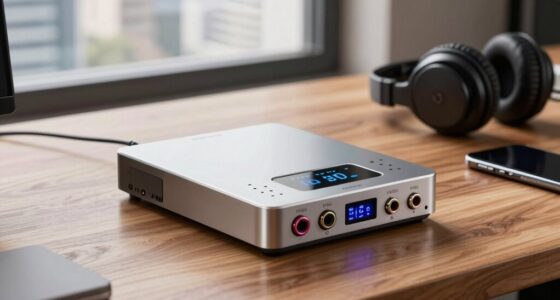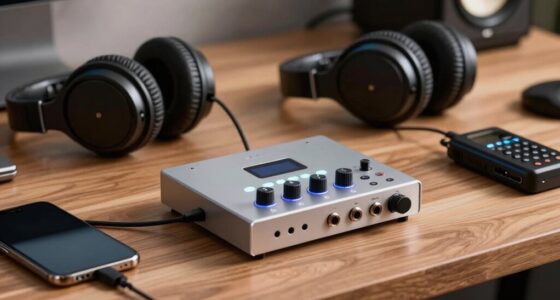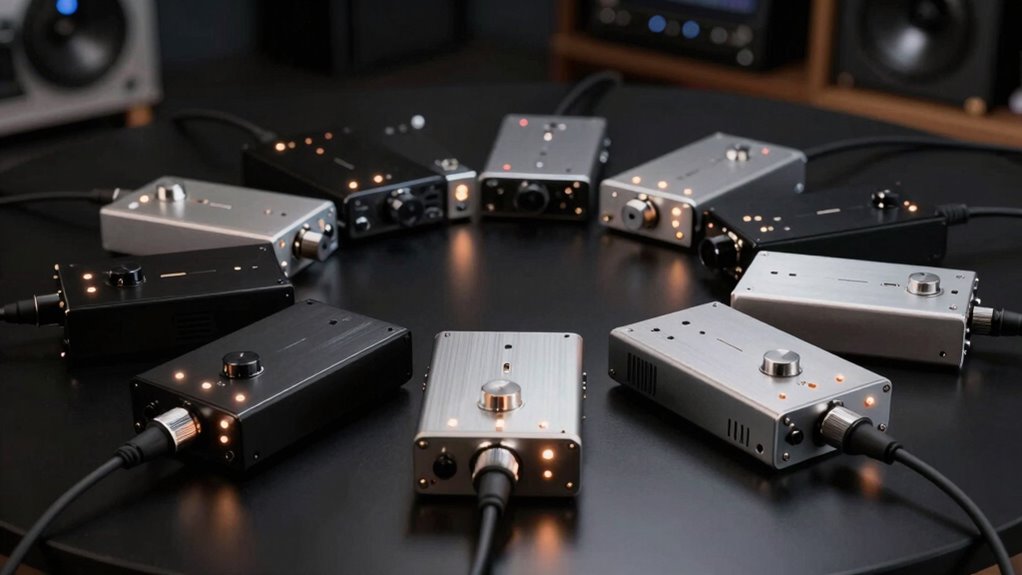
A phono preamp with a headphone output lets you listen to records directly, without routing sound through a separate amplifier or receiver. My best overall pick is the Douk Audio T9, which combines MM/MC support, headphone listening, and tone controls in one unit. The Fosi Audio Box X1 is a simpler choice for MM turntables, while the Douk Audio T14-EQ suits listeners who want tone adjustment and a USB-powered setup. The main tradeoffs are cartridge compatibility, the kind of headphone connection provided, and whether added controls or tube circuitry are worth extra complexity. Read on for the full comparison and guidance on choosing a model that fits your setup.

Get audio and creator gear delivered free with Prime
- Fast, free delivery on millions of items
- Prime Video, Amazon Music and more included
- Member-only deals all year
Complete the kit


Key Takeaways
- The Douk Audio T9 is the most flexible pick: its stated MM/MC compatibility and treble and bass controls set it apart from the MM-only models.
- The Fosi Audio Box X1 keeps the setup focused: it combines an MM phono stage with RCA output and a 3.5mm headphone jack, without the tone controls found on several Douk options.
- The T14-EQ offers a distinct power and control mix: USB power and tone adjustment may suit a compact setup, but buyers should check that its connections match their source and headphones.
- Tube models are not automatically the best fit: the Douk T9 and T4 PRO add tube-based circuitry, while simpler solid-state models may better suit listeners who value fewer setup variables.
- Some listings describe general headphone amplifiers, not clearly specified phono stages: verify that the selected model includes RIAA equalization and suits your cartridge before connecting a turntable.


| phono preamp with headphone output | Channels | Dimensions | Outputs |
|---|---|---|---|
| Douk Audio T9 Vacuum Tube Phon | 2 | — | — |
| Douk Audio T4 PRO Tube Phono P | 2 | 4.61 × 3.74 × 1.18 inches | — |
| Pyle Phono Preamp for Turntabl | 2 | — | RCA line and 3.5mm headphone |
| Mini Stereo Audio Preamplifier | — | 3.42 × 1.96 × 1.45 inches | RCA stereo, 3.5mm, and headphone |
| Douk Audio T14-EQ Phono Preamp | 2 | 3.31 × 3.31 × 1.1 inches | Stereo RCA and 3.5mm headphone |
| 12V RCA Preamplifier with Powe | — | 6.89 x 3.86 x 2.01 inches | — |
| Fosi Audio Box X1 Phono Preamp | 1 | 7.09 x 5.12 x 2.36 inches | 3.5mm headphone and RCA |
More Details on Our Top Picks
Douk Audio T9 Vacuum Tube Phono Preamp Stereo Turntable Preamplifier with Headphone Output and Treble Bass Control for MM/MC Record Player
The Douk Audio T9 is the most adjustable tube option here: it accepts MM and MC cartridges, adds bass and treble controls, and lets owners change tubes to tailor the character. That flexibility suits listeners who want to shape headphone playback rather than simply amplify a turntable signal. Compared with the smaller Douk Audio T4 PRO, the T9 supports MC cartridges and offers tone controls, while the T4 PRO adds an AUX input and has a more compact chassis. The T9’s 250mW headphone output is a useful built-in listening option, but the listed power figure may limit headroom with demanding headphones. Its display and multiple adjustments also make setup less straightforward than the simpler Pyle Phono Preamp. Choose it for cartridge flexibility and hands-on sound shaping, not a bare-bones setup.
Pros:- Supports both MM and MC cartridges
- Bass and treble controls allow direct tone adjustment
- Dedicated headphone output supports private listening
- Tube customization provides another way to change the sound character
Cons:- The 250mW output may not provide enough headroom for demanding headphones
- Tube replacement adds upkeep and requires choosing compatible replacements
- Display and adjustment options may complicate setup for beginners
Best for: Vinyl listeners with MM or MC cartridges who want tube character, headphone listening, and physical bass and treble adjustments in one unit.
Not ideal for: Listeners who want a simple plug-in preamp or use especially demanding headphones that need more output power.
- Cartridge compatibility:MM and MC
- Channels:2
- Headphone output power:250mW
- Voltage:12V
- Tone controls:Adjustable bass and treble
- Mounting type:Freestanding
- Weight:0.96 kg
Our verdict“Choose the T9 if you want MM/MC compatibility and extensive tone shaping; skip it if simple operation or greater headphone drive is your priority.”
Douk Audio T4 PRO Tube Phono Preamp with 6CS6 Headphone Amp for Turntable
The Douk Audio T4 PRO combines an MM phono stage and headphone amp in a chassis small enough to fit a crowded desk or listening shelf. Its AUX input also lets the headphone section serve another line-level source, giving it more day-to-day flexibility than the turntable-focused Douk Audio T9. The tradeoff is cartridge support: this model is specified for MM only, while the T9 and T14-EQ also accept MC cartridges. Output is rated at 150mW at 32 ohms, so it is a better match for easier-to-drive headphones than the T9’s higher-rated output, though neither figure alone tells the whole story for every headphone. Adjustable gain helps tailor the signal, but tube rolling is required for tube-based sound changes. Pick the T4 PRO for a compact, two-source tube setup, not MC compatibility or digital connections.
Pros:- Compact aluminum chassis suits limited shelf or desk space
- MM phono and AUX inputs accommodate two source types
- Adjustable gain helps match different sources and listening levels
- Tube-based design offers a warmer presentation than the solid-state T14-EQ
Cons:- Phono input is specified for MM cartridges, not MC
- 150mW at 32 ohms may be restrictive for demanding headphones
- No digital connectivity is listed
Best for: MM turntable owners who want a compact tube preamp with a headphone output and a second AUX source for desk listening.
Not ideal for: MC cartridge owners, buyers seeking digital inputs, or listeners with headphones that need substantial drive.
- Phono cartridge support:MM
- Inputs:MM phono and AUX
- Headphone output:150mW at 32 ohms; listed for 32–300 ohms
- Channels:2
- Signal-to-noise ratio:105dB
- Power supply:12V DC, 1.5A
- Dimensions:4.61 × 3.74 × 1.18 inches
- Chassis material:Aluminum
Our verdict“Choose the T4 PRO for compact MM vinyl and AUX headphone listening, but pick the T9 or T14-EQ if you need MC support.”
Pyle Phono Preamp for Turntable, Hi-Fi Compact Stereo Preamplifier with RIAA EQ, RCA & 3.5mm Output
The Pyle Phono Preamp keeps its job focused: it converts an MM cartridge’s phono signal to line level and provides RCA and 3.5mm outputs, including a headphone connection. Its grounding post and selectable earthing options offer useful flexibility when dealing with hum, while the metal housing is a more substantial enclosure than the plastic-bodied AU-10X. Compared with the Douk Audio T4 PRO, Pyle avoids tube customization and an AUX input in favor of a simpler phono-only path; the T4 PRO is the more versatile choice if you want a second source or tube character. The Pyle’s key limitation is that it supports MM cartridges only, and the supplied information lists no headphone power rating or volume control. It makes sense for a straightforward MM turntable connection, but not for MC users or buyers who need adjustable headphone output.
Pros:- RIAA equalization converts the phono signal for line-level equipment
- RCA and 3.5mm outputs support stereo-system and headphone connections
- Grounding post includes hard, soft, and no-ground settings
- Metal housing provides a sturdier enclosure than the AU-10X’s plastic case
Cons:- Supports MM magnetic cartridges only
- No built-in volume control is listed
- Headphone output power is not specified in the supplied product data
Best for: MM turntable owners who want a simple phono-to-line connection with RCA and 3.5mm headphone output and grounding options.
Not ideal for: MC cartridge users or headphone listeners who need a specified output level and built-in volume adjustment.
- Cartridge support:MM
- Channels:2
- Equalization:RIAA
- Outputs:RCA line and 3.5mm headphone
- Grounding:Grounding post with hard, soft, or no-ground settings
- Housing:Metal
- Power:External DC adapter
Our verdict“Choose Pyle for a basic MM turntable and headphone connection with grounding options, but look elsewhere for MC support or adjustable headphone level.”
Mini Stereo Audio Preamplifier with Headphone Amplifier and Gain 20dB
The AU-10X is the smallest, most source-flexible headphone option in this group, with RCA and 3.5mm inputs and outputs, a volume knob, and 20dB gain. It can add headphone listening to a setup that already has a phono stage, but it is not a phono preamp: its line-level inputs do not provide the RIAA equalization needed to connect a turntable directly. That makes it a different kind of pick from the Pyle Phono Preamp, which handles MM phono conversion but lacks a listed volume control. The AU-10X’s compact plastic enclosure is easy to place, though it feels less substantial than the T4 PRO’s aluminum chassis. Its product data also says it cannot drive passive speakers, so treat it as a line-level and headphone accessory rather than a complete vinyl system.
Pros:- Very compact 3.42-inch-class form makes placement easy
- RCA and 3.5mm connections accommodate several line-level sources
- Headphone output and volume knob provide direct listening control
- 20dB gain can boost compatible weak line-level signals
Cons:- Not a phono preamp and cannot connect directly to a turntable’s phono output
- Cannot drive passive speakers
- Plastic enclosure is less substantial than the T4 PRO’s aluminum chassis
Best for: Listeners who already own a phono preamp or line-level source and want a tiny unit with a headphone jack and volume control.
Not ideal for: Turntable owners seeking a single box with phono input and RIAA equalization, or anyone who needs to power passive speakers.
- Model:AU-10X
- Inputs:RCA stereo and 3.5mm
- Outputs:RCA stereo, 3.5mm, and headphone
- Gain:20dB
- Power supply:DC 9–19V
- Dimensions:3.42 × 1.96 × 1.45 inches
- Enclosure material:Plastic
Our verdict“Choose the AU-10X only if your turntable already feeds a phono stage and you need a compact headphone and line-level control unit.”
Douk Audio T14-EQ Phono Preamp with RIAA EQ, Headphone Out, Tone Control, USB Power
The Douk Audio T14-EQ brings together the essentials for a compact vinyl-and-headphone station: MM/MC compatibility, RIAA equalization, bass and treble adjustment, and a 3.5mm headphone jack. USB 5V power can simplify placement near a computer or powered USB source, though it still requires an external power source. Compared with the tube-based Douk Audio T9, the T14-EQ is smaller and uses a solid-state design rather than tube customization; the T9 offers a display and a stated 250mW output, while the T14-EQ’s listed output is just 0.25 watts without a headphone impedance rating. That leaves less information for judging how it will suit demanding headphones. Its dual RCA and headphone outputs are handy for a shared setup, but buyers seeking wireless features will need another device.
Pros:- Supports both MM and MC cartridges
- RIAA equalization and two-band tone controls combine phono correction with sound adjustment
- RCA and 3.5mm headphone outputs support speaker-system and private listening connections
- Compact metal enclosure and USB 5V power suit small listening spaces
Cons:- Listed 0.25W output has no headphone impedance range, making headphone matching less clear
- Requires an external USB power source
- No Bluetooth or other wireless connectivity is listed
Best for: MM or MC turntable owners building a small home or office system who want tone controls, RCA output, and headphone listening.
Not ideal for: Listeners who need a documented headphone impedance range, wireless playback, or a tube-based sound and display.
- Cartridge compatibility:MM and MC
- Equalization:RIAA
- Outputs:Stereo RCA and 3.5mm headphone
- Power source:USB 5V
- Listed power:0.25W
- Tone controls:2 bands
- Amplifier type:Solid state
- Channels:2
- Dimensions:3.31 × 3.31 × 1.1 inches
Our verdict“Choose the T14-EQ for compact MM/MC vinyl listening with tone controls, but favor the T9 if you want tube customization and a stated headphone power figure.”
12V RCA Preamplifier with Power Adapter, Mini Stereo Headphone Signal Home Amplifier, Gain 20dB for Turntable, Dual OP AMP NE5532, RCA to 3.5mm Output
This is the more adaptable choice for listeners who want a headphone signal preamp that can accept both RCA and 3.5mm sources. Its stated 20dB gain can boost a weak signal, while the 3.5mm output connects directly to compatible headphones. Compared with the Fosi Audio Box X1, it lists broader input options, but the Fosi is the clearer vinyl-focused pick: the X1 specifies MM cartridge support and RIAA equalization, while this model’s supplied details do not confirm phono-specific RIAA correction. That makes the RCA Preamplifier better suited to varied audio setups than to buyers seeking a clearly specified turntable phono stage. It also needs external power and cannot drive passive speakers, so it belongs in a headphone or line-level signal chain, not a speaker system.
Pros:- Accepts both RCA and 3.5mm inputs for more source flexibility
- 20dB gain can raise weak audio signals
- 3.5mm output provides a direct connection for compatible headphones
- Compact, lightweight design is easy to place in a small setup
Cons:- Product details do not specify RIAA equalization or cartridge compatibility for turntables
- Requires an external DC power supply
- Cannot power passive speakers directly
Best for: Listeners who want one compact, externally powered preamp for RCA or 3.5mm sources and compatible headphones.
Not ideal for: Vinyl owners who need confirmed RIAA equalization, MM cartridge compatibility, or an amplifier for passive speakers.
- Power supply:DC 9–19V
- Gain:20dB
- Inputs:RCA left/right and 3.5mm
- Output:3.5mm
- Circuit:Dual OP AMP NE5532
- Impedance support:Up to 16 ohms
- Dimensions:6.89 x 3.86 x 2.01 inches
- Weight:8.1 ounces
Our verdict“Choose it for flexible RCA and 3.5mm signal boosting with headphones, but pick the Fosi Audio Box X1 for a more clearly specified MM phono stage.”
Fosi Audio Box X1 Phono Preamp for MM Turntable, Mini Stereo Audio Hi-Fi Preamplifier with 3.5mm Headphone and RCA Output, 12V Power Supply
The Box X1 is the most clearly vinyl-oriented pick in this pair: it is specified for MM turntables and uses RIAA equalization to convert a cartridge signal for headphone or RCA playback. That makes it a more grounded choice for a dedicated record setup than the 12V RCA Preamplifier, whose supplied specifications list general signal boosting but do not confirm phono-stage RIAA correction. The X1 also offers both 3.5mm headphone and RCA outputs, so it can serve headphones now and a line-level system later. Its tradeoff is a narrower fit: MC cartridges are outside its stated support, and the listed lack of a volume control means headphone level adjustment may need to happen elsewhere. External 12V power is required, too.
Pros:- Specified for MM turntables with RIAA equalization
- Provides both 3.5mm headphone and RCA outputs
- Low-noise design is aimed at vinyl playback
- Durable aluminum construction
Cons:- Limited to MM turntables; MC support is not specified
- No built-in volume control
- Requires an external 12V power supply
Best for: Vinyl listeners with an MM cartridge who want a dedicated RIAA phono stage and both headphone and RCA outputs.
Not ideal for: Owners of MC cartridges or headphone listeners who need volume adjustment on the preamp itself.
- Turntable compatibility:MM
- Equalization:RIAA
- Outputs:3.5mm headphone and RCA
- Voltage:12V
- Mounting type:Freestanding
- Channels:1
- Dimensions:7.09 x 5.12 x 2.36 inches
- Material:Aluminum
Our verdict“Pick the Box X1 for a clearly specified MM turntable phono stage with headphone output, provided its lack of onboard volume control suits your setup.”
How We Picked
I ranked these models around the specific job implied by phono preamp with headphone output: taking a turntable’s phono signal, applying the needed equalization, and sending sound to headphones without requiring a separate main amplifier. I weighed stated cartridge support, headphone and line-output connections, useful controls, power needs, and how clearly each product description identifies its role. A dedicated phono stage with a headphone jack earns priority over a generic mini headphone amplifier whose phono and RIAA capabilities are not clear from its listed features.
The ranking favors versatility that solves real setup problems, not the longest feature list. The T9 leads for its stated MM/MC support and tone controls; the Fosi Box X1 is a more straightforward MM option; and the T14-EQ stands out for USB power and tone adjustment. The T4 PRO and T9 bring tube circuitry, while the Pyle and the two 20dB mini preamps need closer scrutiny around cartridge compatibility and whether they are true phono stages. Where specifications in the supplied product names are limited, I treat that uncertainty as a buying caveat rather than assuming an unlisted capability.
Factors to Consider When Choosing Phono Preamp With Headphone Output
Before choosing, separate the turntable’s phono-stage requirement from the headphone-amplifier requirement. A product can have a headphone jack and still lack the RIAA equalization a phono cartridge needs, while a phono preamp can offer RCA output without driving headphones directly. These checks help avoid buying a box that fits the cables but not the signal chain.
Confirm It Is a Phono Stage, Not Just a Headphone Amp
A turntable’s cartridge produces a low-level signal that needs phono amplification and RIAA equalization before ordinary listening. A generic stereo preamp or headphone amp may boost volume but still leave records sounding thin or otherwise incorrectly balanced if it lacks a phono stage. Look for explicit language such as phono input or RIAA EQ, rather than relying on a product title that mentions turntables. This matters especially for the two mini 20dB models here, whose listed names emphasize general preamplification and headphone use rather than clearly spelling out RIAA correction. If that specification is not confirmed, ask the seller or choose a clearly identified phono model. A headphone jack alone does not prove turntable compatibility.
Match the Input to Your Cartridge
Most entry-level turntables use a moving-magnet cartridge, but some setups use moving-coil cartridges, which can call for a different gain and input arrangement. Do not assume that an RCA connection means the preamp accepts every cartridge type. The T9 is the only option in this list whose supplied name explicitly states MM/MC support; the Fosi Box X1 is explicitly described for MM. For the other models, confirm cartridge compatibility in the full specifications before purchase. Also check whether your turntable already has a built-in phono preamp: connecting its line-level output to another phono stage can create an unsuitable signal chain. Match the preamp to the cartridge output and the turntable’s selected output mode.
Check Headphone Connector and Listening Level
A headphone output is only useful if its connector and drive capability suit your headphones. Several products name a 3.5mm output, but the supplied descriptions do not establish how well each model handles demanding, high-impedance headphones. Check the headphone impedance and sensitivity guidance when available, and confirm whether you need a 3.5mm-to-quarter-inch adapter. An adapter changes the plug, not the amplifier’s ability to provide enough listening level. For easy-to-drive headphones, a simple integrated output may be all you need; for harder-to-drive models, a dedicated external headphone amp may be a better match. Avoid treating a louder output as proof of better sound or safer volume.
Plan the Whole Signal Path
Think through where the sound needs to go beyond your headphones. If you may add powered speakers or a receiver, check for a usable RCA line output and whether headphone use affects that output. Some products in this roundup list both headphone and RCA connections, while others foreground only a 3.5mm output. Map the turntable, preamp, headphones, and any speakers before buying, including which cables each connection requires. Also verify whether the turntable has a grounding wire and whether the selected preamp provides a ground terminal; an unsuitable grounding setup can introduce hum. A little planning can prevent a second box or extra adapters from being needed later.
Choose Features That Earn Their Place
Treble and bass controls can help tailor playback to a room, headphones, or personal preference, but they add another adjustment point and are not a substitute for correct RIAA equalization. Tube models may appeal to listeners seeking a particular circuit style, yet tube circuitry brings a different set of components and maintenance questions than a straightforward solid-state unit. USB power, as listed for the T14-EQ, can suit a compact desk setup, but check the required power source and cable arrangement rather than assuming any USB port will be appropriate. If you want simple operation, favor a clearly specified phono stage with the connections you need. Pay for extra controls only when you expect to use them.
Treat Gain Claims and Missing Specifications Carefully
A stated 20dB gain figure does not by itself tell you whether a product supplies the correct phono equalization or pairs well with a particular cartridge. Gain, cartridge sensitivity, headphone efficiency, and the next device in the signal chain all affect the result. Read the full specification sheet for input type, output level, power requirements, and supported cartridge rather than choosing from a headline number. This is especially useful for compact preamps whose names describe a gain figure but do not clearly identify an RIAA phono stage. If a key detail is absent, treat that as uncertainty—not as evidence that the feature is included. A clear match matters more than a longer feature list.
Frequently Asked Questions
Can I connect any turntable to a phono preamp with a headphone output?
Not automatically. A turntable with a built-in phono preamp should usually be set to line output when connecting to another phono stage, or the signal may pass through phono equalization twice. A turntable set to phono output needs a compatible external phono input with RIAA equalization. Check the turntable’s output switch and the preamp’s specified input type before connecting them. Also confirm that the preamp supports your cartridge, particularly if you use moving coil rather than moving magnet.
Is a 3.5mm headphone jack enough for my headphones?
The connector tells you whether the plug fits, not whether the preamp can drive the headphones to a suitable level. Headphone impedance and sensitivity both matter, and the supplied product descriptions do not give enough information to assume every model suits every headphone. Check the manufacturer’s headphone specifications and compare them with your headphones’ requirements. If you own demanding headphones, plan for a separate headphone amplifier unless the phono preamp’s output capability is clearly documented. A simple adapter will not add amplification.
Do I need an MM/MC-compatible model if my turntable has an MM cartridge?
No; an MM-only phono stage can be a sensible match if you are confident you will keep an MM cartridge. The T9 is the only model here whose name explicitly lists MM/MC support, giving it a clearer upgrade path for cartridge changes. That flexibility may not matter if your current setup is stable and you do not plan to switch cartridge types. Before buying an MM-only option, verify that its full specifications confirm the cartridge type you use. Avoid paying attention to broad compatibility claims unless they match your specific cartridge.
Will the headphone output and RCA output work at the same time?
That depends on the model’s output design, and the listed product names do not establish whether the headphone and RCA outputs operate simultaneously. If you plan to listen on headphones while also feeding speakers or a receiver, check the manual or ask the manufacturer how the outputs behave when headphones are plugged in. Some units may mute another output when headphones are connected; others may leave it active. This affects shared listening and whether you need to unplug cables between uses. Confirm the behavior before buying rather than assuming that two listed outputs can run together.
Should I choose a tube phono preamp or a simpler solid-state model?
Choose based on the features and setup you want, not on the tube label alone. The Douk T9 and T4 PRO make tube circuitry part of their identity, while models such as the Fosi Box X1 offer a simpler MM-focused route. Tube designs may suit buyers who specifically want that circuit approach, but they can bring additional components and maintenance questions. A straightforward solid-state model may be easier to integrate when the priority is a clear signal path and fewer variables. Check the full specifications and support information for any tube model before deciding.
Conclusion
For the broadest feature set in this group, I recommend the Douk Audio T9 as best overall: its stated MM/MC compatibility and tone controls give it an advantage for listeners who want flexibility. The Fosi Audio Box X1 is my best value-style pick for an MM turntable setup that needs both headphone and RCA outputs without extra tone controls. For beginners, the Fosi is also the clearest straightforward choice, provided the cartridge and turntable output match its specifications. The Douk Audio T14-EQ is the best fit for USB-powered setups where tone adjustment is a priority, while the T9 or T4 PRO best suit buyers specifically seeking tube circuitry; check each model’s full details before choosing. Skip any of the compact 20dB mini preamps unless their documentation confirms phono-level input and RIAA equalization, since a headphone output by itself does not make a device a turntable phono stage.
Halloween Picks
halloween
As an affiliate, we earn on qualifying purchases.