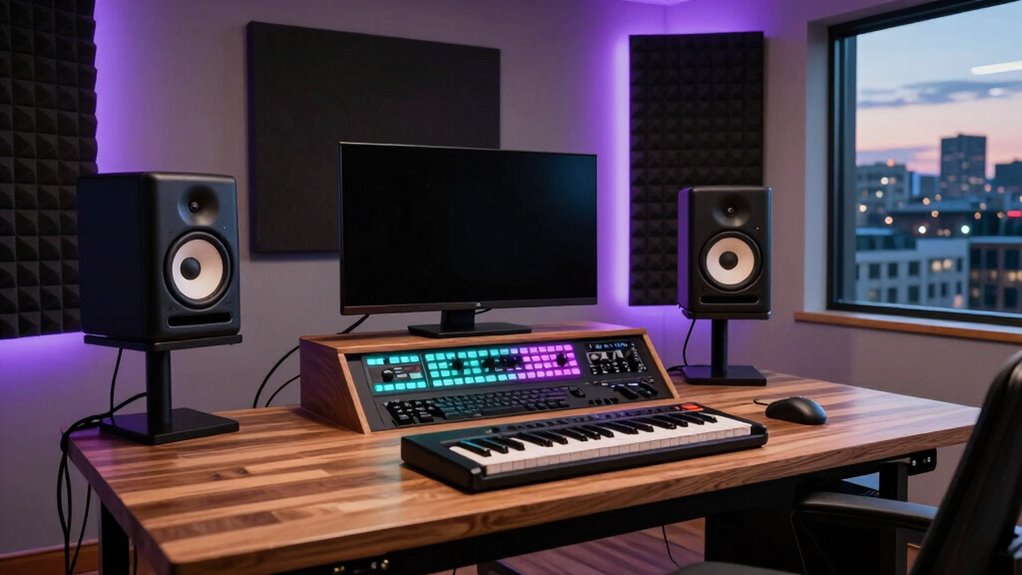

A studio desk for music production should fit your MIDI keyboard, monitors, and daily workflow without crowding your room. My best overall pick is the Monoprice Recording Studio Desk for its raised platform and keyboard tray, while the 88 Key Music Studio Desk stands out for full-size keyboard setups and the Eureka 72-Inch Walnut Desk for a broad, feature-rich work surface. The main tradeoffs are footprint versus usable space, fixed versus adjustable keyboard placement, and dedicated studio features versus general-purpose gaming-desk extras. A desk that suits a compact controller may not work for an 88-key instrument, so measure your gear before choosing. Read on for the full breakdown of how these 13 options differ and which type of producer each one suits.

Get audio and creator gear delivered free with Prime
- Fast, free delivery on millions of items
- Prime Video, Amazon Music and more included
- Member-only deals all year
Complete the kit


Key Takeaways
- Keyboard fit separates these picks: the 88-key models are aimed at full-size instruments, while 47-inch desks are better suited to compact rooms and smaller setups.
- The Monoprice desk leads on studio-specific layout: its raised platform and keyboard tray offer a more recording-focused arrangement than desks built around gaming features.
- Large desks trade room space for expansion: the 71-, 72-, and 83-inch options can accommodate more gear, but their footprint may be excessive for a single-controller setup.
- Adjustability is a distinct advantage, not a default: the hand-cranked model offers height changes, while many alternatives rely on fixed surfaces and trays.
- Wheels and add-ons call for scrutiny: casters, cup holders, shelves, and lighting may add convenience, but stability, cable routing, and clear working space matter more during production.


| studio desk for music production | Dimensions |
|---|---|
| Monoprice Recording Studio Des | 40.55 x 23.62 x 40.55 inches |
| Music Studio Desk with Keyboar | 23.6 x 61.4 x 32.4 inches |
| Armocity Music Studio Desk Pro | 47 x 22.8 x 40 inches |
| Acme Saida MDF Wood and Metal | — |
| Acme 47-Inch Wooden Music Reco | — |
| Eureka Ergonomic 72-Inch Walnu | 72" W x 24" D x 30" H |
| Acme Furniture Metal and Woode | 72" W x 30" D x 40" H |
| Acme 47-Inch Music Recording S | — |
| Acme 71-Inch Music Recording S | — |
| Music Studio Desk Workstation | — |
| Bowery Hill Contemporary Metal | 67 in L x 38 in W x 42 in H |
| 88 Key Music Studio Desk | — |
| Acme 83" Inch Music Recording | 83 in W x 40 in D x 37 in H |
More Details on Our Top Picks
Monoprice Recording Studio Desk with Raised Platform and Keyboard Tray, Black
For a small room where every inch of floor space matters, the Monoprice Recording Studio Desk pairs a raised monitor platform with a pull-out keyboard tray in a compact footprint. Its 175-pound support capacity gives it a practical advantage over lighter-duty setups, while the metal construction is suited to a workstation with monitors and production gear. The tradeoff is keyboard size: the tray is described as accommodating up to a 49-key MIDI keyboard, so it is a poor fit for players who need an 88-key instrument at the desk. Compared with the wider Armocity Music Studio Desk, this Monoprice takes up less space but offers fewer built-in storage and power conveniences. Choose it for a lean home-production setup, not a sprawling instrument rig.
Pros:- Compact footprint suits smaller rooms
- Raised platform puts monitors above the main work surface
- Pull-out tray keeps a compatible MIDI keyboard within reach
- Metal construction is rated to support up to 175 pounds
Cons:- Keyboard tray is limited to a 49-key MIDI keyboard
- No dedicated monitor speaker stands are included
- Metal construction may make repositioning cumbersome
Best for: Home producers in apartments or compact rooms who use a 49-key-or-smaller MIDI controller and want a raised monitor shelf.
Not ideal for: Players who need an 88-key keyboard tray or buyers who want built-in power outlets and several storage shelves.
- Dimensions:40.55 x 23.62 x 40.55 inches
- Material:Metal
- Color:Black
- Maximum weight support:175 pounds
- Weight:29.9 pounds
- Shelves:1
- Drawers:2
Our verdict“Choose the Monoprice for a compact production station with a small controller; skip it if your workflow centers on a full-size keyboard.”
Music Studio Desk with Keyboard Tray and Height Adjustment Bracket, for Full 88 Keys (Music Producer Desk) (Black, 88 Keys)
If an 88-key keyboard is central to your production setup, this LYYL workstation addresses a limitation found in compact desks like the Monoprice Recording Studio Desk, whose tray is specified for a 49-key controller. The keyboard tray offers four height positions, and an added desktop height-adjustment bracket lets buyers tune the relationship between playing surface and main work area. A cable-management system is part of the design, though the supplied description says the cable tray is sold separately, so a tidy wiring setup may require another purchase. Its 61.4-inch width and 74.8-pound weight make it a substantial, less flexible choice than the lighter Armocity Music Studio Desk. The 55-pound tray rating also calls for checking the weight of a heavy keyboard before buying.
Pros:- Designed to accommodate a full 88-key keyboard
- Four keyboard-tray height options support different playing positions
- Desktop height-adjustment bracket adds ergonomic flexibility
- Steel construction and Häfele rails support a more substantial workstation
Cons:- Cable tray is sold separately according to the product description
- At 74.8 pounds and 61.4 inches wide, it is less convenient to move and place
- Keyboard tray has a stated 55-pound support limit
Best for: Keyboard-focused producers who need a full 88-key instrument, adjustable tray height, and a broad workstation.
Not ideal for: Small-room producers seeking a light, easy-to-move desk or anyone whose keyboard and equipment exceed the stated 55-pound tray capacity.
- Dimensions:23.6 x 61.4 x 32.4 inches
- Weight:74.8 pounds
- Keyboard compatibility:Full 88 keys
- Keyboard tray positions:4 height options
- Keyboard tray support:55 pounds
- Materials:Industrial-grade steel and CARB Phase 2 compliant MDF
- Color:Black
- Warranty:6 months
Our verdict“Pick this LYYL desk when an 88-key keyboard and adjustable playing height matter more than compact size or easy repositioning.”
Armocity Music Studio Desk Production Workstation – Recording Studio Desk
The Armocity Music Studio Desk suits a home studio where controllers, headphones, and charging devices all compete for space. Its 47-inch-wide work surface, three shelves, pull-out keyboard tray, and raised monitor stand create more places to keep a modest production setup organized than the streamlined Monoprice Recording Studio Desk. Built-in two AC outlets and three USB ports can reduce the need to reach for a separate charging hub, although the listing does not specify a total power capacity. At 20 pounds, it is much lighter than the full-size LYYL desk, but the MDF-and-metal build and listed weight do not establish how much heavy gear it can safely hold. This is a sensible feature-rich pick for a home workstation, with the caveat that assembly may go faster with an electric screwdriver.
Pros:- Two AC outlets and three USB ports provide convenient device charging
- Three shelves add storage for compact studio accessories
- Raised monitor stand helps separate screens from the main work surface
- Pull-out keyboard tray frees desk space when the controller is not in use
Cons:- No maximum weight capacity is provided in the supplied specifications
- Assembly may be slower without an electric screwdriver
- Black is the only listed finish
Best for: Home producers who want a monitor riser, keyboard tray, several shelves, and convenient charging for small studio devices.
Not ideal for: Owners of heavy racks or extensive gear who need a clearly stated high load capacity, or buyers who require a finish beyond black.
- Dimensions:47 x 22.8 x 40 inches
- Weight:20 pounds
- Materials:MDF board and metal legs
- Color:Black
- Shelves:3
- Open shelves:2
- Power outlets:2
- USB ports:3
Our verdict“Choose the Armocity for an organized home studio with built-in charging, but look elsewhere if you need verified support for heavy equipment.”
Acme Saida MDF Wood and Metal Rectangular Music Desk in White and Black
The Acme Saida emphasizes dedicated places for the accessories that often crowd a production desk: it includes a keyboard tray, two speaker shelves, and two headphone holders. That layout is more purpose-built for keeping listening gear and headphones organized than the Armocity Music Studio Desk, whose appeal leans more toward shelves and built-in charging. The metal frame is paired with MDF and paper veneer, while the carbon-grain finish gives the desk a distinct look. The main limitation is missing practical detail: the supplied product data gives no dimensions or weight capacity, making it difficult to judge fit around a specific room, monitor pair, or keyboard. I would shortlist it for its storage arrangement, but confirm measurements and assembly guidance before committing.
Pros:- Two speaker shelves give monitors dedicated positions
- Two headphone holders keep headphones off the work surface
- Keyboard tray supports a more organized playing setup
- Metal frame combines with MDF and paper veneer for a finished furniture look
Cons:- No dimensions are supplied, so room and equipment fit are difficult to verify
- No weight capacity is listed for studio gear
- Assembly instructions are not included in the provided product information
Best for: Producers who want dedicated speaker shelves and headphone holders to keep a compact listening setup organized.
Not ideal for: Buyers who need to verify room fit, speaker shelf dimensions, load capacity, or assembly steps before purchase.
- Design:Rectangular
- Materials:MDF, metal, and paper veneer
- Finish:Carbon grain
- Frame:Metal
- Keyboard tray:Included
- Speaker shelves:2
- Headphone holders:2
Our verdict“Choose the Saida if dedicated speaker and headphone storage is your priority and you can verify its size and assembly details before buying.”
Acme 47-Inch Wooden Music Recording Studio and Gaming Desk with Sliding Keyboard Tray, Cup Holder, and Casters, Black Finish
Unlike the more studio-specific Acme Saida, this 47-inch Acme desk mixes production features with gaming and general-use extras. Its 40 x 16-inch sliding keyboard tray offers more stated surface area than a small-controller-only arrangement, while the raised shelf adds a separate level for monitors or other gear. Lockable, 360-degree casters make it easier to rearrange a room than the stationary Monoprice Recording Studio Desk, and a cup holder and headset hook help keep accessories off the worktop. The tradeoff is that the listing gives no weight capacity, so heavy monitors or other equipment deserve caution. At 28 inches wide overall, it also needs more floor space than the Monoprice. Assembly may take patience because the desk has multiple components.
Pros:- 40 x 16-inch sliding keyboard tray provides a substantial playing area
- Lockable swivel casters make repositioning easier
- Raised 47 x 10-inch shelf separates equipment from the main work surface
- Cup holder and headset hook add convenient accessory storage
Cons:- No maximum weight capacity is listed
- Overall width of 28 inches can be a challenge in tight spaces
- Multiple components may make assembly time-consuming
Best for: Producers who use one desk for music, gaming, or study and want casters, a wide keyboard tray, and a raised shelf.
Not ideal for: Small-room users who need a narrow fixed workstation, or producers who need a published load rating for heavy equipment.
- Overall dimensions:47 x 28 x 38 inches
- Desk top:47 x 18 inches
- Raised shelf:47 x 10 inches
- Keyboard tray:40 x 16 inches
- Leg space:42 x 20 x 24 inches
- Caster wheels:2-inch
- Frame and top:Metal frame and wooden top
- Finish:Black
Our verdict“Pick this Acme desk for a mobile, multi-use workstation with a roomy tray, but avoid it if space or a verified equipment load limit is a concern.”
Eureka Ergonomic 72-Inch Walnut Gaming Desk with Wing-Shaped Keyboard Tray, LED Monitor Stand, Dual Headphone Hooks, and Cup Holder
The 72-inch work surface makes this a strong fit for producers who need room for displays, controllers, and other equipment without moving everything off the main desk. Its wing-shaped layout and two monitor shelves help separate screen space from the central work area, while the pull-out tray gives a MIDI keyboard a dedicated position. Compared with the Acme 71-inch Eleazar, this desk is wider but shallower, and its listed features emphasize shelves and accessories rather than rack storage. The 400-pound load capacity is generous, though the product is presented as a gaming desk, so buyers seeking a purpose-built rack workstation may prefer the Acme. Assembly and moving are real drawbacks: it weighs 66 pounds and has many integrated features. The walnut-only finish also limits matching options.
Pros:- 72-inch width leaves room for several pieces of production gear
- Wing-shaped layout and two monitor shelves create distinct equipment zones
- Pull-out keyboard tray includes a mouse pad
- Grommets, grooves, and headphone hooks help manage cables and accessories
Cons:- At 24 inches deep, the desktop may feel limiting with large monitors and substantial outboard gear
- Complex, feature-heavy assembly may take time
- 66-pound weight and walnut-only finish limit portability and decor choices
Best for: Home producers who want a broad desk for a computer, controllers, and monitors, plus a separate pull-out keyboard surface.
Not ideal for: Producers who need built-in rack bays, a deeper work surface, or a desk that is easy to move between rooms.
- Dimensions:72″ W x 24″ D x 30″ H
- Weight:66 lbs
- Material:Walnut wood
- Finish:Walnut
- Maximum load capacity:400 lbs
- Keyboard tray:Pull-out with mouse pad
- Monitor shelves:2
- Cable management:Grommets and grooves
- Additional features:RGB lighting, headphone hooks, cup holder
Our verdict“Choose this if you want a wide, accessory-rich production surface; pick a rack-focused desk if mounting audio gear is your priority.”
Acme Furniture Metal and Wooden Music Desk with Wheels, Black
For a producer with rack-mounted processors or other hardware, the Megara’s rack and storage space is its main advantage over the more open Eureka 72-inch desk. Its pull-out keyboard tray, hutch, drawer, cabinet, and shelves provide places for both instruments and accessories, making it better suited to a dedicated equipment station than a minimal computer desk. The 30-inch depth also gives more front-to-back room than the Eureka’s 24-inch surface. Mobility is less straightforward than the eight wheels suggest: at 141.1 pounds, this is a heavy workstation, so the casters help with repositioning on a suitable floor but do not make it an easy desk to relocate. Its 72-inch width and 40-inch height need careful room planning, and composite wood and veneer are not the same as a solid-wood build.
Pros:- Rack space and multiple storage areas suit hardware-heavy studio setups
- Pull-out keyboard tray keeps a controller off the main desktop when not in use
- Waterproof desktop and metal components support practical daily use
- Eight wheels allow repositioning without lifting the desk
Cons:- 141.1-pound weight makes moving it difficult despite the casters
- 72-inch width and 30-inch depth demand substantial floor space
- Composite wood and veneer construction may not suit buyers seeking solid wood
Best for: Producers with rack equipment, controllers, and accessories who want an organized, dedicated workstation with storage.
Not ideal for: Small-room producers, frequent movers, or buyers who need a light desk with a simple footprint.
- Dimensions:72″ W x 30″ D x 40″ H
- Weight:141.1 lbs
- Materials:Metal, composite wood, veneer
- Desktop thickness:0.75 inches
- Storage:1 drawer, 1 shelf, 1 cabinet, 1 open shelf
- Wheels:8
- Features:Pull-out keyboard tray, headset hook, cable management, waterproof desktop
- Color:Black
Our verdict“Pick the Megara when rack space and built-in storage matter more than easy portability or a compact footprint.”
Acme 47-Inch Music Recording Studio and Gaming Desk with Sliding Keyboard Tray, Cup Holder, Wooden Top Shelf, Metal Frame, Casters, White & Black Finish
The 47-inch width makes this Acme a more manageable choice for a bedroom studio or shared workspace than the 71-inch Eleazar or the 72-inch Eureka. It still provides a sliding keyboard tray and a full-width upper shelf, so a producer can separate a MIDI controller from the main work surface without committing to a large workstation. The tradeoff is load capacity: the desktop is rated for 50 pounds and the shelf for 10, making it a poor match for heavy monitors or a dense collection of gear. Its 18-inch-deep desktop is also more limited than the Eleazar’s 40-inch overall depth. Casters add some flexibility, but they may not suit every floor, and full assembly is required. I’d treat this as a starter production desk rather than a hardware-heavy studio anchor.
Pros:- 47-inch width fits more readily into compact rooms than the larger desks in this group
- Sliding keyboard tray creates a dedicated space for a MIDI controller
- Full-width upper shelf adds a separate level for screens or light equipment
- Metal frame and casters support basic mobility
Cons:- 50-pound desktop and 10-pound shelf capacities limit heavier studio setups
- 18-inch desktop depth leaves less room for monitors and controls
- Full assembly is required, and casters may be unsuitable for some flooring
Best for: Bedroom producers and students who need a keyboard tray and monitor shelf in a modest-width workspace.
Not ideal for: Producers with heavy studio monitors, extensive outboard equipment, or a need for a deep, fixed work surface.
- Overall dimensions:47″ L x 28″ W x 38″ H
- Desktop dimensions:47″ L x 18″ D
- Shelf dimensions:47″ L x 10″ D
- Keyboard tray dimensions:40″ L x 16″ D
- Leg space:42″ L x 20″ D x 24″ H
- Materials:Engineered wood, metal, PVC veneer
- Weight:45 lbs
- Load capacity:Desk: 50 lbs; shelf: 10 lbs
- Color:White and black
Our verdict“Choose this for a compact, lighter-duty home setup, but look to the larger Eleazar or Megara for more gear capacity.”
Acme 71-Inch Music Recording Studio Computer Gaming Desk with Wood Storage Keyboard Tray, Wing Shaped & 2 Stands Tray & Bottom Shelf, Metal Frame, Casters Included, Black Oak Finish
The Eleazar’s two speaker stands and listed rack space give it a more production-specific layout than the Acme 47-inch desk, which is aimed at lighter, more compact setups. Its 71-inch width and 40-inch overall depth leave room for a main display, speakers, and working materials, while the pull-out tray can hold a keyboard or controller. The 4U rack capacity on each side is a useful distinction for producers who want hardware within reach rather than stored elsewhere. There are limits: the listed desktop capacity is only 50 pounds and the shelf capacity 10 pounds, so heavy equipment calls for caution. Casters offer repositioning, but the footprint remains substantial. Compared with the deeper-storage Megara, the Eleazar favors speaker and rack placement over enclosed cabinets and multiple storage compartments.
Pros:- Two speaker stands provide dedicated positions for studio monitors
- Rack space accommodates a 4U device on each side
- Pull-out keyboard tray and bottom shelf separate gear by use
- Casters make it possible to reposition the desk
Cons:- Listed desktop capacity is 50 pounds, with only 10 pounds for the shelf
- 71-inch width and 40-inch depth take up considerable room
- Caster mobility does not offset the need for a large permanent footprint
Best for: Producers who want dedicated speaker stands, accessible rack bays, and a wide surface for a home recording setup.
Not ideal for: Buyers needing high listed load limits, enclosed storage, or a desk narrow enough for a small room.
- Overall dimensions:71″ L x 40″ D x 37″ H
- Keyboard tray:39″ L x 16″ D
- Speaker stands:2; each 24″ L x 9″ D
- Knee space:39″ L x 14″ W x 24″ H
- Load capacity:Desk: 50 lbs; shelf: 10 lbs
- Rack space:4U device space on each side
- Materials:Wood top and base with metal support
- Finish:Black oak
- Mobility:Casters included
Our verdict“Choose the Eleazar for integrated speaker stands and side rack bays, but skip it if your equipment load or room size exceeds its limits.”
Music Studio Desk Workstation with Keyboard Tray, Organized Wiring & Keyboard Shelf Workbench Electronic Piano Midi Keyboard Music Production Recording Studio Hand-cranked Lifting Table (Black, 47in)
This 47-inch workstation stands apart from the Acme 47-inch desk by offering a hand-cranked lifting table rather than relying on casters for flexibility. That could suit a producer who wants to change working height, while its multi-tier layout assigns levels to a MIDI keyboard, displays, and other equipment. The product description also calls out wiring organization, a useful feature when several devices share a compact setup. The available data, however, is unusually incomplete: it provides no reliable full dimensions, lifting range, or load ratings, so I can’t recommend it for heavy monitors or equipment that needs a verified height range. The supplied item measurements appear inconsistent with a 47-inch desk, so buyers should confirm the actual specifications before committing. Compared with the wide Acme Eleazar, this is the more height-flexible concept, but with less dependable sizing information.
Pros:- Hand-cranked lifting design offers height adjustment
- Multi-tier arrangement separates screens, monitors, and other equipment
- Dedicated sliding shelf is intended for MIDI keyboards and controllers
- Metal frame and solid-wood desktop surfaces are specified in the description
Cons:- No reliable lifting range or load capacity is provided
- Published item dimensions appear inconsistent with the stated 47-inch size
- Limited verified detail makes equipment fit and stability difficult to judge
Best for: Producers seeking a compact, multi-level workstation with a hand-cranked height adjustment and a dedicated keyboard shelf.
Not ideal for: Buyers who need confirmed load limits, exact workspace measurements, or a proven fit for heavy monitors and rack gear.
- Listed size:47 inches
- Color:Black
- Desktop material:Solid wood, according to the product description
- Frame material:Metal
- Keyboard shelf:Sliding shelf for MIDI keyboards and controllers
- Shelves:2
- Height adjustment:Hand-cranked lifting design
- Storage configuration:Multi-tier shelves and keyboard shelf
Our verdict“Consider this desk only if adjustable height is your priority and the seller can confirm its dimensions and load limits.”
Bowery Hill Contemporary Metal Music Desk, 67 in L x 38 in W x 42 in H, Black Finish
The Bowery Hill suits producers who want a dedicated workstation with storage already built into the layout. Its speaker shelves, pull-out keyboard tray, and headphone hooks keep common studio gear close without crowding the main surface. Compared with the 56.3-inch 88 Key Music Studio Desk, it offers a wider, deeper work area, but its 67-by-38-inch footprint demands more room. The caster wheels are useful when the desk needs repositioning, though mobility is less valuable if you plan to load it with equipment and leave it fixed. Its metal base and PVC-veneered MDF top prioritize practical studio use over a traditional furniture look. Choose it for a roomy setup with accessible accessories; skip it if your room is compact or you prefer a fixed, understated desk.
Pros:- Speaker shelves and headphone hooks provide dedicated places for frequently used studio gear.
- Pull-out keyboard tray keeps a MIDI keyboard accessible while freeing the main surface.
- Caster wheels make it easier to reposition than a fixed workstation.
- Metal base and PVC-veneered MDF top are suited to a working studio environment.
Cons:- The 67-by-38-inch footprint requires substantial floor space.
- Caster mobility may be less useful for a heavily loaded, permanent setup.
- Modern black styling may clash with traditional room decor.
Best for: Home producers with a spacious room who want speaker shelves, a keyboard tray, and headphone storage in one mobile workstation.
Not ideal for: Producers working in a small room or anyone seeking a traditional wood-furniture appearance; its broad footprint and modern black finish may not suit either.
- Dimensions:67 in L x 38 in W x 42 in H
- Base material:Metal
- Top material:MDF with PVC veneer
- Finish:Black
- Keyboard tray:Pull-out
- Speaker storage:Speaker shelves
- Accessories:Headphone hooks
- Mobility:Caster wheels
Our verdict“Choose the Bowery Hill if you have room for a broad, mobile studio desk with built-in gear organization.”
88 Key Music Studio Desk, 56.3” Recording Desk with Sliding Keyboard Tray
This desk’s clearest advantage is its sliding tray designed for an 88-key MIDI keyboard, making it a focused choice for composers who play directly at their production station. The 56.3-inch width is more manageable than the Acme Eleazar’s expansive 83-inch span, while the stated desktop layout has room for monitors, an interface, and a laptop or display. A pegboard side panel and headphone hook give small accessories a home, though the description provides no dimensions for the desk’s depth or tray, so check fit against your keyboard and room before committing. Its reinforced steel frame is presented as a stability feature for studio equipment. Compared with the wider Bowery Hill, this model leans toward keyboard access and a more compact footprint, but offers fewer specified storage features.
Pros:- Sliding tray is specifically described as accommodating an 88-key MIDI keyboard.
- 56.3-inch width is less expansive than the 83-inch Acme Eleazar.
- Pegboard panel and headphone hook help keep accessories accessible.
- Steel frame is described as reinforced for equipment stability.
Cons:- Desk depth and keyboard-tray measurements are not specified, making fit harder to confirm.
- No stated load capacity is provided for heavy monitors or other equipment.
- Organization relies on a pegboard and hook rather than the dedicated speaker shelves offered by the Bowery Hill.
Best for: Keyboard-playing composers and producers who need a full-size 88-key MIDI keyboard within reach at a dedicated home studio desk.
Not ideal for: Buyers who need verified desk depth, detailed load limits, or extensive built-in shelves; those specifications are not provided.
- Desk width:56.3 in
- Keyboard tray:Sliding tray described for 88-key MIDI keyboards
- Frame:Reinforced steel
- Desktop:Large workspace described for studio equipment
- Side organization:Built-in pegboard panel
- Headphone storage:Headphone hook
- Stated uses:Music production, recording, mixing, podcasting, streaming, and content creation
Our verdict“Pick this desk if full-size MIDI keyboard access matters more than extensive storage or fully documented measurements.”
Acme 83″ Inch Music Recording Studio Computer Gaming Desk with Wood Storage Keyboard Tray, Wing Shaped & 3 Stands Tray & Botton Shelf, Metal Frame, Casters Included, Easy Assembly, Black Oak Finish
The Acme Eleazar is the lineup’s expansive storage choice: its 83-inch desktop, keyboard tray, three stands, hutch, and lower shelf provide places for instruments, displays, and studio accessories. That breadth can make a multi-device production station easier to arrange than the 56.3-inch 88 Key Music Studio Desk, but it also calls for a large room. The listed load limits are modest—50 lb on the desk and 10 lb on the shelf—so I would not treat its wide surface as permission to pile on heavy equipment. Casters add flexibility, while the stated assembly recommendation of three people and delivery in two boxes make setup less straightforward than the product’s easy-assembly wording suggests. This makes more sense for organized, lighter home-studio gear than a heavily loaded workstation.
Pros:- 83-inch-wide surface provides room to arrange multiple studio devices.
- Keyboard tray, three stands, hutch, and lower shelf create several storage zones.
- Caster wheels allow the desk to be moved when needed.
- Steel and MDF construction combines a metal frame with a wood-style finish.
Cons:- Desk load limit is 50 lb and lower-shelf limit is 10 lb.
- Its 83-inch width and 40-inch depth need substantial floor space.
- Assembly is recommended for three people, and components arrive in two boxes.
Best for: Producers with a large room and several lighter devices who want a broad desktop plus hutch, stands, and lower storage.
Not ideal for: Owners of heavy monitor pairs or other substantial gear who need high documented load limits, or anyone setting up alone in a small room.
- Dimensions:83 in W x 40 in D x 37 in H
- Frame:Alloy steel
- Desk material:MDF and wood materials
- Finish:Black Oak
- Desk load capacity:50 lb
- Shelf load capacity:10 lb
- Storage:Keyboard tray, three stands, hutch, and lower shelf
- Mobility:Caster wheels included
- Assembly:Partial assembly required; three people recommended
Our verdict“Choose the Eleazar for a roomy, organized studio with lighter equipment, but look elsewhere if your setup needs higher load capacity.”
How We Picked
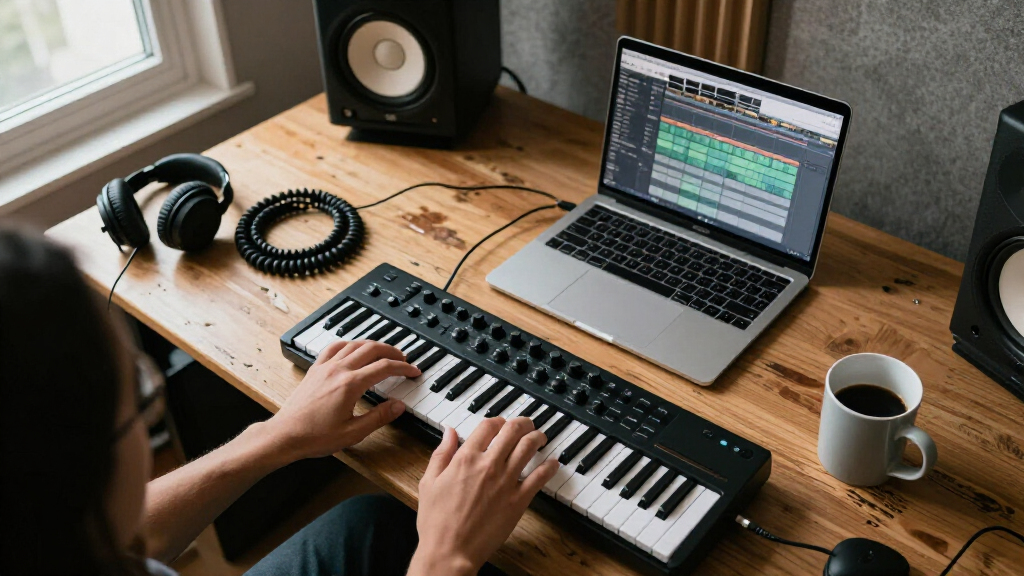
I compared these desks around the practical demands of a music-production workstation: keyboard capacity and placement, usable surface area, monitor and accessory organization, and how well each design appears suited to a recording workflow. I also weighed the tradeoffs between compact dimensions and room to expand, fixed and adjustable layouts, and dedicated production features versus gaming-oriented extras. Because the product list spans 47-inch desks, full-size keyboard workstations, and wide multi-shelf designs, I treated fit for the stated use as more important than feature count alone.
The ranking favors desks that present a clear reason to choose them for music production, then places more specialized options where their strengths matter most. A raised platform and keyboard tray give the Monoprice desk a balanced role; the 88-key desks serve buyers whose instrument dictates the layout; and the broad Eureka and Acme models make more sense for expanded setups than for small rooms. Product details alone do not establish load limits, assembly quality, or real-world stability, so buyers should verify those points and measure their equipment before ordering.
Factors to Consider When Choosing Studio Desk For Music Production
Choosing a production desk starts with your instruments and room, not the number of shelves in a product listing. I’d map out the gear that needs to stay connected, then compare the desk’s working height, depth, and support layout against that plan. These checks help avoid a workstation that technically fits but makes playing, mixing, or cable access awkward.
Measure the Keyboard and Its Playing Position
Measure the instrument’s full width, depth, and height, including knobs, pitch wheels, and any stand or support it needs. A desk described for 88 keys may still leave little room for a mouse or control surface, so check the tray’s usable dimensions rather than relying on the key count. Also consider whether you prefer to play with the keyboard pulled close and low or stored beneath the main surface between sessions. A sliding tray can save surface area, but it may limit legroom or place the instrument at a height that feels wrong for long sessions. Leave room for cables to exit without being pinched when the tray moves. If you switch between a piano and a smaller controller, plan around the larger instrument so the desk does not become a daily compromise.
Match Desk Depth to Monitor Placement
Width gets attention, but depth affects monitor placement, screen distance, and the space available for controls. Shallow surfaces can force speakers too close to a wall or leave a keyboard and mouse competing for the same area. Before choosing a wide desk, mark the speaker and display positions on the floor or a tabletop and check whether the listening position forms a sensible layout. A raised monitor platform can free the main work surface, yet it also fixes the speakers and screen to the platform’s available area. Do not assume a shelf can support every monitor; check the maker’s load guidance and dimensions. Producers who mix at a dedicated desk may value depth more than extra length, while a controller-heavy live setup may benefit more from width.
Decide Whether Adjustability Will Get Used
A hand-cranked height-adjustable desk can suit someone who changes between seated and standing work or shares a workstation with another person. The benefit depends on whether the desk can move through a useful range while carrying the intended gear. Keyboard trays and monitor shelves can complicate height changes, so check which parts move together and which remain fixed. A fixed desk may be the simpler choice when you have a preferred playing height and want fewer moving parts in the layout. Avoid paying for adjustment based only on the idea that you might use it; think about how often your posture or user changes. If you do choose an adjustable design, plan cable slack for every position.
Treat Storage and Add-Ons as Workflow Choices
Shelves, headphone hooks, cup holders, and extra keyboard tiers can reduce clutter, but they are useful only when they fit your actual routine. A lower shelf may be handy for an audio interface or small computer, yet it can obstruct feet or limit a chair’s movement. Extra tiers can help keep controllers accessible, though each shelf adds another dimension to check against your equipment. Cup holders and casters are secondary features; neither replaces a stable surface or sensible cable routing. Decide which items need to remain connected and within reach, then reserve space for them before buying. This prevents a desk from looking well-equipped on paper while leaving the main work area cramped.
Check Stability, Caster Use, and Cable Access
Music-production desks support gear that can shift or vibrate during playing, so a large surface is only useful if the frame and supports suit the load. Product names may mention casters, but buyers should check whether the wheels lock and whether the desk can be kept stationary during performance. A movable desk is convenient for cleaning or room changes; frequent movement can be a nuisance if every cable must be disconnected first. Look for a clear path from wall power and audio connections to the equipment, especially around keyboard trays and bottom shelves. Confirm the stated weight capacity, assembly requirements, and any separate support limits for shelves. When those details are missing, contact the seller rather than assuming every tier can hold heavy studio gear.
Buy for the Setup You Have, With Room for One Change
Oversizing a desk for a hypothetical future studio can consume valuable room without improving today’s workflow. At the other extreme, buying a compact model with no spare space may force an upgrade as soon as you add a second controller or control surface. List the equipment you use now, then identify one likely addition and make sure the layout can accommodate it. The 47-inch options make sense when space is constrained, while wide desks are easier to justify when several devices must stay connected and accessible. Leave enough open surface for writing, a laptop, or temporary gear rather than filling every shelf. A well-planned desk supports the way you make music, not just the maximum amount of equipment you can stack on it.
Frequently Asked Questions
Do I need a dedicated 88-key desk if I own a full-size MIDI keyboard?
Not always, but the keyboard’s dimensions and how you play it should decide the question. A desk designed around 88 keys is a stronger starting point when you want the instrument integrated into a sliding tray or a dedicated lower position. Check the actual tray width, depth, and clearance, since a product title alone does not confirm that your particular keyboard will fit. If you play standing or use a separate keyboard stand, a general desk may work better than forcing the instrument into a tray. Also check whether the keyboard can slide in and out without hitting your legs or connected cables.
Is a 47-inch desk enough for a music-production setup?
It can be enough for a laptop or display, a compact controller, and a small set of essential gear, especially when a shelf moves monitors off the main surface. It is less forgiving if you want full-size speakers, a large keyboard, an audio interface, and a control surface all within easy reach. Sketch the equipment footprints before buying and include space for hands, mouse movement, and cable connections. A compact desk is a sensible fit for a focused setup, not a guarantee that every piece of gear will fit comfortably. If you expect to add equipment soon, compare its footprint with a wider desk before committing.
Are casters a good idea for a studio desk?
Casters help when you need to move the desk for cleaning, rearranging, or shared-room use, but they are not automatically an advantage in a recording space. Check that the wheels lock and that the desk remains steady with your intended equipment in place. Movement also affects cable planning: leave slack for repositioning, but avoid loose loops that can snag. If the workstation will stay in one position, a stationary design may feel simpler and reduce one more point to check. Choose wheels for a real mobility need rather than as a substitute for a suitable footprint.
Should I choose a desk with a raised monitor shelf or a flat work surface?
A raised shelf can free space below for a keyboard, interface, or writing area, and it may help organize a crowded setup. Its usefulness depends on the shelf’s dimensions, height, and stated support capacity, as well as whether your monitors fit the available placement. A flat surface gives you more freedom to arrange screens and speakers, but it can leave less room for instruments and controls. Think about your listening position and monitor placement before deciding that a shelf is helpful. If you use large speakers or prefer flexible positioning, the simplest layout may be easier to adapt.
What should I check before ordering a desk with a sliding keyboard tray?
Compare the tray’s interior dimensions with the keyboard, including any side controls and attached cables. Check its height and travel, then consider how much knee and leg clearance remains when you sit at the desk. Find out whether the tray has a stated weight limit and whether it is intended for playing or mainly for storage. A tray that holds the instrument but sits too low or wobbles under active playing can undermine the point of the design. Finally, confirm that the tray can retract without catching on cables, shelves, or your chair.
Conclusion
For the strongest all-around music-production layout in this group, I’d start with the Monoprice Recording Studio Desk: its raised platform and keyboard tray make it the most balanced choice for a focused workstation. The Acme 47-Inch Wooden Music Recording Studio and Gaming Desk is my value-oriented pick for buyers who want a compact desk with a sliding tray and do not need a large studio footprint. Beginners with a modest controller-based setup should compare the Monoprice and 47-inch options, then choose by keyboard fit and room measurements. For a broader workspace with extra room for gear, the Eureka 72-Inch Walnut Desk is the premium-style choice, while the 88 Key Music Studio Desk is the clearest fit for full-size keyboard needs. Producers who need height changes should give the hand-cranked workstation a closer look; anyone choosing a wheeled or shelf-heavy model should verify stability, clearances, and load limits first.
Halloween Picks
halloween
As an affiliate, we earn on qualifying purchases.


![John Mayer Announces 2027 Las Vegas Sphere Residency [Updated]](https://deadsetlive.com/wp-content/uploads/2026/10/john-mayer-announces-2027-las-vegas-sphere-residency-updated-featured-260x140.jpg)