For a tube headphone amplifier for vintage sound, my best overall pick is the Nobsound P32, whose swappable tube and op-amp design gives listeners room to shape a desktop setup. The Fosi Audio GR70 is a strong alternative for a compact tube-focused headphone amp, while the Douk Audio T9 suits listeners who want phono connections and tone controls for a record-player system. The main tradeoffs are whether you need a headphone amp alone or phono and speaker functions too, how much power your headphones require, and how much hands-on tube swapping you want. A vintage look does not by itself guarantee a warm sound, so I weigh the actual circuit, inputs, and headphone compatibility over styling. Read on for the full breakdown and help matching each model to your listening setup.

Get audio and creator gear delivered free with Prime
- Fast, free delivery on millions of items
- Prime Video, Amazon Music and more included
- Member-only deals all year
Complete the kit


Key Takeaways
- Nobsound P32 takes the lead for flexible desktop listening: its swappable tube and op-amp design offers more scope for setup changes than a fixed-tube model, though buyers should check its sound character with their own headphones.
- The Fosi Audio GR70 keeps the focus on headphones: its dual 5654W and 6AC7 tubes and support for 16–300Ω headphones make it a more direct choice than integrated models built to drive speakers too.
- Turntable owners have distinct options: the Douk Audio T9 combines phono support with treble and bass controls, while the T4 PRO is a more focused phono preamp and headphone pairing.
- Feature-rich integrated units trade simplicity for flexibility: the Fosi MC331 adds DAC inputs, Bluetooth, and speaker amplification, but it is a larger system choice than a dedicated headphone amp.
- Headphone impedance is only part of the match: the Rockville TubeHead lists 16–600Ω support but 180mW output, so listeners should also check headphone sensitivity and desired volume.
| Nobsound P32 Tube Headphone Amplifier |  | Best for High-Impedance Headphones | Maximum output power: 1000mW | Supported headphone impedance: 24–600Ω | Inputs: RCA, 3.5mm AUX | VIEW ON AMAZON | See Our Full Breakdown |
| Fosi Audio GR70 Tube Headphone Amplifier and Preamp |  | Best for Vintage-Style Tone Controls | Tubes: Two 5654W and two 6AC7 | Supported headphone impedance: 16–300Ω | Listed output wattage: 300 watts | VIEW ON AMAZON | See Our Full Breakdown |
| FX-Audio TUBE-05 HiFi Vacuum Tube Headphone Amplifier |  | Best for Remote-Controlled Listening | Tube type: 12AU7/ECC82 | Supported headphone impedance: 30–600Ω | EQ adjustment: Bass and treble | VIEW ON AMAZON | See Our Full Breakdown |
| Fosi Audio MC331 Tube Integrated Amplifier with DAC | 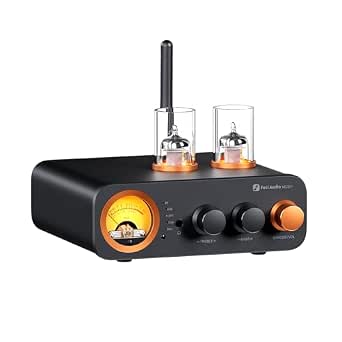 | Best All-in-One Vintage Desk System | Model: MC331 | Speaker power output: 105W × 2 at 4Ω | Inputs: Bluetooth, USB, coaxial, optical, RCA | VIEW ON AMAZON | See Our Full Breakdown |
| Apos Gremlin Headphone Amp |  | Best for Balanced Headphone Setups | Output power: 1250mW | Design: Class A, fully balanced, hybrid tube and transistor | Tube compatibility: 12AU7, 6922 | VIEW ON AMAZON | See Our Full Breakdown |
| Douk Audio T4 PRO Tube Phono Preamp with 6CS6 Headphone Amp for Turntable |  | Best for Turntable Listeners | Inputs: MM phono, AUX | Channels: 2 | Maximum output power: 150mW at 32Ω | VIEW ON AMAZON | See Our Full Breakdown |
| Rockville TubeHead Tube Headphone Amplifier, 6K4, 16-600 Ohms, 180mW | 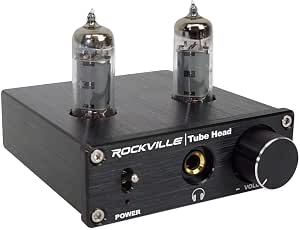 | Best Compact Pick for Broad Impedance Support | Tube type: Dual 6K4 | Supported headphone impedance: 16–600Ω | Maximum output power: 180mW | VIEW ON AMAZON | See Our Full Breakdown |
| Douk Audio T9 Vacuum Tube Phono Preamp Stereo Turntable Preamplifier with Headphone Output and Treble Bass Control for MM/MC Record Player, Home Hi-Fi Audio, Amplifier, Speaker |  | Best for Tone Shaping and MM/MC Vinyl | Cartridge support: MM and MC | Channels: 2 | Maximum output power: 250mW | VIEW ON AMAZON | See Our Full Breakdown |
| Douk Audio Tube Headphone Amplifier with German Valvo Tubes and VU Meter |  | Best Premium Feature Set | Maximum output power: 2W | Supported headphone impedance: 16–600Ω | Headphone outputs: XLR, 4.4mm, 6.35mm | VIEW ON AMAZON | See Our Full Breakdown |
| xDuoo MT-02 Hybrid Tube Headphone Amplifier with Dual 6J1 Vacuum Tubes |  | Best for High-Power Hybrid Drive | Amplifier type: Hybrid tube and transistor | Preamp tubes: Dual 6J1 | Output stage: Class A transistor | VIEW ON AMAZON | See Our Full Breakdown |
| XDUOO TA-66 High-Performance Tube Amplifier |  | Best for Smooth, Low-Level Listening | Preamp tube: 6N2 | Buffer tube: 6N5P | Maximum output power: 200 mW | VIEW ON AMAZON | See Our Full Breakdown |
| xDuoo TA-66 Tube Headphone Amplifier, 60–600 Ω Headphone Amp, 6N2 Tube Preamp, 6N5P Tube Buffer |  | Best for High-Impedance Headphone Owners | Preamp tube: 6N2 | Buffer tube: 6N5P | Headphone impedance range: 60–600 Ω | VIEW ON AMAZON | See Our Full Breakdown |
| Douk Audio Vacuum Tube Preamp (TUBE-T5C) – Headphone Amp with VU Meter, 4-Way RCA Selector and Tone Control |  | Best for Vintage-System Flexibility | Maximum output power: 500 mW | Headphone impedance range: 16–600 Ω | RCA source selection: 4-way | VIEW ON AMAZON | See Our Full Breakdown |
| tube headphone amplifier for vintage sound | Maximum output power |
|---|---|
| Nobsound P32 Tube Headphone Am | 1000mW |
| Fosi Audio GR70 Tube Headphone | — |
| FX-Audio TUBE-05 HiFi Vacuum T | — |
| Fosi Audio MC331 Tube Integrat | — |
| Apos Gremlin Headphone Amp | — |
| Douk Audio T4 PRO Tube Phono P | 150mW at 32Ω |
| Rockville TubeHead Tube Headph | 180mW |
| Douk Audio T9 Vacuum Tube Phon | 250mW |
| Douk Audio Tube Headphone Ampl | 2W |
| xDuoo MT-02 Hybrid Tube Headph | — |
| XDUOO TA-66 High-Performance T | 200 mW |
| xDuoo TA-66 Tube Headphone Amp | — |
| Douk Audio Vacuum Tube Preamp | 500 mW |
More Details on Our Top Picks
Nobsound P32 Tube Headphone Amplifier
The Nobsound P32 is the most flexible pick here for listeners who want vintage tube character without limiting themselves to one headphone or source. Its stated 1000mW output and 24–600Ω range make it a stronger match for demanding, high-impedance headphones than the Fosi Audio GR70, whose listed range ends at 300Ω. RCA and 3.5mm inputs, two headphone jack sizes, and stereo preamp use also let it serve beyond a single desk setup. The tradeoff is that customization comes with homework: swapping tubes or op-amps may suit tinkerers, but not buyers seeking a plug-and-play unit. Its 5V supply requirement and lack of wireless input also make it less self-contained than the Fosi Audio MC331.
Pros:- Listed 1000mW output and 24–600Ω support suit a broad range of headphones.
- Can function as both a headphone amplifier and stereo preamp.
- Swappable tubes and op-amps offer sound customization.
- RCA and 3.5mm inputs pair with 3.5mm and 6.35mm headphone outputs.
Cons:- Tube and op-amp swaps may be too involved for plug-and-play users.
- Requires a 5V DC supply, which may call for an adapter in some setups.
- No Bluetooth or other wireless input.
Best for: Listeners with high-impedance headphones who want tube and op-amp swapping plus the option to feed a stereo system.
Not ideal for: Buyers who want wireless playback, a simple fixed setup, or an amplifier that needs no component-swapping knowledge.
- Maximum output power:1000mW
- Supported headphone impedance:24–600Ω
- Inputs:RCA, 3.5mm AUX
- Headphone outputs:3.5mm, 6.35mm
- Power supply:5V DC
- Dimensions:3.23 × 3.07 × 1.26 inches
- Weight:7.68 ounces
- Warranty:18 months
Our verdict“Choose the P32 if high-impedance headphone support and hands-on tube tuning matter more than wireless convenience.”
Fosi Audio GR70 Tube Headphone Amplifier and Preamp
The Fosi Audio GR70 leans into the character and hands-on feel many vintage-sound buyers want: four vacuum tubes, bass and treble controls, and selectable impedance modes. Those controls make it easier to tailor a warmer presentation than the simpler Nobsound P32, though the P32 offers a wider stated headphone range, reaching 600Ω rather than the GR70’s 300Ω ceiling. The GR70’s 16–300Ω support covers many common headphones, while its RCA connections also suit a home audio chain. I would choose it for an accessible, adjustable desktop setup, not for maximum drive flexibility. The product data’s 300-watt output listing is not directly comparable to the P32’s 1000mW figure, so buyers should verify actual headphone power details before pairing it with demanding models.
Pros:- Four listed vacuum tubes support a tube-centered sound and visual character.
- Switchable low- and high-impedance modes accommodate different headphone types.
- Bass and treble controls provide direct tonal adjustment.
- RCA connections support integration with home audio components.
Cons:- Listed headphone impedance support stops at 300Ω, below the Nobsound P32 and FX-Audio TUBE-05 ranges.
- The supplied output-power figure is listed as 300 watts, leaving headphone drive capability unclear.
- At 3.1 pounds, it is heavier than the small desktop footprint might suggest.
Best for: Desktop listeners with low- or medium-impedance headphones who want tube styling, impedance modes, and direct bass and treble adjustment.
Not ideal for: Owners of headphones above 300Ω or buyers who need clearly specified output power for a demanding headphone load.
- Tubes:Two 5654W and two 6AC7
- Supported headphone impedance:16–300Ω
- Listed output wattage:300 watts
- Connectors:3.5mm, 6.35mm, RCA
- Channels:2
- Enclosure material:Aluminum alloy
- Weight:3.1 pounds
- Warranty:24 months
Our verdict“Pick the GR70 for adjustable vintage-style tone with common headphone impedances, but confirm output suitability before using demanding headphones.”
FX-Audio TUBE-05 HiFi Vacuum Tube Headphone Amplifier
The FX-Audio TUBE-05 is the comfort-focused choice in this group: its remote and adjustable bass and treble let listeners tune a vintage-leaning presentation from their seat. The 12AU7/ECC82 tube and stated 30–600Ω support put it in the same broad impedance class as the Nobsound P32, but the TUBE-05’s published information gives no specific output-power figure. That makes the P32 easier to judge for buyers pairing an amp with harder-to-drive headphones. Compared with the Fosi Audio GR70, the TUBE-05 offers remote operation and support up to 600Ω, while the GR70 lists impedance modes and a four-tube arrangement. Its aluminum chassis and larger footprint suit a stationary setup; buyers seeking a tiny desktop unit or detailed power specifications should look elsewhere.
Pros:- Remote control adds convenience for listening away from the desk.
- Bass and treble adjustment helps tailor the presentation to headphones and recordings.
- 12AU7/ECC82 tube supports the desired tube-based vintage character.
- Stated 30–600Ω range covers a wide selection of headphones.
Cons:- No specific power-output figure is supplied, making demanding headphone pairings harder to evaluate.
- Larger than the compact Nobsound P32, at 7.48 × 6.89 × 3.27 inches.
- Vacuum tubes call for careful handling.
Best for: Listeners who want a remote-operated desktop amp with tone controls and headphones rated between 30Ω and 600Ω.
Not ideal for: Buyers who need a clearly documented output-power rating, a particularly compact unit, or easy tube-free handling.
- Tube type:12AU7/ECC82
- Supported headphone impedance:30–600Ω
- EQ adjustment:Bass and treble
- Control:Remote control included
- Power output:Described as high-performance transistor IV conversion; no numeric rating provided
- Material:Aluminum alloy
- Dimensions:7.48 × 6.89 × 3.27 inches
- Weight:1.65 pounds
Our verdict“Choose the TUBE-05 if remote control and tone shaping matter most, and its unspecified power rating is acceptable for your headphones.”
Fosi Audio MC331 Tube Integrated Amplifier with DAC
The Fosi Audio MC331 makes the most sense when the goal is a vintage-inspired listening hub rather than a headphone amp alone. Its DAC, tube preamp, speaker amplifier, and 3.5mm headphone output share one compact unit, while Bluetooth, USB, optical, coaxial, and RCA inputs cover a wider source mix than the RCA-focused Nobsound P32. The replaceable tubes and retro VU meter bring the visual and tonal cues this roundup is about, and 105W per channel at 4Ω gives it a role with bookshelf speakers that the headphone-focused Apos Gremlin cannot fill. The tradeoff is less specialization: the listed headphone connection is 3.5mm, and there is no headphone impedance or headphone-output power figure here. It is a better system centerpiece than a targeted upgrade for demanding headphones.
Pros:- Combines DAC, preamp, speaker amplifier, and headphone output in one unit.
- Bluetooth, USB, coaxial, optical, and RCA inputs handle varied sources.
- 105W × 2 at 4Ω supports bookshelf-speaker use.
- Replaceable tubes and a vintage VU meter reinforce its retro setup appeal.
Cons:- Only a 3.5mm headphone output is listed; no balanced headphone connection is specified.
- Headphone impedance support and headphone-output power are not provided.
- No Wi-Fi or network streaming support.
Best for: Listeners building a compact vintage-style desk system around digital sources, bookshelf speakers, and occasional 3.5mm headphone listening.
Not ideal for: Headphone-focused buyers who need balanced outputs, documented headphone drive specifications, or Wi-Fi streaming.
- Model:MC331
- Speaker power output:105W × 2 at 4Ω
- Inputs:Bluetooth, USB, coaxial, optical, RCA
- Outputs:Pre-out, 3.5mm headphone jack
- Tubes:2, replaceable
- Power adapter:24V 4.5A
- Weight:1.4 pounds
- Warranty:24 months
Our verdict“Choose the MC331 when you want one vintage-styled unit for digital sources, bookshelf speakers, and casual headphone listening.”
Apos Gremlin Headphone Amp
The Apos Gremlin is the specialist pick for listeners building around balanced connections and a tube-shaped sonic flavor. Its fully balanced Class A hybrid design pairs replaceable 12AU7 or 6922 tubes with transistor amplification, while the listed 1250mW output gives it more specified power than the FX-Audio TUBE-05, whose power figure is not numeric. Balanced XLR input and 4.4mm output make the Gremlin a different proposition from the single-ended Nobsound P32: it favors compatible balanced sources and headphones over broad everyday connectivity. That focus is also its main limitation. It is described as a headphone amp, not a speaker amplifier, and buyers without balanced cables or a compatible source may get more practical flexibility from the P32 or Fosi Audio MC331. Tube changes add personalization, but also add setup effort.
Pros:- Fully balanced Class A hybrid design supports a dedicated balanced signal path.
- Listed 1250mW output provides a numeric power specification.
- Replaceable 12AU7 and 6922 tube compatibility allows changes to the tube setup.
- Balanced XLR input and 4.4mm output suit compatible equipment.
Cons:- Balanced XLR input and 4.4mm output limit usefulness with single-ended-only equipment.
- Designed for headphone use, not speaker amplification like the Fosi Audio MC331.
- Tube swapping requires extra handling and setup.
Best for: Headphone enthusiasts with balanced XLR sources and 4.4mm headphones who want a tube-swappable Class A hybrid amp.
Not ideal for: Listeners using only single-ended gear, anyone seeking a speaker amplifier, or buyers who prefer not to handle tube swaps.
- Output power:1250mW
- Design:Class A, fully balanced, hybrid tube and transistor
- Tube compatibility:12AU7, 6922
- Tube configuration:Replaceable matched pair
- Input:XLR
- Output:4.4mm balanced
- Amplifier use:Headphone amplifier
Our verdict“Pick the Gremlin if your system already uses balanced connections and you want a tube-swappable headphone amp rather than a speaker system component.”
Douk Audio T4 PRO Tube Phono Preamp with 6CS6 Headphone Amp for Turntable
For a vintage listening setup built around vinyl, the Douk Audio T4 PRO is the most focused choice here: its MM phono input and headphone output let a turntable feed headphones without a separate phono stage. An AUX input adds a second source, while adjustable gain gives some room to match different headphones. Its compact aluminum case also takes up less desk space than the more feature-rich Douk Audio T9. The tradeoff is specialization: this is not the pick for someone seeking a powerful, all-purpose headphone amp, and its stated 150mW output is modest beside the xDuoo MT-02’s 1500mW. I’d choose it for a simple vinyl-first chain, but skip it if high-demand headphones or a wide range of sources are central to the setup.
Pros:- MM phono and AUX inputs support a turntable plus an additional source.
- Adjustable gain helps tailor output to the connected headphones.
- Compact aluminum chassis suits a small home stereo or desktop setup.
- Tube-based presentation fits listeners seeking a warmer vintage character.
Cons:- 150mW maximum output is limited compared with higher-powered options such as the xDuoo MT-02.
- MM-only phono input excludes MC cartridges.
- The 12V DC supply requirement and replaceable tubes add setup and upkeep.
Best for: Vinyl listeners with an MM turntable who want a compact tube-flavored phono stage and headphone output in one unit.
Not ideal for: Listeners using MC cartridges or power-hungry headphones who need broader cartridge support or substantially more output.
- Inputs:MM phono, AUX
- Channels:2
- Maximum output power:150mW at 32Ω
- Output impedance range:32–300Ω
- Signal-to-noise ratio:105dB
- Power supply:12V DC, 1.5A
- Dimensions:4.61 × 3.74 × 1.18 inches
- Chassis material:Aluminum
Our verdict“Choose the T4 PRO if your vintage sound starts with an MM turntable and you value a compact phono-and-headphone unit over high output.”
Rockville TubeHead Tube Headphone Amplifier, 6K4, 16-600 Ohms, 180mW
The Rockville TubeHead suits listeners who want a small, straightforward tube amp rather than a turntable-specific component. Its RCA and 3.5mm inputs make it easier to connect common sources than the T4 PRO, while its stated 16–600Ω headphone range covers a broad spread of impedance ratings. The dual 6K4 tubes aim for a warm presentation, but the 180mW maximum output remains modest next to the xDuoo MT-02’s 1500mW, so impedance range alone should not be read as a guarantee for difficult headphones. At just under four inches wide and about a pound, it is the more portable desktop choice in this group. The compromises are a 6.35mm headphone output only, external power, and a listing that describes one channel, which makes it a less clear fit for buyers prioritizing conventional stereo specifications.
Pros:- RCA and 3.5mm inputs accommodate a range of everyday audio sources.
- Specified support from 16Ω to 600Ω gives broad impedance compatibility.
- Small aluminum enclosure is easy to fit on a crowded desktop.
- Dual 6K4 tubes provide the vintage-style tube stage sought in this roundup.
Cons:- 180mW maximum output is far below the xDuoo MT-02’s stated 1500mW.
- Only a 6.35mm headphone output is listed; no balanced connection is specified.
- Requires external power and tube care, limiting portability and simplicity.
Best for: Listeners who want a small, tube-based desktop amp for common RCA or 3.5mm sources and headphones across a wide impedance range.
Not ideal for: Owners of power-hungry headphones seeking strong output headroom, or buyers who need balanced headphone connections or battery operation.
- Tube type:Dual 6K4
- Supported headphone impedance:16–600Ω
- Maximum output power:180mW
- Inputs:RCA, 3.5mm
- Headphone output:6.35mm
- Signal-to-noise ratio:106dB
- THD:0.03%
- Dimensions and weight:3.94 × 3.74 × 0.9 inches; 1.02 lb
Our verdict“Pick the TubeHead for a compact, single-ended tube amp with broad stated impedance support, not for high output or balanced connectivity.”
Douk Audio T9 Vacuum Tube Phono Preamp Stereo Turntable Preamplifier with Headphone Output and Treble Bass Control for MM/MC Record Player, Home Hi-Fi Audio, Amplifier, Speaker
The Douk Audio T9 is the vinyl-focused option for listeners who want more control than the simpler T4 PRO provides. It supports both MM and MC cartridges, and its treble and bass controls let you adjust tonal balance instead of relying on tube character alone. That flexibility makes it a stronger match for varied records and cartridge setups, though the available data lists a 250mW output without specifying the headphone impedance at which that figure applies. Compared with the T4 PRO, the T9 offers broader cartridge compatibility and tone adjustment; compared with the Rockville TubeHead, it is more purpose-built around turntable playback. Its 12V supply and tube swapping add setup work, and the product data does not give dimensions or a complete connection list, so buyers wanting a clearly documented general-purpose amp may prefer another option.
Pros:- Supports both MM and MC cartridges, unlike the MM-only Douk Audio T4 PRO.
- Treble and bass controls allow direct tonal adjustment for different recordings.
- Provides a dedicated headphone output in a turntable-oriented design.
- Compatible tube types offer options for tube replacement and sound customization.
Cons:- The stated 250mW output is limited for demanding headphone loads, and no load condition is supplied.
- Requires a 12V power supply and may involve tube replacement and setup.
- The supplied product data does not specify dimensions or a full set of input connections.
Best for: Vinyl enthusiasts with an MM or MC turntable who want onboard bass and treble adjustment alongside a headphone output.
Not ideal for: Listeners seeking a documented high-output headphone amp or a simple, low-maintenance unit for non-vinyl sources.
- Cartridge support:MM and MC
- Channels:2
- Maximum output power:250mW
- Tone controls:Treble and bass
- Headphone output:Yes
- Supported tube types:6K4, EF93, 6BA6, W727
- Power supply:12V
- Mounting type:Freestanding
Our verdict“Choose the T9 if you play MM or MC vinyl and want hands-on tone shaping more than broad, high-power headphone capability.”
Douk Audio Tube Headphone Amplifier with German Valvo Tubes and VU Meter
For buyers who want vintage styling without giving up modern headphone connections, this Douk Audio tube amplifier has the widest listed output selection in the group: XLR, 4.4mm, and 6.35mm. Its 2W maximum output also gives it a clear power advantage over the turntable-centered T4 PRO and T9, while the 16–600Ω range is listed for varied headphones. German Valvo tubes, VU meters, and dual-mode preamp functionality make it the most feature-rich, component-like pick here. That extra flexibility comes with more setup complexity, a 15V DC supply, and a 2.6-pound chassis that is less suited to portable use. Buyers should also note that the provided specs do not state the load condition for the 2W figure, so I would not treat that number alone as a complete guide to headphone matching.
Pros:- XLR, 4.4mm, and 6.35mm outputs accommodate multiple headphone connection types.
- Stated 2W maximum output exceeds the listed output of the T4 PRO and T9.
- Dual-mode preamp operation gives it a role beyond headphone amplification.
- German Valvo tubes and VU meters deliver a distinct retro-industrial presentation.
Cons:- At 2.6 pounds and with a 15V DC supply, it is less convenient to move or use portably.
- Tube handling and customizable op-amps may be complex for first-time tube-amp owners.
- The supplied specifications do not identify the load condition for its 2W output rating.
Best for: Desktop listeners with multiple headphone plug types who want high stated output, preamp functionality, and visible vintage styling.
Not ideal for: Buyers seeking a compact portable amp, a phono stage for turntables, or a simple device with minimal setup.
- Maximum output power:2W
- Supported headphone impedance:16–600Ω
- Headphone outputs:XLR, 4.4mm, 6.35mm
- Channels:2
- Power supply:15V DC, 3A
- Preamp mode:Dual-mode preamp functionality
- Chassis material:Aluminum
- Weight:2.6 lb
Our verdict“Choose this Douk if you want a powerful, feature-rich desktop amp with vintage visuals and several headphone outputs, rather than a vinyl-specific preamp.”
xDuoo MT-02 Hybrid Tube Headphone Amplifier with Dual 6J1 Vacuum Tubes
The xDuoo MT-02 takes a different route to vintage character: dual 6J1 tubes shape the preamp stage, while a Class A transistor output supplies the drive. Its stated 1500mW output is far above the T4 PRO’s 150mW and the Rockville TubeHead’s 180mW, making this the stronger candidate for listeners whose headphones need more headroom. A 4.4mm balanced output, 6.35mm single-ended output, and pre-out also support a more flexible desktop chain than the T9’s turntable-centered setup. The tradeoff is that its hybrid design may appeal less to buyers seeking an all-tube signal path, and the supplied specifications do not give a headphone impedance range or the load condition for its power figure. Tube warm-up and a larger desktop footprint also make it less immediate than the compact Rockville.
Pros:- Hybrid tube preamp and Class A transistor output combine tube coloration with stronger drive.
- Stated 1500mW output substantially exceeds the T4 PRO and Rockville TubeHead figures.
- 4.4mm balanced and 6.35mm single-ended outputs support different headphone connections.
- Pre-out and ground terminal offer useful integration options for a desktop system.
Cons:- Hybrid architecture is not an all-tube signal path.
- The supplied product data does not state a supported headphone impedance range or output load condition.
- Tube warm-up and a larger desktop footprint make it less convenient than the compact Rockville TubeHead.
Best for: Desktop listeners who want tube-stage warmth with stronger transistor drive, balanced and single-ended outputs, and a pre-out.
Not ideal for: Buyers who specifically want a fully tube-based output stage, a compact portable unit, or published impedance matching details before purchase.
- Amplifier type:Hybrid tube and transistor
- Preamp tubes:Dual 6J1
- Output stage:Class A transistor
- Output power:Up to 1500mW
- Headphone outputs:6.35mm single-ended, 4.4mm balanced
- Pre-out:Yes
- Ground terminal:Yes
- Enclosure:Aluminum with acrylic panels
Our verdict“Pick the MT-02 if you want tube flavor paired with substantial stated output and flexible desktop connections, and can accept a hybrid rather than all-tube design.”
XDUOO TA-66 High-Performance Tube Amplifier
The TA-66 suits listeners who want tube warmth without fussy volume matching. Its 6N2 preamp and 6N5P buffer are described as sweet, detailed, and soft in character—a vintage-leaning presentation rather than a feature-packed control hub like the Douk Audio TUBE-T5C. The step-by-step potentiometer is a practical advantage for quiet listening, where channel imbalance at low settings can distract. A line-out also lets it feed an audio amplifier or active speakers, extending its role beyond headphones. The tradeoff is that the supplied data lists one channel and 200 mW maximum output, so buyers should verify their intended headphone connection and power needs before choosing it. Its aluminum-alloy enclosure has a polished, interference-conscious finish, but this is a simpler, less configurable choice than the Douk.
Pros:- 6N2 preamp and 6N5P buffer are designed for a sweet, detailed, softened presentation.
- Step-by-step potentiometer helps address channel imbalance at low listening levels.
- Line-out can feed an audio amplifier or active speakers.
- Sandblasted aluminum-alloy housing is built to resist interference.
Cons:- Listed as one channel, so stereo use and connections need clarification before purchase.
- Maximum output is specified as 200 mW, which may limit headroom with demanding headphones.
- The feature set is less flexible than the Douk Audio TUBE-T5C, which adds source selection and tone adjustment.
Best for: Listeners seeking a warm, understated tube stage for low-volume headphone sessions who also want line-out connectivity for powered speakers or another amplifier.
Not ideal for: Buyers who need clearly specified stereo headphone operation, substantial power for demanding headphones, or source switching and tone controls.
- Preamp tube:6N2
- Buffer tube:6N5P
- Maximum output power:200 mW
- Number of channels:1
- Supply voltage range:100–240 V AC
- Enclosure material:Aluminum alloy with copper components
- Line-out:Can serve as a preamp for an audio amplifier or active speakers
- Warranty:1 year
Our verdict“Choose the TA-66 for a restrained, warm tube character and careful low-level volume control, but verify its channel configuration and power fit first.”
xDuoo TA-66 Tube Headphone Amplifier, 60–600 Ω Headphone Amp, 6N2 Tube Preamp, 6N5P Tube Buffer
This TA-66 listing makes the clearest case for pairing a vintage-voiced tube amp with 60–600 Ω headphones. Its 6N2 preamp and 6N5P buffer are presented as a route to warm, smooth sound, while point-to-point wiring and film capacitors support its more traditional construction pitch. Compared with the other TA-66 listing, this version gives a specific headphone impedance range, making it easier to judge fit; that listing instead specifies 200 mW output and a broad supply-voltage range. The step-by-step volume control is useful for listeners who favor quieter sessions, and line-out adds a preamp function for speakers or an amplifier. Its large listed package and 11-pound weight make it less appealing for a compact desk, while reports of possible rust on tube holders may bother buyers focused on finish.
Pros:- Specifies compatibility with 60–600 Ω headphones.
- 6N2 preamp and 6N5P buffer target a warm, smooth presentation.
- Step-by-step potentiometer is intended to reduce low-volume imbalance.
- Line-out can function as a preamp for an amplifier or active speakers.
Cons:- Listed package dimensions and 11-pound weight make it a substantial desktop component.
- Possible rust on tube holders may detract from the finish even if functionality remains unaffected.
- Unlike the other TA-66 listing, the supplied specs do not state maximum output power or supply voltage.
Best for: Owners of 60–600 Ω headphones who want a warm tube character, a line-out for other audio gear, and a clearly stated impedance range.
Not ideal for: Desk-space-conscious buyers, listeners with headphones below 60 Ω, or anyone who wants detailed output-power specifications before buying.
- Preamp tube:6N2
- Buffer tube:6N5P
- Headphone impedance range:60–600 Ω
- Wiring:Point-to-point
- Capacitors:Professional metal polyester film
- Package dimensions:13.39 × 9.37 × 8.66 inches
- Item weight:11 lb
- Line-out:Can serve as a preamp for audio amplifiers or active speakers
Our verdict“Pick this TA-66 when your headphones fall within its stated 60–600 Ω range and warm, smooth tuning matters more than compact size.”
Douk Audio Vacuum Tube Preamp (TUBE-T5C) – Headphone Amp with VU Meter, 4-Way RCA Selector and Tone Control
The TUBE-T5C is the most versatile choice here for a vintage-style desk or small audio system. Its four-way RCA selector reduces cable swapping, and bass-and-treble controls let you shape the sound rather than relying only on the tube stage. A lit dual-channel VU meter adds period-inspired visual character, while replaceable tube and op-amp sockets invite later tuning. Compared with either xDuoo TA-66, the Douk offers more source and tone control; the TA-66 models instead emphasize their 6N2/6N5P tube pairing and stepwise volume adjustment. The Douk’s stated 500 mW output and 16–600 Ω support cover a broad headphone range, though buyers of particularly demanding headphones should still check their power needs. Its extra controls and upgrade options also mean a less minimalist listening experience.
Pros:- Four-way RCA selector accommodates multiple audio sources without repeated cable changes.
- Bass and treble controls allow sound shaping to suit recordings and headphones.
- Dual-channel VU meter with customizable RGB lighting delivers a vintage visual style.
- Replaceable tube and op-amp sockets allow user-led sound customization.
Cons:- Maximum output of 500 mW may not provide enough drive for some demanding headphones.
- More controls and upgrade options make it less direct than the TA-66 models.
- The supplied information does not name the included tube or op-amp types.
Best for: Vintage hi-fi fans with several RCA sources who want a warm headphone stage, tactile tone controls, and room to experiment with tube or op-amp changes.
Not ideal for: Listeners who prefer a simple, fixed-sound headphone amp or need high output power for especially demanding headphones.
- Maximum output power:500 mW
- Headphone impedance range:16–600 Ω
- RCA source selection:4-way
- Tone controls:2 bands: bass and treble
- Audio outputs:RCA and headphone
- Connectors:3.5 mm jack and RCA
- Enclosure:Metal
- Dimensions:3.62 × 5.98 × 3.35 inches
- Warranty:18-month limited warranty
Our verdict“Choose the TUBE-T5C for a multi-source vintage setup with tone controls and upgrade flexibility, rather than a minimalist tube-only listening chain.”

How We Picked
I ranked these models by how directly they serve the goal of vintage-leaning headphone listening, then weighed headphone compatibility, useful connections, adjustment options, build and control practicality, and versatility. I gave dedicated headphone amplifiers an advantage over models that mainly serve as phono preamps or speaker amps, unless their extra functions clearly suit a common vintage-audio setup. Published impedance ranges and output figures help establish compatibility, but they do not tell the whole story: headphone sensitivity and the amp’s output behavior matter too.
The order also reflects tradeoffs, not just feature counts. The Nobsound P32 ranks first for its adaptable desktop format; the GR70 follows as a straightforward tube-centered alternative, while models with phono stages, DACs, balanced connections, or speaker outputs earn their places for specific setups. I treat vintage styling and tube presence as clues rather than proof of a particular sound. Where a product’s role or specifications leave uncertainty, I avoid claiming a sonic result that the available details cannot establish.
Factors to Consider When Choosing Tube Headphone Amplifier For Vintage Sound
Choosing a tube amp for vintage sound is less about buying the unit with the most visible tubes and more about matching its circuit and connections to the rest of your system. I would settle the headphone and source questions first; that can narrow the field before appearance or tube-swapping options enter the decision.
Decide What “Vintage Sound” Means to You
Listeners use vintage sound to mean different things: a softer presentation, a midrange-forward balance, or simply the tactile look and ritual of glowing tubes. A tube stage alone cannot promise any one of those outcomes, since the circuit, connected source, headphones, and recording all shape what you hear. Avoid treating tube type or vintage styling as a sound guarantee. If you want to alter tonal balance, a model with tone controls gives you a direct adjustment; if you want a classic tube signal path, prioritize the amplifier design instead. Set your goal before comparing features, or you may pay for functions that do not address what you actually want to change.
Match the Amp to Your Headphones, Not Just Their Impedance
Check the amp’s stated impedance range, but do not use that number as the only measure of compatibility. Sensitivity and output power influence whether the amp can reach your preferred listening level cleanly, particularly with less sensitive headphones. A high-impedance headphone may suit a model designed for that load, while a low-impedance set can still be a poor match if the amp’s output behavior is unsuitable. Look for output figures alongside the impedance range, and consult the headphone maker’s sensitivity information where available. Leave some headroom rather than assuming that a compatible range guarantees satisfying volume. This is a common reason to compare the product specifications as a pair, not as isolated numbers.
Choose Dedicated Headphone Use or a Multi-Source System
A dedicated headphone amp keeps the job focused, while an integrated model may add DAC, Bluetooth, phono, or speaker connections. Those extras can simplify a mixed home setup, but they may add controls and connection options you will never use. Before buying, list every source you plan to connect and check whether it needs a phono stage, digital conversion, or just a line-level input. A turntable without its own phono preamp needs suitable phono support; a standard line output is not a substitute. Also check whether the headphone output remains useful when the unit is connected to speakers. Paying for broader system capability makes sense only when it replaces equipment you otherwise need.
Understand Tube Swapping and Ongoing Care
Replaceable tubes appeal to listeners who want to experiment, but swapping is not a guaranteed shortcut to a preferred tone. Compatibility comes first: use the tube types approved for the specific amplifier and check whether the design calls for any setup procedure. Tubes are consumable parts, so factor in replacement availability and the effort of keeping spares if the amp is central to daily listening. Fixed or less user-adjustable designs may suit buyers who want fewer variables. Do not buy a tube amplifier solely for the promise of rolling different tubes; first decide whether that hobby is part of the experience you want.
Treat Balanced Connections as a System Choice
An amp with XLR or 4.4mm balanced outputs can fit headphones already wired for balanced use, but the connector alone does not guarantee a sound improvement. You need a compatible cable and an amp designed to provide that output properly. Avoid using adapter chains to force a balanced connection when the headphone wiring or amplifier configuration is unclear. If your headphones use a standard 3.5mm or 6.35mm plug, a single-ended model may be simpler and just as suitable for your needs. Choose balanced connectivity when it solves a real compatibility or system requirement, not because it sounds like an automatic upgrade.
Budget for the Whole Listening Chain
The amplifier is one part of a chain that includes a source, headphones, cables, and sometimes a phono stage or speaker amp. System fit matters more than feature count: a unit with many inputs can still be the wrong choice if it cannot serve your headphone load or connect cleanly to your source. Check the number and type of inputs, desk space, control layout, and whether you need a separate preamp or speaker amplifier. When paying more, look for a specific gain such as needed balanced outputs, broader source support, or integrated speaker drive. Skip extras that duplicate equipment you already own, and reserve attention for the pieces that affect your actual setup.
Frequently Asked Questions
Will a tube headphone amplifier make every pair of headphones sound warmer?
No. The result depends on the amplifier circuit, the headphones, and the source, so the word “tube” alone does not predict a warmer balance. Some models combine tubes with other circuit elements, while others are designed around a more direct tube stage. Headphone sensitivity and impedance can also affect how the amp behaves in your system. If tonal adjustment matters, look for explicit tone controls rather than relying on vintage styling or tube labels to deliver it.
Can I connect a turntable directly to any tube headphone amplifier?
Usually not. A turntable with a moving-magnet or moving-coil cartridge generally needs a suitable phono stage before its signal can feed a standard line input. Models such as the Douk T9 and T4 PRO are positioned for phono use, but you should confirm the cartridge type and supported inputs before choosing. If your turntable already has a built-in phono preamp, its line output may connect to a regular amplifier input. Check the turntable’s output setting and avoid connecting a phono-level signal to an input that expects line level.
Is an amplifier rated for 600Ω headphones automatically powerful enough?
No. An impedance range indicates the loads a model is intended to support, but it does not alone show how loud or cleanly it will drive a particular headphone. Output power and headphone sensitivity help fill in that picture. The Rockville TubeHead, for example, lists a broad impedance range alongside a stated 180mW output, so both figures deserve attention. Compare the amp’s available output with the headphone maker’s specifications, and allow for the listening level you prefer rather than buying from the impedance ceiling alone.
Should I choose a model with tube rolling if I am new to tube audio?
Tube swapping can be enjoyable, but it adds research and upkeep rather than making setup automatically easier. A beginner may prefer a model with the connections and headphone support already needed, then explore tube changes later if the amp supports them clearly. Confirm approved tube types and replacement availability before experimenting; a tube that physically fits is not necessarily electrically suitable. If you value a simple setup, avoid paying extra for customization you do not expect to use. If experimentation is part of the appeal, treat it as a separate hobby with its own learning curve.
Is the Fosi MC331 a better choice than a dedicated headphone amp for a small room?
It may be a better fit if you want one unit to handle headphones, bookshelf speakers, and several source types, including digital inputs or Bluetooth. That flexibility is less useful if you only listen through headphones and already own a DAC or preamp. A dedicated headphone model can keep the setup simpler and focus the purchase on headphone compatibility. Check how much desk space you have and which connections you will actually use. The right choice depends on whether you need a small system hub or a headphone amp alone.
Conclusion
For most desktop listeners seeking a vintage-leaning headphone setup, I recommend the Nobsound P32 as best overall for its tube and op-amp flexibility. The Fosi Audio GR70 is my best value-style pick for buyers who want a more direct tube headphone amp without prioritizing integrated speaker or phono features. For beginners, I would start with a straightforward dedicated model whose inputs match the current system, rather than paying for tube swapping or functions they may not use. The Douk Audio T9 is the better fit for turntable listeners who want tone controls, while the Fosi MC331 suits buyers seeking a broader desktop audio hub. For a premium-oriented setup centered on balanced connections and replaceable tubes, the Apos Gremlin deserves attention, provided its interface matches your headphones. My final check would be headphone sensitivity, source connections, and the role the amp needs to fill; those details matter more than the vintage look alone.