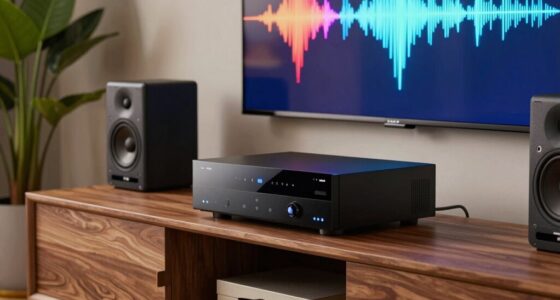
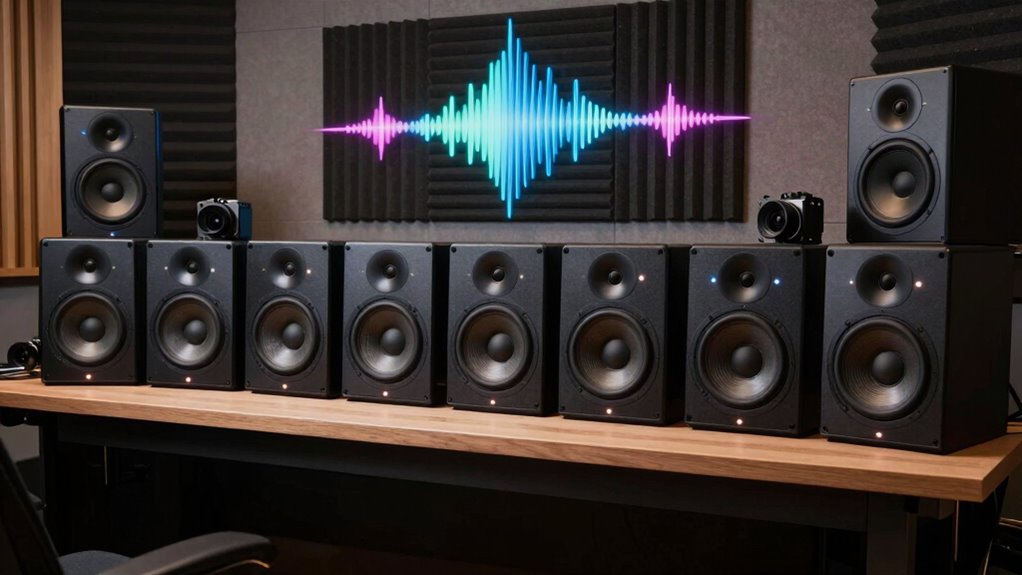

Choosing a studio subwoofer for a home studio is less about chasing the biggest bass figure and more about matching low-frequency extension, crossover controls, and physical size to your monitors and room. My lead pick is the Yamaha HS8 for its studio-focused controls and stated 22 Hz lower reach; the ADAM Audio T10S is a strong match for T5V or T7V monitor owners; and the PreSonus Eris Sub 8BT suits compact nearfield setups that can benefit from flexible connections. The tradeoff is clear: larger drivers and deeper extension can reveal more low end, but they also demand more placement care, while Bluetooth and remote features favor convenience over a strictly wired workflow.

Get audio and creator gear delivered free with Prime
- Fast, free delivery on millions of items
- Prime Video, Amazon Music and more included
- Member-only deals all year
I rank these options by how directly they serve home-studio monitoring, how readily they can fit into a nearfield system, and what their controls and connections offer for integration. The JBL and Mackie bring different strengths—larger-driver output and day-to-day convenience—while each has compromises a buyer should weigh before adding a sub to a small room.
Complete the kit


Key Takeaways
- The Yamaha HS8 has the lowest stated frequency figure here, 22 Hz, plus low-cut, high-cut, and phase controls for monitor integration.
- The ADAM Audio T10S is the clearest pairing choice for owners of ADAM T5V or T7V monitors, but it has no wireless input.
- The compact PreSonus Eris Sub 8BT is the most connection-flexible nearfield pick, though its stated bass reach begins at 30 Hz.
- The JBL LSR310S uses a 10-inch driver and 200-watt amplifier, making it better suited to room and output demands beyond a modest desktop setup.
- The Mackie CR8SBT prioritizes convenience with Bluetooth and a remote, while its stated 40 Hz frequency figure is less compelling for deep-bass checking.
| Yamaha HS8 Studio Subwoofer, Black |  | Best Overall for Nearfield Studio Systems | Driver size: 8 inches | Frequency response: 22 Hz–150 Hz | Amplifier power: 150 W | VIEW ON AMAZON | See Our Full Breakdown |
| PreSonus Eris Sub 8BT — 8-Inch Powered Subwoofer with Bluetooth |  | Best Compact and Connected Nearfield Option | Speaker size: 8 inches | Frequency response: Down to 30 Hz | Power: 100 W | VIEW ON AMAZON | See Our Full Breakdown |
| ADAM Audio T10S Subwoofer |  | Best Match for ADAM T-Series Monitors | Woofer: 10-inch, down-firing | Frequency response: 28 Hz–120 Hz | Amplifier power: 130 W | VIEW ON AMAZON | See Our Full Breakdown |
| JBL Professional LSR310S Studio Monitor Subwoofer, 10-Inch, Black |  | Best for Larger Rooms and Stronger Low-Frequency Output | Driver size: 10 inches | Frequency response: Down to 27 Hz | Amplifier power: 200 W | VIEW ON AMAZON | See Our Full Breakdown |
| Mackie CR8SBT 8″ Studio Subwoofer for CR Monitors with Bluetooth and Remote |  | Best for Convenient Controls and Everyday Listening | Driver size: 8 inches | Frequency response: 40 Hz | Maximum output power: 200 W | VIEW ON AMAZON | See Our Full Breakdown |
| studio subwoofer for home studio | Frequency response | Controls | Driver size | Amplifier power |
|---|---|---|---|---|
| Yamaha HS8 Studio Subwoofer | 22 Hz–150 Hz | Low-cut, high-cut, phase switch | 8 inches | 150 W |
| PreSonus Eris Sub 8BT | Down to 30 Hz | High-pass and low-pass filters, tuning controls, power saver | — | — |
| ADAM Audio T10S Subwoofer | 28 Hz–120 Hz | Adjustable crossover, phase switch, volume | — | 130 W |
| JBL Professional LSR310S Studi | Down to 27 Hz | — | 10 inches | 200 W |
| Mackie CR8SBT 8" Studio Subwoo | 40 Hz | Remote, adjustable crossover, polarity switch | 8 inches | — |
More Details on Our Top Picks
Yamaha HS8 Studio Subwoofer, Black
The Yamaha HS8 is my strongest all-around recommendation because it combines the deepest stated extension in this group with controls aimed at getting a sub to work alongside studio monitors. Its listed response of 22 Hz–150 Hz reaches below the figures supplied for the other models, giving a producer more scope to hear very low material without treating the sub as merely a bass enhancer. Low-cut and high-cut controls, plus a phase switch, make monitor integration more adjustable than a simple level-only approach.
Compared with the PreSonus Eris Sub 8BT, the HS8 is the more studio-first pick: the PreSonus adds Bluetooth and several input formats, while Yamaha puts its appeal in calibration controls and stated low-frequency reach. The ADAM T10S may make more sense if the rest of a system is already built around ADAM T-series monitors, but the HS8 has a broader stated use case. At 33.6 pounds and with a substantial listed footprint, it is not a tiny desktop accessory. Buyers should plan where it will sit and be prepared to adjust it carefully; the supplied description also notes that setup may take expertise. For nearfields that need meaningful low-end checking, it offers the most balanced case in this lineup, provided the room can accommodate it.
Pros:- Stated frequency response extends down to 22 Hz.
- Low-cut, high-cut, and phase controls support system adjustment.
- 150-watt amplifier is suited to studio monitoring duties.
- XLR connectivity fits many wired monitor setups.
Cons:- Large and heavy for a compact home workspace.
- An 8-inch driver may not satisfy larger-room output needs.
- May take careful setup to blend properly with monitors.
Best for: Home-studio producers who want deep stated extension and hands-on filtering and phase controls for a nearfield monitoring system.
Not ideal for: Buyers with a very small desk area, a large room requiring more output than an 8-inch design can provide, or a plug-and-play setup that avoids calibration.
- Driver size:8 inches
- Frequency response:22 Hz–150 Hz
- Amplifier power:150 W
- Connectivity:XLR, wired
- Controls:Low-cut, high-cut, phase switch
- Dimensions:18 × 16 × 18.5 inches
- Weight:33.6 lb
- Warranty:1 year
Our verdict“I’d choose the Yamaha HS8 for a home nearfield system that needs deep stated extension and useful integration controls, if its size suits the room.”
PreSonus Eris Sub 8BT — 8-Inch Powered Subwoofer with Bluetooth
The PreSonus Eris Sub 8BT has the most flexible connection story for a small studio that also serves as a listening or multimedia setup. It accepts balanced ¼-inch TRS, RCA, and ⅛-inch aux inputs, then adds Bluetooth 5.0 for wireless playback. Its listed enclosure dimensions are more compact than the Yamaha’s, which makes it easier to fit into a nearfield workspace where the sub cannot dominate the room.
For critical low-bass checking, it gives up some stated reach: PreSonus specifies response down to 30 Hz, compared with 22 Hz for the Yamaha HS8 and 28 Hz for the ADAM T10S. That difference may matter when judging material with very deep sub-bass. Its high-pass and low-pass filters and tuning controls are valuable for fitting the unit into a system, though buyers new to crossover setup may need time to understand them. The supplied weight is 8,000 g, so compact dimensions do not mean it is effortless to move. Unlike the JBL LSR310S, it uses an 8-inch driver and is a more natural scale for many home nearfields; unlike the Mackie CR8SBT, Bluetooth is paired with several wired input formats. I’d favor it for flexible small-room use, not for the deepest extension or the simplest possible setup.
Pros:- TRS, RCA, and ⅛-inch aux inputs support varied equipment.
- Bluetooth 5.0 adds convenient wireless playback.
- Compact listed dimensions suit many nearfield rooms.
- High-pass, low-pass, and tuning controls aid integration.
Cons:- Stated response reaches down to 30 Hz, not as low as the Yamaha HS8.
- Control options may feel involved for first-time subwoofer setup.
- Its listed weight is substantial for a compact cabinet.
Best for: Producers who want an 8-inch sub for a compact home studio that also needs Bluetooth and multiple wired input choices.
Not ideal for: Listeners who need the lowest stated bass extension in this group or beginners who want minimal crossover and tuning decisions.
- Speaker size:8 inches
- Frequency response:Down to 30 Hz
- Power:100 W
- Inputs:¼-inch TRS, RCA, ⅛-inch TRS aux, Bluetooth 5.0
- Controls:High-pass and low-pass filters, tuning controls, power saver
- Dimensions:9.8 × 12.7 × 11.7 inches
- Weight:8,000 g
- Bluetooth range:10 meters
Our verdict“I’d pick the Eris Sub 8BT when flexible connections and compact nearfield fit matter more than the deepest bass reach.”
ADAM Audio T10S Subwoofer
The ADAM Audio T10S earns its place through system matching rather than the most expansive feature list. It is designed to complement T5V and T7V monitors, giving owners of those speakers a straightforward brand-family option for extending low-frequency coverage. Its 10-inch down-firing woofer and stated 28 Hz–120 Hz response put it between the Yamaha HS8 and PreSonus on the supplied lower-frequency figures, while the adjustable crossover, phase switch, and volume control provide the basic tools needed to blend it with a monitor pair.
Compared with the JBL LSR310S, the ADAM is less powerful on paper at 130 W versus 200 W, but its intended pairing with T-series monitors makes its role more specific. The Yamaha HS8 reaches lower by specification and has a wider stated response ceiling, so it remains my more flexible all-round pick. The T10S instead has a compelling five-year warranty and a studio-oriented control set. Its wired RCA and XLR connections suit a fixed monitoring setup, but there is no Bluetooth for casual wireless listening. The stated 104 dB maximum SPL is useful context, though real results depend on placement and room conditions. For an ADAM-based nearfield rig, the matching intent is its main advantage; buyers using other monitors should compare crossover compatibility before choosing it.
Pros:- Designed to complement ADAM T5V and T7V monitors.
- 10-inch down-firing woofer with stated response to 28 Hz.
- Crossover, phase, and volume controls support calibration.
- Listed five-year warranty.
Cons:- No wireless input; connections are wired RCA and XLR.
- 130 W output is lower than the JBL and Mackie figures.
- Its monitor-family focus is less compelling for unrelated systems.
Best for: Owners of ADAM T5V or T7V monitors who want a purpose-matched subwoofer with adjustable crossover and phase controls.
Not ideal for: Buyers who need Bluetooth, very deep sub-bass beyond the stated 28 Hz, or a sub chosen primarily for use with a different monitor system.
- Woofer:10-inch, down-firing
- Frequency response:28 Hz–120 Hz
- Amplifier power:130 W
- Maximum SPL:104 dB
- Connectivity:RCA, XLR
- Controls:Adjustable crossover, phase switch, volume
- Enclosure:MDF
- Warranty:5 years
Our verdict“I’d choose the T10S for an ADAM T-series nearfield setup, where monitor matching matters more than wireless features or maximum listed power.”
JBL Professional LSR310S Studio Monitor Subwoofer, 10-Inch, Black
The JBL LSR310S is the lineup’s clearest step toward a larger-room system. Its 10-inch driver and 200-watt amplifier exceed the Yamaha HS8 and PreSonus Eris Sub 8BT on driver size and listed power, while the stated lower response of 27 Hz makes it a strong candidate for monitoring material with substantial bass content. Balanced XLR and TRS inputs with XLR output also suit a more conventional wired studio chain.
That scale comes with a practical cost: this is a floor-standing unit that needs dedicated space, so it is less naturally suited to a crowded desktop nearfield setup than the compact PreSonus. The Yamaha remains the more compelling all-round recommendation for its stated 22 Hz extension and adjustment controls, while the JBL has the advantage of a 10-inch driver and an XLF setting that can emulate club-style bass. That XLF option is useful as a separate listening reference, but it should not be confused with a neutral mix-checking setting. The supplied information does not list a crossover control set as clearly as the Yamaha or ADAM descriptions. I’d choose the JBL when room and output needs justify its larger format; small studios and casual listening setups may find its scale unnecessary.
Pros:- 10-inch driver and 200-watt amplifier suit more demanding systems.
- Stated response reaches down to 27 Hz.
- Balanced XLR and TRS inputs with XLR output.
- XLF setting offers an alternate club-bass reference.
Cons:- Floor-standing format needs dedicated space.
- May be excessive for casual listening or a very small nearfield room.
- No wireless connectivity is listed.
Best for: Producers with room for a floor-standing 10-inch sub and a wired balanced monitor chain who want stronger low-frequency coverage.
Not ideal for: Nearfield users with little floor space, buyers who prioritize compact placement, or anyone looking for wireless input.
- Driver size:10 inches
- Frequency response:Down to 27 Hz
- Amplifier power:200 W
- Inputs:XLR, TRS
- Output:XLR
- Tuning feature:XLF setting
- Mounting:Floor standing
- Signal-to-noise ratio:113 dB
Our verdict“I’d take the JBL LSR310S over the smaller options when a larger room needs a 10-inch sub, but not for a cramped desktop studio.”
Mackie CR8SBT 8″ Studio Subwoofer for CR Monitors with Bluetooth and Remote
The Mackie CR8SBT stands apart by making system operation easy: it includes Bluetooth, a remote, an adjustable crossover, a polarity switch, and a desktop volume control. That combination suits a studio that also handles casual listening, where changing level from a seated position is more useful than adding another control to reach under a desk. Its 200-watt maximum output is a substantial listed figure for an 8-inch design, and RCA and TRS connections keep it compatible with common wired sources.
For critical nearfield bass work, though, the supplied frequency figure is 40 Hz, which is less persuasive than the Yamaha’s 22 Hz, the JBL’s 27 Hz, or the ADAM’s 28 Hz. The Mackie therefore lands below those models for low-end extension, even though its convenience features are unusually strong. The PreSonus Eris Sub 8BT also offers Bluetooth and several input choices in a more compact listed cabinet; Mackie’s differentiator is its remote and desktop volume control, not a smaller footprint. At 32.4 pounds, it remains a substantial piece of gear, and it needs a power connection despite Bluetooth playback. I’d pick it for flexible everyday use, but not as my first choice when mixing decisions depend on hearing the lowest bass clearly.
Pros:- Bluetooth input supports wireless playback.
- Remote and included desktop volume control simplify level changes.
- Adjustable crossover and polarity switch assist system setup.
- RCA and TRS connections support common wired sources.
Cons:- Stated frequency figure is 40 Hz, higher than the other models’ listed lower limits.
- 32.4-pound weight makes repositioning less convenient.
- Bluetooth does not remove the need for a power connection.
Best for: Home-studio users who want Bluetooth, remote operation, and a desktop volume control alongside a wired monitor setup.
Not ideal for: Producers whose main priority is low-frequency extension below 40 Hz or buyers needing a lightweight, compact subwoofer.
- Driver size:8 inches
- Frequency response:40 Hz
- Maximum output power:200 W
- Connectivity:Bluetooth, RCA, TRS
- Controls:Remote, adjustable crossover, polarity switch
- Dimensions:12.6 × 16.2 × 14 inches
- Weight:32.4 lb
- Mounting:Floor standing
Our verdict“I’d choose the CR8SBT for convenient controls and mixed studio-listening use, not for the deepest bass checking in this group.”

How We Picked
I ordered these five subwoofers around their usefulness in a home-studio monitoring chain, not around feature count alone. A sub for nearfields needs enough adjustment to blend with the main speakers, connections compatible with an audio interface or monitors, and a footprint a home workspace can accommodate. I also weighed each model’s stated frequency range, driver size, amplification, and practical extras such as crossover adjustment or phase switching.
That approach puts the Yamaha first because its listed 22 Hz–150 Hz response and dedicated filter and phase controls give it a persuasive balance of extension and setup flexibility. The ADAM earns a distinct place for monitor matching, while the PreSonus is a practical compact choice with broad input options. I placed the JBL higher than the Mackie for monitoring-focused low-frequency extension and balanced studio connections, but below the lead pick because its 10-inch format is less naturally suited to every nearfield room. Mackie’s remote and Bluetooth are useful, yet its stated 40 Hz response gives it a narrower case for critical low-bass work.
I rely only on the supplied product information here. Published specifications do not predict how a sub will behave in every room: placement, room modes, monitor output, and crossover settings all affect the result. I treat features as evidence of fit, not as a promise that any model will produce a perfectly flat response in a particular studio.
| studio subwoofer for home studio | Connectivity | Controls |
|---|---|---|
| Yamaha HS8 Studio Subwoofer | XLR, wired | Low-cut, high-cut, phase switch |
| PreSonus Eris Sub 8BT | — | High-pass and low-pass filters, tuning controls, power saver |
| ADAM Audio T10S Subwoofer | RCA, XLR | Adjustable crossover, phase switch, volume |
| JBL Professional LSR310S Studi | — | — |
| Mackie CR8SBT 8" Studio Subwoo | Bluetooth, RCA, TRS | Remote, adjustable crossover, polarity switch |
Factors to Consider When Choosing Studio Subwoofer For Home Studio
I’d make the choice in this order: match the sub to the room and monitors, then compare extension and controls, and only after that weigh convenience features. A subwoofer can add useful information for production, but a mismatch or poor placement can make bass decisions less dependable.
Match the sub to your nearfield room
Nearfield listening usually means you work close to the main monitors, often in a small room where low frequencies can build up unevenly. An 8-inch model such as the Yamaha HS8, PreSonus Eris Sub 8BT, or Mackie CR8SBT may be easier to accommodate than a larger 10-inch cabinet, though driver size alone does not tell you how a sub will behave in your room. The JBL and ADAM both use 10-inch drivers and make more sense when you have room for floor placement and can tune the system thoughtfully. Leave space to position the sub and listen from your actual mixing seat before settling on a location.
Read frequency figures as a comparison, not a guarantee
The supplied lower-frequency figures make the Yamaha the deepest-reaching pick at 22 Hz, followed by JBL at 27 Hz, ADAM at 28 Hz, and PreSonus at 30 Hz; Mackie lists 40 Hz. Those numbers help distinguish intended low-end coverage, but they do not describe response level tolerances or room performance. A lower figure can help expose very deep content, yet it does not promise that every note will be equally clear at your listening position. If your work includes sub-heavy electronic music or film sound, the Yamaha and JBL specifications deserve attention; for general nearfield production, monitor matching and usable controls may matter more.
Look for integration controls you can actually use
A crossover sets where the sub and main monitors hand off, while phase or polarity adjustment can help their output combine more coherently at the listening position. The Yamaha and ADAM list phase controls, while the PreSonus offers high-pass and low-pass filtering and tuning controls. Mackie lists adjustable crossover and polarity features. The JBL listing highlights XLF, a club-bass reference mode, rather than detailing the same calibration controls. More features are not automatically better: pick the controls that match your signal chain and that you are willing to set up carefully.
Choose connections for your actual workflow
For a wired interface-and-monitor setup, the JBL’s XLR and TRS inputs and XLR output are a straightforward studio fit; Yamaha specifies XLR, and ADAM lists XLR and RCA. The PreSonus offers the widest stated input variety, including TRS, RCA, aux, and Bluetooth, while Mackie combines RCA and TRS with Bluetooth. Wireless playback can make casual listening simple, but for production monitoring I’d prioritize a dependable wired route and avoid assuming Bluetooth is the best path for critical mix decisions. Confirm how your monitors and interface connect before choosing.
Budget space and setup time as well as sound
A subwoofer takes floor or desk space, needs power, and can add setup work. The Yamaha and Mackie are both listed above 32 pounds; the JBL is a floor-standing 10-inch option, and the ADAM is also floor standing. PreSonus has the most compact listed dimensions, but its stated weight is still 8,000 g. Measure the intended location and leave room to adjust placement. If you cannot position and calibrate a sub sensibly, a good pair of nearfields without a sub can be a more dependable monitoring choice than a poorly integrated system.
Frequently Asked Questions
Do I need a subwoofer for a home studio?
No. I’d add one when your work needs more information below the range your main monitors reproduce, or when you need to check bass-heavy material at low frequencies. A sub does not automatically improve every setup: in a small or untreated room, room modes and placement can make bass harder to judge. If your current monitors cover your work reliably and the room cannot accommodate careful placement, keeping the system simple may serve you better.
Which of these is best suited to nearfield monitors?
My general nearfield pick is the Yamaha HS8, because its 22 Hz–150 Hz specification and low-cut, high-cut, and phase controls provide a strong mix of stated extension and integration options. For a more compact connection-focused setup, the PreSonus Eris Sub 8BT is a sensible alternative. The best match still depends on your monitor outputs, room, listening distance, and willingness to calibrate the crossover.
Should I choose an 8-inch or 10-inch studio subwoofer?
I’d choose based on room size, monitor capability, and the low-frequency coverage you need, rather than driver diameter alone. The Yamaha, PreSonus, and Mackie are 8-inch options and may be easier to place in a home nearfield room. The ADAM and JBL have 10-inch drivers; JBL also lists 200 watts and a 27 Hz lower figure, which may suit a larger system. A bigger driver does not remove the need for room-aware placement.
Are Bluetooth subwoofers suitable for mixing?
Bluetooth is convenient for casual playback, but I would build critical monitoring around a wired connection when the product and system support it. The PreSonus and Mackie both add Bluetooth to wired inputs, so they can serve mixed listening and production roles. That convenience does not make wireless playback the best route for evaluating every mix detail. Check your source and monitor chain, and keep production decisions on a consistent signal path.
How should I set up a studio subwoofer with nearfields?
I’d connect the sub according to the monitor and interface instructions, start with a conservative level, and set the crossover so the sub complements rather than overwhelms the main speakers. Use available phase or polarity controls while listening from the normal work position, then compare familiar tracks with the sub on and off. Placement has a strong effect on perceived bass, so try more than one location if the low end sounds uneven. The product specifications alone cannot identify the right settings for a particular room.
Conclusion
For most home-studio buyers seeking a nearfield-ready all-rounder, I’d start with the Yamaha HS8: it has the lowest stated reach here and useful filters and phase control, balanced against a large, heavy cabinet. Choose the ADAM Audio T10S if your system already uses T5V or T7V monitors, or the PreSonus Eris Sub 8BT if compact placement and flexible wired and Bluetooth inputs matter more than the deepest extension. If your room can handle a larger floor-standing unit, the JBL LSR310S brings a 10-inch driver and balanced connections. I’d reserve the Mackie CR8SBT for buyers who value remote operation and everyday listening convenience over low-bass reach. In every case, I’d check monitor compatibility, make room for sensible placement, and plan time to calibrate before relying on the sub for mix decisions.
Halloween Picks
halloween
As an affiliate, we earn on qualifying purchases.