
When choosing a home theater speaker package for your living room, focus on sound quality, placement, and room size. Look for clear dialogue, rich bass, and balanced sound across frequencies. Position front speakers at ear level, angle them toward your seating, and place surround speakers behind or beside your seating area. Experiment with subwoofer placement for best bass. Proper setup and calibration make a big difference, and if you keep exploring, you’ll discover how to get the most out of your system.

Get audio and creator gear delivered free with Prime
- Fast, free delivery on millions of items
- Prime Video, Amazon Music and more included
- Member-only deals all year
Key Takeaways
- Choose a package with appropriately sized drivers, wattage, and balanced design for clear, natural sound in a living room.
- Ensure front speakers are at ear level, equidistant, and angled toward seating for optimal sound distribution.
- Place the center channel aligned with the viewing position, with surround speakers behind or to the sides at ear level.
- Position subwoofers near walls or corners, balancing bass response and room acoustics through experimentation.
- Calibrate and experiment with speaker placement to maximize sound quality and immersion in your specific living room space.
Are you wondering where to start when choosing a home theater speaker package? The first step is to understand how sound quality and speaker placement can transform your viewing experience. Sound quality is the foundation of an immersive home theater, so you want speakers that deliver clear dialogue, rich bass, and balanced sound across all frequencies. When evaluating different packages, pay attention to the drivers’ sizes, wattage, and overall design. A good speaker system should produce crisp, natural audio without distortion, even at higher volumes.
Start with quality sound and thoughtful placement for the ultimate home theater experience.
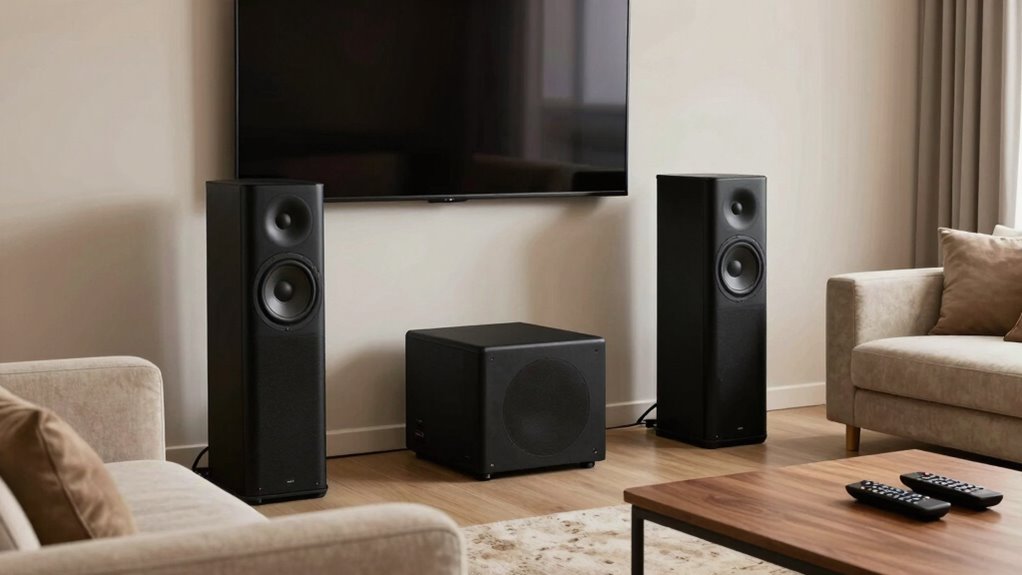
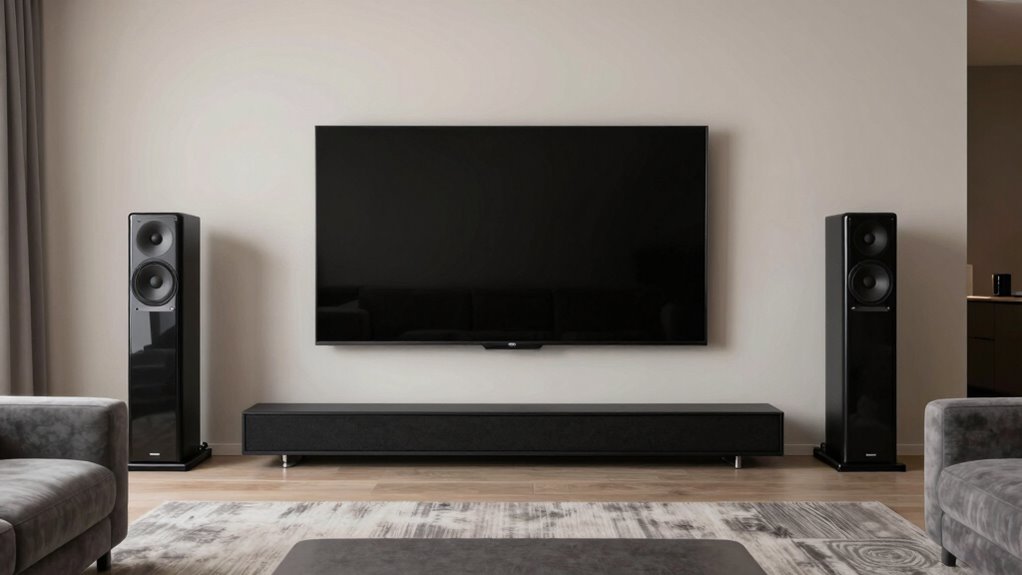
Speaker placement is equally vital. Proper placement ensures that sound reaches you evenly and creates a realistic, surround sound environment. In a living room, this often means positioning the front left and right speakers at ear level, equidistant from your seating area, and angled slightly toward you. The center channel speaker should sit directly above or below your TV, aligning with the main viewing position, to anchor dialogue and vocals. Surround speakers are typically placed slightly behind or to the sides of your seating area, at ear level or slightly above, to envelop you in sound. Subwoofers, which handle bass frequencies, work best when placed near a wall or corner, but you might need to experiment with placement for the deepest, most even bass response. Understanding speaker placement principles can significantly enhance your listening experience.
When setting up your speakers, consider the size and shape of your living room. Larger spaces might require more powerful speakers or additional units to fill the room with sound. Conversely, smaller rooms benefit from compact speakers that won’t dominate the space. Keep in mind that unobstructed speaker placement improves sound quality because walls, furniture, or other obstacles can muffle or distort audio. Use stands or mounts to position speakers at the ideal height and angle, ensuring sound waves reach your ears directly for the best experience. Additionally, knowing how room acoustics influence sound can help you make smarter placement choices to optimize audio performance. Proper audio calibration can further fine-tune your setup for optimal sound quality, especially in challenging environments.
Ultimately, choosing a home theater speaker package is about balancing sound quality with practical placement. Good speakers will sound great even when slightly off-position, but proper placement maximizes their potential. Take the time to plan where each speaker will go before you make your purchase, and don’t hesitate to experiment with different arrangements once your system is set up. Achieving perfect sound quality hinges on thoughtful speaker placement, so it’s worth investing effort upfront to enjoy a truly immersive home theater experience.
5.1 home theater speaker package
As an affiliate, we earn on qualifying purchases.
As an affiliate, we earn on qualifying purchases.
Frequently Asked Questions
How Do I Choose the Right Speaker Wattage for My Room?
To choose the right speaker wattage for your room, consider your space size and desired volume levels. Opt for speakers with enough wattage to deliver clear, powerful sound without strain, ensuring durability and consistent performance. Higher wattage speakers often offer better power efficiency, meaning they can handle volume increases without distortion. Match the wattage to your room’s size, your listening habits, and your system’s power capacity to get the best balance of durability and efficiency.
Can I Upgrade Individual Speakers Later in the Package?
Yes, you can upgrade individual speakers later in your package. When doing so, consider the speaker’s durability to guarantee it lasts and performs well over time. Also, check brand compatibility to make sure the new speaker blends seamlessly with your existing setup. Upgrading one speaker can enhance audio quality, but matching specifications and maintaining overall harmony in your system is key for a balanced home theater experience.
What Is the Ideal Speaker Placement for Small Living Rooms?
You might think placing speakers at ear level is best, but research shows that ideal speaker height varies based on acoustic treatment and room layout. For small living rooms, position speakers slightly above ear level to prevent sound reflection, and angle them toward your listening area. Incorporate acoustic treatment like rugs or curtains to improve sound quality, ensuring your speakers deliver clear, immersive audio without overwhelming the space.
How Do I Connect Older AV Receivers to Modern Speakers?
To connect older AV receivers to modern speakers, first check the speaker impedance ratings to guarantee compatibility. Use speaker wires to connect the receiver’s outputs to the speakers, making sure the impedance matches the receiver’s specifications. For wireless connectivity, consider adding a wireless transmitter or adapter compatible with your receiver. This setup allows you to enjoy modern speakers’ sound quality without needing new wiring, simplifying your upgrade process.
Are Wireless Home Theater Speaker Options Reliable?
Wireless home theater speakers are generally reliable if you choose models with strong wireless connectivity. However, signal interference from other devices can occasionally disrupt the connection, causing audio dropouts. To minimize issues, opt for speakers with robust wireless signals and avoid placing them near Wi-Fi routers or other electronics that might cause interference. Regular updates and proper placement help guarantee a consistent, enjoyable wireless audio experience.
surround sound speaker system for living room
As an affiliate, we earn on qualifying purchases.
As an affiliate, we earn on qualifying purchases.
Conclusion
Now that you know the basics of a home theater speaker package, you’re ready to create an immersive sound experience. Think of your speakers as the heartbeat of your entertainment setup, bringing movies and music to life like a symphony in your living room. With the right choices, you’ll enjoy rich, clear audio that makes every moment feel like you’re right there in the action. So, go ahead—bring your home theater dreams to life!
home theater subwoofer with adjustable placement
As an affiliate, we earn on qualifying purchases.
As an affiliate, we earn on qualifying purchases.
calibrated surround sound speakers
As an affiliate, we earn on qualifying purchases.
As an affiliate, we earn on qualifying purchases.
Halloween Picks
halloween
As an affiliate, we earn on qualifying purchases.