


Choosing a wireless microphone system is a decision about the radio environment as much as the microphone. A 2.4 GHz system often offers a compact receiver, straightforward setup, and a lower entry cost. A UHF system usually gives the user more room to select and coordinate frequencies, which matters when several microphones must work together or nearby wireless equipment competes for spectrum.

Get audio and creator gear delivered free with Prime
- Fast, free delivery on millions of items
- Prime Video, Amazon Music and more included
- Member-only deals all year

Phenyx Pro PTU-71-2H Dual UHF Wireless Handheld Microphone System
- ✔ Channels: 2
- ✔ Selectable frequencies: 100 per channel
- ✔ Channel 1 frequency range: 536.57–561.32 MHz

JBL Wireless Two-Microphone System with Dual-Channel Receiver, Black
- ✔ Microphones: 2 wireless microphones
- ✔ Receiver: Rechargeable dual-channel UHF
- ✔ Playback time: Up to 6 hours
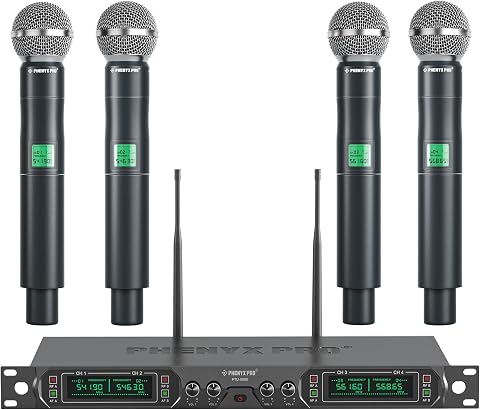
Phenyx Pro PTU-5000-4H 4-Channel UHF Wireless Microphone System
- ✔ Channels: 4
- ✔ Wireless band: UHF
- ✔ Fixed frequencies: 541.9, 546.3, 561.6 and 568.65 MHz
For a solo presenter, creator, or small event in a relatively quiet setting, 2.4 GHz can be the more practical buy. For a venue, production team, or touring act that needs dependable operation across multiple channels, UHF is usually the stronger choice. The gap is not simply sound quality: both types can deliver clear audio. The deciding question is how much radio coordination and operational reliability the job demands.
At a Glance
| Criteria | 2.4 GHz wireless microphone systems | UHF wireless microphone systems | Winner |
|---|---|---|---|
| Setup and ease of use | Often quick to pair, with automatic channel selection | May need scanning and frequency coordination before use | A |
| Crowded RF environments | Can face interference from Wi-Fi, Bluetooth, and other 2.4 GHz devices | Often easier to coordinate in busy venues, though local UHF use still matters | B |
| Multiple microphone channels | Suitable for a modest channel count, subject to the model and local conditions | Better suited to coordinated multi-channel setups | B |
| Range and consistency | Can work well at short to moderate distances with a clear path | Can offer more reliable coverage when properly selected and placed | B |
| Portability and receiver design | Often compact, with small plug-in or camera-mount receivers | Often uses larger dedicated receivers and antennas | A |
| Cost and long-term value | Usually lower entry cost and simple to deploy | Higher initial cost can pay off in repeated or professional use | Depends |
| Frequency flexibility | Usually less user control over operating frequencies | Typically offers more channel selection and coordination tools | B |
Phenyx Pro PTU-71-2H Dual UHF Wireless Handheld Microphone System
The PTU-71-2H is the most balanced choice here for events that need two handheld microphones and some help navigating wireless setup. Its receiver can auto scan for frequencies and synchronize with the microphones by IR, which gives an operator a more guided path to a usable connection than the PTU-5000-4H’s fixed-frequency design. With 100 selectable frequencies per channel, it also offers room to adjust if a channel is unsuitable in a particular setting.Phenyx Pro states a line-of-sight range of 290–328 feet. That makes this system appealing when a speaker or performer may move around a larger room, but the figure depends on unobstructed conditions; walls and interference can reduce practical range. The cardioid dynamic microphones are designed to emphasize vocals while reducing pickup from other directions, and their metal construction and replaceable heads are useful details for a system that may see regular event use.Compared with the JBL, this Phenyx Pro prioritizes frequency options and a longer stated range over a described plug-and-play experience. Its up-to-16-hour battery claim is also longer than the JBL receiver’s up-to-six-hour playback figure, though the Phenyx microphones require four AA batteries. It is still a two-microphone system, so groups needing four simultaneous handhelds should step up to the PTU-5000-4H. We would choose the PTU-71-2H for karaoke, speeches or small events where flexibility matters, and skip it if rechargeable microphones or a particularly simple speaker-first setup is the main goal.
Pros:
- Auto scan and IR synchronization help simplify frequency selection and connection.
- Two selectable-frequency channels provide more adjustment options than the PTU-5000-4H’s fixed frequencies.
- Stated line-of-sight range of 290–328 feet suits larger open spaces.
- Metal handheld microphones have replaceable heads, and the kit includes setup accessories.
Cons:
- The stated range depends on line-of-sight conditions and may be lower in obstructed or interference-heavy venues.
- The microphones require four AA batteries, so users need to keep spares available.
Best for: Event hosts, churches and karaoke users who need two handheld microphones, frequency scanning and more room to adjust channels.
Not ideal for: Buyers who need four microphones, want rechargeable microphone batteries or cannot accommodate the receiver and separate power setup.
Bottom line: We recommend the PTU-71-2H as the strongest all-around fit for two-mic events where frequency setup flexibility and stated range matter.
“We recommend the PTU-71-2H as the strongest all-around fit for two-mic events where frequency setup flexibility and stated range matter.”
JBL Wireless Two-Microphone System with Dual-Channel Receiver, Black
The JBL system puts ease of setup ahead of detailed frequency controls. It includes two wireless microphones and a rechargeable dual-channel receiver that mixes both voices through a compatible speaker. For a host who wants to connect the receiver and get two people talking without managing a larger rack-style setup, that straightforward arrangement is its main appeal.Its power design divides convenience between components: the receiver is rechargeable and offers up to six hours of playback, while the microphones use replaceable AA batteries. That can make it easier to keep the handhelds going during an event if spare batteries are on hand, but the receiver’s stated runtime is shorter than the PTU-71-2H’s battery-life claim. The supplied details do not list frequency scanning, range, polar pattern or microphone construction, so we cannot make the same claims about channel adjustment or vocal isolation that we can for the Phenyx models.Compared with the PTU-71-2H, JBL is the more direct choice for a compatible speaker setup and less compelling if long operating range or frequency management is central. Compared with the four-channel PTU-5000-4H, it keeps the system to two microphones and avoids the need for four-channel control, but it cannot serve a panel or performance that needs four simultaneous handhelds. This is a sensible starting point for presentations and small gatherings, provided the speaker connection is compatible and six hours covers the planned session.
Pros:
- Plug-and-play setup makes it approachable for occasional event use.
- Dual-channel receiver mixes two microphones through a compatible speaker.
- Rechargeable receiver provides up to six hours of playback.
- Microphones use replaceable AA batteries.
Cons:
- Up to six hours of receiver playback may be limiting for longer events.
- The provided specifications do not state operating range or frequency-selection options.
Best for: Beginners and hosts who want two microphones with a rechargeable receiver for a compatible speaker.
Not ideal for: Buyers needing four simultaneous microphones, a documented long operating range or selectable frequency-management features.
Bottom line: We’d choose the JBL for simple two-mic use with a compatible speaker, as long as its stated receiver runtime suits the event.
“We’d choose the JBL for simple two-mic use with a compatible speaker, as long as its stated receiver runtime suits the event.”
Phenyx Pro PTU-5000-4H 4-Channel UHF Wireless Microphone System
When the event needs four handheld microphones at once, the PTU-5000-4H is the clear specialist in this group. Its four channels, four included microphones and individual volume controls let an operator manage multiple speakers or performers from one receiver. The four XLR outputs can also be useful when a sound setup needs access to each channel separately, while the other two systems are built around two microphones.Each handheld uses a dynamic cardioid cartridge, intended to focus on the person speaking or singing and reduce unwanted sound pickup. The receiver has an LCD and all-metal construction; snap-on antennas and included accessories support a more complete event kit. The stated maximum range is up to 260 feet, below the PTU-71-2H’s stated line-of-sight range, so the two-channel Phenyx is a better match when roaming distance and frequency choice matter more than microphone count.The main tradeoff is that the PTU-5000-4H uses fixed UHF frequencies and is not intended for multiset operation, limiting how flexibly it can adapt to crowded wireless environments or expand alongside another set. It also requires an amplifier or speaker for sound output, so the receiver alone is not a complete audio solution. Its up-to-eight-hour battery claim is shorter than the PTU-71-2H’s stated figure. We would pick it for a small performance, party or panel with four vocalists and a compatible sound system already in place; for two-person events, the PTU-71-2H or JBL keeps the setup more focused.
Pros:
- Four handheld microphones and four channels support more simultaneous voices than the other picks.
- Individual volume controls and four XLR outputs provide useful channel-by-channel management.
- Cardioid dynamic cartridges are designed to reduce unwanted pickup around the vocal source.
- All-metal receiver construction and included batteries, cables and antennas make it event ready.
Cons:
- Fixed frequencies offer less flexibility than the PTU-71-2H’s selectable channels.
- An amplifier or speaker is required for sound output.
- Stated range of up to 260 feet is lower than the PTU-71-2H’s stated line-of-sight range.
Best for: Small performances, panels and events that need four handheld microphones with individual volume controls.
Not ideal for: Buyers who need selectable frequencies, plan to run multiple sets together or do not already have an amplifier or speaker.
Bottom line: Choose the PTU-5000-4H when four simultaneous handhelds are essential and your sound system can accept its outputs.
“Choose the PTU-5000-4H when four simultaneous handhelds are essential and your sound system can accept its outputs.”
As an Amazon Associate we earn from qualifying purchases.
Key Differences
The clearest difference is control over the radio link. Many 2.4 GHz systems handle frequency selection automatically, making them attractive when one person needs a working mic without learning RF coordination. That convenience has a limit: the 2.4 GHz band is shared with common wireless devices, so performance depends on what is active nearby. In a quiet room, this may never matter. In a busy conference center or venue full of access points and phones, it can become a real constraint.
UHF systems ask for more planning but give operators more tools to find and coordinate usable frequencies. That advantage grows with channel count and the cost of a dropout. UHF is not immune to interference, and available frequencies vary by location and regulation, so buyers should check local rules and the system’s supported bands. For occasional solo use, paying for that flexibility may bring little benefit. For recurring events, multiple performers, or production work, it can be worth the added cost and setup effort.
Neither radio band guarantees better audio by itself. Microphone capsule, transmitter design, codec, gain staging, antenna placement, and the room all affect the result. A good 2.4 GHz kit can sound better than a poor UHF kit. Choose based on operating conditions and workflow first, then compare audio features, battery life, build, and support among specific models.
Detailed Comparison
Setup and ease of use (2.4 GHz wireless microphone systems wins — moderate)
Winner: 2.4 GHz, by a moderate margin. Many systems in this category pair quickly and choose a channel automatically, so a solo user can often get started with little RF knowledge. UHF setups can also be simple, especially when they include scanning tools, but an operator may need to scan, select frequencies, and coordinate channels. For a one-person presentation or quick video shoot, the reduced setup burden is useful. For a managed production, the extra UHF steps are usually routine rather than a serious obstacle.
Crowded RF environments (UHF wireless microphone systems wins — major)
Winner: UHF, by a major margin for busy venues. The 2.4 GHz band is shared with Wi-Fi and Bluetooth equipment, and local congestion can affect how much clean airtime a particular system finds. UHF systems provide more scope to select and coordinate frequencies, though they must still be chosen for the local spectrum and legal requirements. This difference matters at a conference, theater, or event with many wireless devices. In a quiet office or home studio, it may be minor or invisible.
Multiple microphone channels (UHF wireless microphone systems wins — major)
Winner: UHF, by a major margin as channel counts rise. A small 2.4 GHz setup can suit a presenter and a guest, but performance depends on the product’s channel limits and other active devices in the band. UHF systems are commonly chosen when several transmitters must operate together because frequencies can be planned as a coordinated set. That reduces guesswork at larger productions. For a single microphone, this capability is unlikely to justify a premium; for a panel or stage, it can prevent operational headaches.
Range and consistency (UHF wireless microphone systems wins — moderate)
Winner: UHF, by a moderate margin when coverage is demanding. A well-chosen UHF system can provide a robust link over a venue-sized area, particularly when its antennas are placed and configured well. A 2.4 GHz model may be entirely adequate for a nearby camera, classroom, or small room, but walls, distance, and competing devices can reduce reliability. Advertised range figures are not guarantees: they typically assume favorable conditions. For a speaker moving around a venue, test the system in the actual space before relying on it.
Portability and receiver design (2.4 GHz wireless microphone systems wins — moderate)
Winner: 2.4 GHz, by a moderate margin for compact mobile kits. Many systems are designed around small receivers that connect directly to a camera or phone, making them easy to carry and quick to deploy. UHF systems often use a separate receiver with antennas, controls, and more cabling. That format can be less convenient for a creator packing light, but it can suit a rack, mixing desk, or fixed venue installation. The best format depends on whether the receiver travels with the camera or stays at a production position.
Cost and long-term value (major difference)
Winner: Depends on the workload. 2.4 GHz usually costs less to enter and can be the better value when the system handles occasional, low-channel use reliably. UHF costs more, and its price makes sense when frequency coordination, additional channels, or dependable coverage protect paid work. A cheaper system that drops out during a live event can be expensive in practice; a premium system used once a month in a quiet room may be more capability than needed. Compare complete kits, including microphones, receivers, batteries, accessories, and support.
Frequency flexibility (UHF wireless microphone systems wins — moderate)
Winner: UHF, by a moderate margin. UHF models often provide selectable frequency groups, scanning, and coordination options. These tools help an operator adapt to local conditions and keep multiple links organized. Many 2.4 GHz systems prioritize automatic operation instead, which reduces user effort but leaves less direct control when a channel performs poorly. Buyers should check the exact model: features differ, and frequency availability is shaped by regional rules. Flexibility matters most when conditions change between venues or when the system is part of a larger wireless setup.
2.4 GHz wireless microphone systems: Pros and Cons
Pros:
- Quick setup suits solo users and small crews.
- Compact receiver options work well with cameras and mobile devices.
- Lower entry price can make sense for occasional use.
- Automatic channel handling can reduce the need for RF expertise.
Cons:
- Shares spectrum with common Wi-Fi and Bluetooth devices.
- Less user control over frequency selection on many models.
- Can be a less dependable fit for busy venues or larger channel counts.
- Small plug-in receivers may offer fewer connection and antenna options.
UHF wireless microphone systems: Pros and Cons
Pros:
- More frequency selection and coordination options on many models.
- Better fit for several microphones operating at once.
- Can handle demanding venue coverage more reliably when configured well.
- Common choice for production teams and recurring professional work.
Cons:
- Higher initial price.
- Setup can require scanning and frequency planning.
- Dedicated receivers and antennas can be bulkier to transport.
- Local frequency regulations and availability need checking.
Who Should Choose What
Choose 2.4 GHz wireless microphone systems if:
- You need one microphone for videos, presentations, classes, or small events.
- Your operating area is usually close range and has manageable wireless congestion.
- You value a compact receiver and quick setup more than frequency control.
- Your budget is limited and the cost of an occasional interruption is low.
Choose UHF wireless microphone systems if:
- You run microphones at theaters, conferences, houses of worship, or other busy venues.
- You need several wireless channels to work together.
- A dropout could disrupt paid work or a live event.
- You can budget for a more involved setup and want tools to coordinate frequencies.
Skip both if: You work in a fixed installation where wired microphones meet the need more reliably and at lower cost, or you cannot confirm that a wireless system’s frequencies are legal and usable in your area.
Value for Money
Paying more for UHF is worthwhile when the system must cover a large or changing space, support several microphones, or protect an event where a failure has a real cost. Its value comes from control and coordination, not from an automatic promise of better sound. If you need those capabilities regularly, the additional receiver and setup cost can prevent wasted time and reduce the risk of interference problems.
For a single microphone used nearby in a home, classroom, or small meeting room, a reliable 2.4 GHz kit is often better value. You get a simpler workflow and keep money available for a better capsule, spare batteries, or monitoring headphones. Pay more only if the UHF features solve a recurring problem you actually face. Before buying either type, compare the system’s supported frequencies, local legality, connection compatibility, battery runtime, and return policy.
Final Verdict
For most solo creators, presenters, and small teams, start with a reputable 2.4 GHz system: it is portable, quick to operate, and usually costs less. Choose UHF when you manage multiple channels, work in crowded venues, or cannot afford radio interruptions. The biggest deciding factor is the operating environment, followed by channel count. UHF is the stronger professional tool; 2.4 GHz is the more sensible everyday buy when its simpler setup covers the job.
Frequently Asked Questions
Does UHF always sound better than 2.4 GHz?
No. The radio band alone does not determine sound quality. The microphone capsule, transmitter and receiver design, codec, placement, and gain settings all affect the audio. A well-designed 2.4 GHz kit can sound excellent; UHF’s main advantage is greater frequency control in many models.
Is a 2.4 GHz wireless microphone reliable for live events?
It can be reliable for a small event in a quiet environment, especially with a short, clear path between transmitter and receiver. Risk rises when many Wi-Fi and Bluetooth devices are active or the microphone must cover a large area. Test in the venue with its usual equipment running before relying on it.
How many microphones can I use on one system?
There is no universal channel count for either band. Check the specific system’s supported simultaneous transmitters and its coordination guidance. UHF is generally the more flexible choice for larger setups, but the number of clean channels depends on the model and local spectrum.
Do I need to check local rules before buying UHF?
Yes. Usable UHF frequencies and licensing requirements vary by country and region. Confirm that the system’s frequency range is permitted where you will use it, and check current local guidance before purchasing or deploying it.
Fall Picks
fall essentials
As an affiliate, we earn on qualifying purchases.



![Iron Maiden Legend Nicko McBrain Turned Down Trump Golf Invite: “[He] Should Be Put In Jail”](https://deadsetlive.com/wp-content/uploads/2026/10/iron-maiden-legend-nicko-mcbrain-turned-down-trump-golf-invite-he-should-be-put-featured-260x140.jpg)