
For festival vlogging, I’d choose the DJI Osmo Pocket 3 as the best overall pick for its compact gimbal design, 1-inch sensor, and 4K/120fps recording. The Osmo Pocket 3 Creator Combo suits creators who want a more ready-to-film kit, while the DJI Osmo Nano is a distinct hands-free option for capturing moving crowds. The main tradeoffs are stabilization and image quality versus pocketability, battery life, and the limits of filming in loud, crowded spaces. Smaller cameras can be easier to carry, but they may offer fewer controls or weaker audio options than larger vlogging models. Read on for the full breakdown and help matching a camera to the way you film festivals.

Get audio and creator gear delivered free with Prime
- Fast, free delivery on millions of items
- Prime Video, Amazon Music and more included
- Member-only deals all year
Complete the kit


Key Takeaways
- The DJI Osmo Pocket 3 leads for walk-and-talk footage: its gimbal stabilization and 1-inch sensor make it a stronger all-round festival choice than the rotating-lens budget cameras.
- The Creator Combo is about kit readiness, not a different camera: compare its included accessories with the standard Pocket 3 before choosing between them.
- The Osmo Nano fills a different role: its wearable design and wide field of view suit hands-free crowd footage, but that perspective is less suited to deliberate presenter shots.
- Several budget listings share similar rotating-lens features: compare the exact bundle, included storage, and accessories rather than assuming every 4K listing offers a meaningfully different filming experience.
- The Sony ZV-1F and Canon PowerShot V10 favor conventional vlogging: they make more sense for planned face-to-camera clips than for the most mobile, stabilization-heavy festival filming.




| camera for festival vlogging | Display | Sensor | Video resolution | Video |
|---|---|---|---|---|
| Kaysunlink 1080P Vlogging Came | 1.33-inch touch screen | — | 1080p at 30fps | — |
| 4K Vlogging Camera Portable Po | 1.7-inch touch screen | 1/2.8-inch CMOS | 4K at 30fps | — |
| 4K Vlogging Camera with 330° G | 1.72-inch screen | CMOS | 4K (2160p) | — |
| 4K Vlogging Camera with 330° R | 1.72-inch screen | 1/2.5-inch CMOS | 4K at 30fps; 1080p also listed | — |
| DJI Osmo Pocket 3 Vlogging Cam | 2-inch rotating touch screen | 1-inch CMOS | 4K at up to 120fps | — |
| Insta360 Luna Ultra | Detachable 2-inch OLED touchscreen | — | — | 8K at 30 fps with Dolby Vision |
| Duluvulu 4K Digital Camera for | 3-inch, 180-degree flip screen | — | 2160p (4K) | — |
| DJI Osmo Pocket 3 Creator Comb | 2-inch touchscreen | 1-inch CMOS | — | 4K at up to 120 fps |
| Canon PowerShot V10 Compact Vl | — | 1-inch CMOS | — | 4K at 29.97 fps; Full HD at 60 fps |
| Sony ZV-1F Compact Digital Cam | Side-articulating touchscreen | 1-inch | — | 4K |
| DJI Osmo Nano Standard Combo | — | 1/1.3-inch | — | 4K at up to 60fps |
| 4K Vlogging Camera with 330° R | — | — | 4K | — |
| 4K Vlogging Camera with 330° R | — | — | — | 4K at 30fps |
| Sony ZV-1F Vlogging Camera Bun | — | 1-inch | — | 4K |
More Details on Our Top Picks
Kaysunlink 1080P Vlogging Camera with 270° Rotatable Lens, Touch Screen & WiFi, 5 Hours Battery, 64GB Card
The Kaysunlink’s strongest case for festival vlogging is its stated five-hour battery life, which gives it an endurance advantage over the 4K Vlogging Camera with 330° Rotating Lens and WiFi, listed at 1.5 hours per charge. Its 1080p recording is a more modest choice than the 4K options here, but should suit creators who value a lightweight, straightforward camera over maximum detail. The 270° rotating lens and small touch screen help with self-framing, while the included 64GB card means less preparation before heading out. I’d keep its limits in mind at crowded outdoor events: it is not water resistant, the lens needs manual adjustment, and the basic sensor is a weaker fit for demanding image quality. Choose it for simple daytime clips and long recording stretches, not polished low-light footage.
Pros:- Stated five-hour battery life suits long stretches of casual recording.
- 270° rotating lens gives solo vloggers flexible framing.
- Touch screen makes previews and basic controls accessible.
- Includes a 64GB Micro SD card for getting started.
Cons:- Records at 1080p rather than 4K.
- Not water resistant, which limits use in rain or around spills.
- Lens rotation is manual, and the basic sensor may fall short in difficult lighting.
Best for: Festival-goers who want a compact, easy-to-operate camera for extended 1080p clips and already plan to protect it from rain and dust.
Not ideal for: Creators who need 4K detail, automatic subject tracking, or a weather-resistant camera for unpredictable outdoor conditions.
- Video resolution:1080p at 30fps
- Lens:270° rotatable fisheye lens
- Display:1.33-inch touch screen
- Connectivity:Wi-Fi; USB
- Battery life:5 hours
- Included storage:64GB Micro SD
- Water resistance:Not water resistant
- Form factor:Handheld; 0.98 × 1.18 × 4.9 inches
Our verdict“Choose the Kaysunlink for long, uncomplicated 1080p festival coverage; pick a 4K model if image detail matters more than its stated battery runtime.”
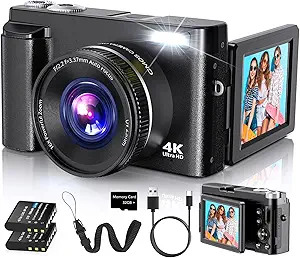
4K Vlogging Camera Portable Pocket Camera with 75MP Photo, 330° Rotating Lens & Face Tracking, 1.7” Touch Screen, Wi-Fi, 18x Digital Zoom, Includes 128GB Card & Tripod
This camera makes a practical starter kit for festival creators who want 4K recording, face tracking, a 128GB card, and a tripod in one package. Its 330° rotating lens offers more framing range than the Kaysunlink’s 270° lens, and face tracking can help keep a solo vlogger in view while moving between stages. The supplied tripod is useful for quick, hands-free introductions or group clips, though a small handheld camera still needs care in dense crowds. Its digital stabilization is a compromise beside the DJI Osmo Pocket 3’s 3-axis mechanical stabilization, which is better suited to walking footage. Battery life is not specified, so I wouldn’t choose it for a full day of continuous shooting without a charging plan. It’s a more complete out-of-box option than the Crxythmenon, which includes only 16GB storage.
Pros:- Records 4K video at 30fps and captures listed 75MP photos.
- 330° rotating lens and face tracking support solo framing.
- Includes a 128GB Micro SD card and tripod.
- Wi-Fi supports connection to compatible phones and other devices.
Cons:- Digital stabilization is less suited to walking footage than the DJI Osmo Pocket 3’s mechanical gimbal.
- Battery life is not specified, making all-day recording harder to plan.
- 18x zoom is digital, so zoomed-in clips may lose detail.
Best for: New festival vloggers who want an all-in-one 4K starter package with substantial included storage and a tripod for stationary clips.
Not ideal for: People filming long walking sequences or full-day events who need proven battery runtime and stronger mechanical stabilization.
- Video resolution:4K at 30fps
- Photo resolution:75MP
- Sensor:1/2.8-inch CMOS
- Lens movement:330° rotating lens with face tracking
- Image stabilization:Digital
- Display:1.7-inch touch screen
- Included storage:128GB Micro SD, C10
- Battery capacity:2400mAh
- Weight:Approximately 240g
Our verdict“Pick this package for an accessible 4K kit with generous included storage, but favor the DJI Osmo Pocket 3 for steadier moving footage.”
4K Vlogging Camera with 330° Gimbal Lens and 75MP Photo, WiFi Pocket Camera
The Crxythmenon’s standout appeal is its stated 10g weight and pocket-sized form, making it the easiest option here to carry between sets without adding much bulk. It pairs 4K recording with a 330° lens, face tracking, and electronic stabilization, giving it a more movement-oriented feature set than the Kaysunlink’s manually adjusted 270° lens. The listing also describes a horizontal gimbal system, though the stabilization is specified as EIS rather than mechanical stabilization; I would not expect the same walking smoothness as the DJI Osmo Pocket 3’s 3-axis mechanical gimbal. Its included 16GB card is a clear limitation for lengthy 4K festival days, and it has no water resistance. This is the carry-anywhere pick for short clips, not the strongest choice for all-day capture or wet weather.
Pros:- Listed weight of 10g and pocket-sized design favor easy carry.
- 4K video and listed 75MP photo resolution offer high-resolution capture.
- 330° rotating lens and auto face tracking support solo filming.
- Wi-Fi and USB connectivity support file transfer.
Cons:- Included 16GB card may fill quickly with 4K footage.
- Not water resistant for rainy or splash-prone festival conditions.
- Electronic stabilization is not the same as the DJI Osmo Pocket 3’s 3-axis mechanical stabilization.
Best for: Creators who prioritize an exceptionally light pocket camera for short 4K festival clips and are willing to bring extra Micro SD storage.
Not ideal for: Vloggers who need long recording sessions, rain protection, or the smoother moving footage offered by a mechanical gimbal.
- Video resolution:4K (2160p)
- Photo resolution:75MP
- Sensor:CMOS
- Lens:330° rotating lens with auto face tracking
- Image stabilization:Electronic image stabilization (EIS); horizontal gimbal listed
- Display:1.72-inch screen
- Included storage:16GB SD card
- Connectivity:Wi-Fi; USB
- Water resistance:Not water resistant
Our verdict“Choose the Crxythmenon when pocketability matters most, but bring extra storage and choose the DJI for steadier movement.”
4K Vlogging Camera with 330° Rotating Lens and WiFi
This model offers a rotating 330° lens and 4K recording at 30fps, but its clearest distinction is also its main constraint: a listed 1.5-hour battery life. That makes it better suited to short stage-side updates or planned clips than to following a festival from afternoon into night. Its 75MP photo specification, autofocus, Wi-Fi, and tripod mount cover basic creator needs, while the 1.72-inch screen provides a compact preview. Compared with the Kaysunlink, it trades the latter’s stated five-hour runtime for 4K capture and a wider lens rotation. Compared with the 4K camera that includes a 128GB card and tripod, this listing does not specify bundled storage or a tripod accessory. It also lacks water resistance and has no flash, so I’d keep it for dry conditions and nearby lighting.
Pros:- Records 4K video at 30fps and lists 75MP still resolution.
- 330° rotating lens allows flexible solo framing.
- Autofocus and Wi-Fi support basic vlogging and sharing workflows.
- Tripod mount supports stationary introductions and group shots.
Cons:- Listed 1.5-hour battery life is restrictive for a full festival day.
- Not water resistant and has no camera flash.
- Digital stabilization is less suited to walking footage than the DJI Osmo Pocket 3’s mechanical system.
Best for: Festival creators who shoot brief, planned 4K updates near a charging option and want a rotating lens with autofocus.
Not ideal for: Anyone filming throughout a long festival day, recording in rain, or relying on a built-in flash for dark scenes.
- Video resolution:4K at 30fps; 1080p also listed
- Photo resolution:75MP
- Sensor:1/2.5-inch CMOS
- Lens movement:330° rotating lens
- Image stabilization:Digital
- Display:1.72-inch screen
- Battery life:1.5 hours
- Connectivity:Wi-Fi; USB
- Water resistance:Not water resistant
Our verdict“Choose this camera for short, planned 4K segments near power, not as your only camera for a full day of festival coverage.”
DJI Osmo Pocket 3 Vlogging Camera with 1” CMOS & 4K/120fps
The DJI Osmo Pocket 3 is the strongest choice here for creators who want polished footage while walking through a festival. Its 1-inch CMOS sensor, 4K recording up to 120fps, and 3-axis mechanical stabilization give it a clear image-quality and motion-smoothness advantage over the digital-stabilized 4K pocket cameras in this group. Active tracking, fast autofocus, and a rotating 2-inch touch screen make solo vlogging easier when scenes and angles change quickly. Stereo recording also provides a more capable audio starting point than the smaller cameras’ less detailed audio specifications. The tradeoff is that this is a more specialized, premium-style tool, and the listed package notes a charger is sold separately. It is also not the carefree choice for rough crowds or wet weather; the supplied cover and wrist strap help with handling, but do not make it water resistant.
Pros:- 1-inch CMOS sensor and 4K recording up to 120fps support detailed, flexible footage.
- 3-axis mechanical stabilization is better suited to walking clips than digital stabilization on the other 4K pocket cameras.
- Active tracking, fast autofocus, and a rotating 2-inch touch screen aid solo shooting.
- Stereo recording and compatibility with DJI Mic 2 and Mic Mini support improved audio options.
Cons:- Charger is sold separately according to the product details.
- The compact gimbal needs careful handling in dense crowds and is not listed as water resistant.
- More camera capability may be unnecessary for creators who only need occasional casual clips.
Best for: Festival vloggers who prioritize steady walking footage, strong image quality, and reliable self-framing over the smallest setup.
Not ideal for: Casual creators seeking a simple low-commitment camera, or anyone needing water resistance and a charger included in the listed package.
- Sensor:1-inch CMOS
- Video resolution:4K at up to 120fps
- Stabilization:3-axis mechanical
- Display:2-inch rotating touch screen
- Color depth:10-bit with D-Log M
- Autofocus and tracking:Fast autofocus; active tracking
- Audio:Stereo recording
- Audio connectivity:Compatible with DJI Mic 2 and Mic Mini
- Included accessories:Protective cover, wrist strap, handle with 1/4-inch thread
Our verdict“Choose the Osmo Pocket 3 for the steadiest, most capable festival vlogging footage here, provided you can handle its extra gear and protect it from weather.”
Insta360 Luna Ultra – 8K Vlogging Camera with Dual Leica Lenses, 12× Zoom, 1″ Sensor, Detachable 2″ Touchscreen, Triple AI Chip, Pocket Gimbal Camera for Vlog Photography – Cosmic Black
For creators who want a festival recap to look more like a produced film than a quick social clip, the Insta360 Luna Ultra has the most ambitious imaging kit here: 8K30 Dolby Vision, Leica color profiles, a 14-stop dynamic range, and a 3-axis gimbal. Its zoom gives more framing flexibility than the fixed wide lenses on the Canon PowerShot V10 and Sony ZV-1F, useful when a stage is distant or the crowd makes it hard to move. The detachable screen also helps when setting up solo shots. That range of controls and recording modes comes with a learning curve, though, and its stated battery life of up to four hours may still call for a charging plan across a long festival day. I’d choose it for image control, not simplicity.
Pros:- 8K Dolby Vision recording and Leica color profiles offer substantial scope for detailed, stylized footage.
- 3-axis mechanical stabilization helps smooth walking shots through a crowd.
- Optical zoom provides more reach than the fixed lenses on the Canon PowerShot V10 and Sony ZV-1F.
- Detachable touchscreen supports more flexible solo framing and remote operation.
Cons:- Advanced recording options and AI features may take time to learn.
- Up to four hours of stated battery life may not cover a full festival day of frequent shooting.
- Its high-end feature set is excessive for casual clips and quick social posts.
Best for: Experienced vloggers making polished festival films who want gimbal stabilization, flexible zoom, and advanced color options.
Not ideal for: Casual attendees who want a simple point-and-shoot camera or need dependable all-day recording without managing battery breaks.
- Main sensor:1-inch
- Telephoto sensor:1/1.3-inch
- Video:8K at 30 fps with Dolby Vision
- Zoom:6× lossless; 12× optical
- Stabilization:3-axis mechanical
- Display:Detachable 2-inch OLED touchscreen
- Battery life:Up to 4 hours
- Dynamic range:14 stops
Our verdict“Choose the Luna Ultra if cinematic image control and zoom matter more to you than a simple setup and lightweight day-long use.”
Duluvulu 4K Digital Camera for Photography Autofocus, 2026 Latest 48MP Vlogging Camera for YouTube with SD Card, 2 Batteries, 3″ 180° Flip Screen Compact Travel Camera for Teens
The Duluvulu 4K Digital Camera is the approachable pick for a first festival vlog: it pairs a 180-degree flip screen with autofocus, two batteries, and an included 32GB card, so a beginner can start framing and recording without building a kit. Its 3-inch display is larger than the Canon PowerShot V10’s 2-inch screen, making self-framing easier to check. But the listing gives little detail about the sensor, stabilization, or weather protection, so I wouldn’t choose it for demanding stage footage or rough conditions. The 16× zoom is digital, not optical, and should not be treated as a substitute for the Luna Ultra’s optical reach. This is a straightforward entry point for casual clips and stills, with fewer assurances for low light or moving crowd shots.
Pros:- 180-degree flip screen makes it easier to frame solo clips.
- Two rechargeable batteries provide a spare for a day of intermittent recording.
- Includes a 32GB SD card, reducing the need to source storage before first use.
- Records 4K video and captures 48MP stills according to the supplied specifications.
Cons:- The 16× zoom is digital, offering less practical reach than the Luna Ultra’s optical zoom.
- Limited sensor and stabilization details make performance harder to judge for crowded, moving scenes.
- No weather resistance is specified for outdoor festival use.
Best for: Teen and first-time vloggers who want a flip-screen camera with basic accessories for casual festival clips and photos.
Not ideal for: Creators who need reliable stabilization, detailed low-light performance, weather protection, or long-reach optical zoom.
- Photo resolution:48 MP
- Video resolution:2160p (4K)
- Sensor type:CMOS
- Display:3-inch, 180-degree flip screen
- Zoom:16× digital
- Included storage:32GB SD card
- Battery:Two rechargeable lithium-ion batteries
- Connectivity:USB
Our verdict“Pick the Duluvulu for an accessible starter kit and easy selfie framing, but skip it if your festival footage needs proven stabilization or strong low-light credentials.”
DJI Osmo Pocket 3 Creator Combo Vlogging Camera with 1” CMOS & 4K/120fps
The DJI Osmo Pocket 3 Creator Combo is my strongest all-round fit for festival vlogging because its 3-axis mechanical stabilization is built for the walking, panning, and quick reframing that make handheld crowd footage difficult. It records 4K at up to 120 fps, and the included Mic 2 transmitter helps capture clearer speech when ambient noise competes with a voiceover or on-camera update. Compared with the fixed-lens Canon PowerShot V10, the Pocket 3 prioritizes stabilized movement and slow-motion options over a wide-angle-first setup. The tradeoff is session length: the supplied data reports roughly 22 minutes of continuous recording per session, so it may interrupt long sets. It also needs a microSD card, which is not listed among the included accessories.
Pros:- 3-axis mechanical stabilization is well suited to walking through busy festival grounds.
- 4K recording at up to 120 fps enables slow-motion clips.
- Creator Combo includes a DJI Mic 2 transmitter for more controlled voice capture.
- Compact body and touch display support quick handheld filming.
Cons:- Continuous recording is listed at approximately 22 minutes per session, limiting uninterrupted coverage.
- A microSD card is required but is not listed among the included accessories.
- Firmware updates and app compatibility may add setup work.
Best for: Festival vloggers who film while walking, want smooth handheld footage, and value an included wireless microphone transmitter.
Not ideal for: Anyone who needs uninterrupted long-form recording or wants a camera ready to record without buying a microSD card.
- Sensor:1-inch CMOS
- Video:4K at up to 120 fps
- Display:2-inch touchscreen
- Stabilization:3-axis mechanical
- Battery capacity:1300 mAh
- Audio compatibility:DJI Mic 2 compatible
- Included audio accessory:DJI Mic 2 transmitter
- Other included accessories:Tripod, handle, protective cover, wrist strap
Our verdict“Choose the Pocket 3 Creator Combo for stabilized walk-and-talk clips and better audio support, provided its session limit fits your filming style.”
Canon PowerShot V10 Compact Vlogging Camera
The Canon PowerShot V10 suits festival-goers who want a pocketable camera for quick face-to-camera updates rather than distant stage coverage. Its 19mm wide-angle lens, flip touchscreen, and built-in stand make it easy to set down for a short intro or hold at arm’s length for a group clip. The built-in stereo microphones, plus a third mic for noise reduction, give it a practical edge over the entry-level Duluvulu, whose supplied data offers less detail about audio. Unlike the gimbal-based DJI Osmo Pocket 3, however, the V10 does not list 3-axis mechanical stabilization, and its fixed lens limits framing options. I’d favor it for simple, stationary clips and straightforward 4K recording, not for zooming into performances or extensive walking shots.
Pros:- 19mm wide-angle lens fits the vlogger and background into a selfie frame.
- Built-in stand supports quick hands-free recording without a separate tripod.
- Stereo microphones and a third noise-reduction mic provide dedicated audio hardware.
- Compact design is easier to carry between stages than a larger camera setup.
Cons:- Fixed wide-angle lens offers little flexibility for distant performers.
- No 3-axis mechanical stabilization is specified, unlike the DJI Osmo Pocket 3.
- Battery life may be limiting during extended shooting, and wireless transfer is not listed.
Best for: Festival attendees who mainly record wide selfie updates, group clips, and short stationary segments without carrying a separate stand.
Not ideal for: Vloggers who want optical zoom, extensive slow motion, or gimbal-level stabilization while moving through crowds.
- Sensor:1-inch CMOS
- Resolution:15.2 MP
- Video:4K at 29.97 fps; Full HD at 60 fps
- Lens:19mm f/2.8 wide-angle
- Screen:2-inch flip touchscreen
- Microphones:Stereo microphones with third noise-reduction mic
- Connections:Micro-HDMI, USB-C
- Additional feature:Built-in stand
Our verdict“Choose the V10 for compact wide-angle selfie clips and quick hands-free setups, not for zoomed stage shots or stabilized walking footage.”
Sony ZV-1F Compact Digital Camera 4K Video
The Sony ZV-1F makes the most sense for festival vloggers who put low-light selfies and a simple wide frame ahead of zoom or elaborate stabilization. Its 20mm f/2 lens and 1-inch sensor are a useful pairing for evening clips, while Eye-AF helps keep a speaker in focus as they address the camera. The side-articulating screen is practical for checking framing, and the directional microphone is a plus when recording speech amid surrounding noise. Compared with the Canon PowerShot V10, the Sony offers a similarly wide fixed-lens approach but has a stated F2 aperture; unlike the DJI Osmo Pocket 3, it does not list mechanical gimbal stabilization. The fixed lens also leaves little room to tighten a stage shot, so this is a face-first camera, not an all-purpose festival recorder.
Pros:- 20mm ultra-wide lens makes arm’s-length vlogging and group framing easier.
- 1-inch sensor and f/2 aperture are suited to dimmer festival scenes.
- Eye-AF helps maintain focus on the vlogger while speaking to camera.
- Side-articulating touchscreen and directional microphone support solo recording.
Cons:- Fixed lens provides limited framing flexibility and no listed optical zoom.
- No image stabilization system is specified, unlike the DJI Osmo Pocket 3’s mechanical gimbal.
- A wide selfie lens is less suited to close framing of distant performers.
Best for: Solo vloggers who film themselves at dusk or after dark and want a wide frame with autofocus and a directional microphone.
Not ideal for: Festival shooters who need zoom for performers, gimbal stabilization for walking footage, or a stated built-in stand.
- Sensor:1-inch
- Lens:20mm ultra-wide
- Maximum aperture:f/2
- Video:4K
- Autofocus:Eye-AF
- Display:Side-articulating touchscreen
- Microphone:Directional microphone
Our verdict“Pick the ZV-1F for wide, low-light selfie vlogs with autofocus, but choose a stabilized zoom option if stage coverage is your priority.”
DJI Osmo Nano Standard Combo (128GB), 4K Wearable Camera
For festival-goers who want to film while moving through a crowd, the DJI Osmo Nano is the most hands-free choice here. Its magnetic wearable design and light build make it easier to capture performances or moments with friends without holding a camera up all day. The 1/1.3-inch sensor, 4K/60fps recording, and 143° view give it a stronger action-footage profile than the pocket-sized 330° rotating-lens cameras in this lineup. It also has a stated 200-minute battery life and built-in storage, useful for longer festival days. The tradeoffs are heat during high-resolution recording in hot weather and possible DJI Mimo compatibility problems on Google Play. Unlike the Sony ZV-1F, it has no conventional flip-out screen for framing yourself, so it suits immersive clips more than carefully composed talking-head vlogs.
Pros:- Magnetic wearable design supports hands-free recording in a crowd
- 1/1.3-inch sensor and 4K/60fps capture suit fast-moving performance footage
- 143° field of view fits performers and surrounding crowd into a shot
- Up to 200 minutes of battery life and 128GB built-in storage
Cons:- High-resolution recording may overheat in hot festival conditions
- DJI Mimo app compatibility on Google Play may be an obstacle for some Android users
- Additional storage requires a microSD card
Best for: Festival attendees who want lightweight, wearable footage while dancing, walking, or keeping both hands free
Not ideal for: Vloggers who need a screen for frequent selfie framing or plan long 4K sessions in hot conditions
- Sensor:1/1.3-inch
- Video:4K at up to 60fps
- Field of view:143°
- Battery life:Up to 200 minutes
- Storage:128GB built-in; expandable via microSD
- Water protection:Waterproof to 10m; IPX4 splash resistant
- Audio:Supports two microphones
- Design:Lightweight magnetic wearable design
Our verdict“Choose the Osmo Nano if hands-free festival clips matter more than having a flip-out screen for direct-to-camera vlogging.”
4K Vlogging Camera with 330° Rotating Lens & Face Tracking, Includes 16GB Card, Mini Tripod & Carrying Bag
This kit is aimed at a first-time festival vlogger who wants a simple, ready-to-go setup rather than a wearable action camera. The 330° rotating lens and face tracking help keep a solo creator in frame while speaking to camera, a more direct fit for selfie updates than the DJI Osmo Nano. It also includes a mini tripod, bag, wrist strap, and a card, so basic accessories are covered from the start. The listed 4K video and WiFi add useful everyday flexibility, but the 16GB card gives little room for a full day of clips before transferring or adding storage. Battery life is not specified, which makes it harder to plan around long festival days. Compared with the Sony ZV-1F, this is a more accessory-focused beginner package, while the Sony offers a named sensor size and lens details.
Pros:- Face tracking helps solo creators stay framed while addressing the camera
- 330° rotating lens supports flexible selfie and scene angles
- Includes a mini tripod, carrying bag, wrist strap, and 16GB card
- WiFi plus time-lapse, slow motion, and interval shooting add recording options
Cons:- The included 16GB card limits how much footage can be kept on the camera
- Battery life is not specified, making long-session planning uncertain
- Basic feature set may not satisfy creators seeking advanced video controls
Best for: New solo vloggers who want face tracking, a rotating lens, and basic accessories in one compact package
Not ideal for: Festival attendees who need dependable all-day recording capacity or want detailed battery-life information before buying
- Video resolution:4K
- Photo resolution:75MP
- Lens rotation:330°
- Included storage:16GB TF card
- Connectivity:WiFi
- Recording features:Face tracking, time-lapse, slow motion, and interval shooting
- Included accessories:Mini tripod, carrying bag, charging cable, and wrist strap
- Warranty:1 year
Our verdict“Pick this kit for approachable solo vlogging and included accessories, but bring extra storage and avoid relying on it for an unplanned full day of recording.”
4K Vlogging Camera with 330° Rotating Lens and Face Tracking
The appeal here is a rotating lens with face tracking in a compact camera, letting a solo vlogger shift between speaking to camera and turning toward a stage without constantly repositioning the device. Its 1.72-inch touchscreen and WiFi offer straightforward framing and sharing options, while the stated 2400mAh battery is rated for up to three hours. That is a clearer planning guide than the battery information provided for the other 330° camera in this batch, but it still falls short of the DJI Osmo Nano’s stated 200 minutes and hands-free wearable format. The listing specifies 4K at 30fps, not 60fps, so fast crowd movement may look less smooth than on the Nano. With no stated external-microphone support and a small screen, this is better for casual selfie clips than ambitious event production.
Pros:- 330° horizontal and 180° vertical lens movement support varied framing
- Face tracking helps keep the creator in view during direct-to-camera clips
- Battery is specified at up to three hours for easier session planning
- WiFi supports sharing and remote control
Cons:- 4K recording is listed at 30fps, below the Osmo Nano’s 60fps capability
- The 1.72-inch touchscreen can feel cramped for detailed adjustments
- External microphone support is not specified
Best for: Solo festival vloggers who prioritize flexible selfie angles, a small touchscreen, and a stated battery estimate
Not ideal for: Creators recording fast action who want 4K/60fps, or vloggers who need confirmed external-microphone support
- Video:4K at 30fps
- Photo resolution:75MP
- Lens rotation:330° horizontal and 180° vertical
- Screen:1.72-inch touchscreen
- Battery:2400mAh; up to 3 hours
- Connectivity:WiFi
- Features:Face tracking and filters
Our verdict“Choose this compact camera for flexible selfie framing and a stated battery estimate, not for smoother high-frame-rate stage footage.”
Sony ZV-1F Vlogging Camera Bundle (Black) with 64GB Card, Bag, and Battery
For creators who want festival footage built around themselves speaking to camera, the Sony ZV-1F offers a more conventional vlogging setup than the wearable Osmo Nano. Its 1-inch sensor, 20mm wide-angle f/2 lens, flip-out touchscreen, and directional microphone support a more deliberate approach to framing and on-camera narration. The bundle also includes a 64GB card, bag, and replacement battery, making it more prepared for a day out than the 16GB starter kit in this batch. The fixed lens has limited zoom, however, so a distant performer can remain small in frame; the Osmo Nano’s 143° view is better suited to capturing a broad scene hands-free. Battery life may also constrain extended shooting, and the menu system may take time to learn. This is a stronger fit for composed vlogs than carefree crowd coverage.
Pros:- 1-inch sensor and f/2 lens support detailed footage in varied lighting
- 20mm wide-angle lens and flip-out touchscreen suit selfie vlogging
- Directional microphone is included for on-camera narration
- Bundle includes a 64GB card, bag, and replacement battery
Cons:- Fixed lens has limited zoom for distant stages
- Battery life may be restrictive during extended festival recording
- Menu system may feel complex to first-time camera owners
Best for: Festival creators who prioritize clear selfie framing, on-camera narration, and a flip-out screen over hands-free recording
Not ideal for: People who need a wearable camera, close-ups of distant performers, or a setup they can operate without learning camera menus
- Sensor:1-inch
- Resolution:20.1MP
- Lens:20mm wide-angle
- Aperture:f/2
- Video:4K
- Screen:Flip-out touchscreen
- Audio:Directional microphone
- Bundle includes:64GB memory card, camera bag, and replacement battery
Our verdict“Choose the ZV-1F bundle for more composed, direct-to-camera festival vlogs, and choose the Osmo Nano instead if hands-free crowd footage is your priority.”
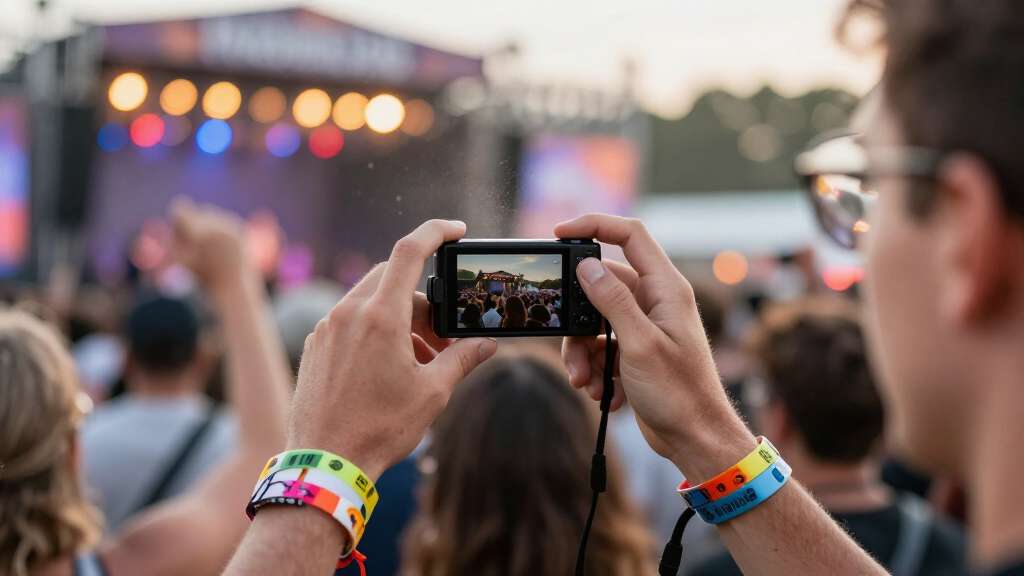
How We Picked
I ranked these cameras for the conditions festival vloggers actually face: moving between stages, filming while walking, switching between yourself and the performance, and carrying gear for long stretches. I gave the most weight to stabilization, low-light potential, easy framing, and practical portability. I also looked at recording formats and listed specifications, while treating claims such as high megapixel counts and digital zoom cautiously when they do not directly establish better video footage.
The Osmo Pocket 3 ranks first because its gimbal design and 1-inch sensor offer a useful balance for handheld festival footage. The Creator Combo follows for buyers who value an expanded kit, while the Osmo Nano earns a separate place for wearable capture rather than traditional vlogging. Cameras with broadly similar rotating-lens designs rank lower because their listings provide less evidence of a clear advantage in stabilization or image quality; bundles and included cards affect convenience, but do not by themselves make footage better.
Factors to Consider When Choosing Camera For Festival Vlogging
I’d choose a festival camera around the footage I expect to make, not the biggest number on the box. A walk-and-talk vlog, a hands-free crowd clip, and a quiet interview between sets place different demands on a camera. These factors can help narrow the field before comparing bundles.
Prioritize stabilization for walking shots
Festival clips often involve walking, turning, and filming over people, so shake can distract more than a small difference in resolution. A gimbal physically steadies the camera, while electronic stabilization crops the image and can behave differently in low light. Check whether the camera’s stabilization suits the way you move, not just whether a listing uses the word “steady.” A wearable camera can capture movement naturally, but its wide, body-mounted view may not resemble a composed vlog shot. If you mostly film from one spot, stabilization may matter less than framing and audio. Avoid choosing purely by resolution if your footage will be handheld in a dense crowd.
Think about low light before choosing resolution
Festival lighting changes quickly: daylight may give way to dim stages, colored lights, and dark walkways. Sensor size and lens performance can affect how clean footage looks in those conditions, while a high megapixel photo figure does not tell you much about video in low light. Larger sensors can help, but camera processing and the available lens also shape the result. If you mostly film daytime sets, portability or battery life may be a better priority. For night performances, check video-specific details and seek sample footage under similar lighting where available. Do not assume “4K” alone means a camera will handle a dark stage well.
Plan for festival audio and venue rules
A camera’s built-in microphone may capture your voice clearly in a quiet room but struggle with bass, cheering, and nearby conversations. Decide whether you need commentary during a set or whether you will add voiceover later; the latter can make a small camera much easier to use. Check microphone inputs and accessory compatibility before buying, since external audio gear adds bulk and may not be allowed at every venue. Even a capable microphone cannot remove every loud crowd sound or prevent clipped audio near speakers. Review the event’s recording policy as well, particularly for professional cameras or detachable accessories. A camera that fits venue rules and your audio plan is more useful than one with features you cannot bring or use.
Match the camera shape to how you film
Compact pocket cameras are suited to quick changes between filming yourself and the stage, while wearable designs free up your hands for crowd movement. Flip screens make it easier to frame a presenter shot, but a screen does not help much if the camera is awkward to hold or operate in a crowd. Consider whether you need a grip, tripod, or a camera that can be carried securely between sets. Small accessories can add setup time and create more items to keep track of. Test your intended carry method at home with the camera and any attachments before festival day. Choose for your actual filming routine rather than assuming the smallest body is always easiest.
Treat battery and storage as part of the setup
Recording 4K video can fill storage quickly and draw down batteries, especially when clips run continuously between performances. Estimate how much footage you plan to keep, then check supported card types, recording limits, and whether the camera can record while charging. An included memory card is convenient, but its presence does not tell you its speed or capacity for a full day of filming. Carrying spare batteries may solve one problem while adding weight and requiring safe storage. A battery claim should be read as a best-case specification, not a promise of all-day recording. Plan to offload clips or conserve recording time if you expect to film across multiple stages.
Pay for useful accessories, not a crowded bundle
A bundle can save setup effort when it includes accessories you will actually use, such as a suitable microphone or a practical grip. A card, small tripod, or bag may be useful, but those items do not improve the camera’s sensor, stabilization, or sound by themselves. Compare the exact contents of each package and verify compatibility before treating two bundles as equivalent. For a first festival, a spare battery and secure carry solution may matter more than several minor add-ons. Buyers who already own compatible accessories may get more value from a standard camera kit. Spending more makes sense when the included extras solve a real filming need rather than simply increasing the box contents.
Frequently Asked Questions
Is the DJI Osmo Pocket 3 a better festival choice than its Creator Combo?
The camera itself is the central point of comparison: both listings name the Osmo Pocket 3, so the main distinction is the package rather than a different imaging system. The Creator Combo makes more sense if its added accessories match your recording plan and save you from buying compatible gear separately. The standard model may be the simpler choice if you already own what you need or want to keep your kit small. Check the exact bundle contents, since package details can vary by listing. For festival use, prioritize accessories that support audio, carrying, or steady handling.
Should I choose a wearable camera or a pocket gimbal for crowd footage?
A wearable camera is useful when you want hands-free, wide-angle footage of moving through a crowd. Its body-mounted viewpoint can feel immersive, but it gives you less direct control over framing and may not suit face-to-camera clips. A pocket gimbal is a better fit when you want to point deliberately at yourself, a performer, or a scene while walking. It does require you to hold and manage the camera. Decide whether spontaneous first-person footage or composed vlogging matters more before choosing between these forms.
Do I need a camera with 4K/120fps for festival vlogging?
Not necessarily: standard 4K recording is already enough for many vlog clips, and high frame rates are most useful when you want smooth slow-motion footage. They can also increase storage use and may depend on recording settings or lighting conditions. For long sets and spontaneous commentary, stabilization, audio, battery planning, and low-light performance may have a larger effect on your results. If slow-motion crowd or stage clips are a specific creative goal, the added frame-rate option can be worthwhile. Otherwise, do not make it your only selection criterion.
Are the rotating-lens 4K cameras interchangeable?
The listings share features such as a rotating lens, Wi-Fi, or face tracking, but that does not establish that their video quality, stabilization, or controls are identical. Some packages specify a memory card, tripod, or carrying bag, while others provide fewer bundle details. Compare the exact model and included items, and look for reliable video samples before treating one as equivalent to another. Claims such as 75MP still photos or digital zoom do not, on their own, prove stronger festival video. If dependable moving footage is your priority, weigh the listed stabilization and sensor information carefully.
What should I prioritize if I mainly film night performances?
Start with sensor and lens information, then look for footage recorded in lighting similar to the stages you expect to visit. A bright, colorful stage can still leave faces dark, and digital zoom may make distant footage look less clean. Stabilization helps when you move, but it cannot compensate for every low-light limitation. Consider recording shorter clips from a steadier position rather than relying on a camera to solve every difficult lighting condition. A separate voiceover can also make it easier to capture usable visuals without trying to talk over the music.
Conclusion
For most people choosing a camera for festival vlogging, I’d start with the DJI Osmo Pocket 3: its gimbal design and 1-inch sensor make it the strongest balance of handheld mobility and image capability in this lineup. Pick the Creator Combo if its included extras fit your setup, and the Osmo Nano if hands-free, wide-angle crowd footage is your main goal. For a beginner who wants an accessible compact vlogging format, compare the Canon PowerShot V10 and Sony ZV-1F around screen layout, handling, and the way you plan to record audio. The rotating-lens budget cameras may suit buyers focused on basic features and bundled accessories, but I would not choose among them by resolution claims alone. For a premium, feature-forward option, the Insta360 Luna Ultra is the standout on listed specifications, though its fit depends on whether you value its distinctive dual-lens setup and detachable screen enough to accept a more specialized choice.
Columbus Day / Indigenous Peoples' Day Picks
long weekend sales
As an affiliate, we earn on qualifying purchases.