Setting up a studio microphone for streaming involves selecting the right microphone, connecting it properly, and optimizing your setup for clear, professional audio. This guide is designed for streamers who want to improve their sound quality, whether you’re new to audio gear or have some experience. Expect to spend about 30 to 60 minutes completing all steps, including testing and adjustments. By following this guide, you’ll achieve a crisp, balanced microphone sound that enhances your stream and engages your audience.

Get audio and creator gear delivered free with Prime
- Fast, free delivery on millions of items
- Prime Video, Amazon Music and more included
- Member-only deals all year

Logitech Blue Yeti USB Microphone for PC, Mac, Gaming, Recording, Streaming, Podcasting, Studio, Condenser Mic with Blue VO!CE Ef…
- ✔ Pickup Patterns: Cardioid, Omni, Bidirectional, Stereo
- ✔ Connectivity: USB
- ✔ Color: Blackout

FIFINE T669 Studio Condenser USB Microphone for Recording and Podcasting
- ✔ Output: USB
- ✔ Frequency Response: Wide
- ✔ Handling Capacity: High SPLs

ZealSound Podcast Microphone for PC, Noise Cancellation USB Mic with Gain, Volume Adjustment & Mute Button, Monitoring & Echo, fo…
- ✔ Frequency Response: 40Hz–18kHz
- ✔ Sampling Rate: 46kHz
- ✔ Sensitivity: –45dB ±3dB
Difficulty: Intermediate | Time: 30-60 minutes
What You’ll Need
Tools & Materials:
- XLR microphone or USB microphone
- Audio interface (for XLR mics)
- Microphone stand
- Pop filter
- XLR or USB cable
- Headphones
- Computer with streaming software
Knowledge:
- Basic understanding of audio equipment
- Familiarity with connecting devices to a computer
Ensure your computer has available USB ports or audio input jacks. If using an XLR microphone, confirm you have an audio interface compatible with your microphone. Prepare a quiet workspace to prevent background noise during setup.
Logitech Blue Yeti USB Microphone for PC, Mac, Gaming, Recording, Streaming, Podcasting, Studio, Condenser Mic with Blue VO!CE Ef…
<p>The <strong>Blue Yeti</strong> stands out for its <strong>multiple pickup patterns</strong>—cardioid, omni, bidirectional, and stereo—that make it adaptable for various streaming scenarios. Its <strong>Blue VO!CE effects</strong> add professional polish directly from the mic, reducing the need for external audio processing. Compared to other models, it offers <strong>easy plug-and-play setup</strong> and adjustable stand, making it suitable for beginners and experienced streamers alike. However, its <strong>bulky design</strong> and complex onboard controls can be drawbacks for those with limited desk space or who prefer simplicity. This pick makes the most sense for streamers who want flexible, high-quality audio without extra equipment, but it may require additional accessories for optimal positioning.</p>
Pros:
- High-quality broadcast sound with multiple pickup patterns
- Built-in Blue VO!CE effects for enhanced audio
- Easy plug-and-play setup with adjustable stand
- Suitable for a variety of recording and streaming styles
Cons:
- Bulky design may not fit all desk setups
- Some users find onboard controls complex
- May require additional accessories for optimal positioning
Best for: Streamers needing versatile audio options and onboard effects for professional-quality broadcasts
Not ideal for: Users with limited desk space or those preferring a minimal, compact setup
Bottom line: The Blue Yeti is ideal for streamers seeking a versatile, feature-rich microphone that handles a range of content creation needs.
“The Blue Yeti is ideal for streamers seeking a versatile, feature-rich microphone that handles a range of content creation needs.”
FIFINE T669 Studio Condenser USB Microphone for Recording and Podcasting
<p>The <strong>FIFINE T669</strong> offers a <strong>cost-effective</strong> solution for streamers who want quality audio without complicated setups. Its <strong>USB condenser capsule</strong> delivers clear sound with a broad frequency response, making it suitable for voice, music, and podcasting. Compared to the Blue Yeti, it’s <strong>more compact and lightweight</strong>, making it easier to position and transport, but it doesn’t include onboard effects or multiple patterns. Instead, it shines through its <strong>included accessories</strong>, such as a boom arm, pop filter, shock mount, and USB cable, providing excellent value. The main tradeoff is that you’ll need an external stand or mount, and it’s incompatible with consoles like Xbox, limiting its flexibility for gamers.</p>
Pros:
- Easy plug-and-play USB connection
- Excellent sound quality with wide frequency response
- Durable construction and versatile adjustable arm
- Includes comprehensive accessories for immediate use
Cons:
- Requires external stand or mount for optimal positioning
- Incompatible with Xbox and some gaming consoles
- Lacks onboard effects or multiple pickup patterns
Best for: Budget-conscious streamers seeking a straightforward, high-quality mic with accessories included
Not ideal for: Gamers or users who prefer an all-in-one, compact USB mic without needing external stands
Bottom line: The FIFINE T669 is perfect for streamers looking for a high-quality, affordable microphone with a complete accessory set, though it needs external mounting solutions.
“The FIFINE T669 is perfect for streamers looking for a high-quality, affordable microphone with a complete accessory set, though it needs external mounting solutions.”
ZealSound Podcast Microphone for PC, Noise Cancellation USB Mic with Gain, Volume Adjustment & Mute Button, Monitoring & Echo, fo…
<p>The <strong>ZealSound K66</strong> distinguishes itself with <strong>advanced noise cancellation</strong> and compatibility across a broad range of devices, including smartphones, tablets, and gaming consoles. Its <strong>studio-quality audio</strong> is enhanced by features like <strong>real-time monitoring, adjustable gain, and echo control</strong>, making it suitable for professional-grade streaming and content creation. Compared to the Blue Yeti and FIFINE, it offers <strong>better noise suppression</strong> for busy environments, but its complex feature set might be overwhelming for beginners. Additionally, it’s a <strong>USB-C device</strong> with Lightning adapters, which can add to setup complexity but offers great flexibility in multi-platform usage.</p>
Pros:
- Excellent noise cancellation for professional-quality recordings
- Wide device compatibility including mobile, PC, and gaming platforms
- Intuitive physical controls for gain, volume, and echo
- Real-time monitoring ensures accurate audio feedback
Cons:
- Feature-rich design can be overwhelming for novices
- Requires physical space and setup effort
- Limited to USB-C or Lightning adapters, no XLR option
Best for: Content creators requiring noise reduction and multi-platform compatibility, especially in noisy environments
Not ideal for: Beginners or those seeking a simple plug-and-play mic without complex controls
Bottom line: The ZealSound K66 is best for streamers or podcasters who prioritize noise reduction and multi-device compatibility, at the cost of a steeper learning curve.
“The ZealSound K66 is best for streamers or podcasters who prioritize noise reduction and multi-device compatibility, at the cost of a steeper learning curve.”
As an Amazon Associate we earn from qualifying purchases.
Before You Start
Verify all equipment is in good working condition. Read the manufacturer’s instructions for your microphone and audio interface. Make sure your streaming software is installed and updated. Avoid setting up in a noisy environment to better evaluate your microphone’s sound quality during adjustments.
Step-by-Step Instructions
Step 1: Select the appropriate microphone
Choose between a USB condenser microphone for plug-and-play convenience or an XLR condenser microphone for higher audio quality and flexibility. Consider your budget, space, and sound quality needs.
Tip:USB mics are easier to set up but may have limitations in sound quality compared to XLR mics, which require additional equipment.
Check: You have the microphone ready and know its connection type (USB or XLR).
Step 2: Position your microphone correctly
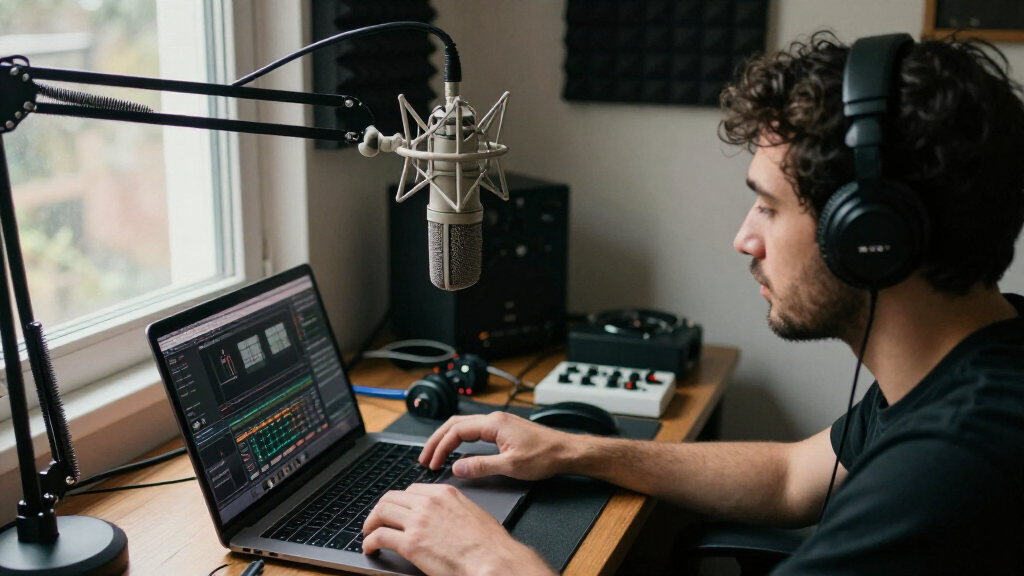
Place the microphone about 6-12 inches from your mouth, slightly below or to the side to reduce plosive sounds. Use a microphone stand to keep it stable and at a consistent height.
Tip:Use a pop filter about 2-3 inches in front of the mic to minimize plosives like ‘p’ and ‘b’ sounds.
Check: The microphone is positioned at a comfortable distance, and the pop filter is correctly aligned in front.
Step 3: Connect the microphone to your computer
If using a USB microphone, plug it directly into a USB port. If using an XLR microphone, connect it to your audio interface using an XLR cable, then connect the interface to your computer via USB or Thunderbolt.
Tip:Ensure all connections are secure and use quality cables to prevent noise.
Check: The microphone is powered (if necessary) and recognized by your computer or streaming software.
Step 4: Configure your audio settings
Open your computer’s sound settings or streaming software preferences. Select your microphone as the input device. Adjust input levels so the loudest sounds do not clip or distort.
Tip:Test speaking into the mic and watch the input level meters. Aim for peaks around 75-85% of maximum to prevent clipping.
Check: The microphone is selected as the input device, and input levels are set correctly without distortion.
Step 5: Adjust microphone gain and position
Use the gain control on your audio interface or software to set a clear, strong signal without distortion. Fine-tune the mic position if needed for optimal sound capture.
Tip:Lower gain if you notice distortion; increase if the audio sounds distant or quiet.
Check: The audio input is clear, without background noise or distortion, and you can speak at a normal volume with consistent levels.
Step 6: Test and optimize sound quality
Record a short test clip or do a live test. Listen with headphones to evaluate clarity, background noise, and plosives. Adjust the mic position, gain, or add filters as needed.
Tip:Use a noise gate or compressor in your streaming software if background noise persists or to smooth out volume fluctuations.
Check: The recorded or live audio is clear, balanced, and free from unwanted noise or distortion.
Common Mistakes to Avoid
- Placing the microphone too close or too far from the mouth — Position the mic about 6-12 inches from your mouth for balanced sound and minimal plosives.
- Using low-quality cables or connections — Use high-quality, shielded cables and ensure all connections are secure to prevent noise.
- Ignoring input levels, causing clipping or inaudible sound — Monitor input levels and adjust gain to prevent distortion or overly quiet signals.
Troubleshooting
Problem: Microphone not recognized by the computer
Solution: Check all connections, restart your computer, and verify device drivers are installed. Test with different ports if necessary.
Problem: Audio sounds distorted or too quiet
Solution: Reduce gain or input volume, reposition the mic closer to your mouth, or check for software volume settings.
Problem: Background noise or static persists
Solution: Use a pop filter, turn on noise suppression in your streaming software, or move to a quieter environment.
What Success Looks Like
The microphone captures your voice clearly with minimal background noise, distortion, or plosives. The audio levels are balanced, and your stream’s audio input is stable and professional sounding.
Next Steps
Secure your microphone with a boom arm or shock mount for stability. Explore additional audio processing like EQ or compression. Regularly test your setup before streaming, and update your drivers and software as needed.
Frequently Asked Questions
Can I use a USB microphone for professional streaming?
Yes, a quality USB microphone can produce good results with minimal setup, suitable for most streamers. For higher control and quality, consider an XLR microphone with an audio interface.
How do I reduce background noise in my microphone setup?
Use a pop filter, position the mic correctly, and enable noise suppression features in your streaming software. Also, choose a quiet environment for streaming.
Do I need an audio interface for an XLR microphone?
Yes, an audio interface converts the analog signal from the XLR microphone into a digital format your computer can process, and provides proper power and gain control.
How often should I test or adjust my microphone setup?
Test your microphone before each streaming session and periodically during longer streams. Adjust levels if you notice changes in sound quality or background noise.
Halloween Picks
halloween
As an affiliate, we earn on qualifying purchases.