
When choosing studio monitors for small rooms, prioritize speakers at ear level, forming an equilateral triangle with your listening position. Avoid placing monitors directly against walls or in corners to prevent bass issues. Use acoustic treatments like bass traps and absorption panels to reduce reflections and echo. Vibration isolation stands help maintain sound clarity. Measuring and adjusting speaker placement can improve sound accuracy. To get the most out of your setup, explore more tips for optimizing small-room sound.

Get audio and creator gear delivered free with Prime
- Fast, free delivery on millions of items
- Prime Video, Amazon Music and more included
- Member-only deals all year
Key Takeaways
- Choose monitors with flat frequency response to accurately reproduce sound in small spaces.
- Opt for nearfield monitors designed for close listening positions to minimize room issues.
- Consider size and power to match your room’s dimensions and acoustic environment.
- Prioritize monitors with good transient response for clarity and detail.
- Use proper placement, acoustic treatments, and calibration for optimal sound quality.
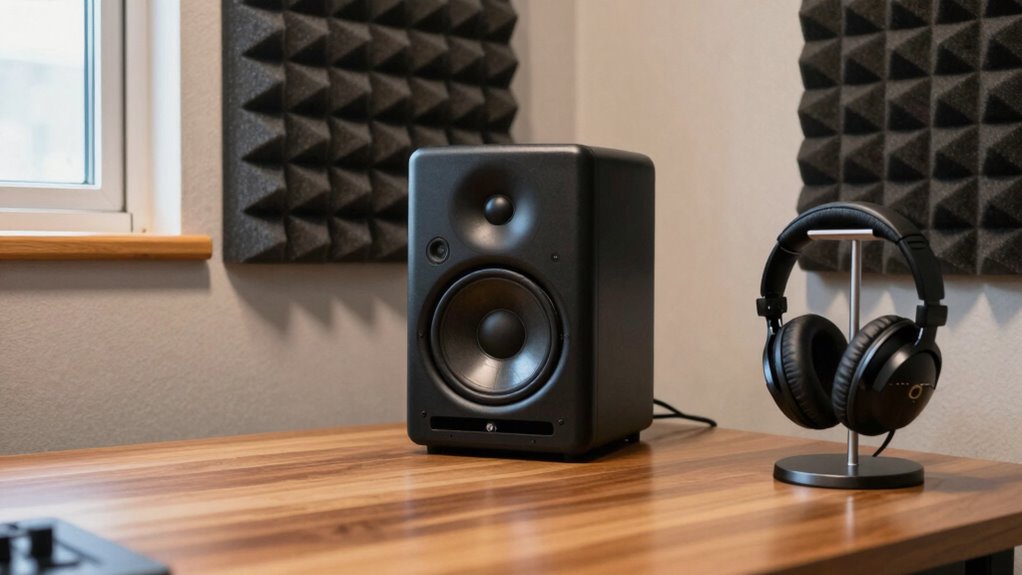
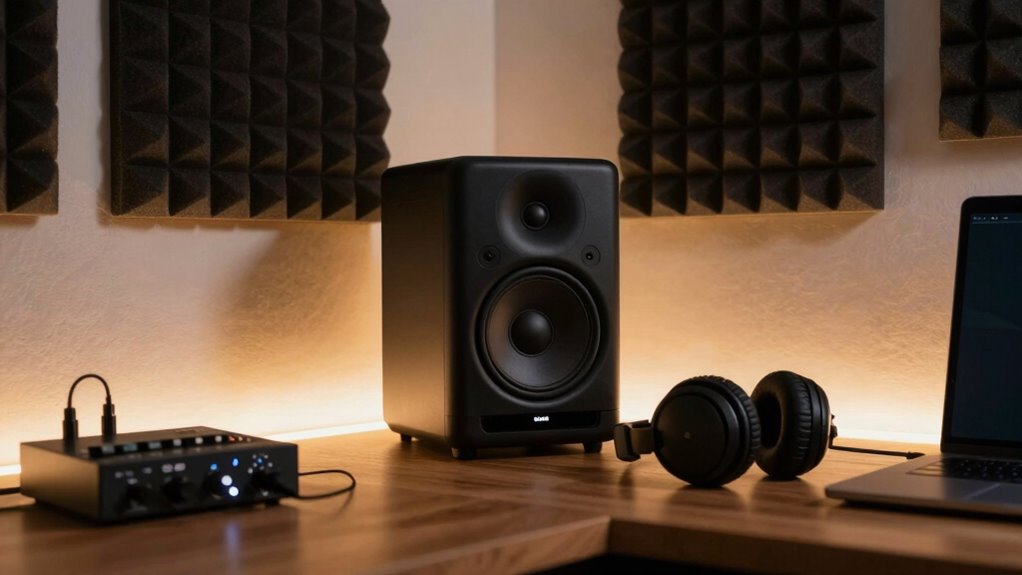
Are you ready to choose the right studio monitors for your setup? In small rooms, this task can seem intimidating, but understanding a few key principles can make all the difference. First, you need to contemplate how your room’s acoustics and speaker placement influence sound quality. Small spaces tend to have more reflective surfaces—walls, ceilings, and desks—that can cause sound waves to bounce around, creating muddiness and uneven frequency response. To counter this, acoustic treatments are essential. Adding bass traps, diffusers, and absorption panels helps control reflections and reduces echo, allowing your monitors to produce a clearer, more accurate sound.
Effective acoustic treatments like bass traps and absorption panels improve sound clarity in small studio spaces.
When it comes to speaker placement, positioning your monitors correctly is vital. In small rooms, you want to keep the monitors at ear level, forming an equilateral triangle with your listening position. This means the distance between the monitors should be roughly the same as the distance from each monitor to your ears. Avoid placing monitors directly against walls or corners, as this can boost bass frequencies artificially and create an unbalanced sound. Instead, leave some space behind and beside the speakers—about a foot or more—so sound waves aren’t overly reflected or muffled.
You also need to think about the angle of your monitors. Tilt them slightly upward toward your ears for ideal stereo imaging and frequency response. This small adjustment can considerably improve clarity, especially in tight spaces where sound waves tend to reflect unpredictably. Additionally, ensure your desk or monitor stands are stable and isolating: vibrations can color your sound and reduce accuracy. Using isolation pads or stands helps prevent vibrations from transferring into your desk, keeping your sound cleaner. Proper monitor placement is crucial for achieving a balanced sound in limited space. Furthermore, experimenting with different speaker orientations can help you find the optimal sound projection for your specific room setup. Taking the time to measure your room’s acoustics can also provide valuable insights into how sound behaves in your space. It’s also helpful to consider how room treatments can be tailored to your environment to optimize sound quality. Incorporating measurement tools can assist in fine-tuning your setup and ensuring your monitors perform at their best. Finally, remember that small rooms require careful calibration. Once your monitors are positioned, spend time adjusting volume levels and listening position until you find the sweet spot. Play familiar tracks and listen for any muddiness or dead zones—then tweak your acoustic treatments and speaker placement accordingly. The goal is to create a balanced, transparent listening environment where your mixes translate well to other systems. While it takes some trial and error, paying attention to acoustic treatments and speaker placement will greatly elevate your experience and results in a small-room studio.
As an affiliate, we earn on qualifying purchases.
Frequently Asked Questions
How Do I Choose the Right Studio Monitor Size for a Small Room?
To choose the right studio monitor size for a small room, consider room acoustics and speaker placement first. Smaller monitors, like 5-7 inches, prevent overpowering the space and reduce bass muddiness. Proper speaker placement—placing monitors at ear level and equidistant from your listening position—helps optimize sound. If your room has poor acoustics, add bass traps or acoustic panels to improve sound clarity, regardless of monitor size.
What Are the Best Budget-Friendly Studio Monitors for Small Spaces?
Your small room’s sound quality can be transformed with budget-friendly studio monitors like the Kali Audio LP-6 or the JBL 305P MkII, which are incredible value. To get the best sound, focus on speaker positioning—place them at ear level and form an equilateral triangle—and add acoustic treatment like bass traps and foam panels. These simple steps make even modest monitors sound professional and clear.
How Important Is Room Treatment When Using Studio Monitors?
Room treatment and speaker placement are essential when using studio monitors because they directly affect sound clarity. Good room acoustics help reduce unwanted reflections and resonances, making your mixes more accurate. Proper speaker placement ensures even sound distribution and minimizes phase issues. Ignoring these aspects can lead to misleading audio cues, so investing in room treatment and paying attention to placement will greatly improve your monitoring environment and your overall sound quality.
Can I Use Consumer Speakers as Studio Monitors in a Small Room?
Using consumer speakers as studio monitors in a small room is like trying to paint with a watercolor brush instead of a fine-tipped pen—you might get close, but it’s not perfect. Consumer speakers often lack the accuracy you need for critical listening. Proper speaker placement and acoustic treatment are essential to improve sound quality. But for precise mixes, investing in dedicated studio monitors remains the best choice.
What Features Should I Prioritize in Studio Monitors for Small Rooms?
You should prioritize clear, accurate sound reproduction, focusing on speaker placement and acoustic treatment. Look for monitors with flat frequency responses to hear true mixes. Opt for models with appropriate size and power for your space, and guarantee your speakers can be positioned correctly—avoiding corners and reflective surfaces. Good acoustic treatment helps reduce echo and bass build-up, making your small room more suitable for precise monitoring.
acoustic treatment panels for small rooms
As an affiliate, we earn on qualifying purchases.
As an affiliate, we earn on qualifying purchases.
Conclusion
Don’t let limited space hold you back—small rooms can still deliver great sound with the right studio monitors. Just focus on choosing monitors with accurate sound and proper placement, and you’ll get professional-quality results. It’s a common worry that small spaces can’t produce big sound, but with careful selection, you’ll find your setup sounds fantastic. Trust your ears, not just the size of your room, and enjoy creating your best work.
As an affiliate, we earn on qualifying purchases.
As an affiliate, we earn on qualifying purchases.
Fall Picks
fall essentials
As an affiliate, we earn on qualifying purchases.