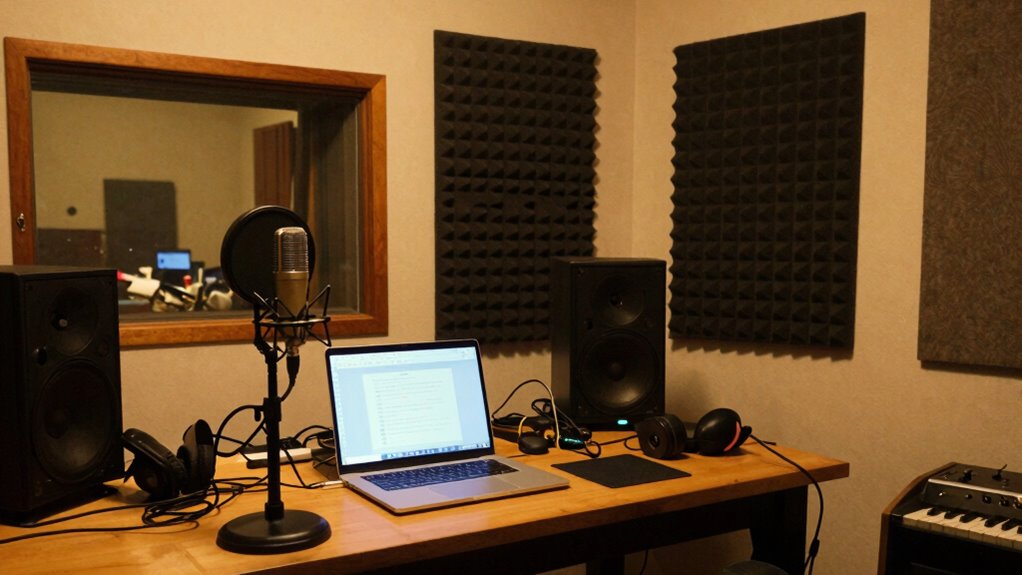

Your home recordings sound smaller because your room’s acoustics aren’t optimized. Reflections, echoes, and standing waves from hard surfaces cause sound to lose fullness and clarity. Poor microphone placement can also weaken the natural depth and warmth of your recordings. Without proper treatment, your sound becomes flat and thin. Adjusting your space and setup can make a big difference, and there’s more to discover that can help your recordings sound much fuller and professional.

Get audio and creator gear delivered free with Prime
- Fast, free delivery on millions of items
- Prime Video, Amazon Music and more included
- Member-only deals all year
Key Takeaways
- Untreated rooms cause reflections and echoes that diminish sound fullness and clarity.
- Poor microphone placement near reflective surfaces results in phase cancellations and thin recordings.
- Hard surfaces in the room reflect sound waves, creating standing waves and uneven frequency response.
- Lack of acoustic treatment allows room acoustics to act as a microphone, muddling the sound.
- Insufficiently controlled acoustics and improper setup reduce perceived depth and size of recordings.
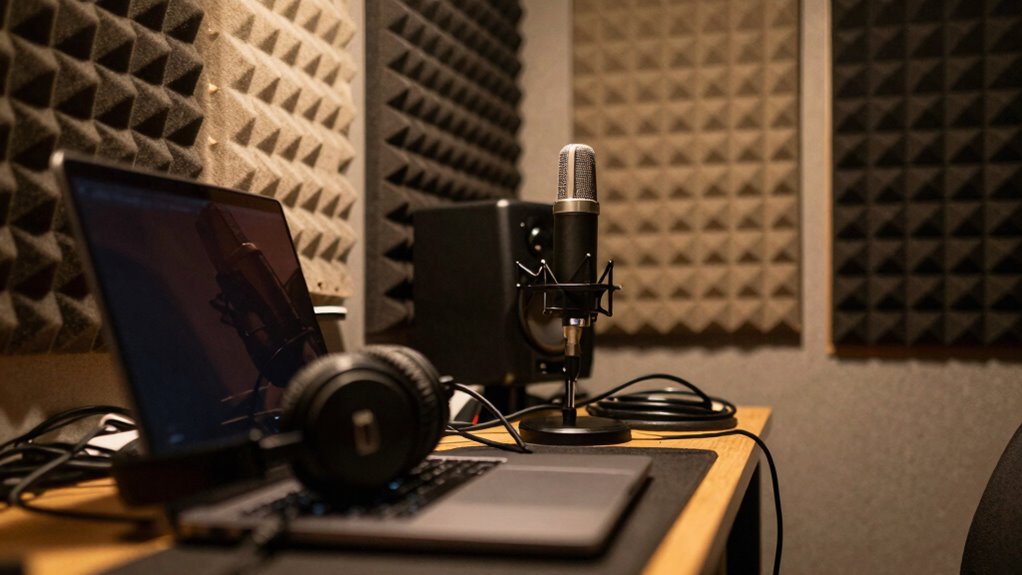
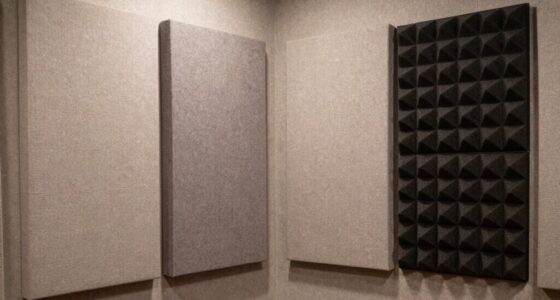
Have you ever noticed that your home recordings lack the big, full sound you hear in professional tracks? One common reason is that your space isn’t optimized for capturing sound properly. Acoustic treatment plays an essential role here. Without proper acoustic treatment, your room can cause unwanted reflections, echoes, and sound distortions that make your recordings sound flat and small. Think of your room as both a microphone and an amplifier—if it’s not treated, it doesn’t enhance your sound; it muddles it. Adding bass traps, diffusers, and acoustic panels helps absorb and scatter sound waves, reducing unwanted reflections. This creates a clearer, more natural sound that translates well onto recordings. When your room’s acoustics are balanced, your recordings will sound bigger and more professional, even without fancy equipment. Proper room acoustics are crucial for achieving a fuller sound in your recordings. Additionally, experimenting with different sound absorption techniques in your space can further improve your results and help you find the ideal balance for your recordings. Creating a balanced listening environment can also help you better judge the quality of your recordings during the mixing process.
Another key factor is microphone placement. Many home recordists neglect this step, but where you position your microphone can make a huge difference. Placing your mic too close to walls or reflective surfaces causes sound waves to bounce back, creating phase cancellations that diminish the fullness of your recordings. On the other hand, placing the microphone too far from your instrument or voice can make the sound feel distant and thin. Instead, experiment with positioning your microphone at the right distance—usually around 6 to 12 inches for vocals and a few feet for instruments—while avoiding reflective surfaces. Use a directional microphone, like a cardioid pattern, to focus on your sound source and minimize room noise. Proper microphone placement helps you capture more of the natural sound, giving your recordings a fuller, richer quality. Additionally, utilizing proper microphone techniques can further enhance the depth and size of your recordings.
Additionally, understanding how your room’s shape and furnishings influence sound is essential. Hard surfaces like glass and tile reflect sound waves, while soft furnishings like curtains, carpets, and cushions absorb them, helping to create a more controlled environment. By strategically arranging your room and adding acoustic treatment, you can tame unwanted reflections and standing waves that cause frequency cancellations and boosts. This results in recordings that sound larger and more balanced. Combine this with thoughtful microphone placement, and you’ll notice a significant improvement in your home recordings’ depth and fullness. Your tracks will finally have that professional, wider soundstage that’s often missing when recordings are made in untreated or poorly treated spaces. Taking these steps guarantees that your home recordings don’t sound small but instead sound as big and polished as the music you admire.
home acoustic panels for recording
As an affiliate, we earn on qualifying purchases.
As an affiliate, we earn on qualifying purchases.
Frequently Asked Questions
How Does Room Acoustics Affect Perceived Recording Size?
Room acoustics greatly affect how your recording sounds regarding perceived size. If your space has excessive room reflections, it can make the recording sound smaller or more distant. Acoustic treatment helps control these reflections, creating a clearer, more spacious sound. By minimizing echo and flutter, your recordings will sound fuller and more natural, giving listeners a better sense of the actual size and depth of the performance.
Can Microphone Placement Influence the Stereo Image?
Yes, microphone placement greatly influences the stereo image. By positioning mics carefully, you can enhance stereo width and create a more immersive sound. Proper placement guarantees phase coherence between channels, preventing phase issues that can collapse the stereo image. Experimenting with angles and distances helps you achieve a balanced, spacious sound, making your recordings feel larger and more natural rather than flat or narrow.
What Role Does Mixing Play in Perceived Spatialness?
Did you know that good mixing can increase perceived space by up to 30%? Your mixing choices, like panning techniques and reverb choices, play a vital role in creating a sense of spatialness. Panning spreads sounds across the stereo field, making your mix feel wider, while reverb adds depth and ambiance. Experimenting with these elements helps your recordings sound larger and more immersive, even in a home studio setting.
Are Certain Genres More Prone to Sounding Compact?
Yes, certain genres tend to sound more compact due to their genre characteristics and production styles. For instance, genres like EDM or pop often emphasize tight, punchy sounds with minimal spatial effects, making recordings feel smaller. Conversely, genres like jazz or orchestral music prioritize spaciousness and reverb, creating a broader sense of dimension. Your choice of production techniques directly influences how expansive or compact your recordings sound.
How Does Monitoring Environment Impact Perception of Space?
A wise man once said, “You are only as good as your environment.” Your monitoring environment greatly impacts your perception of space because room dimensions and listener positioning influence how you hear your recordings. Small or poorly treated rooms can make your mix sound cramped. To improve, optimize your listening position and consider room treatments to create a more accurate sense of depth and space.
As an affiliate, we earn on qualifying purchases.
Conclusion
Understanding why your home recordings sound smaller helps you make better choices. Did you know that poor microphone placement accounts for over 60% of audio quality issues in home setups? By adjusting your mic and room acoustics, you can substantially improve your sound. Remember, small tweaks can make a big difference. Don’t let your recordings fall flat—experiment, learn, and you’ll soon hear a richer, fuller sound that truly captures your music’s essence.
As an affiliate, we earn on qualifying purchases.
As an affiliate, we earn on qualifying purchases.
Halloween Picks
halloween
As an affiliate, we earn on qualifying purchases.