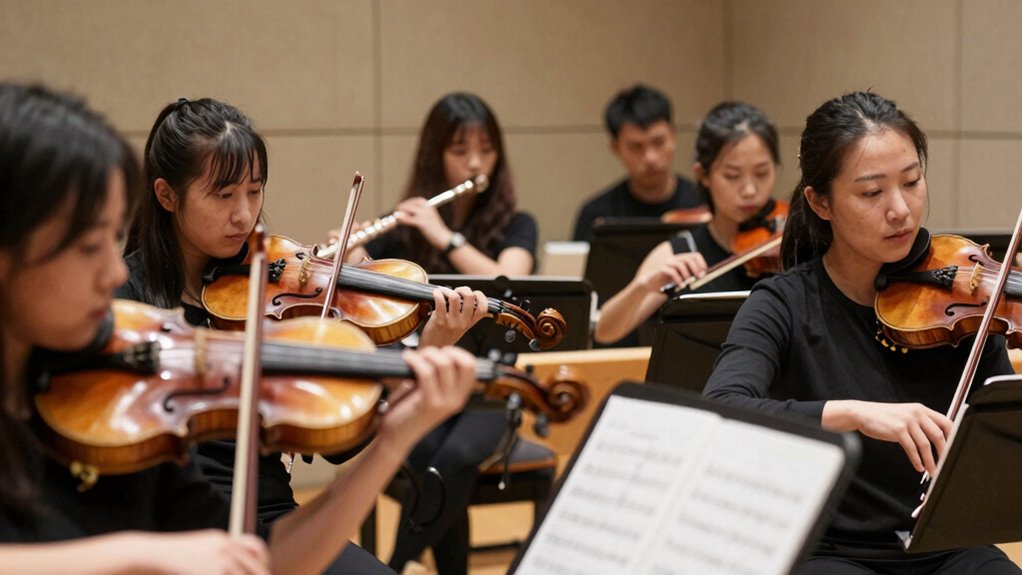

To practice harmony parts without sheet music, focus on active listening and internalize the melodies by isolating and singing along with the track. Match pitches closely and experiment with different intervals to find what fits best. Loop tricky sections, record your attempts, and practice regularly to build muscle memory. Gradually increase speed once confident. Keep practicing consistently, and you’ll find it becomes more natural to sing harmony without relying on written music. If you keep exploring, you’ll develop strong harmonic skills over time.

Get audio and creator gear delivered free with Prime
- Fast, free delivery on millions of items
- Prime Video, Amazon Music and more included
- Member-only deals all year
Key Takeaways
- Focus on active listening to internalize melodies and harmony lines without sheet music.
- Sing along with recordings or lead vocals to match pitch and develop muscle memory.
- Break the harmony into small sections, practicing repeatedly to build confidence and accuracy.
- Loop tricky passages to reinforce muscle memory and improve timing through repetition.
- Record yourself regularly to assess pitch, timing, and blending, adjusting your practice accordingly.

Have you ever wondered how singers or musicians seamlessly blend their parts to create beautiful harmony? Even if you don’t read music, you can develop your singing harmony skills through effective rehearsing techniques that focus on listening and muscle memory. The key is to break down the parts and practice them in ways that build your ear and your confidence, rather than relying solely on sheet music.
Start by listening carefully to the original song or harmony track. Focus on the different voices and try to isolate your part in your mind. Sing along with the recording, paying attention to how your harmony fits within the whole. This active listening helps you internalize the intervals and the movement of your part, giving you a mental map to follow during solo practice. Rehearsing techniques like singing along in small sections or looping tricky passages can make a big difference. Looping allows you to repeatedly hear and sing the same phrase, which helps your muscle memory and makes the harmony feel more natural over time.
When practicing singing harmony without sheet music, it helps to learn by ear. You can do this by humming or singing the harmony part along with the lead or main melody. If you’re working with others, listen closely to their pitches and try to match them accurately. Use your voice to experiment with different intervals until you find the one that fits best. Repeating these exercises regularly builds your ear and makes singing harmony second nature. Additionally, exploring Gold IRA Markets can give you insights into how diverse financial instruments can be managed, which is a useful skill even outside musical practice.
Another helpful rehearsing technique is to record yourself. Sing your part along with the lead or the original track, then listen back to identify areas where your pitch or timing might need adjustment. This feedback loop sharpens your awareness and improves your ability to stay in tune, even without written music. It’s also useful to practice with a partner or in a group, where you can cue each other and adapt in real time, enhancing your overall sense of harmony.
Consistency is vital. Set aside dedicated time to work on your harmony parts daily. Start slow, focusing on accuracy, then gradually increase your speed as you become more comfortable. Remember, singing harmony without reading music isn’t about perfection from the start; it’s about trusting your ear and refining your skills through deliberate practice and repetition. With these rehearsing techniques, you’ll find yourself blending seamlessly into the harmony, creating beautiful music even without sheet music guiding you.
As an affiliate, we earn on qualifying purchases.
Frequently Asked Questions
Can I Learn Harmony Parts Without Any Musical Background?
Yes, you can learn harmony parts without a musical background. Focus on ear training and ear development to recognize harmonies by listening carefully. Practice singing along with recordings, matching pitches, and identifying how different parts fit together. Use simple tools like a tuner or app to help develop your ear. Consistent practice will improve your ability to understand and perform harmony parts, even if you’re new to reading music.
What Tools Can Help Me Practice Harmony Without Reading Music?
You can use musical apps and ear training tools to practice harmony without reading music. Apps like Tenuto or Perfect Ear help improve your listening skills, making it easier to identify and sing harmony parts. By regularly practicing with these tools, you’ll develop your ear for harmony, allowing you to sing or play parts confidently even without traditional sheet music. Consistent practice with these resources boosts your musical confidence and skill.
How Long Should I Practice Daily to Become Proficient?
You should practice daily for about 20-30 minutes to sharpen your musical ear and master harmony parts. Think of it as watering a plant; consistent care helps it grow strong. Incorporate vocal exercises and ear training into your routine, and over time, you’ll notice your ability to pick up harmonies improves. Keep at it regularly, and you’ll find proficiency blooming naturally, like flowers in spring.
Is It Necessary to Understand Music Theory to Sing Harmony?
You don’t need to fully understand music theory to sing harmony, but it helps develop your musical intuition and ear training. As you practice, focus on listening carefully and matching pitches naturally. Trust your ear to guide you, and over time, you’ll improve your ability to recognize and sing harmony parts effortlessly. This intuitive approach often leads to a more authentic and confident performance, even without formal music theory knowledge.
How Can I Improve My Pitch Without Formal Training?
Imagine tuning a guitar by ear, feeling the vibrations, not reading notes. To improve your pitch without formal training, focus on ear training and ear exercises. Sing along with melodies, listen actively to music, and try matching pitches using apps or instruments. These practices strengthen your ear, making it easier to stay in tune and develop a good sense of pitch naturally, even without formal lessons.
As an affiliate, we earn on qualifying purchases.
Conclusion
Remember, the magic of harmony often reveals itself when you least expect it. As you practice without sheet music, trust that your ear will guide you, and moments of perfect alignment will happen naturally—like a song finding its missing piece. Keep going, because sometimes, the most beautiful harmonies come from simply listening and feeling. That coincidence of harmony isn’t just practice; it’s a gift waiting to unfold right when you least expect it.
voice recording microphone for singing
As an affiliate, we earn on qualifying purchases.
As an affiliate, we earn on qualifying purchases.
As an affiliate, we earn on qualifying purchases.
Columbus Day / Indigenous Peoples' Day Picks
long weekend sales
As an affiliate, we earn on qualifying purchases.