

Choosing a guitar wireless system for stage involves balancing performance, reliability, and ease of use. The best options offer low latency, clear audio, and long battery life, but often come with tradeoffs in cost or complexity. The JOYO 5.8GHz Wireless Guitar System stands out as the overall top pick for its balance of features and affordability, while the Xvive AC58 impresses with its charging case for extended use. For those seeking premium quality, the LEKATO 5.8GHz Wireless Guitar System with 24-Bit Audio delivers studio-level sound. Continue reading to see how these options compare and which suits your stage needs.

Get audio and creator gear delivered free with Prime
- Fast, free delivery on millions of items
- Prime Video, Amazon Music and more included
- Member-only deals all year
Complete the kit


Key Takeaways
- Low latency and stable connections are critical for live performance, making 5.8GHz systems preferable over 2.4GHz in crowded venues.
- Battery life varies significantly; longer sessions demand systems with at least 8-10 hours of continuous use.
- Multiple channels help avoid interference in band-rich environments but often increase the price.
- Build quality and durability matter, especially for frequent gigging, to prevent connection issues or damage.
- Price differences reflect features like audio quality, range, and included accessories; higher cost usually means more reliable performance.




| guitar wireless system for stage | Range | Frequency | Battery Life | Latency |
|---|---|---|---|---|
| JOYO 5.8GHz Wireless Guitar Sy | 65ft | 5.8GHz | 6 hours | — |
| Xvive AC58 Wireless Guitar Sys | — | 5.8 GHz | — | — |
| JOYO JW-06 5.8GHz Wireless Gui | — | — | — | Under 6ms |
| LEKATO 5.8GHz Wireless Guitar | 20 meters | 5.8GHz | 15 hours | — |
| LEKATO 5.8GHz Wireless Guitar | Up to 100 feet | 5.8GHz | — | Less than 6ms |
| JOYO Wireless Guitar System UH | — | — | — | — |
| 5.8GHz Wireless Guitar System | over 30 meters (100 feet) | 5.8GHz | — | — |
| SONICAKE 5.8GHz Wireless Guita | 50 meters | — | 8 hours | 5 milliseconds |
| Xvive A58 Wireless Guitar Syst | 100 feet | 5.8GHz | Up to 5 hours | Less than 5ms |
| JOYO 2.4GHz Wireless Guitar Sy | 65ft | 2.4GHz | Up to 8 hours | 5 milliseconds |
| Xvive A58 Wireless Guitar Syst | 100 ft | 5.8 GHz | up to 5 hours | — |
| Flatsons 5.8GHz Wireless Guita | 100+ feet | — | Over 6 hours | 5.58ms |
| Positive Grid Spark Link Wirel | up to 70ft | — | up to 6 hours | under 3ms |
| LEKATO 5.8GHz Wireless Guitar | about 100 ft | 5.8 GHz | up to 5 hours | less than 6ms |
More Details on Our Top Picks
JOYO 5.8GHz Wireless Guitar System with 4 Channels and Rechargeable Transmitter/Receiver
This system stands out for its balance of solid audio quality and versatility in small to medium settings. Operating at 5.8GHz with frequency hopping, it resists interference better than some lower-tier options like the LEKATO 24-Bit system, making it more reliable for practice and studio use. Its high-resolution 48kHz/24-bit sound ensures clear tone, while the 65ft range and rotatable plug provide compatibility with a variety of guitars. However, it’s less suited for large stage performances where range and robustness are critical, and it requires pairing before each use, which can be a minor inconvenience. Compared to the JOYO JW-06, it offers similar sound quality but with a more straightforward interface. This pick makes the most sense for musicians who need dependable audio fidelity and moderate mobility without the complexity of larger systems.
Pros:- Stable wireless connection with minimal interference
- High-resolution 48kHz/24-bit sound quality
- Long battery life of up to 6 hours
- Rotatable plug for various guitars
Cons:- Limited range for large stages
- Requires pairing before use
- Range can be obstructed by walls or electronics
Best for: Musicians performing in small venues or studio settings who prioritize sound clarity and ease of use.
Not ideal for: Large stage performers needing extended range and rugged reliability across bigger venues.
- Frequency:5.8GHz
- Channels:4
- Sound Quality:48kHz/24-bit
- Range:65ft
- Battery Life:6 hours
- Connector:1/4-Inch
- Compatible Devices:Guitar, Bass, Acoustic Guitar, Digital Music Instruments
- Enclosure Material:ABS, Plastic
Our verdict“Ideal for small gigs and studio work where high-quality audio and reliability matter most.”
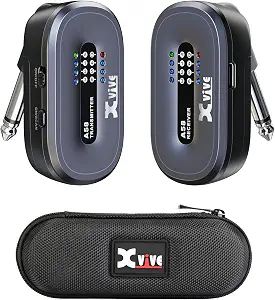
Xvive AC58 Wireless Guitar System with Charging Case 5.8GHz
The Xvive AC58 offers a straightforward solution for guitarists who want high-resolution, low-latency sound with minimal fuss. Its compatibility with active and passive pickups broadens its appeal, and the included charging case ensures multiple sessions without constant recharging, setting it apart from simpler models like the LEKATO with shorter battery life. The easy channel scanning feature helps avoid interference in busy environments, making it suitable for rehearsals and smaller gigs. However, it relies on Lithium Ion batteries that may need replacement over time, and its 5.8 GHz frequency can be crowded in some environments, posing a risk of interference. Compared to the JOYO JW-06, it’s more portable and user-friendly with a compact design. This makes it a strong choice for players seeking reliable, hassle-free wireless connectivity with good sound fidelity.
Pros:- High-resolution 24-bit/48 kHz audio
- Includes a charging case for multiple uses
- Easy channel scanning to avoid interference
- Compatible with active and passive pickups
Cons:- Lithium Ion batteries may require replacement
- Limited to 5.8 GHz frequency, potential interference in crowded areas
Best for: Guitarists who perform in environments prone to interference and need quick, hassle-free setup.
Not ideal for: Large stage performers or users in extremely crowded RF environments where 5.8GHz could be congested.
- Item Weight:3.2 ounces
- Frequency:5.8 GHz
- Audio Quality:24-bit/48 kHz
- Modes:Active and Passive
- Includes:Transmitter, Receiver, Charging Case, USB-C cable, Manual
Our verdict“Best suited for rehearsals and small gigs where convenience and interference resistance are priorities.”
JOYO JW-06 5.8GHz Wireless Guitar System with Charging Case
The JOYO JW-06 makes a compelling case for stage musicians needing extended playtime and multiple channels. Its 18-hour total battery life via the charging case far surpasses many competitors, ideal for long gigs or multiple practice sessions. The system’s 48kHz/24-bit audio and latency under 6ms deliver clear, responsive sound, comparable to the LEKATO but with greater endurance. The four channels support multiple instruments or band members, giving it an edge over simpler single-channel systems. However, range can drop to 30-50 feet within obstructed environments, and it’s incompatible with 18V active pickups, limiting some users. Compared with the LEKATO, its longer battery life and multiple channels make it more suitable for band settings, though its larger case adds some bulk. This pick fits musicians who need reliable, lengthy wireless operation across multiple instruments.
Pros:- Extremely long 18-hour total playtime
- Supports four channels for multi-instrument use
- High-quality 48kHz/24-bit audio
- Low latency under 6ms
Cons:- Range decreases with obstructions
- Not compatible with 18V or high-output pickups
- Bulkier charging case may be less portable
Best for: Performers in bands or large groups requiring long-lasting, multi-instrument wireless systems.
Not ideal for: Solo performers or small venues where simplicity and portability are more critical than extended battery life.
- Wireless Frequency:5.8GHz
- Audio Resolution:48kHz/24-bit
- Latency:Under 6ms
- Total Playtime:Up to 18 hours
- Channels:4
- Included Components:Transmitter, receiver, charging case, USB cable
Our verdict“Designed for band settings where long duration and multiple channels are essential.”
LEKATO 5.8GHz Wireless Guitar System with Charging Box, 15H Battery Life, 4 Channels for Live Stage & Practice
The LEKATO system offers a practical balance of affordability and performance. Its 15-hour battery life via a portable charging box makes it suitable for extended practice or smaller gigs, though it doesn’t quite match the longevity of the JOYO JW-06. The 5.8GHz operation reduces interference, and four channels support multiple instruments or band members. Its audio quality, while solid, may not match the clarity of higher-end systems like the Xvive AC58, but it’s more than enough for casual live use. The 20-meter range fits most small to medium stages, but limitations become apparent in larger venues or obstructed environments. Compared to the more feature-rich JOYO JW-06, this is a more straightforward, budget-friendly option that still delivers reliable wireless audio.
Pros:- Long-lasting 15-hour battery
- Supports four channels
- Low interference operation on 5.8GHz
- Affordable price point
Cons:- Limited to 20 meters range
- Setup can be slightly complex
- Sound quality is decent but not premium
Best for: Budget-conscious musicians who need reliable wireless for rehearsals and small gigs.
Not ideal for: Large stage performers or those needing ultra-long battery life or extensive channels.
- Frequency:5.8GHz
- Battery Life:15 hours
- Range:20 meters
- Channels:4
- Supported Devices:Guitar, Bass, Keyboard, Electric Violin
- Charging Case:Yes, 5000mAh
Our verdict“A solid, cost-effective choice for small-stage performers and practice sessions.”
LEKATO 5.8GHz Wireless Guitar System, 24-Bit Audio Transmitter and Receiver for Live Stage and Studio Practice
This LEKATO system emphasizes high-fidelity audio and flexible instrument compatibility, featuring 24-bit/48KHz sound and a 220° rotatable plug, making it adaptable to various instruments. The ultra-low latency of less than 6ms ensures real-time responsiveness, which is critical for studio work or live performance. Its four channels support multiple instruments, but the 5-hour battery life is shorter than some competitors like the JOYO JW-06, limiting its use in extended gigs without recharge. The rechargeable dual USB feature adds convenience, yet its range of up to 100 feet is less constrained, making it suitable for larger stages or rehearsal spaces. Compared to the Xvive AC58, it offers slightly higher resolution and more flexibility with plugs, but at a higher price. This system appeals to musicians seeking detailed sound for recording and flexible instrument connectivity.
Pros:- High-fidelity 24-bit/48KHz sound
- 220° rotatable plug for compatibility
- Low latency under 6ms
- Supports four channels
Cons:- Limited to 5 hours of battery life
- Requires frequent recharging for long gigs
- Higher price compared to similar models
Best for: Studio musicians and performers needing high-resolution, flexible setup, and reliable wireless audio.
Not ideal for: Performers requiring all-day battery life or extensive channels for large bands.
- Frequency:5.8GHz
- Audio Quality:24-bit/48KHz
- Latency:Less than 6ms
- Range:Up to 100 feet
- Channels:4
- Plug Rotation:220°
Our verdict“Best suited for studio applications and detailed live performances where audio quality is paramount.”
JOYO Wireless Guitar System UHF Transmitter and Receiver, 6 Channel, Low Latency, Long Range Rechargeable for Guitar and Bass
This JOYO UHF system stands out for its reliable transmission and long range, making it a solid choice for small gigs and practice sessions. Compared with the Xvive A58, it offers similar low latency but at a more affordable price point, though it supports only mono audio and has a shorter effective range in obstructed environments. Its auto-pairing and rechargeable design simplify setup, but the limited channels and the absence of stereo output can be drawbacks for more complex stage setups. For those prioritizing ease of use and cost-efficiency over advanced features, this system hits the sweet spot.
Pros:- Reliable UHF transmission with minimal latency
- Long wireless range up to 150ft
- Auto pairing for multiple devices
Cons:- Limited to mono audio output, not suitable for stereo needs
- Range can be reduced by obstructions or interference
Best for: Musicians needing a reliable, affordable wireless system for practice or small local gigs
Not ideal for: Performers on large stages or in environments with lots of obstructions, where the 150ft range and mono output may fall short
- Compatible Devices:Electric Guitar, Bass, Acoustic Guitar, Electronic Instruments
- Power Source:Battery Powered
- Output Channel Quantity:6
- Connector Type:6.35mm Jack
- Item Weight:60 g
- Enclosure Material:ABS, Plastic
Our verdict“This system is ideal for casual performers and practice setups where budget and simplicity matter most.”
5.8GHz Wireless Guitar System with 4 Channels, Digital Audio Cordless Transmitter and Receiver for Electric Guitars and Basses
This 5.8GHz system excels in delivering high-fidelity stereo digital audio with low latency, making it well-suited for serious performers. Compared to the JOYO UHF system, it offers clearer sound and multiple channels for interference management, but its range over 30 meters is more limited. The rotatable transmitter adds comfort during extended playing, though it requires USB charging and is primarily designed for electric guitars and basses. This pick makes the most sense for performers who prioritize audio quality and multi-instrument compatibility in controlled environments.
Pros:- High-quality digital audio with low latency
- Supports multiple channels for interference-free operation
- Rotatable transmitter for comfort
Cons:- Limited range of just over 30 meters
- Requires USB charging, leading to potential recharging needs during gigs
Best for: Professional musicians or recording artists needing high-quality digital sound and multiple channels
Not ideal for: Stage performers in large venues or outdoor settings where the 30-meter range could be restrictive
- Frequency:5.8GHz
- Channels:4
- Sampling Rate:24bit / 48KHz
- Range:over 30 meters (100 feet)
- Charging Time:1.5 hours
- Compatibility:Electric guitars, bass, electric-acoustic guitars
Our verdict“This system is tailored for those who need pristine audio and multi-channel flexibility in controlled environments.”
SONICAKE 5.8GHz Wireless Guitar System for Electric Guitar, Bass & Acoustic
The SONICAKE system offers a straightforward, plug-and-play experience with a rugged build and a substantial 8-hour battery life. It matches well against the Xvive A58 by providing a broader compatibility range, including acoustic guitars, and easy setup. However, its 50-meter range is somewhat limited for large stage performances, and it lacks advanced control features found in higher-end models. This system is especially suitable for rehearsals, studio work, or small gigs where simplicity and long battery life take priority.
Pros:- Stable 5.8GHz transmission with low latency
- Up to 8 hours of battery life
- Plug-and-play setup
Cons:- Limited 50-meter range in open areas
- No waterproofing for outdoor use
Best for: Rehearsal spaces and small gigs where quick setup and long-lasting battery are essential
Not ideal for: Large outdoor performances or environments with potential interference, where longer range and advanced controls are needed
- Enclosure Material:Metal, Polycarbonate
- Color:Black
- Range:50 meters
- Latency:5 milliseconds
- Battery Life:8 hours
- Warranty:Limited
Our verdict“This pick makes the most sense for users valuing simplicity, durability, and all-day battery life in smaller venues.”
Xvive A58 Wireless Guitar System with 5.8GHz Transmitter and Receiver
The Xvive A58 stands out with a robust 100-foot range and less than 5ms latency, making it a preferred choice for larger stages and outdoor performances. Compared with the SONICAKE, it offers a longer reach, though it supports only up to four systems simultaneously, which can limit multi-instrument setups. Its rechargeable battery lasts about 5 hours, slightly less than some competitors, but still enough for most gigs. This system is well-suited for performers who need dependable, long-distance wireless performance without sacrificing audio clarity.
Pros:- Long 100-foot wireless range
- Low latency for real-time playing
- Rechargeable with case included
Cons:- Supports only 4 systems simultaneously
- Battery life may be limiting for very long gigs
Best for: Performers requiring extensive stage coverage and a clear, stable signal
Not ideal for: Small venues or studio environments where shorter range and more control options are preferable
- Frequency:5.8GHz
- Range:100 feet
- Latency:Less than 5ms
- Battery Life:Up to 5 hours
- Includes:Transmitter, Receiver, USB Cable, Case
Our verdict“This system is perfect for stage performers prioritizing long-range reliability and clear audio over multi-system capacity.”
JOYO 2.4GHz Wireless Guitar System with Rechargeable Transmitter and Receiver
The JOYO 2.4GHz system offers a versatile, affordable option with 8 hours of battery life and support for up to four channels, ideal for rehearsal, recording, or small gigs. Compared to the 5.8GHz options like the Xvive A58, it operates on a different band, potentially reducing interference in crowded Wi-Fi environments. Its 65ft range suits small venues and studio scenarios, but it isn’t designed for large outdoor performances or big stage setups. The rotatable plug enhances compatibility across guitar types, making it a flexible choice for casual and semi-professional use.
Pros:- Low latency with decent signal quality
- Long battery life up to 8 hours
- Supports up to 4 channels and flexible plug rotation
Cons:- Limited range of 65 feet in open spaces
- Not recommended for large stages or Wi-Fi-heavy environments
Best for: Small venue musicians, recording artists, or those practicing at home
Not ideal for: Large outdoor gigs or stages with high Wi-Fi congestion, where higher frequency systems may perform more reliably
- Frequency:2.4GHz
- Latency:5 milliseconds
- Range:65ft
- Battery Life:Up to 8 hours
- Charging:Dual USB
- Channel Support:Up to 4 channels
Our verdict“This system makes a solid choice for small venues and practice settings where affordability and flexibility are key.”
Xvive A58 Wireless Guitar System 5.8GHz Wireless Transmitter and Receiver for Electric and Acoustic Guitars and Basses
The Xvive A58 stands out for delivering high-resolution 24-bit/48 kHz audio with a reliable 100-foot range, making it a flexible choice for stage performers. Its support for both active and passive pickups broadens compatibility, and its USB-C charging with up to 5 hours of battery life suits most gigs. Compared with the Flatsons 5.8GHz System, the A58’s longer battery life and support for diverse pickups make it more adaptable, though it requires manual channel matching, which can slow setup. Its high audio quality with minimal interference is a key benefit, but limited battery life may be a concern during lengthy performances.
Pros:- High-resolution 24-bit/48 kHz audio with minimal interference
- Supports both active and passive pickups for versatility
- Long battery life with quick USB-C charging
Cons:- Requires manual channel matching after scan
- Battery life may be limited for very long performances
Best for: Musicians who need a dependable, high-fidelity wireless system with broad compatibility for both electric and acoustic guitars
Not ideal for: Performers with very long sets or multiple instruments, since battery life might fall short during extended gigs
- Frequency:5.8 GHz
- Audio Resolution:24-bit/48 kHz
- Range:100 ft
- Battery Life:up to 5 hours
- Charging:USB-C
- Modes:Active and Passive
Our verdict“This system is perfect for stage performers seeking reliable, high-quality sound with broad instrument compatibility.”
Flatsons 5.8GHz Wireless Guitar System – Low Latency, 100ft Range, 6+ Hours Battery
The Flatsons 5.8GHz System emphasizes ultra-low latency, with just 5.58ms delay, making it ideal for performers who need real-time response. Its auto-channel selection and over 100 feet of range allow freedom of movement on stage, similar to the Xvive A58, but with a focus on interference-free operation via auto scanning. Unlike the A58, it offers a slightly longer battery life of over 6 hours, though it’s limited to 7 channels, which may be restrictive in crowded venues. The rotatable 1/4-inch plug adds convenience, but the need for line-of-sight could limit flexibility in complex stage setups.
Pros:- Exceptional low latency of 5.58ms for real-time playing
- Long range of over 100 feet for stage freedom
- Auto-channel scanning prevents interference
Cons:- Limited to 7 channels, which may cause issues in crowded environments
- Requires line-of-sight for optimal performance
Best for: Performers prioritizing ultra-low latency and interference-free operation during energetic live shows
Not ideal for: Guitarists performing in highly crowded venues with many wireless systems, due to channel limitations
- Frequency Band:5.725–5.850GHz
- Audio Quality:44.1kHz/24-bit
- Latency:5.58ms
- Range:100+ feet
- Battery Life:Over 6 hours
- Channels:7
Our verdict“This pick makes the most sense for stage acts where ultra-low latency and interference-free performance are critical.”
Positive Grid Spark Link Wireless Guitar System – Electric, Acoustic, Bass
The Positive Grid Spark Link offers a reliable 2.4G connection with ultra-low latency under 3ms, a key advantage over 5.8 GHz options like the LEKATO 5.8GHz System. Its transmission range of 70 feet fits well for stage use, and the rechargeable battery lasts up to 6 hours. While its 2.4G tech ensures stable and quick pairing, it’s less suitable for environments with many competing wireless signals, unlike the Xvive A58 that operates on a less crowded band. Its focus on guitars and bass makes it less flexible for other instruments, but the high-quality audio and low latency are unmatched for guitarists needing quick response during performances.
Pros:- Ultra-low latency under 3ms for real-time playing
- Stable, quick pairing with simple setup
- Long 6-hour rechargeable battery life
Cons:- Limited to wireless guitar and bass use, not universal for all instruments
- Less effective in environments with many 2.4G devices
Best for: Guitarists and bassists seeking a low-latency, stable wireless system that emphasizes quick setup and high audio fidelity
Not ideal for: Multi-instrument performers or venues with dense wireless traffic, where 2.4G signals may face interference
- Transmission Technology:2.4G wireless
- Audio Quality:24-bit/48kHz
- Latency:under 3ms
- Range:up to 70ft
- Battery Life:up to 6 hours
- Connectivity:USB-C
Our verdict“This system is ideal for guitarists and bass players prioritizing ultra-low latency and quick, stable connections on stage.”
LEKATO 5.8GHz Wireless Guitar System with 24-Bit Audio, 220° Rotatable Plug, Black
The LEKATO 5.8GHz System provides high-quality 24-bit audio with a range of about 100 feet, and its 220° rotatable plug offers excellent flexibility across various electric guitars and basses. Compared to the Xvive A58, its multi-channel capability (up to four channels) helps prevent interference, especially in busy stage environments. However, its 5-hour battery life is slightly shorter, and manual channel switching might be needed if interference occurs, unlike the auto channel scan of the Flatsons System. Its straightforward setup makes it a smart choice for musicians who need reliable performance across different instruments.
Pros:- High-quality 24-bit audio with low latency
- Range of approximately 100 feet for stage freedom
- Supports up to four channels to minimize interference
Cons:- Limited to about 5 hours of battery life
- Requires manual channel switching if interference occurs
Best for: Performers who switch instruments frequently or need a multi-channel system for crowded stage settings
Not ideal for: Guitarists needing all-day battery life or those in environments with heavy wireless congestion, where manual channel management may be inconvenient
- Frequency:5.8 GHz
- Audio Quality:24-bit/48KHz
- Latency:less than 6ms
- Range:about 100 ft
- Battery Life:up to 5 hours
- Channels:4
Our verdict“This system makes a strong case for musicians who need multi-instrument flexibility and straightforward setup in diverse environments.”

How We Picked
These products were evaluated based on several key factors relevant to stage performance. Performance criteria included latency, connection stability, and audio clarity, with an emphasis on real-world reliability over marketing specs. Usability considerations such as ease of setup, channel selection, and user interface played a role, alongside build quality and durability for frequent use. Value was assessed by balancing features against cost, and versatility was evaluated through compatibility with different guitar types and playing environments. The ranking reflects a mix of these factors, prioritizing models that deliver consistent stage performance while offering good value for different budgets.Factors to Consider When Choosing Guitar Wireless System For Stage
When selecting a guitar wireless system for stage use, it’s essential to weigh several factors to match your specific needs. Understanding these considerations helps avoid common pitfalls like interference, poor audio quality, or short battery life, which can disrupt performances. A well-chosen system enhances your stage presence by providing seamless connectivity and reliable sound, so taking the time to evaluate these factors is well worth it.Frequency Band and Interference Resistance
Choosing the right frequency band is crucial; 5.8GHz systems generally offer less interference than 2.4GHz, especially in crowded venues or festivals. Systems with multiple channels can help avoid signal clashes, but often come at a higher price. Be mindful of your environment and consider a system with auto-channel scanning to adapt to interference dynamically. Investing in a frequency band with proven stability can prevent dropped signals or audio glitches mid-performance.
Battery Life and Power Management
Battery longevity directly impacts your ability to perform without interruptions. Look for systems offering at least 8-10 hours of continuous use, especially for long gigs. Rechargeable options with quick charge features or charging cases add convenience and reduce downtime. Remember that battery performance can degrade over time, so check user reviews for real-world longevity and consider systems with replaceable batteries if you perform frequently.
Audio Quality and Latency
Sound clarity and low latency are vital for maintaining musical integrity and timing. A high-quality digital transmission ensures your tone isn’t compromised, while low latency (under 5ms) prevents noticeable delay. Some systems include 24-bit audio processing, which can deliver studio-quality sound on stage. Be cautious of systems that advertise high specs but have noticeable lag or signal degradation in real-world use.
Build Quality and Durability
Guitar wireless systems are often subjected to frequent setup and transport, so durability matters. Metal casings, reinforced connectors, and secure battery compartments help prevent damage over time. Consider the system’s resistance to sweat, dust, and accidental drops, especially if you tour regularly. Cheaper models might save money upfront but can lead to frequent replacements or repairs, disrupting your performance schedule.
Additional Features and Accessories
Features like multiple channels, tuning calibration, and included accessories such as charging cases or belt clips add value. Some systems provide easy channel scanning, which simplifies setup in busy environments. Wireless systems with versatile connectors or adjustable plug angles improve compatibility with various guitars and basses. Always check what’s included in the package to avoid unexpected extra costs.
Frequently Asked Questions
How do I prevent interference with my wireless guitar system on stage?
To minimize interference, opt for systems operating on 5.8GHz, which are less crowded than 2.4GHz. Using multiple channels allows you to switch to a clearer frequency if interference occurs. Position the receiver away from other wireless devices and metal objects that can cause signal blockage. Regularly scanning for the best channel before a performance can also maintain a stable connection throughout your set.
Is battery life a critical factor for live performances?
Absolutely. Long battery life ensures your performance isn’t interrupted unexpectedly. For gigs lasting several hours, aim for systems with at least 8 hours of continuous use or those with quick-charging cases. Keep spare batteries or a backup system ready if you perform frequently. Shorter battery life can mean frequent recharges or carrying extra gear, which adds complexity and risk of misplacing components.
Can I use a wireless system with both electric guitar and bass?
Most wireless systems are compatible with both electric guitars and basses, as long as they have the appropriate output connectors. Check the system’s specifications to confirm compatibility, especially if you use active pickups or specific output levels. Some models include adjustable gain or audio settings to optimize sound for different instruments, making them versatile for various performance setups.
What is the typical range I should look for in stage wireless systems?
For stage use, a range of 50 to 100 feet is generally sufficient to cover most venues comfortably. Larger venues may require systems with extended range capabilities, up to 200 feet or more. Keep in mind that obstacles like walls and equipment can reduce effective range, so choose a system with a slightly higher specified range than your venue size to ensure reliable performance.
Are more expensive systems worth the investment?
Higher-priced systems often offer better audio fidelity, lower latency, more stable connections, and longer battery life, making them a worthwhile investment for frequent performers. Cheaper models might suffice for practice or casual playing but can introduce issues like interference or audio degradation on stage. Consider your performance frequency and environment before deciding; if stage reliability is critical, investing in a premium system usually pays off.
Conclusion
For most stage performers seeking dependable performance, the JOYO 5.8GHz Wireless Guitar System offers a strong balance of features and affordability, making it the best overall choice. If you prioritize sound quality and extended use, the LEKATO 24-Bit Audio System suits professionals or studio musicians. Beginners or casual players might prefer the Xvive AC58 with its simple charging case. For those who perform regularly in crowded venues, systems with multiple channels and robust build quality should be your focus. Ultimately, matching your specific needs and budget will lead to the best stage experience with a wireless system that performs reliably every time.
Halloween Picks
halloween
As an affiliate, we earn on qualifying purchases.