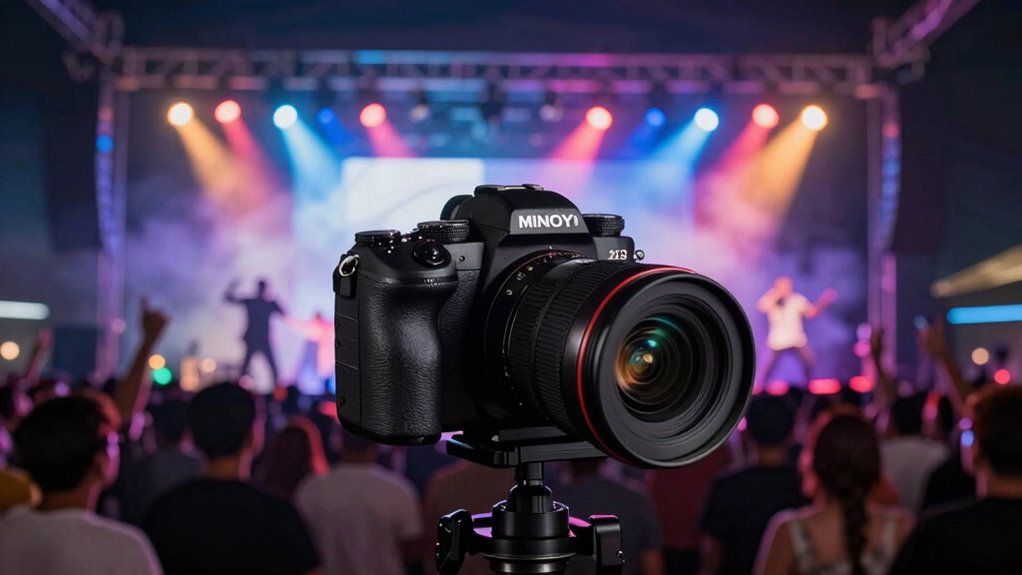
If you’re looking for the best mirrorless cameras for concerts in low light in 2026, I recommend models like the Sony a7 III, Canon EOS R50, and Panasonic LUMIX G100. These cameras excel with high ISO performance, fast autofocus, and excellent stabilization, perfect for capturing fast-moving performers in dim environments. They also offer versatile lenses and great video options, making them ideal for concert photography. Keep exploring to discover which one suits your style best.
Key Takeaways
- Cameras with large sensors (full-frame or APS-C) excel in high ISO performance for low-light concert photography.
- Models featuring advanced autofocus systems like Dual Pixel CMOS AF II ensure sharp focus on moving performers in dim environments.
- High ISO range (25,600+), combined with noise reduction technology, enables clear images in challenging lighting conditions.
- Versatile lenses with wide apertures (f/1.4–f/2.8) improve light intake and autofocus accuracy during performances.
- Additional features like in-body stabilization, vari-angle screens, and fast continuous shooting enhance low-light shooting flexibility.
| Canon EOS R50 Mirrorless Camera Kit |  | Versatile Content Creator | Sensor Type: 24.2 MP CMOS APS-C | Video Recording: 4K at 30 fps | Autofocus System: Dual Pixel CMOS AF II, 651 zones | VIEW LATEST PRICE | See Our Full Breakdown |
| Canon EOS R100 Mirrorless Camera Kit |  | Compact Entry-Level | Sensor Type: 24.1 MP APS-C CMOS | Video Recording: 4K at 24 fps | Autofocus System: Dual Pixel CMOS AF, 143 zones | VIEW LATEST PRICE | See Our Full Breakdown |
| Panasonic LUMIX G100 4K Mirrorless Camera with Lens |  | Video-Focused Vlogger | Sensor Type: 4K Micro Four Thirds | Video Recording: 4K at 30 fps | Autofocus System: Face, eye, tracking AF | VIEW LATEST PRICE | See Our Full Breakdown |
| Sony Alpha a6000 Mirrorless Camera (Body Only) |  | Fast Autofocus | Sensor Type: 24.3 MP APS-C CMOS | Video Recording: 4K at 30 fps | Autofocus System: Hybrid AF, phase and contrast detection | VIEW LATEST PRICE | See Our Full Breakdown |
| Fujifilm X-T10 Body Silver Mirrorless Camera |  | Stylish & Compact | Sensor Type: 16 MP X-Trans CMOS II | Video Recording: Full HD, no 4K noted | Autofocus System: AF with phase detection, tracking | VIEW LATEST PRICE | See Our Full Breakdown |
| Canon EOS R100 Mirrorless Camera with 2 Lenses | | Beginner’s Complete Kit | Sensor Type: 24.1 MP APS-C CMOS | Video Recording: 4K at 30 fps | Autofocus System: Dual Pixel CMOS AF, wide coverage | VIEW LATEST PRICE | See Our Full Breakdown |
| Canon EOS R7 Lens Kit with 32.5MP 4K Video |  | High-Resolution Sports | Sensor Type: 32.5 MP APS-C CMOS | Video Recording: 4K at 60 fps | Autofocus System: Dual Pixel CMOS AF, subject detection | VIEW LATEST PRICE | See Our Full Breakdown |
| Sony a7 III Full-frame Mirrorless Camera with 28-70mm Lens |  | Professional Performer | Sensor Type: 24.2 MP Full-frame CMOS | Video Recording: 4K at 30 fps | Autofocus System: Fast hybrid AF, 693 points | VIEW LATEST PRICE | See Our Full Breakdown |
More Details on Our Top Picks
Canon EOS R50 Mirrorless Camera Kit
If you’re looking for a compact yet powerful camera that handles low-light concert scenes effortlessly, the Canon EOS R50 Mirrorless Camera Kit is an excellent choice. Its 24.2MP APS-C sensor paired with the DIGIC X processor delivers sharp, detailed images even in challenging lighting. The Dual Pixel CMOS AF II covers the entire frame with 651 AF zones, ensuring quick, accurate focus on moving subjects. It supports high-speed shooting up to 15 fps, perfect for capturing lively concert moments. With 4K video and a versatile vari-angle touchscreen, this camera combines excellent image quality with user-friendly features, making it ideal for concert photography and videography.
- Sensor Type:24.2 MP CMOS APS-C
- Video Recording:4K at 30 fps
- Autofocus System:Dual Pixel CMOS AF II, 651 zones
- Connectivity Options:Bluetooth, Wi-Fi
- Viewfinder/Screen:2.36M-dot EVF, vari-angle LCD
- Lens Compatibility:RF Mount (with kit lens)
- Additional Feature:Vari-angle touchscreen display
- Additional Feature:Deep learning autofocus tracking
- Additional Feature:6K oversampling 4K video
Canon EOS R100 Mirrorless Camera Kit
The Canon EOS R100 Mirrorless Camera Kit stands out as an excellent choice for entry-level photographers and videographers who want high-quality images in a compact, lightweight package. With its 24.1-megapixel APS-C sensor, it captures sharp, detailed photos even in challenging lighting. The camera’s fast autofocus system covers 143 zones, including face and eye detection, making it great for dynamic scenes. It records 4K video at 24 fps and Full HD at 60 fps, ensuring versatile content creation. Its small size, combined with connectivity options like Wi-Fi and Bluetooth, makes it perfect for on-the-go shooting, especially at concerts or low-light events.
- Sensor Type:24.1 MP APS-C CMOS
- Video Recording:4K at 24 fps
- Autofocus System:Dual Pixel CMOS AF, 143 zones
- Connectivity Options:Bluetooth, Wi-Fi, USB
- Viewfinder/Screen:3-inch fixed LCD
- Lens Compatibility:RF Mount (kit lens included)
- Additional Feature:Compact, lightweight design
- Additional Feature:RF-S lens compatibility
- Additional Feature:3-inch fixed LCD screen
Panasonic LUMIX G100 4K Mirrorless Camera with Lens
For anyone seeking a compact, easy-to-use camera that delivers professional-quality 4K video and sharp audio, the Panasonic LUMIX G100 is an excellent choice. It records stunning 4K footage at 24p and 30p, with advanced audio features like a 360-degree microphone that tracks sound sources. Its 5-axis hybrid stabilization keeps footage steady, even in low light or shaky hands. The camera uses the Micro Four Thirds system, so you can swap lenses for different scenarios. It’s perfect for live streaming, social media, or capturing concerts, thanks to its user-friendly controls, facial recognition, and seamless sharing capabilities.
- Sensor Type:4K Micro Four Thirds
- Video Recording:4K at 30 fps
- Autofocus System:Face, eye, tracking AF
- Connectivity Options:Wi-Fi, Bluetooth, micro HDMI
- Viewfinder/Screen:Vari-angle screen, no EVF mentioned
- Lens Compatibility:Micro Four Thirds, kit lens included
- Additional Feature:Micro Four Thirds system
- Additional Feature:V-Log L recording
- Additional Feature:Live streaming capability
Sony Alpha a6000 Mirrorless Camera (Body Only)
With its 24.3 MP APS-C CMOS sensor and fast hybrid autofocus system, the Sony Alpha a6000 is an excellent choice for capturing sharp, detailed images in low-light concert settings. Its focus sensitivity range from EV 0 to EV 20 guarantees reliable autofocus even in dim environments. The camera’s ISO can be expanded up to 51,200, boosting performance in challenging light. With 179 phase-detection points and 11 fps continuous shooting, it keeps up with fast-moving action. The tilting 3.0-inch LCD and OLED electronic viewfinder provide flexible framing options. Plus, its interchangeable E-mount lens system and wireless connectivity make it versatile and easy to share images instantly.
- Sensor Type:24.3 MP APS-C CMOS
- Video Recording:4K at 30 fps
- Autofocus System:Hybrid AF, phase and contrast detection
- Connectivity Options:Wi-Fi, NFC, USB
- Viewfinder/Screen:OLED EVF, tilting LCD
- Lens Compatibility:E-mount, kit lens included
- Additional Feature:OLED electronic viewfinder
- Additional Feature:179-point phase-detection AF
- Additional Feature:Tilting 3-inch LCD
Fujifilm X-T10 Body Silver Mirrorless Camera
If you’re looking for a lightweight, stylish camera that delivers high-quality images in low-light concert settings, the Fujifilm X-T10 Body Silver Mirrorless Camera is an excellent choice. Its compact magnesium body offers a comfortable grip and a sleek “X-T” design, making it easy to carry and handle. The 16MP X-Trans CMOS II sensor paired with the EXR Processor II provides sharp, color-rich images with minimal moiré. The autofocus system combines phase and contrast detection for quick, accurate focus, even in challenging lighting. Plus, the OLED viewfinder with a 0.005-second lag guarantees precise framing, making it a versatile option for concert photography.
- Sensor Type:16 MP X-Trans CMOS II
- Video Recording:Full HD, no 4K noted
- Autofocus System:AF with phase detection, tracking
- Connectivity Options:Wi-Fi, Bluetooth, NFC
- Viewfinder/Screen:OLED viewfinder, LCD
- Lens Compatibility:Interchangeable lens, no specific mount
- Additional Feature:Classic X-T design
- Additional Feature:16MP X-Trans sensor
- Additional Feature:Built-in pop-up flash
Canon EOS R100 Mirrorless Camera with 2 Lenses
The Canon EOS R100 Mirrorless Camera with 2 lenses stands out as an ideal choice for aspiring concert photographers seeking excellent low-light performance. Its compact, lightweight design makes it easy to carry and perfect for on-the-go shooting. The 24.1 MP APS-C CMOS sensor, combined with the DIGIC 8 processor, ensures sharp, high-quality images even in challenging lighting. With Dual Pixel CMOS AF, Eye Detection AF, and continuous shooting at 6.5 fps, capturing fast-moving moments is effortless. Plus, it supports 4K video recording. The included RF-S18-45mm and RF-S55-210mm lenses offer versatile focal lengths, making it a flexible option for live concert photography.
- Sensor Type:24.1 MP APS-C CMOS
- Video Recording:4K at 30 fps
- Autofocus System:Dual Pixel CMOS AF, wide coverage
- Connectivity Options:Bluetooth, Wi-Fi, USB
- Viewfinder/Screen:Fixed LCD, no EVF
- Lens Compatibility:RF Mount with kit lenses
- Additional Feature:2-lens kit (18-45mm & 55-210mm)
- Additional Feature:Eye Detection AF
- Additional Feature:4K video support
Canon EOS R7 Lens Kit with 32.5MP 4K Video
The Canon EOS R7 Lens Kit stands out for concert photographers in low-light conditions thanks to its 32.5MP APS-C sensor and advanced image stabilization. It captures sharp, high-resolution images and supports 4K 60p video, perfect for dynamic concert scenes. The included RF-S 18-150mm lens offers versatile zoom options, while the camera’s five-axis stabilization provides up to seven stops of shake correction. Its fast 15 fps continuous shooting and Dual Pixel AF ensure you won’t miss any key moments. Compact and lightweight, it’s designed for handheld shooting in challenging lighting. Plus, the battery and accessory options make extended concert photography sessions seamless.
- Sensor Type:32.5 MP APS-C CMOS
- Video Recording:4K at 60 fps
- Autofocus System:Dual Pixel CMOS AF, subject detection
- Connectivity Options:USB, Wi-Fi, Bluetooth
- Viewfinder/Screen:Tilting LCD, no EVF mentioned
- Lens Compatibility:RF-S Mount, kit lens included
- Additional Feature:32.5 MP sensor
- Additional Feature:5-axis image stabilization
- Additional Feature:15 fps continuous shooting
Sony a7 III Full-frame Mirrorless Camera with 28-70mm Lens
Designed for photographers who need reliable performance in challenging lighting conditions, the Sony a7 III with its full-frame sensor excels at capturing sharp, detailed images even in low light. Its 24.2MP back-illuminated CMOS sensor offers an impressive 15-stop dynamic range and supports ISO from 50 to 204,800, expandable to 51200. With 693 phase-detection points covering 93% of the frame and 5-axis stabilization, autofocus is fast and accurate. The camera shoots up to 10 fps, supports 4K HDR video, and includes a versatile 28-70mm zoom lens. Compact and lightweight, it’s perfect for concert photography where capturing moments in dim environments is essential.
- Sensor Type:24.2 MP Full-frame CMOS
- Video Recording:4K at 30 fps
- Autofocus System:Fast hybrid AF, 693 points
- Connectivity Options:Wi-Fi, NFC, Bluetooth
- Viewfinder/Screen:Tilting LCD, no EVF
- Lens Compatibility:Sony E-mount, kit lens included
- Additional Feature:693-point phase AF
- Additional Feature:10 fps burst shooting
- Additional Feature:Dual SDXC slots
Factors to Consider When Choosing a Mirrorless Camera for Concerts in Low Light

When choosing a mirrorless camera for low-light concerts, I focus on sensor sensitivity and ISO performance to capture clear images in dim settings. Autofocus speed and accuracy are vital for sharp shots, especially with moving performers, while a wide lens aperture helps gather more light. Additionally, features like image stabilization and high ISO capability guarantee I get great results even in challenging lighting conditions.
Sensor Sensitivity and ISO
Choosing a mirrorless camera with high sensor sensitivity is essential for capturing sharp, clear images during concerts in low light. A higher ISO range allows you to maximize available light without introducing excessive noise, which is key in dim environments. Cameras with a wide ISO range, like 100-25,600 or more, give you flexibility to adapt to changing lighting conditions on the fly. Larger sensors, such as full-frame or APS-C, generally perform better at high ISO settings, producing cleaner images with less grain. Advanced noise reduction technology helps maintain image quality even at higher ISO levels. To get the best results, it’s important to balance ISO, shutter speed, and aperture, ensuring ideal exposure while minimizing noise. This approach helps preserve detail and captures the vibrant atmosphere of a concert.
Low Light Autofocus
A camera’s autofocus system can make or break your concert photos, especially in low-light situations where quick, accurate focusing is vital. I look for models with advanced autofocus features like Dual Pixel CMOS AF II, which provides fast, reliable focus even in dim conditions. Wide autofocus coverage is also essential, as it ensures subjects are detected and tracked across most of the frame. Eye and face detection autofocus further improve focus precision on performers’ faces and eyes, making shots sharper. Sensors with larger pixels or better light sensitivity help autofocus perform better in low light by capturing more light. Additionally, lenses with wide apertures (f/1.4 or f/2.8) let in more light, optimizing autofocus performance and helping me achieve clear, in-focus images during concerts.
Lens Aperture Range
The lens aperture range plays a essential role in low-light concert photography, directly impacting how much light reaches the sensor. A wider aperture, like f/1.4 to f/2.8, allows more light in, which is indispensable for capturing sharp images in dim settings. This enables faster shutter speeds, reducing motion blur and camera shake during performances. Conversely, lenses with narrower apertures, such as f/4 or higher, restrict light entry, making it harder to shoot without increasing ISO, which can introduce noise. Prime lenses generally offer larger apertures than zooms, providing better low-light sensitivity. Additionally, the aperture range affects depth of field, giving you creative control over focus and background blur even in challenging lighting conditions. Selecting the right aperture is key for clear, vivid concert photos.
Image Stabilization Features
When capturing concerts in low light, image stabilization features become essential for getting sharp, clear shots without relying on bulky tripods. In-body image stabilization (IBIS) helps reduce blur caused by camera shake, especially at slower shutter speeds needed in dim environments. Optical image stabilization (OIS) within lenses can also compensate for hand movements, providing steadier shots. Cameras with dual stabilization systems that combine both IBIS and OIS offer the highest level of shake correction, making handheld shooting more reliable. Effective stabilization allows me to shoot at lower ISO settings, which minimizes noise and enhances image quality. Additionally, advanced stabilization features enable smoother handheld videos and sharp still images, giving me more flexibility and confidence during concerts where lighting conditions are constantly changing.
High ISO Performance
High ISO performance is vital for concert photography in low-light conditions because it determines how well a camera can produce clear, detailed images without excessive noise. A wide ISO range, like 100-25,600 or higher, offers flexibility to adapt to changing lighting conditions during a concert. Excellent high ISO performance minimizes graininess and preserves detail, which is essential for capturing sharp, vibrant images in dim environments. Thanks to advanced sensor and image processing technology, modern mirrorless cameras can greatly reduce noise at high ISO levels, resulting in cleaner pictures. Additionally, cameras with strong high ISO capabilities often include in-body image stabilization, helping me shoot handheld without sacrificing sharpness. Choosing a camera with superb high ISO performance ensures better results in challenging low-light concert situations.
Frequently Asked Questions
How Do Mirrorless Cameras Perform in Extreme Low-Light Concert Environments?
Mirrorless cameras perform really well in extreme low-light concert environments. I’ve found they handle high ISO settings smoothly, producing clear, sharp images without too much noise. Their fast autofocus and wide apertures help me capture moments in dimly lit spaces. Plus, their compact size makes it easier to move around and stay discreet. Overall, I trust my mirrorless camera to deliver great shots even in the darkest concert settings.
Which Camera Features Most Impact Concert Photography in Dim Lighting?
The most impactful feature for concert photography in dim lighting is a camera’s high ISO performance. I look for cameras that handle noise well at high ISO settings, so I can capture sharp images without too much grain. Additionally, a wide aperture lens helps let in more light, making it easier to shoot in low-light environments. Fast autofocus and good image stabilization also play vital roles in capturing clear, vibrant shots.
Are There Recommended Settings for Capturing Sharp Images in Low-Light Concerts?
I believe that using a wide aperture, high ISO, and a slow shutter speed truly helps capture sharp images in low-light concerts. I recommend setting your camera to aperture priority mode with the widest lens opening, increasing ISO to avoid blur, and adjusting shutter speed to about 1/125 or faster. Stabilize your camera with a tripod or steady surface, and shoot in RAW for better post-processing.
How Important Is Autofocus Speed and Accuracy in Concert Low-Light Photography?
Autofocus speed and accuracy are essential for concert low-light photography because they help me capture sharp, well-focused images quickly. In challenging lighting, slow or unreliable autofocus can cause missed moments, especially with moving performers. I always look for cameras with fast, precise autofocus systems, so I can stay ready for spontaneous shots without worrying about blurry results. Good autofocus truly makes a difference in capturing the energy and emotion of a live performance.
Can Mirrorless Cameras Handle Fast-Moving Subjects in Dark Concert Venues?
Think of a mirrorless camera as a nimble dancer on a dark stage. Yes, they can handle fast-moving subjects in dim venues, especially models with advanced autofocus and high burst rates. I’ve found that choosing cameras with quick, accurate focus systems and good image stabilization helps freeze motion without sacrificing clarity. So, if you pick the right gear, capturing lively concert moments in low light becomes a thrilling, achievable performance.
Conclusion
Choosing the right mirrorless camera for low-light concerts isn’t just about specs—it’s about capturing those unforgettable moments when the lights dim and the music hits deep. I’ve found that the perfect camera can turn fleeting memories into lasting emotions. Whether it’s the warmth of a Fujifilm or the versatility of a Canon, I believe your next shot could be the one that makes your heart race every time you look back.