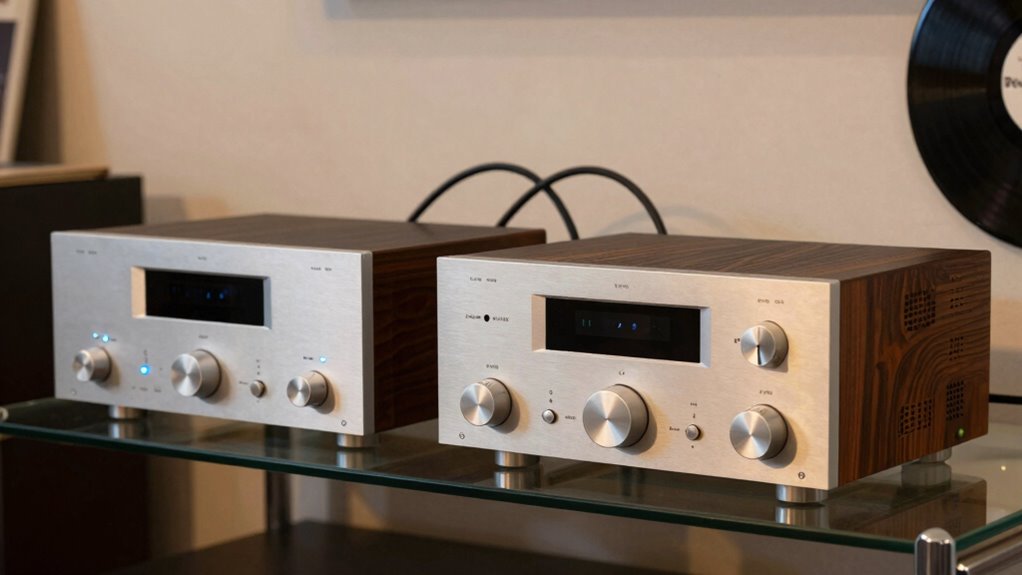

If you’re setting up a two-channel system, an integrated amplifier offers a streamlined, focused option with fewer connections and precise speaker control. It’s great if you want simplicity and clean sound without extra features. A receiver includes all-in-one functions like radio, Bluetooth, and multi-zone support, making it versatile for more complex setups. Consider your space, speaker needs, and desired features to choose the best fit. Keep exploring to determine which option truly matches your preferences and setup.

Get audio and creator gear delivered free with Prime
- Fast, free delivery on millions of items
- Prime Video, Amazon Music and more included
- Member-only deals all year
Key Takeaways
- Integrated amplifiers provide a streamlined, dedicated solution ideal for focused two-channel audio setups.
- Receivers offer more features like radio, Bluetooth, and multi-zone support, suitable for versatile listening environments.
- For two-channel listening, integrated amplifiers typically deliver cleaner, more direct power to speakers.
- Receivers are better if you need additional connectivity or plan to expand to multi-channel or home theater systems.
- Proper matching of power output and speaker impedance is crucial regardless of the choice for optimal sound quality.
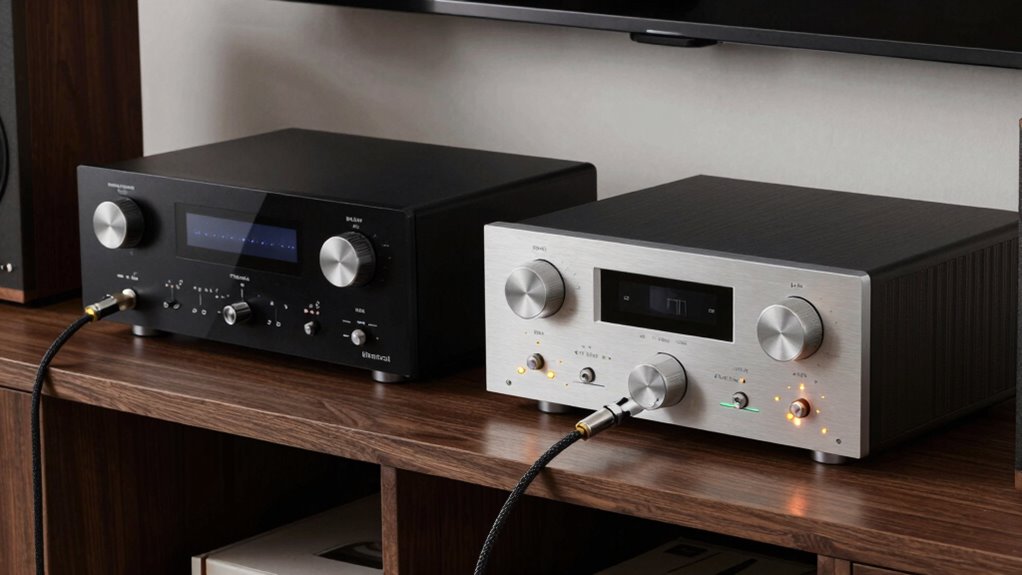
When choosing equipment for two-channel listening, understanding the differences between an integrated amplifier and a receiver is essential. Both options serve as the core of your audio setup, but they cater to different preferences and needs. An integrated amplifier is straightforward: it combines a power amplifier and a preamplifier in one unit, offering a clean, focused approach to powering your speakers. A receiver, on the other hand, includes those same components but also integrates a radio tuner, multiple input options, and often, additional features like Bluetooth or Wi-Fi connectivity. Your choice depends on how you want to enjoy your music, and how much space and flexibility you need.
Speaker placement plays a significant role regardless of which device you choose. With an integrated amplifier, you typically get a more streamlined setup, allowing you to position your speakers precisely for *ideal* sound. Since these amplifiers usually have fewer external connections, you have more control over the placement without unnecessary clutter. Proper speaker placement is key to experiencing the full potential of your system, ensuring balanced soundstage and clarity. Conversely, receivers can offer more built-in features that help you manage multiple speakers and zones, which is useful if you want to expand your listening area or set up a home theater alongside your stereo system. Still, you should pay attention to how your speaker placement interacts with the output power of your amplifier or receiver. Larger rooms or speakers with higher sensitivity require more power output to fill with sound, so matching your equipment’s power rating to your space guarantees consistent volume levels without distortion. Understanding the power requirements of your speakers can help optimize your setup for the best sound quality. Power output is a critical factor because it directly affects how loud and clear your music will sound. Integrated amplifiers often have a dedicated power rating that makes it easier to gauge their ability to drive your speakers effectively, especially when considering the matching of amplifier and speaker specifications. When selecting an amplifier, consider the speaker’s impedance and sensitivity to ensure your chosen power output will handle your speakers comfortably. Additionally, some models feature adjustable gain controls, which can help fine-tune the system for optimal performance in different listening environments. Moreover, it’s important to consider the compatibility of your components to avoid potential issues with connectivity or performance. Receivers tend to have a broader range of power outputs, sometimes with multiple channels, making them suitable for more complex setups. If you have high-sensitivity speakers or a smaller room, a lower power output might suffice, but if your space is large or your speakers demand more juice, you’ll need a model with higher wattage. For optimal performance, always consider room acoustics and how they interact with your equipment. Ultimately, matching the power output to your speakers and room size guarantees a *superior*, distortion-free listening experience, whether you opt for an integrated amplifier or a receiver.
integrated stereo amplifier for hi-fi audio
As an affiliate, we earn on qualifying purchases.
As an affiliate, we earn on qualifying purchases.
Frequently Asked Questions
Can I Upgrade Components Separately With an Integrated Amplifier?
Yes, you can upgrade components separately with an integrated amplifier, but it depends on component compatibility. You might update your preamp or power amp modules individually, offering flexible upgrade pathways. However, integrated amps often have limited options for component swapping compared to separate components. Before upgrading, check compatibility to guarantee new parts will work seamlessly with your existing setup, so your system maintains peak performance.
Which Option Offers Better Future Expandability?
For future expandability, receivers tend to offer better flexibility, allowing you to add components like additional speakers, subwoofers, or surround sound options with ease. You can adapt to room acoustics and listening preferences by upgrading or connecting new gear through the receiver’s multiple inputs and outputs. This versatility makes a receiver a more adaptable choice if you plan to evolve your setup over time, compared to most integrated amplifiers.
How Do Power Outputs Compare in Real-World Listening?
In real-world listening, power outputs considerably impact sound quality and speaker compatibility. Higher wattage generally delivers cleaner, more dynamic sound, especially with demanding speakers. You’ll notice better clarity and volume control with more power, but only if your speakers match the amplifier or receiver’s output. For ideal sound quality, choose a device with enough power for your speakers, ensuring they perform well together without distortion or strain during listening sessions.
Are There Specific Genres Better Suited for One Over the Other?
If you fancy genres with intricate musical nuances like classical or jazz, an integrated amplifier might be your hero, offering cleaner sound and better control. For genres that thrive on power and versatility, such as rock or pop, a receiver’s extra features and wattage can elevate your experience. So, choose based on your genre preferences—your ears will thank you for the tailored sound, and your playlist will sound just right.
What Are the Maintenance Differences Between the Two?
You’ll find maintenance differences are minimal between integrated amplifiers and receivers. Vintage models may require more frequent upkeep, like cleaning or replacing aging components. Receivers often have built-in protections, reducing potential issues. Warranty coverage varies; newer models typically come with warranties, while vintage units might not. Regularly check connections and keep vents clear for both. Ultimately, choosing depends on your comfort with repairs and whether you prefer the reliability of modern warranties.
home theater receiver with Bluetooth and radio
As an affiliate, we earn on qualifying purchases.
As an affiliate, we earn on qualifying purchases.
Conclusion
Choosing between an integrated amplifier and a receiver is like selecting the right paintbrush for your masterpiece. An integrated amplifier offers precision and clarity, guiding your sound with finesse, while a receiver acts as a versatile artist, blending multiple functions seamlessly. Consider your needs and space; whichever you choose, you’ll craft a listening experience that’s uniquely yours. Ultimately, your setup shapes the symphony, turning your listening room into a personal concert hall.
two-channel amplifier for bookshelf speakers
As an affiliate, we earn on qualifying purchases.
As an affiliate, we earn on qualifying purchases.
As an affiliate, we earn on qualifying purchases.
Fall Picks
fall essentials
As an affiliate, we earn on qualifying purchases.